
To what extent is moral law applicable to those who do not have the intelligence to realize the consequences of their actions? Is there such thing as culpability if evildoing results from not having the wit to make good choices?
With these questions in mind, it should be firstly noted that true intelligence or the capacity to make true and good choices actually resides in the Heart, which is identifiable with the Intellect as such and is essentially universal. Anything other than universal is incomplete and partial, which is to say that individual intelligence is by its nature subject to ignorance. Intelligence, if it is to be worthy of the name, can be so only through a participation in the Universal Intellect.
In the context of spiritual or qualitative life, cleverness and measurable intelligence is largely beside the point as is shown, on the one hand, by the possibility of 'clever' sinners and, on the other, by that of ‘simple’ souls who manifest goodness and wisdom. It is free will, or the ability to transcend one's native intelligence which is literally decisive and is our true connection with Knowledge, while one’s identification with the individual intelligence more or less blocks access to the Intellect.
If it is true that ‘all men are equal in God's eyes’, it is because God views the inward, or the Heart, which is of course given to all universally, without measure, and because it is this alone that really matters. Inwardness (available to all without distinction) is the kind of intelligence which, because it has ‘quality beyond measure’, gives our lives meaning and gives access to the inwardness of things around us. In fact there is nothing without meaning, or neutral from the spiritual point of view.
The dual nature of manifestation corresponds to the fall of man for having eaten from the tree of the knowledge of good and evil. Man has polarized his Knowledge and placed himself in the midst of duality. Nevertheless, in virtue of man's continuing connection with Knowledge, manifestation does not appear as an incoherent multiplicity, for Knowledge liberates inwardly by binding or unifying outward things and making the relative intelligible. It has been said that ‘there is nothing good or bad, but thinking [our connection with Knowledge] makes it so’ (Shakespeare, Hamlet, 2.2: 244-245) and though this kind of ‘thinking’ is but a polarized Knowledge it allows us to see that each thing has an inward essence that reveals its Source as well as an outward shell that conceals it. It is because there is no common measure between these two aspects of things that there can be no neutrality as to how we view them.
man is more than his native intelligence and is not just a ‘native’ of this world but has one foot, or rather has his Heart, in the Beyond
Fallen man incarnates duality inasmuch as his exile is that of being betwixt and between, for though fallen and bound by relativity he is nonetheless ‘made in the image of God’ and has, in principle, the freedom and universality that Knowledge gives. In short, though all men are in a no-man's land, it is a no-man's land where there can be no neutrality because the very raison d'être of our connection with Knowledge is that we strive for the qualitative and rise above our exile. We are reminded of this when Jesus says: ‘He that is not with me is against me, and he that gathereth not with me scattereth abroad’ (Matt. 12:30).
All this refers to the fact that man is more than his native intelligence and is not just a ‘native’ of this world but has one foot, or rather has his Heart, in the Beyond. In other words he is free to ‘gather’ and take Creation seriously, or he can ‘scatter’ centrifugally in a kind of play or re-creation. To the question posed earlier, we now answer emphatically that it is to those who ‘do not have the intelligence to realize the consequences of their actions’ that moral law is most applicable. It is precisely because he does not know any better and because, as man, he should know better that he especially needs the imposition of moral law.
man's integrity and freedom depends upon the submission of his will to the Intellect
Though life in this world may be seen as a trial, one does not imagine it to be a kind of intelligence test because, as mentioned, what actually is decisive is the will to transcend one's native intelligence and individual partialities. Free will, as the double word suggests, is like a watershed between the freedom, or universality, of the Intellect on the one hand, and the limitations of the individual will on the other. The practical criterion of man's worth is his capacity to unite his will with the Intellect rather than the reverse, of wasting his intelligence on wilfulness. Thus, man's integrity and freedom depends upon the submission of his will to the Intellect, as when, in Plato's words, ‘the entire soul accepts the guidance of the wisdom·loving part and is not filled with inner dissension’ (Republic, 586e).
Neither the Intellect, nor virtue, can belong to anyone because it is in essence universal and essentially beyond measure. Morality, on the other hand, in so far as it is the expression of individual action, is measurable. This difference of levels (the one measurable and the other beyond measure) can result in confusions that nevertheless have their practical resolution through man's capacity to choose what may be called ‘a humble participation in the Intellect'.

worldly man is typically ‘partial’ in that he is taken out of the universality of the Intellect by his will or desires
Being made in ‘the image of God’ it is in man's nature to manifest God. Man can reflect his Source, but by the same token he is, so to speak, free to be captivated by the image itself, namely, himself. The ‘proud’ man, captivated by himself, is no longer so much ‘made in the image of God’ as a self·made man. The man who is ‘full of himself’ will, by nature scatter, and thereby he re-creates the image of an image. With this projection of ‘who he thinks he is’, as image upon image, man obscures his primordial innocence. In brief, far from one having to prove the culpability of the ‘self made man’, the expression itself shows where the responsibility lies.
Ignorance can be said to have two phases: firstly, man is, so to speak, taken outside of himself (or outside his role of Centrality) through an idle curiosity; this outwardness is then given substance, since for man nothing can be neutral or without significance. To put it another way: worldly man is typically ‘partial’ in that he is taken out of the universality of the Intellect by his will or desires, and, thus impassioned and beside himself, he is then susceptible of being taken in by his projected dream or his re-creation. This second phase of ignorance could then be characterized as manifest ignorance and it represents personal attachment to illusion.
Paradoxically it is being made in the image of the Creator that makes it possible for man to re-create in this centrifugal way. Having this Centre (or an independence that directly reflects the self-sufficiency of Necessary Being) he will naturally seek to extend and manifest or to create outwardly and beyond himself. The gift of free will is a double-edged sword that has a power and a plausibility that imparts imaginative reality to man's vision of things. He who would ‘eat, drink and be merry’ (i.e., play or re-create) cannot but be intoxicated by the gift of freedom and be forgetful of the Source.
For man forgetfulness of the Origin (which is well-characterized as Original sin) combined with refusal to acknowledge his error ensures
its wilful continuation; ‘oftentimes excusing of a fault doth make the fault the worse, as little patches set upon a little breach discredit more in the hiding of a fault’ (Shakespeare, King John, 4; 11:30). On the basis of this ignorance of his Origin man feels obliged to continue and to consolidate his fragmentary position, which is really an uncomfortable mix of ignorant pride and intelligent shame. The initial error contains the very program of fallen man in that it establishes outwardness, or a world in which he is driven to further re-creations and subterfuge. ‘It is in the nature of men's minds that when they throw away the truth they embrace false ideas.’ (Boethius, The Consolation of Philosophy, 1:6).
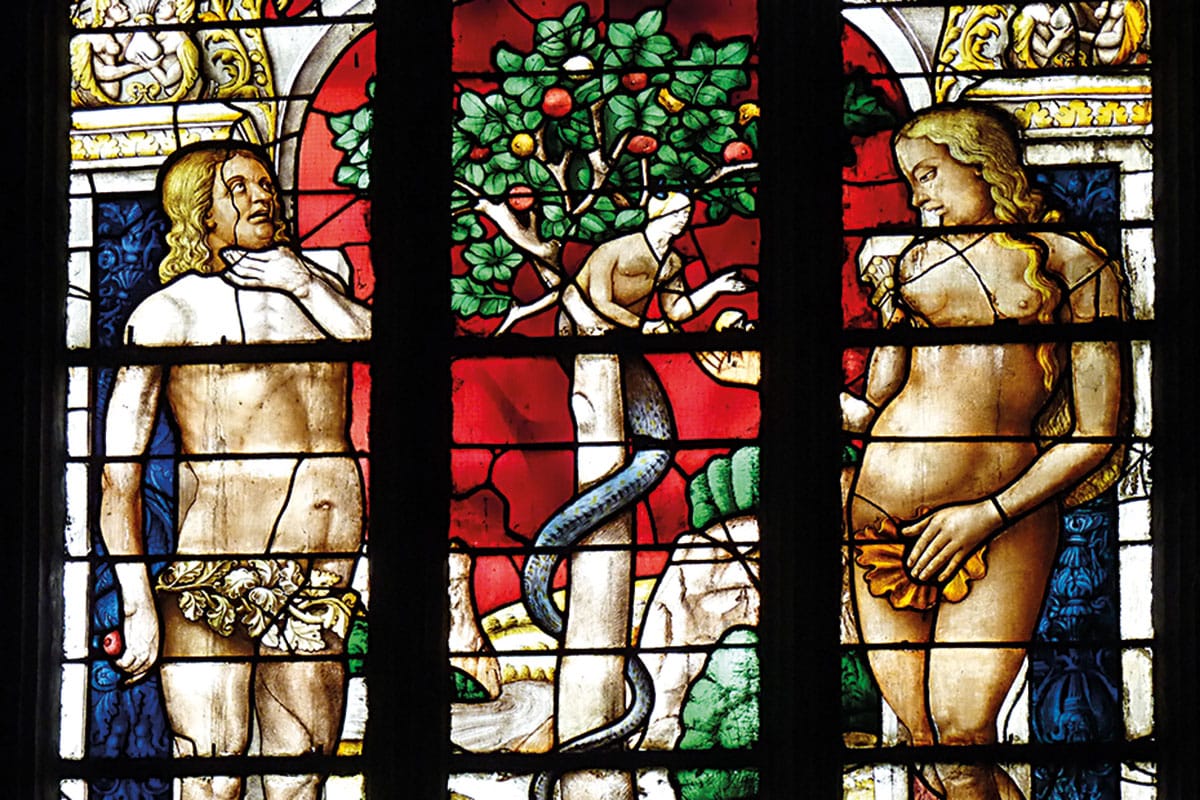
Having re-created a world of duality where prevarication seems natural, it is clear that it is actually man who has driven himself out of Paradise. This self-perpetuating mechanism is a recapitulation of the fall of man or is rather a continuous fall. Adam and Eve's grasping at the fruit of the tree of the knowledge of good and evil (i.e. the knowledge of duality, or relativity) is symbolically the original act of outwardness. In theological language, it is the wilful defiance of their Creator, while in microcosmic terms it is the opposition of the individual will to Wisdom, or to the Intellect. The centrifugal process of reaching for the outward splendour of the fruit (which contains the seeds of multiplicity) while ignoring the Source (the roots) is dramatically represented as the turning of man from the roots of Wisdom to the fruits of folly. Being a microcosm, man epitomizes the drama, but by the same token he is able (through the Inward life) to dispel the outward illusion: ‘My Heaven cannot contain Me, nor can My earth, but the heart of My believing slave can contain Me.’ (Tradition of the Prophet Muhammad).
He who is caught by, or en-grossed in relativity and things measurable, will inevitably ‘scatter’. Even logically, that is, aside from the exigencies of religion, one needs a beyond-measure reference point in order to integrate, or ‘gather’ the otherwise immeasurable fragments and multiplicity of worldly experience. Without such reference to the Beyond, things of this world are assumed to be significant in their own right. Apart from the expression ‘significance in their own right’ being the essence of worldliness, it is literally ‘meaningless’ since, if things are to be significant, they can only be so by virtue of being something other than themselves. The danger is that, by being ‘made in the image of God’, man cannot but reflect Absoluteness and, because neutrality is not an option, as noted earlier, he is susceptible of taking his re-creation or play too seriously. In this regard Plato reminds us that ‘human affairs ought not be taken very seriously’ (Laws, 803b).
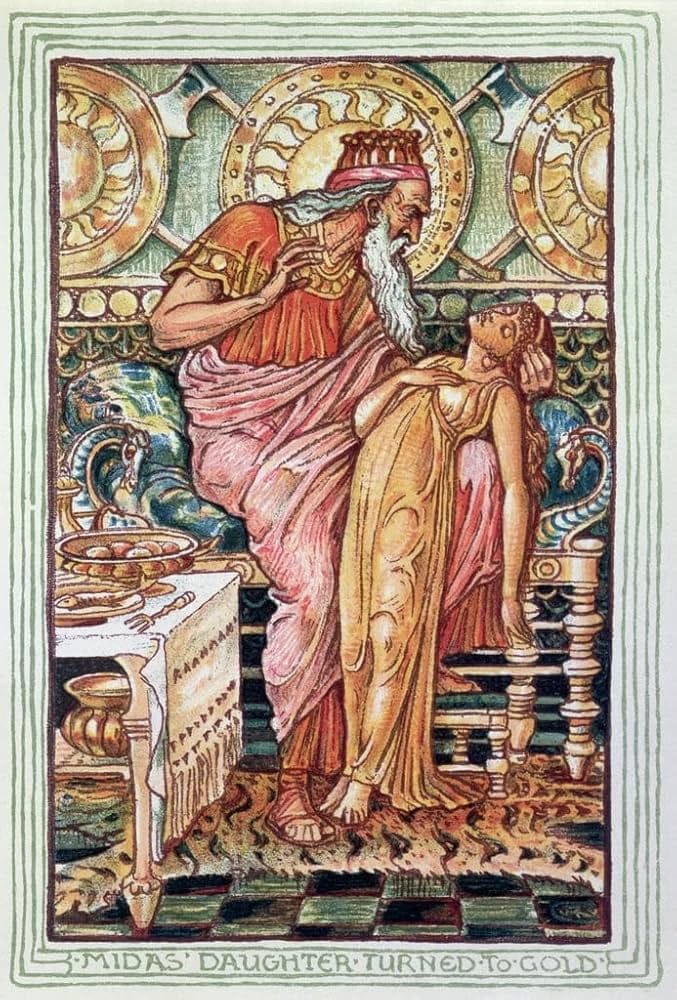
The folly of worldliness is conveyed by the story of King Midas, who despite a regal predisposition, manifested firstly his ignorance, and then when his wish was granted, his momentary intoxication as ‘his joy knew no bounds’. Man too has been granted a gift, but if like Midas he has forgotten his 'regal predisposition' (more particularly, forgotten his sense of the Absolute) he will necessarily, though unconsciously, assume that there is a kind of absoluteness about his earthly self and this is reflected in ‘everything he touches’. The intoxicating gift, which had been granted by Bacchus (appropriately god of the vine), represents a re-creative freedom. In Christian terms, man having been created in the image of the Creator, embodies the gift of manifesting, or of re-creating within creation. For Midas, his avaricious will, or his projection, reflected what was really his terrible subjective burden of ignorance. After the realization of his wish (which was really a crystallization of his ignorance) the world, which once appeared as abundant with untold riches, appeared an empty and fragmentary shell.
Despite the dramatic outcome of Midas’ ignorance, his aspiration of having ‘a golden life’ is nonetheless symbolic in the sense that it reflects man's thinking of himself as somehow other than of the world in which he lives. This of course corresponds to the truth, but when his true provenance is not understood, it simply misses the point and manifests as common ignorance or pride. The moral of this profound story is that the desired transmutation from base matter to gold is not an outward, but an Inward, process and that the true treasure which ‘neither moth nor rust doth corrupt’ (Matt. 6:20), is not to be found without, but only Within. Because the gift is that of Centrality, not to acknowledge it is to scatter oneself, centrifugally. With the story of Midas we are made aware of the enormous responsibility of Centrality and of having re-creative freedom, and we are also reminded of the Biblical question, ‘For what profiteth it a man if he shall gain the whole world, and lose his own soul?’ (Matt. 16:26)

consciousness of something greater than one's own head (namely: the Heart or Universal Intellect) is the indispensable requisite for true Knowledge
When we acknowledge Wisdom as Divine, Transcendent, and Absolute, we also acknowledge human knowledge as limited in that it is separate from God, or Wisdom itself: ‘…real wisdom is the property of God, and this oracle is his way of telling us that human wisdom has little or no value.’ (Plato, Apology, 23a). The Transcendence of God or the ‘separation’ of the world from the Beyond corresponds to the microcosmic detachment of the will from the Intellect (‘the kingdom of heaven’ that is Within), and the degree of individual ignorance, is measured by our attachment to the will rather than to the Intellect. In so far as the saying ‘There is no room for God in a man who is full of himself’ is true, it can be seen that there is an equivalence between self-will, or being full of oneself and ignorance. In short, the absence of God (the source of Wisdom) is equivalent to ignorance, and it is clear that consciousness of something greater than one's own head (namely: the Heart or Universal Intellect) is the indispensable requisite for true Knowledge while the folly of pride verifies the point.
As ignorance excludes intelligence, so self-will excludes the Universal Intellect, and when man errs he does so through identification with the partialities of his individual will as opposed to the universality of the Intellect. When actions, with the best will in the world, miss the mark and have evil consequences they are done in ignorance. Others actions, which are done in anger, or even with cold calculation and with knowledge and foresight, are simply more ignorant. They are so because they are either more passionately or more profoundly detached from the Intellect. As attachments to the will they are detachments from the Intellect. All of these actions are done in ignorance and are wilful in that they are remote, in varying degrees, from the Intellect.
It is evident that man will only freely choose evil when he does not really know, or is not completely convinced of it as such. He will only choose such and such an evil if he thinks there is some kind of good attached, or in other words, he must have a reason for his choice. All evil actions result from some form of ignorance or more precisely, from some form of a ‘partial’ knowledge, and it could then be argued that every evil choice is in this sense an innocent mistake resulting from the evil doer not being fully informed. Seen in this way there is no real division or difference between a wilful choice and an ignorant mistake. Ultimately they are both forms of ignorance and thus both wilful in the strict sense of being a predominance of the will at the expense of the Intellect. Nonetheless he who knows that a given deed is somewhat evil and proceeds regardless is clearly ignorant in a more substantial way than he who does the same deed as a plainly ignorant mistake. Both result from ignorance, though admittedly there is an all-important difference of degree. At the risk of repetition all such mistakes (desire, whether it be via cold calculation, hot passion or simple ignorance) are accidents that belong to the will as opposed to the substance of the Intellect and are simply different measures of remoteness from Knowledge.
Wilfulness is essentially the choice (for whatever ‘reason’) of allowing the will a freedom or independence and separation from the Intellect. This freedom or independence is, as mentioned above, a necessary but double-edged condition of being ‘made in the image of God’. The capacity for choice necessarily includes the possibility of self-will or being will-full (wilful); and to be full of oneself, is to be (so to speak) empty of God or Wisdom. Ultimately, in the arena of free choice, the only question is ‘Shall I be myself (wilful), or shall I rise above myself?’ Free will is ultimately the divine gift of being able rise above ourselves and choose Knowledge (Intellect) rather than just being ‘ourselves‘, partial and incomplete. We cannot blame the limitations of our condition for the nature of our inward response because free will, precisely because it is free, is in essence unconditional, or without limits.
Man's choices can result from objectivity or alternatively be an expression of the will; either way the result is still a choice. If it is an impassioned choice, where the will is predominant, it is a choice of ignorance rather than Knowledge and it is precisely ‘ours’ in that it defines us or we define ourselves by it. In other words, to opt for the individual will rather than for the Universal Intellect is the choice of independence and undeniably defines us as ‘wilful’. By this we mean that wilfulness clearly belongs to, and is manufactured by ‘us.’ In spite of our being, so to speak, subject to remoteness from Knowledge, we are so through our will, or rather in as much we choose to identify with our self-will. ‘God casts away no soul unless it cast itself away; every soul is its own judgement.’ (Jacob Boehme).
From the philosophical, or Platonic, point of view, it is not so much a question of innocence or guilt but rather of evil resulting directly from
ignorance in whatever form, with the consequence of further engrossment in illusion or in a shadow-world. To be full of self-will is to preclude access to the Intellect and thereby breed further evil or separation from Knowledge; ‘philosophy can see that the imprisonment is ingeniously affected by the prisoner’s own active desire, which makes him first accessory to his own confinement.’ (Phaedo, 82e).
From the theological or moral perspective, man should know better since he has been given Wisdom, through Revelation, by his Transcendent Father in Heaven. In terms of punishment, our actions are measured by their degree of wilful disobedience to the voice of Wisdom. In either case, philosophical or theological, the result or punishment is the same, namely, further illusion (the consequence of ignorance), or further exile and separation from Reality. The issue is the degree of ignorance, rather than how it is measured for the consequence is always a corresponding degree of separation from Reality.
Consequent upon the separation that is the hallmark of this world there are two mutually exclusive ways of viewing free will. Firstly it can be seen as the worldly freedom to ‘eat, drink, and be merry’, or it can be seen as what it actually is, namely the op-port-unity (doorway) to transcend the lures and the constraints of this world. Though the two opposing views of free will do not always seem to be appear as an ‘implacable alternative’, they are really a reflection of the gulf between this world and the Beyond. Since there is nothing insignificant (or neutral) within this world it is consequently fitting that man has the implacable alternative imposed on him at every turn. In a world of duality and prevarication man needs resolve for, whether he likes it or not, he is at a crossroads where there is no recourse to a ‘halfway house.’

Since through grace we find ourselves born into this world, our part is to find our-Selves beyond it.
Free will, like any gift, ultimately comes from Love, but in this case it is also a direct reflection of the Giver for in it, at least virtually, is contained limitless Freedom. In this gift the Giver has given Himself (Freedom) so that we may, through it transcend this world and give ourselves to Him. Since through grace we find ourselves born into this world, our part is to find our-Selves beyond it.
The condition of having a connection with Knowledge and yet being separate from the Source, is crystallized in free will itself in that man has both freedom, and yet the obligation to make a choice between good and evil, or between Reality and illusion. It is a conditional freedom in that it carries the responsibility (obligation to respond), for to neglect this decisive gift is itself a choice. The responsibility, which renders our freedom conditional (imposing on us the obligation to choose one way or another), is actually a reflection, of the intrinsically unconditional nature of Freedom itself. Consequently responsibility is built into the very substance of free will, for only with a full response can one realize the true and full nature of freedom. Free will is essentially a gift of plenitude, and not to embrace it fully is to prove oneself both ignorant and undeserving.
With his capacity for vision and freedom of choice, man is able firstly to see the Perfect Source within the 'accidents', or to see that everything manifests Reality, and secondly to embrace the opportunities for Transcendence; ‘for I was an hungered, and ye gave me meat: I was thirsty and ye gave me drink: I was a stranger, and you took me in: naked, ye clothed me: I was sick, and ye visited me: I was in prison, and ye came to me ... Verily I say unto you, Inasmuch as ye have done it unto one of the least of these my brethren, ye have done it to me.’ (Matt. 25:35-40). With this quotation we not only acknowledge the ultimate unity of all things within this world but also, in the same stroke, the multiplicity of opportunities to rise above ourselves.
In conclusion, it is clear that we always have before us a rigorous alternative: either to ‘gather’ or to ‘scatter’. He who does not to acknowledge free will as a means of transcending himself chooses, by default, to be a ‘man of the world’, and thereby forecloses the Universal. Anything other than complete freedom is not true freedom and to those who would proclaim ‘the world is your oyster’, it is to be said that only by venturing to the transcendent depth Within can one discover the ‘Pearl of great price’.