Introduction: Approaching the Text
That which is above is like that which is below, and that which is below is like that which is above, teaches Hermes Trismegistus in the Tabula Smaragdina (the “Emerald Tablet”). Likewise, what is in the sea is in the human psyche or soul—water being viewed as a universal symbol of the soul. This is due to its plasticity, fluidity, adaptability, and depth—qualities that mirror the mutable and receptive nature of the psyche. Furthermore, water possesses a purifying quality, both materially and spiritually; this is evidenced by the use of water in the rites of various religions—most notably baptism, the quintessential rite of purification in the Christian tradition. The spiritual path is, as it were, a ‘voyage’ across this psychic ocean, René Guénon describes in his Spiritual Authority and Temporal Power.[[1]] The pilgrim's goal is not to drown or passively merge with the subtle substance, but to cross the waters and reach the ‘center of the world’—Ithaca, for Odysseus (known by the Romans as ‘Ulysses’).
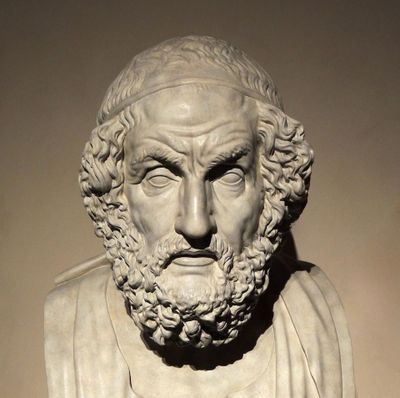
There are, grosso modo, two main ways of reading an emblematical text. One is the exterior, literary, historical or social reading–‘exoteric’, in a word. The other is the interior, or ‘esoteric’, focused on the spiritual dimension. In this way, The ‘Odyssey’ can be viewed either exoterically or esoterically. Understood esoterically, the seas and the men who crossed them–described by Homer, and now adapted for the big screens by British director Sir Christopher Nolan—are not only physical realities, but also components of our soul, and therefore in this essay we will focus on an anagogical exegesis of the story.
Inner World as Mythology
In the vastness of the Homeric seas, where violent storms roar, seductive enchantments whisper, and insatiable monsters lurk, the true odyssey unfolds not in the physical world, but in the silent, invisible ocean of the human soul. Amidst an epic filled with bloody battles, sacrifices, and extraordinary twists of fate, the saga of Odysseus charts a map of the inner journey. Each shipwreck and loss that strips the hero of his possessions, his men, and his very identity represents the inevitable confrontation every man must wage in the solitude of his own conscience—an arduous ordeal in which the ego must be divested of its ambitions and pretensions, and the world of its illusions, so that the spirit may recognize its true nature.
From this perspective, the journey’s terrifying challenges cease to be mere external adventures and instead reflect the abysses and risks within the human soul. In this light, monsters and enchanted islands symbolize the phantoms of pride, passion, vice, and forgetfulness, against which the soul struggles to avoid losing itself. The decisive battle to reclaim our place in the world—our Ithaca—demands, apart from necessary force, the wisdom of patience and timing, the austerity of detachment, and the moral courage to become ‘Nobody’. The Odyssey thus serves as a universal mirror: a reminder that existence is a stormy ocean—yet one containing islands of peace and enjoyment—where every pain and every joy becomes a secret trial directed to the soul’s inward purification.
The Perennialist Lens
Nearly three millennia after its composition, Homer’s Odyssey remains a fixture of the Western canon—as is shown, precisely, by the huge popularity of the film based on it. While modern readers routinely would analyze the text and the film through historical, poetic, or socio-political lenses, an original (that is, archetypal) reading reveals itself when viewed through the prism of the Perennial Philosophy. Viewed thus, the epic ceases to be a mere adventure tale and becomes an exteriorization of the inner spiritual journey of man.
Odysseus’s decade-long return voyage is nothing less than a holy war, in fact a jihad al-akbar, the ‘greater holy war‘, as the Sufis would say. If the bloody siege of Troy represented the jihad al-asghar—the lesser, outward conflict against external adversaries—the return to Ithaca demands a far more grueling campaign. It is the inward combat against the illusions of the world and the fierce pretensions of the ego.
THE TWO JIHADS OF THE ODYSSEY
Lesser Holy War (Jihad al-Asghar)
External, physical warfare
• Fought at the gates of Troy
• Victory over worldly enemies
Greater Holy War (Jihad al-Akbar)
Inward, spiritual combat
• Fought on the soul’s open seas
• Victory over the ego and illusion
To reclaim his soul and rightful kingdom, the hero must undergo a process of spiritual dispossession. Odysseus loses everything: his fleet, his accumulated wealth, his spoils of war, and his companions. He is stripped bare, arriving on the shores of his homeland naked, destitute, and utterly unrecognizable. For the spiritually awakened individual, this trajectory serves as the ultimate paradigm: the outer ego must be systematically dismantled, dispossessed of all outer attachments, and be purified before, in this psychic ‘emptiness’, one can attain what one really is.
the arrogant, insolent men occupying the royal palace are not merely usurpers; they are symbols of the base passions that dwell within our own soul
This esoteric framework brings a striking clarity to the poem/film’s most violent and enigmatic episodes, most notably the climactic slaughter of the suitors. Viewed from this vantage point, the arrogant, insolent men occupying the royal palace are not merely usurpers; they are symbols of the base passions that dwell within our own soul, constantly plotting to take possession of it. Stripped of his false grandeur, living like an outcast in his own home, Odysseus is finally able to see these passions objectively for what they truly are. He must then engage in a battle to the death, nothing less, as Titus Burckhardt notes in his stimulating text on the topic.[[2]]
To achieve this, the hero—the very incarnation of mental sagacity and discernment—disguises himself as a beggar. By choosing humiliation within his own court, he undergoes a metamorphosis, a metanoia. This final ruse beautifully mirrors his initial stratagem at Troy. The narrative arc comes full circle: from the outward deception of the wooden horse to the inward deception of the mendicant's rags, the hero triumphs through an economy of cunning—which can be perceived in both poem and film.
Nolan’s Reimagining of the Homeric Tale
There are of course differences between the Homeric portrayal and Nolan’s reimagining of it, and also inconsistencies in the film, but nothing that would absolutely preclude an anagogic reading. Yes, a few sequences are missing; Nolan alters the story's ending, he introduces the theme of the danger brought by the ‘Peoples of the Sea’, and he merges two episodes into one—such as the Lotus-Eaters and the nymph Calypso—and burdens Odysseus with a sense of guilt that is absent in the original; among other changes. Yet none of this poses an insurmountable obstacle to an anagogic reading.
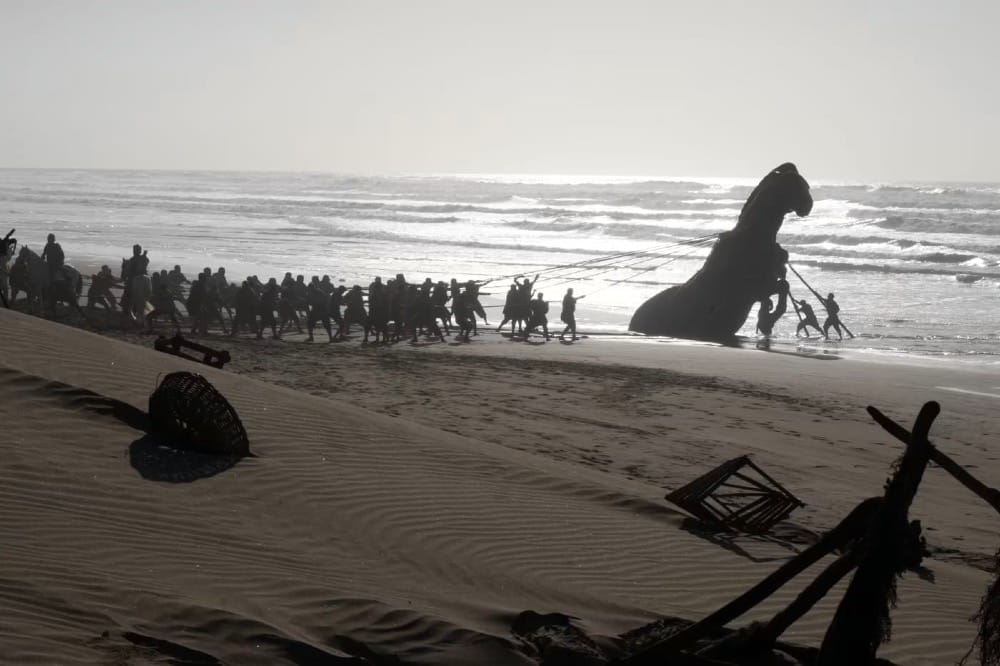
A film is not a book, and an adaptation is not a translation. Despite the appropriation and recasting of the original text through the prism of modern idiosyncratic anxieties, illustrating how interpretation is bound to the reader's subjectivity while successfully moderating the text for contemporary reception, the film offers a powerful visual experience and recreates a more or less ‘traditional’ ambiance remote in certain aspects from the artificialities of the modern world. Yet the film has touched a chord in the soul of contemporary man with which he feels attracted to the immersive, albeit short-lived, impact brought by moviegoer‘s experience of it. Generally, any movie’s impact—as is intrinsic to the nature of the medium and its ‘horizontality’—will be of shorter duration than, say, that of a book which offers greater access to ‘verticality’. And this is interesting, as many critics act as if this filmic adaptation would endure as a classic, forever. No, the popular impact of a film is rather short-lived, and sooner than later the hordes of critics judging it by predominantly outward and temporal criteria, and not so much by inward and perennial ones, will not focus on the transcendence intrinsically embedded in the epic but only on its mundane success or relevance, and will cease to talk anymore about it. Be that as it may, thousands of viewers (if not millions, now that around almost one thousand Chinese theatres are exhibiting the movie) have sat in a cinema chair and have been transported into a mythical universe that riveted and fascinated them for more than two hours. A work of art has resonance when the spectator leaves the theatre with mind and soul impacted by the experience and is compelled to ponder it. Based on that gauge, the movie has made a mark.
Coherence and Consistency
A critical question then arises: Does Nolan present a coherent explanation for the hero's return journey that aligns with the Homeric theme? Furthermore, how should the viewer interpret Odysseus's vengeance in light of his ‘guilt’, as portrayed by the film?
Nolan’s added element of the hero’s guilt is a kind of ‘toll’ paid to modern ‘politically correct’ audiences, but it does not obscure the work’s openness to anagogic interpretation.
Despite the introduction of a sense of guilt into the hero's conscience—certainly a concession to the psychologizing zeitgeist of modernity—this does not, in our view, weigh heavily enough to undermine the original spiritual message, even though it certainly introduces a distinctly modern nuance foreign to the spirit of the original. After all, the ruse of the wooden horse employed by Odysseus against the Trojans is one thing, while his final battle against the suitors, symbolizing passions in the soul, is quite another—a conflict that can be viewed not merely as irrational revenge, but as an act of justice, outward and inward. In short, Odysseus's alleged guilty conscience does not invalidate the legitimacy of his actions against the suitors.
Nolan’s added element of the hero’s guilt is a kind of ‘toll’ paid to modern ‘politically correct’ audiences, but it does not obscure the work’s openness to anagogic interpretation. Ultimately, the theme that predominates is not reducible to external contemporary ideologies or panaceas, but the deeper vision of cosmic symbiosis, the thesis that the macrocosm of the sea and the microcosm of the psyche are interconnected. By capturing the outward magnetism of this spiritual journey, the film reaffirms that, even when immersed in the distractions and concessions of modernist mind, art can still serve as a gateway to the Sacred.
Another point of debate is whether the film succeeds in sustaining a coherent spiritual telos for Odysseus, and, if not, whether any gaps stem from Homer’s old Hellenistic worldview or from Nolan’s screenplay. Approached from a convergent perspective, the film succeeds in maintaining a compelling purpose for the protagonist, despite its concessions to modern bias and prejudices. In short, these changes, however ideologically motivated they may be, have not foreclosed a spiritual interpretation.
Professor Emily Wilson, a British classicist, scholar and translator of Homer’s Odyssey, claims in an essay published in the London Review of Books that “the film’s own values and vision don’t hang together”. She notes that the movie appears to condemn the Greeks for the deception of the wooden horse, yet it asks us to applaud when Odysseus uses deception and violence to reclaim his home. Remarking on this in The Guardian (3 August), Jamil Smith argued that ‘Wilson treats those contradictions as proof that the film has no coherent argument”. However, If the expedient used against the Trojans is morally debatable, the episode of the massacre of the suitors is, again, fully justifiable, even in the guilt context of the film, given the suitors’ arrogance and malice with which they treated Odysseus and others, and in view of their symbolic representation as passions in the soul which need to be purged.
This topic brings us to the question of Pallas Athena, the goddess of wisdom in the old Greek religion, who acts as guide and protector of Odysseus. Notwithstanding the key role the gods play in Homer’s Odyssey–which begins precisely by mentioning an assembly of the gods in which it is decided that Odysseus will finally be allowed to journey home to Ithaca—the film does not focus on that aspect, emphasizing instead the human side of the equation. After this assembly has determined that the hero may return, Athena, disguised as Mentor, goes to Ithaca in order to inform and instruct Odysseus’s son, Telemachus.
there is a fascinating parallelism between Odysseus and the Hindu warrior Arjuna, the hero of the Bhagavad Gita, and also between Athena and Krishna
As the old Greek tradition belongs to the same category of religions of the Hindu tradition, known as the ‘Aryan mythologies‘, one can mention in passing that there is a fascinating parallelism between Odysseus and the Hindu warrior Arjuna, the hero of the Bhagavad Gita, and also between Athena and Krishna, who act as the guide and protector of Odysseus and Arjuna, respectively. Arjuna, differently from Odysseus, does not wish to fight, fearing the ensuing bloodshed. Krishna, disguised as his charioteer, teaches him that he must fight, because one must perform one’s ‘dharma’ or moral duty and strive in the right cause. There is no world without effort and combat, inward and outward, ‘lesser’ and ‘greater’, as in the Sufi concept of striving discussed before. Some wars are justified, as St Augustine and St Thomas Aquinas taught in Catholicism, but only as a last resort in special circumstances and only in the most extreme cases. This is the ‘just war’ theory as explained in the Summa Theologica (2nd part, Question 40, Article 1). Here, the father of Scholasticism and “Doctor of the Church” explains that war is not a good in itself, but it can be morally justified under the principle of self-defence or, if warranted, to restore order. However, it must meet three strict conditions:
- Competent authority - auctoritas principis: War can only be declared by a legitimate sovereign who possess the authority and power to use force—and not by private citizens or groups.
- Just cause - causa iusta: There must be a meritorious cause, such as self-defence, a grave, legitimate, and proportionate reason for resorting to arms.
- Right intention - intentio recta: The purpose must be morally intended, such as restoring peace, promoting the good, or combating evil—and cannot be motivated by anger, hatred or revenge.
The Soul’s Trials and the Exile’s Return
Taking all this into consideration, the film serves as a hermeneutic laboratory for contemporary man, in which the enduring nature of myth both clashes and coexists with the demands and superstitions of our time. Although the film makes concessions to political correctness—adapting the classical narrative to suit modern sensibilities—these concessions do not negate the production's underlying archetypal power. The film manages to preserve the traditional symbolism of the crossing of waters and the final struggle against the passions that seek to subjugate the soul. Its compelling impact demonstrates that, even when wrapped in the conceptual constraints of the twenty-first century, the symbolism of the voyage of Odysseus still resonates as a visual projection of the ‘great holy war’; it is a mirror in which the modern soul, weary of its own illusions, is secretly invited to see itself in its state of self-empties spiritual poverty, and thereby rediscover the path back to its true home.
Odysseus provides an enduring roadmap for the human spirit, charting a course through the storms of existence back to one’s true Self.
Even with its ideological inconsistencies, the film allows the spiritual themes of Homer's poem to radiate through its sequences. Odysseus’s maritime wanderings continue to be classic expressions of the universal symbol of navigation—‘the treacherous transit of the human soul through the subtle currents of worldly passion toward the immanent divine Self’, as René Guénon wrote.[[3]]
Similarly, Titus Burckhardt observed that the motif of the exile who returns to his realm disguised as a beggar and stranger is a universal trope in the world’s folklore; it is a timeless mythological archetype representing the rightful ruler reclaiming his spiritual kingdom from the usurper.[[4]] Guénon expanded on this theme in Spiritual Authority and Temporal Power, asserting that the Homeric myth transcended ordinary literature and was the deliberate crystallization of ancient, esoteric mysteries. He interpreted the external warfare as a macrocosmic disorder destined to compensate for an inner imbalance–the very type of disequilibrium which we encounter nowadays among many of the main political leaders of our world.
It is worth reminding ourselves that although Odysseus is depicted as a warrior—a kshatriya in the Hindu framework—he also functions as a kind of priestly or brahminical warrior. He seems to intuit that external trials are projections of the drama within one’s soul. This realization requires the cultivation of virtues: vacare Dei (divine emptiness), fakr (spiritual poverty), and sabr (profound patience). We see this particularly during his seven-year exile on Calypso’s island, where he resigns himself to a destiny dictated entirely by the gods.
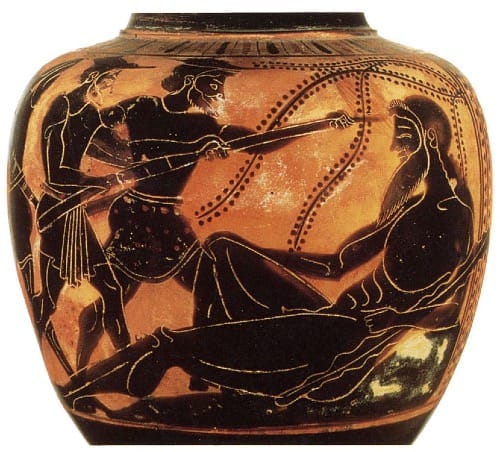
Later, enduring the insults of the suitors in Ithaca, Odysseus dryly observes that ‘the clearest view of a man is from below’. Having previously effaced his identity before the Cyclops with the spiritually resonant declaration, ‘My name is Nobody’, Odysseus embraces the detachment required to receive the fullness of spiritual realization. Ultimately, his path aligns more with the way of knowledge—gnosis or jnana—than with the paths of action (karma) and devotion (bhakti), despite the fact that elements of both these are also present. His reliance on highly strategic, intricate, and occasionally amoral ruses distances him from the conventional devotional hero.
What Homer describes as tempests, monsters, and physical battles, the contemplative experiences as internal trials against pride, vanity, and the capital sins of Christian mysticism. By conquering the rough seas of the manifested world, Odysseus provides an enduring roadmap for the human spirit, charting a course through the storms of existence back to one’s true Self.
Integration
For the spiritual seeker, trials are never confined to the aesthetic dilettantism of parlour esoterism, which commits to nothing. The challenges of human existence do not resemble the passive or casual wandering in a labyrinth drawn on some ancient floor. Rather, every disruption within the biography of a man—be it the grief of losing a kinsman, a severe illness, a residency abroad, the birth of a son, the publication of a book, the bittersweet unraveling of a marriage—carries an inward weight. Life itself is an ‘initiator’, so to speak, and every event operates as a subtle alchemy aimed at the purification of the soul.
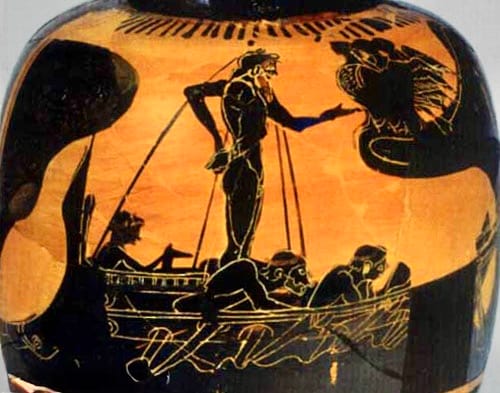
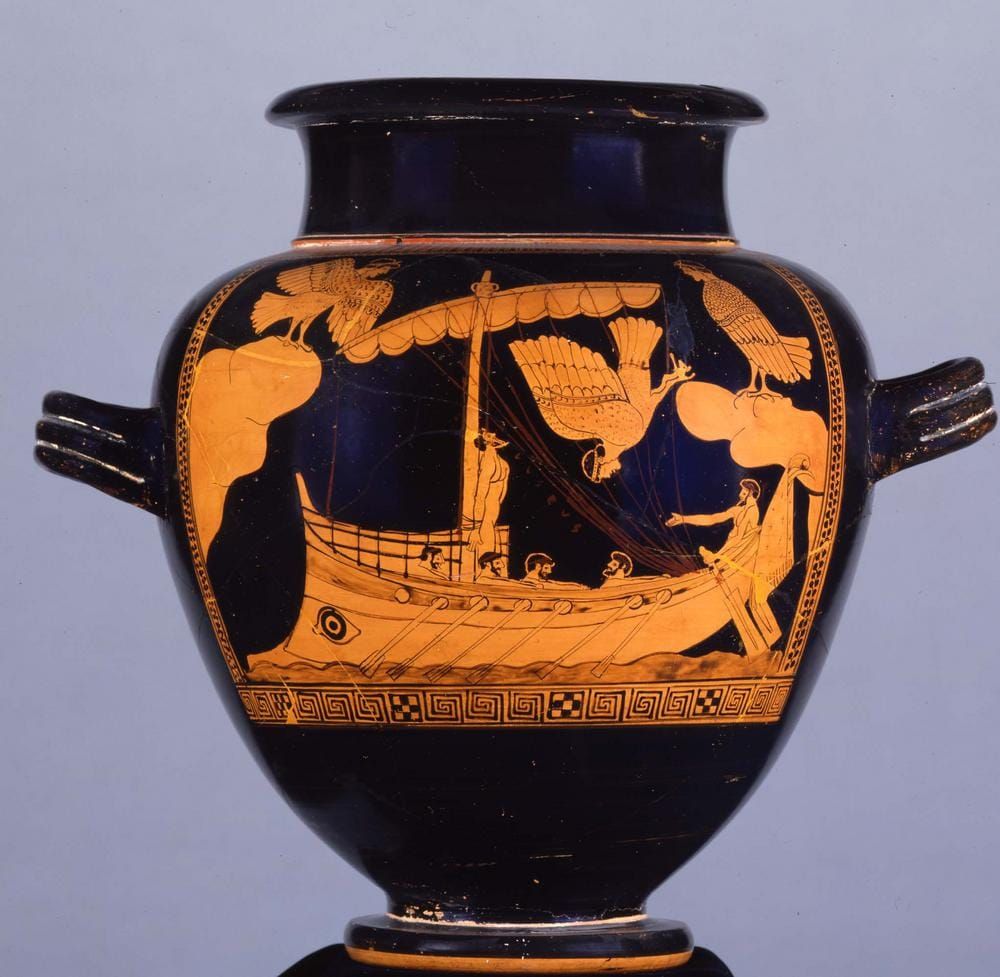
This perspective illuminates the famous encounter of Odysseus with the Sirens. Their hypnotic, devastatingly beautiful song represents the manifold pleasures and wonderments with which the world is prodigal. Because Odysseus does not adhere principally to the way of works (karma) or devotion (bhakti), but instead travels the narrow sapiential path (jnana), his relationship to worldly charm is distinct from that of the ordinary religionist. For him, in keeping with his sapiential typology, the beauty of the world has two faces: it simultaneously veils and reveals the Divine Source. Odysseus wishes to experience the celestial melody without losing his way or capsizing his vessel. He therefore orders his crew to bind him to the mast—the ultimate symbol of axial verticality—while their ears are, unlike his own, sealed with wax. The wax represents the necessary ascetic caution of the exoteric religious path—the classic monastic detachment that denies the world to preserve the soul. Without this protective barrier, the exoterist would perceive worldly pleasures as ends in themselves, severing them from their divine source and suffering spiritual shipwreck.
Negation
• Ears sealed with wax
• Ascetic isolation
• Protection from ruin
Integration
• Bound to the mast
• Direct contemplation
• Transmuted pleasure
In keeping with his jnanic tendencies, Odysseus wishes to know the Sirens, to integrate their melody without being consumed by and idolizing their beauty. Integration is essential for spiritual alchemy. As Frithjof Schuon clarified in a letter dated August 4, 1973: ‘...the cause of the Fall lies solely in the fact of separating all natural data from their divine Source, of living them separately from God and attributing the glory and the enjoyment to oneself.’[[5]]
Schuon remarked that the original sin of Adam was not a specific outward act, but fundamentally the choice to exist, think, and experience life independently of the Creator. Concupiscence is neither desire nor pleasure, but rather choosing to divorce these from the Divine. When enjoyment becomes an idol, it inflates the brute ego and assumes a luciferian character. Before the Fall, carnal union was an act of spiritual extinction within the Divine Consciousness—a primordial outlook still accessible through esoteric sanctity, an archetype exemplified historically, as Schuon noted, by figures such as Krishna, David, Solomon, and Muhammad.
Athena, Dante, and the Virtue of Craftiness
Odysseus’s spiritual orientation is signaled by his patron deity, Pallas Athena, the goddess of Wisdom. The resourcefulness and cunning (metis) he displays throughout his journey do not carry the negative connotations found in a moralistic and exoteric context. For the ancient Greeks, this strategic dissimulation was proof of an elevated intellect capable of navigating cosmic illusions.
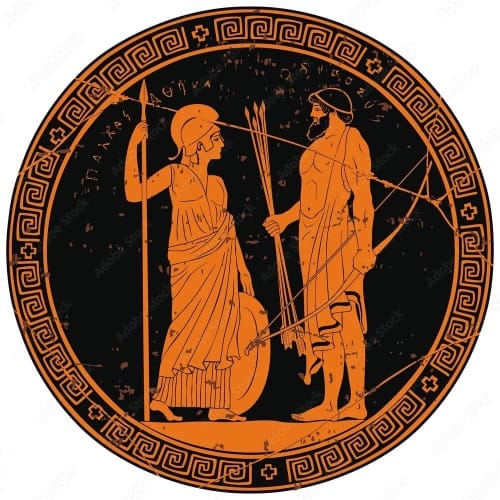
THE DIVERGENT VIEWS ON STRATAGEM
The Homeric Classic
• Cunning as mental sharp intellect
• Guarantees structural survival
• Celebrated by Pallas Athena
The Dantean Vision
• Placed in the Eighth Circle
• Convicted as a false counselor
• Shaped by Western Bhaktism
This structural divergence explains why Dante Alighieri famously cast Odysseus into the Eighth Circle of Hell as a fraudulent counselor (in Canto 26 of the Inferno). Despite his clear literary admiration for the hero—putting into his mouth the famous utterance: ‘Consider your origin: you were not made to live as brutes, but to follow virtue and knowledge’—Dante judges him effectively through the lens of Western devotionalism (bhakti).
What a moralistic mind condemned as deceitful, the older traditional framework recognized as the necessary stratagem of a sacerdotal warrior.
Though, as a member of an esoteric Catholic order, the Fedeli d'Amore, Dante did not operate within an exoteric framework, yet his worldview remained bound by the religious exclusivism of medieval Europe and a fragmented knowledge of the original Homeric epics. What a moralistic mind condemned as deceitful, the older traditional framework recognized as the necessary stratagem of a sacerdotal warrior.
The Esoteric Geography of the Odyssey
Episodes of the Odyssey that function as stages of an inward path. They are described briefly below:
The Cicones (Ismarus): Fresh from the sack of Troy, Odysseus’s men succumb to greed and drunkenness, leading to a counter-attack that claims six sailors from each ship. Greed and intoxication—spiritual vices—derail the traveler from his spiritual focus. (Significantly, Odysseus spares Maron, a priest of Apollo, who rewards him with a sacred wine—the very substance that will later blind the Cyclops Polyphemus).
The Lotus-Eaters: Blown off course by a tempest, the crew encounters a people sustained by the magical lotus flower. Those who consume it suffer a hypnotic amnesia, losing their will to return, and forgetting their homeland. This represents spiritual amnesia—the world's capacity to lull the soul into a passive condition where material comfort replaces the longing for the sacred.
The Cyclops: Trapped in the cave of the one-eyed cannibal Polyphemus, Odysseus loses six men before using Maron’s wine to intoxicate the giant and blind him with a wooden stake. Escaping by camouflaging themselves beneath the bellies of the monster’s herd of sheep, Odysseus claims his name is ‘Nobody’. While his cunning saves him, his initial entry into the cave was a sin of presumption. He entered expecting hospitality based on a naive confidence in his own reputation—a warning against spiritual pride.
King Aeolus and the Bag of Winds: The keeper of the winds gifts Odysseus a leather pouch containing all the world's tempestuous gales, leaving only the West Wind to guide the voyagers home. On the threshold of Ithaca, the crew opens the bag under the impression that it contains gold, unleashing a storm that drives them back to zero. This denotes how the lust for material wealth can instantly squander the ultimate spiritual treasure.
The Laestrygonians: The giant cannibals bombard the fleet with massive boulders, destroying 11 of Odysseus's 12 ships and devouring their crews. Only Odysseus’s own vessel manages to escape. He survives solely because, acting on a providential caution and mistrust, he had anchored his ship outside the harbor, tethering it securely to a rock at the island's outermost edge. Upon witnessing the carnage, he swiftly cuts the moorings and orders his men to row with all their might toward the open sea. This episode is critical because it drastically reduces Odysseus's forces: he enters the island with 12 ships and hundreds of men, but escapes with a single vessel and its remaining crew. The spiritual failure here is one of gnostic recklessness, presumption, and levity—a fatal lack of vigilance and attention. Odysseus's men enter the territory of the cannibals blindly, entirely oblivious to their imminent danger, mistaking a perilous landscape for a safe harbour.
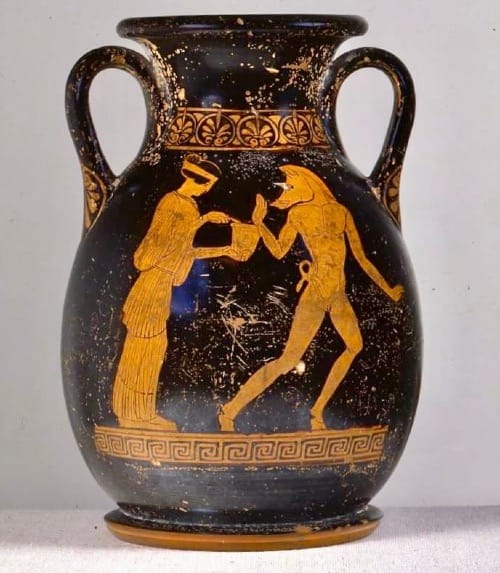
Circe the Enchantress: Upon landing on Circe’s island, the sorceress transforms half of Odysseus’s crew into swine. With the intervention of the god Hermes, who provides a protective magical herb, Odysseus successfully resists the witch’s enchantments. He ultimately compels her to release and restore his men to human form.
The Guide and Counselor: Odysseus and his crew spend a year enjoying Circe's hospitality. When the hour of departure arrives, she transforms into an indispensable guide for the hero's homecoming. She warns Odysseus that before reaching home, he must descend into the Realm of the Dead (Hades) to consult the blind prophet Tiresias.
The Navigational Blueprint: It is Circe who gives Odysseus precise instructions on how to resist the song of the Sirens (by sealing the sailors’ ears with wax) and how to navigate the treacherous strait guarded by the monsters Scylla and Charybdis. Circe represents the adversary who is transmuted into an ally. She demonstrates that within the cosmic order, appearances are profoundly deceptive; once the lower nature is conquered via divine intervention (Hermes), it becomes the very vehicle that fuels higher realization.
The Sirens: To safely pass the reef of the Sirens, whose irresistible melodies lure mariners to their doom, Odysseus executes Circe’s blueprint: he seals his men's ears with beeswax and orders them to bind him immovably to the ship's mast, allowing him to be the only living man to hear the song and survive. The Sirens symbolize the world and its vast, shimmering web of seductions, fascinations, ephemeral beauties, and transient pleasures. The spiritually awakened man must possess the capacity to hear this cosmic melody, recognize it ultimately as an illusion (maya), and view it as a strictly relative reality while pressing forward toward the Absolute. One must consciously resist the ‘siren song’ of both the world and the ego to return to the Self.
Scylla and Charybdis: Odysseus’s ship must navigate a narrow oceanic channel guarded by two terrifying monstrosities. On one side churns Charybdis, a gargantuan whirlpool that swallows entire vessels; on the other looms Scylla, a six-headed beast. Odysseus uses the counsels of Circe to steer closer to Scylla to avoid the total destruction of his vessel, deliberately sacrificing six of his sailors. This passage underscores the necessity of spiritual discernment to always choose the lesser evil, as spiritual life is a constant walk on the razor's edge. In The Symplegades,[[6]] Ananda Coomaraswamy discuss the universal theme of the antagonistic and complementary pair of opposites through which the pilgrim has to pass in order to reach the goal. This is similar to the case of the monsters Scylla and Chaybdis in the Odyssey, as these two opposing and complementary challenges represent the frontier between the visible and the invisible. The duality has to be transcended through the passage which can only be won in an ‘a-temporal instant’, and not without divine help. The Symplegades (and Scylla and Chaybdis) are not merely a mythical geographical feature, notes Coomaraswamy, but a universal symbol of an ‘active door’ representing the metaphysical transition from the temporal and dualistic world to the eternal and spiritual world.
The Cattle of Helios: Stranded by a prolonged lack of wind on a desolate island, Odysseus’s starving crew violates their sacred oath and slaughters the holy cattle of the sun god, Helios. In retribution, Zeus shatters their ship with a thunderbolt the moment they return to sea, killing the entire crew. Odysseus, the sole survivor, is left adrift on the open currents until he washes ashore on the island of the nymph Calypso. There, he endures a seven-year captivity before building a rudimentary raft to make his final push toward Ithaca. This episode depicts the profanation of that which belongs exclusively to God. It highlights the sins of gluttony, lack of self-restraint, and the inability to endure the ascetic sacrifice in the face of material temptation. The sacred cattle were reserved for divine worship; by failing to control their own lower desires and consuming the beasts for their personal gratification, the men turn a potential support of contemplation from an icon into an idol, immediately triggering divine retribution.
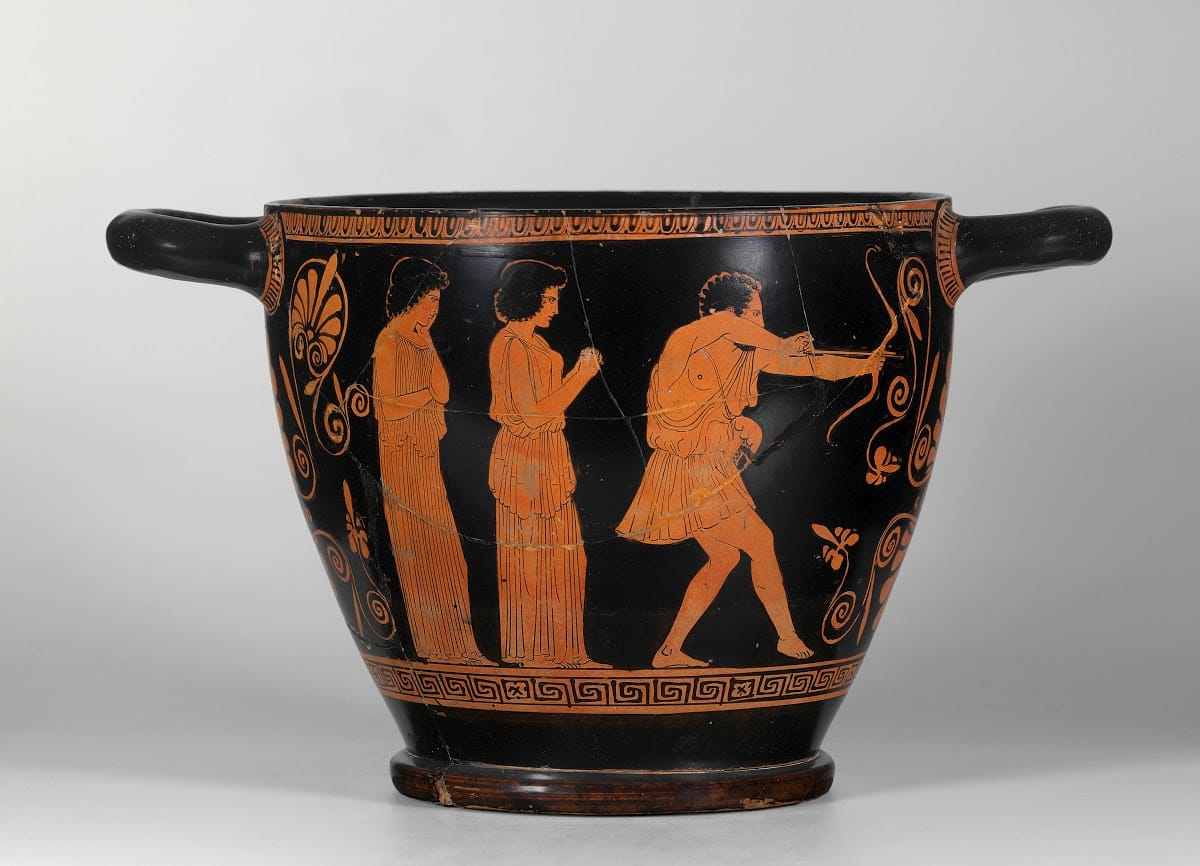
The Slaughter of the Suitors: From an esoteric vantage point, the arrogant, insolent suitors occupying the palace are not merely physical usurpers, but are symbols of the base passions dwelling within the human soul, constantly plotting to take absolute possession of it. Stripped of his false grandeur, and assuming the outer appearance of an impoverished stranger in his own palace, Odysseus sees these passions objectively for what they truly are. As Titus Burckhardt noted in his essay in Mirror of the Intellect, the hero must engage these passional forces in a battle to the death. Alternatively, this passage frames Odysseus as the absolute incarnation of discernment and cunning. He feigns the status of a beggar and accepts profound degradation within his own court to systematically outmaneuver the vain usurpers. This final ruse beautifully completes the narrative architecture of his life. Just as the Trojan Horse—conceived by Odysseus to break the siege of Troy—served as his initial outward stratagem, his disguise here serves as his final inward masterstroke. The circle closes perfectly: traveling from one inspired ruse to another, the hero successfully purges the palace of the soul of its unruly elements.
Conclusion
Ultimately, the transposition of the Odyssey to the contemporary screen reaffirms the enduring nature of the myth, the essence of which withstands even the distortions of the culture industry. By recapturing a certain traditional atmosphere and symbolism, the film serves—perhaps unwittingly—as a vehicle for universal, timeless truths. Its success with modern audiences also demonstrates that, beneath layers of entertainment and anxiety, contemporary man is not hermetically sealed off from the deeper dimensions of reality. Whether in the pages of Homer or in the cinema, the saga of Odysseus/Ulysses remains alive as a useful anagogic map. It serves as a reminder that the true homeland of the spirit can only be reclaimed by stripping away our illusions and superstitions and accepting the final battle against the passions that threaten to usurp the soul.
Thus, despite his inevitable concessions to the contemporary Zeitgeist, Nolan’s cinematic version of the Odyssey validates the premise of Hermes Trismegistus: what appears on the screen and upon the seas is a reflection of what dwells in the depths of our being. The anagogic perspective proposed here deconstructs the external adventure to reveal the triumph of the ‘great holy war’ within the invisible territory of the human heart. Whether we read the Greek poem or watch the film, the fundamental call remains essentially unchanged.
[[1]]: Spiritual Authority and Temporal Power (Sophia Perennis, 2004)
[[2]]: Titus Burckhardt, “The return of Ulysses”, in Mirror of the Intellect, ed. by William Stoddart (Fons Vitae, 1987)
[[3]]: Spiritual Authority and Temporal Power (Sophia Perennis, 2004)
[[4]]: Titus Burckhardt, “The return of Ulysses”, in Mirror of the Intellect, ed. by William Stoddart (Fons Vitae, 1987)
[[5]]: Towards the Essential: Letters of a spiritual master. Edited by T. Beguelin (Matheson Trust, 2021)
[[6]]: Studies in Comparative Religion, Vol. 7, N.1 (Winter 1973) Available online www.studiesincomparativereligion.com