“Who will Rule, God or Man?” - Politics and the Sacred
The aim of this essay is to look beyond modernist conceptions of politics, rooted in a materialistic view of reality that reifies the world and deifies man, and to propose in their stead a principled basis that transcends both reductive and relativistic conceptions.
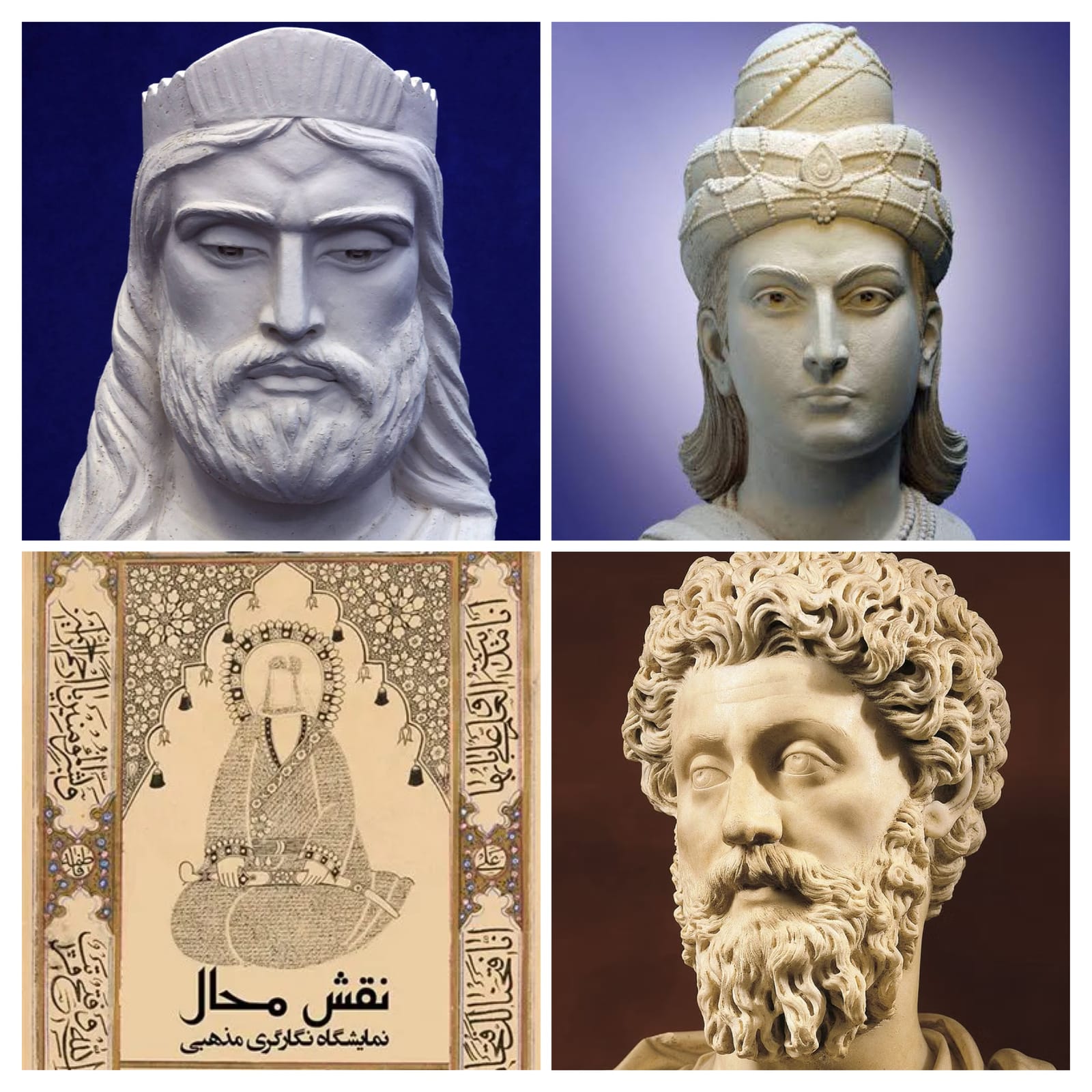
Philosopher Kings (clockwise from top left): King Solomon, Emperor Aśoka, Emperor Marcus Aurelius, Imam ‘Ali Ibn Abi Talib
This essay originally appeared in Volume 35 of the print edition of Sacred Web in Summer 2015.
Who will rule, God or man? This is the great constitutional question of human existence...The perennial question is always whether we humans are to understand our presence on this earth as a vice-regency or trusteeship under the mandate of heaven and the divine commandments, or whether we must strive to emancipate ourselves from any higher dominion, with human supremacy as our ultimate aim. — Tage Lindbom
A Principial Approach to Political Philosophy
“Who will rule, God or man?” So begins The Myth of Democracy by the Swedish political philosopher, the late Tage Lindbom.[[1]] The question posed by Lindbom lies at the heart of this essay because any discussion about politics leads inevitably to questions about the nature of the polis, and about the objectives of and criteria for government, and these in turn lead to metaphysical questions about human nature and the purpose and meaning of human existence. At core, questions about political philosophy require one to examine the underlying world view informing the conceptions which frame one's thought.
the true dividing line in politics is not between the liberal left and the totalitarian right, but between those who accept the transcendent order and those who do not
An objection may immediately be noted: the terminology used by Lindbom in his formulation of the question about the governance of “God or man” may be unacceptable to many modern readers, embedding presuppositions about the existence and nature of God and of the “divine commandments”. Might not these presuppositions dictate the only legitimate form of government to be a theocracy, thereby eliminating the so-called “separation of Church and State” which is so vital to many political philosophies in the world today? It is an understandable objection. Yet Lindbom’s question remains valid, particularly if viewed a different way, where the metaphysical reality that he seeks to evoke is perceived beyond its semantic and theological limitations. The term ‘God’, which even theologically is a debated term, should be understood for our purposes as the underlying reality that pervades and transcends existence, and not in a particular theological or religious formulation that clothes that reality. The term ‘divine’ is better understood then as not merely a relativized or theological conception of deity, but as total reality in its most profound sense, representing that which is Absolute, Infinite and Perfect, the summum bonum of existence, whose imprint in contingent reality is termed the ‘Sacred’.[[2]] This conception of reality (denoted by terms meaning ‘God’ or ‘divine’ by theistic faith traditions such as the Abrahamic religions or Hinduism, and denoted by terms meaning ‘Reality’, ‘Being’ or ‘Principle’ by ‘non-theistic’ religions such as Buddhism or Taoism) is universal to all major traditions, and can be understood, if not accepted, by atheists and hard secularists alike. It is a conception that conforms to the notion of the homo religiosus, of Man as innately aware of his spiritual foundation, and as possessing as an attribute of his very ‘nature’ a sense of the Sacred.
Similarly the expression “divine commandments” can be understood to refer explicitly to the cardial obligation of love, and implicitly to the metaphysical origin of that obligation,[[3]] which are common to all the faith traditions. In Christianity, these are referred to as the Supreme Commandments:
Thou shalt love the Lord thy God with all thy heart, and with all thy soul, and with all thy mind. This is the first and great commandment. And the second is like unto it, Thou shalt love thy neighbor as thyself. On these two commandments hang all the law and the prophets. (The Gospel of St. Matthew, 22:37-40).
In this way, the question posed by Lindbom can be understood as a choice between rooting political philosophy in the Sacred and the love-based communal order it entails or, alternatively, outside it. And why not outside it? Because the Sacred is the source of universal principles that are ontologically higher by virtue of their interiority (and therefore more real or true) than those that are merely logical or narrowly theological. To link politics to the Sacred is not to define it by any narrow theological particularism nor, it will be argued, to confine political expression to theocratic forms as the sole legitimate form of government. Rather, the link between politics and the Sacred merely suggests a principial premise (that reality possesses a sacred dimension which connects us all), allowing for a myriad of forms of government operating within a framework attuned to the Sacred. As Eric Voegelin has noted in his correspondence with Hannah Arendt, the true dividing line in politics is not between the liberal left and the totalitarian right, but between those who accept the transcendent order and those who do not.
The aim of this essay is to look beyond modernist conceptions of politics, ones that are not rooted in the Sacred but in a materialistic view of reality that reifies the world and deifies man (and which, in consequence, have, in Lindbom’s words, “human supremacy” as their aim), and to propose in their stead a principled basis for politics that transcends both reductive and relativistic conceptions. Our approach is to view the political life and health of the polis in integrative terms, holistically, not in a sense that addresses merely the outer symptoms of political malaise in the modern world, but in a more profound sense that traces political issues back to their metaphysical roots, adopting a perspective from which the particular is seen in relation to the universal, to the whole of reality, understood as the Absolute and integral whole. The perspective offered is therefore metaphysical and principial, universal and perennial, rather than normativist, relativist, or time-bound. That said, we will illustrate this perspective from scriptural and other authorities primarily derived from the Islamic tradition, in part to because Islam is so misunderstood in our times, but we do not intend thereby for this to be an essay about Muslim political philosophy in any narrow sense, either historical or ideological. Instead, though our illustrations will be primarily Islamic, the perspective offered here will be principial.
Metaphysical Presuppositions and the Centrality of the Sacred
harmony is predicated on an intrinsically ordered hierarchy that is vital to its equilibrium
This essay is premised on a world view that envisions the underlying harmony of reality beyond its reductive or relativistic conceptions. It is founded on the principial, primordial and perennial metaphysical insight of the absolute integrity of reality and, as a corollary, of the centrality of the Sacred as the ordering principle of existence. This world view of the intrinsic Oneness of a reality which is Absolute is present in all the faith traditions. It is expressed in particular, theological idioms, which it transcends by its unifying metaphysical perspective. It comprises the heart of all religious doctrines, signifying the universal ‘Truth’ of Reality as the Unity of Being, and the goal of all religious methodologies, signifying the universal ‘Law’ of Realization as Union. As such, it is an expression of the idea that “All paths lead to the same Summit”.
The Absolute is understood as necessary reality (as distinct from possible or contingent reality), and as the Essence or Principle underlying contingent reality. In other words, reality, understood as Absolute, cannot be merely reduced to the conditions of existence nor, paradoxically, can it be excluded from existence itself because, by virtue of its absoluteness, its totality must pervade existence as its underlying ground. Absolute reality is therefore both transcendent and immanent.
A corollary of this is that the Absolute is the principle of All-Possibility, and therefore is also Infinite. The Absolute transcends finitude but at the same time it actualizes the possibilities of its Infinitude in the diversity of existence. Another way of stating this is that the Absolute is reflected in the continually renewing ‘theophany’. From this perspective, the transient and contingent world of existence is, in its diversity, merely an expression of an integrated underlying reality. This integrity, as we shall argue, is the principial foundation of political order.
A further corollary is that the Absolute lies at the very heart of all existence, containing at its core the qualitative archetypes of its expression. Archetypally, it is therefore the font of Perfection, the still-point or Center of existence, its Essence or unifying Substance, the Origin and optimal End of all the existential qualities it expresses and which it transcends. This Substance is, as we shall argue, the primordial norm or spiritual core which defines the very nature of the community of Man.[[4]]
The intrinsic nature of Man possesses a cognitive faculty, the transcendent ‘intellect’[[5]] (as distinct from the merely discursive reasoning faculty) and is, in Meister Eckhart’s words, “something in the soul which is uncreated and uncreatable”. It is the spiritual core of Man in the Scholastic sense of ‘Spiritus vel Intellectus’. Knowledge is therefore to be understood as ontological, rooted in being, and not merely logical, and it therefore possesses a sacred dimension (a thesis expounded by the Muslim scholar, Seyyed Hossein Nasr (b. 1933) in his book, Knowledge and the Sacred (based on his Gifford lectures).
The hierarchic order of the microcosm is a reflection of the order of the macrocosm
To understand the nature of Man within this framework, it will be helpful to first clarify the meaning of the term ‘Sacred’, which is central to our argument. The ‘Sacred’ denotes the imprint of the Absolute in the contingent world, of the Infinite in the finite, and of the Eternal in the temporal. It is “the presence of the Center in the periphery, of the Motionless in the moving.”[[6]] That is to say, it is reality viewed not as matter but as theophany, as the ‘Face of God’.[[7]] To view reality in this way is to apprehend it from the depths of one’s being, to feel a resonant kinship with the created world – a kinship which is fundamental to the conception of ‘community’ that lies at the heart of civic order. This is an ‘intellectual’ apprehension that corresponds to the sense of the sacred and to the cognition that ‘Everything that lives is holy’ (William Blake). The term ‘holy’, a cognate of the terms ‘whole’ and ‘hale’, suggests the correspondence between holiness, wholeness, and good health, all of which meanings are implicitly contained in the sense of the Sacred. There can be no integrity without a sense of the Sacred, which is innate to human nature, to what it means to be ‘human’ in the noblest conception of that term, in the sense of one’s primordial nature. The sense of the Sacred is therefore located within the very core of a human being, referred to in traditional discourse as the ‘Heart’, the metaphysical center of Man. The Heart is the microcosm, reflecting the divine center or metacosm. This is in accordance with the hadith, “My earth and My heaven contain me not, but the Heart of My faithful servant containeth Me”. The Heart is a visionary Eye, as it were, illumined by the grace of the divine Sun.[[8]]
In traditional cosmology, the Sacred is the prototype of order, a factor relevant to the question of the origin of political order which we will examine later in this essay. The outer world, in substance, reflects the inner world of Man so that both the microcosm (which corresponds to the archetype of ‘Primordial Man’) and the macrocosm (represented in traditional symbolism by ‘Earth’) are a reflection of the metacosm (represented by ‘Heaven’). The outer universe comprises three hierarchical dimensions: the spiritual, the psychic, and the material. Man reflects the cosmos by possessing, in order of hierarchic descent, a spiritual/intellectual dimension, a psychic/rational dimension, and a physical/corporeal dimension. It is in this sense that Man is a microcosm, a mirror of the outer cosmos. The spiritual substance or Nature of the metacosm is reflected in the lower orders which derive archetypally from, and are crystallizations of, the higher order. Within this schema, harmony is predicated on an intrinsically ordered hierarchy that is vital to its equilibrium. This is represented, for example, in the image of the charioteer and the steeds in traditional Vedantic scriptures (Katha Upanishad, 1.3.3-6) and in classical Greek philosophy (Phaedrus, 246a–254e), which symbolizes the primacy of the ‘intellect’ (the divine charioteer) over the psyche (the reins of reason) and the appetitive faculties (the willful steeds). The lower faculties cannot subvert the government of the higher faculties without potentially disastrous results. The hierarchic order of the microcosm is a reflection of the order of the macrocosm, which is the source of its harmony, as is implied by the traditional notion of the ‘Great Chain of Being’, and by the Shakespearean admonition, “Take but degree away, untune that string, And hark, what discord follows!”[[9]]
The traditional world view, guided as it is by the sense of the Sacred, stands in stark contrast to that of ‘modernism’, which is characterized principally by its reductive outlook derived from the Cartesian schism between knowing and being. The effect of that cognitive rupture was to upset the traditional cosmological harmony of the correspondence between the divine order and that of the created worlds of Man and Nature, which latter, in the traditional perspective, were harmoniously related by their common spiritual patrimony. Modernist philosophies, by reducing spiritual Man to the Cartesian ‘res cogitans’ or self-enclosed knowing subject, and the theophany of Nature to the ‘res extensa’ or known object, have in effect divorced Man from both Earth and Heaven. The Cartesian cogito is a very different thing from the ‘intellect’ in that, unlike the latter, it is grounded in the merely human and not in the transcendent Spirit of Absolute Reality.
This de-spiritualization has had deleterious consequences which are beyond the scope of this essay to discuss, but, in short, it has contributed profoundly to the dehumanization of Man and the denaturing of the universe. In the advent of the Cartesian schism, Man was to view himself as independent of Nature, and capable through reason and human power alone of ordering the universe, which was henceforth viewed by him in predominantly materialistic terms. The aims and methods of this ‘ordering’ were no longer constrained by the bulwarks of spiritual responsibility – of, in Lindbom’s words, “our presence on this earth as a vice-regency or trusteeship under the mandate of heaven and the divine commandments”. This legacy of the Enlightenment has left Man potentially bereft of the sense of the Sacred – though, we hasten to add, not of God who, being by nature Good, cannot forsake humankind, though the latter can undoubtedly abandon Him – and this has important implications for political philosophy, as we shall see.
Politics and the Nature of Man
a ‘synoptic’ view of the cosmos as a harmonious Whole … was essential to a sense of cosmic order
From the dawn of civilization, mankind has grappled with certain questions about social and civic order: How should societies be constituted? Who should decide this, and on what basis? Who should govern, and according to what civic laws? What rights and freedoms should be protected, what legal obligations imposed, and based on what conception of justice? Should dissent be tolerated, and, if so, to what extent? Underlying these questions are larger questions about the nature of Man: Is Man at core a ‘political animal’ with a natural predisposition to both civic society and government, as Aristotle and Ibn Khaldun have claimed, or is he essentially self-centered, antisocial and anarchic, tending in his relations to a Hobbesian ‘state of nature’ as allegorically depicted in William Golding’s Lord of the Flies? Is the basis of legal obligation as expressed in convention and law (nomos) a reflection of human nature (phusis) in its highest form, as Socrates and Plato have claimed, or is it merely posited as an instrument of human power and expediency as the Sophist, Protagoras, and, later, Niccolo Machiavelli, have argued?
The answers to these underlying questions can lead to very different political outlooks, and it is therefore important to articulate the world view informing the assumptions of any political philosophy. Aristotle correctly observed[[10]] that political philosophy is inextricably connected to the ‘philosophy of human nature’ (anthropeia philosophia). As we will attempt to show, the principial world view which is represented in traditional Islam, is that human nature, in its primordial and therefore normative sense, reflects a divine prototype which is the foundation of the political conscience of Man and of a sense of community that lies at the heart of the polis.
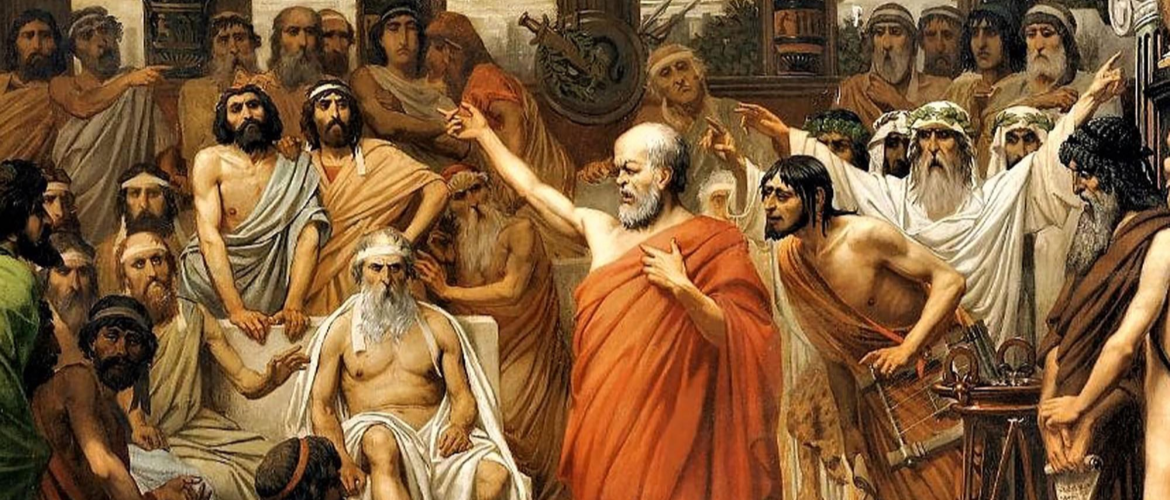
Socrates engaging Athenian society
In classical philosophy beginning with the Greeks, the question of human nature lay at the heart of political thinking. Protagoras, like other Sophists, was a rhetorician, teaching the technique of sound deliberation (euboulia) aimed at achieving political success in Athenian society. In his eponymous dialogue with Socrates, one of the principal questions discussed was whether virtues such as justice were innate to human nature or whether they were merely skills capable of being acquired and taught by rhetoricians. In arguing for the latter, Protagoras cited to Socrates the fable of Zeus distributing to humanity the civilizing virtues of tolerance and civic respect (aidos), and of justice (dike), as necessary skills in order to enable humanity to survive the hostile wilderness of the natural world (taken here as including their own selfish and bestial tendencies). Protagoras regarded these social and civic virtues as being in effect no more than teachable cooperative skills, not qualities in human nature but rather techniques that could be taught to promote individually determined ends, which were not necessarily virtuous. These could be selfish ends, a view contrary to that of Socrates, who regarded human nature as inherently good and therefore altruistic, qualities of goodness that he regarded as fundamental to order. For Socrates, order was predicated on the excellence of virtue (arete), an innate sense of underlying harmony, and was not merely a learned skill (techne) of accommodation for the sake of expediency. If ‘Man is the measure of all things’, as Protagoras famously stated, then the levers of government would be no more than expediencies, wielded to further the relativistic ends that suited the whims of the ruler from time to time. For Protagoras, the political techne possessed a utilitarian value (an argument that Hobbes and Locke, for example, would later advocate) because it conduced to self-preservation, and it thereby had a tempering effect upon anarchic human nature. Although, in Protagoras’ view, the civic virtues were not innate, they could be taught and learned, and in this way, Protagoras offered a way of reconciling nomos and phusis.
According to Socrates, civic virtue depended on the soul’s self-knowledge, its innate sense of harmony.
By contrast to Protagoras’ accommodationist view, which allowed for a reasoned compromise of essentially selfish ends, there were others, such as Thrasymachus, and Plato’s brothers, Adeimantus and Glaucon, interlocutors in Republic, who maintained that human nature was intrinsically competitive, uncooperative and selfish, and that justice was no more than the law of ‘might is right’ or of operating below the radar of legal detection. An extreme version of this view was represented by the Sophist, Callicles, who denied the existence of civic virtue at all, declaring instead the individual’s unfettered right to self-assertion and domination. His cynical view represented essentially a non-political perspective, as did that of the Sophists, Antiphon and Antisthenes, who maintained that all government was unjust insofar as it was predicated on the inequality of power between the ruler and the ruled, or between the diverse constituents of a society. In the latter instances, phusis was equated with the ‘higher’ principles of freedom and equality, and thereby was said to be above nomos.
In contrast with the views of the Sophists, the Platonic view regarded civic order as an aspect of the cosmic order, whose structure and template of harmony was reflected in the very nature of Man. Order was not, as Callicles claimed, based on an imposition of selfish ends but on a sense of civic virtue. As Socrates states,
Wise men say, Callicles, that heaven and earth, and gods and men, are bound together by fellowship and friendship, by orderliness, temperance, and justice, and that is the reason why they call the whole of this world ‘cosmos’ [order], my friend, not disorder or dissoluteness. (Gorgias, 507e, 508a)
Order was the architectonic structure of nature embedded in the soul, hence the Platonic emphasis on knowledge and the ‘care of the soul’. According to Socrates, civic virtue depended on the soul’s self-knowledge, its innate sense of harmony. In this conception, justice was to the soul as health was to the body, and the care of the soul was to be entrusted to the skilled physician of the soul, the philosopher. The ‘true philosopher’ was one who possessed a ‘synoptic’ view of the cosmos as a harmonious Whole, a vision of theophany – of the Absolute Reality – which was essential to a sense of cosmic order:
But what, according to you, is a true philosopher? he asked. He, I answered, who loves to contemplate truth... who is able to arrive at what remains ever constant. He who is capable of seeing the Whole is a philosopher; he who is not, is not. (Republic, V, 475; VI, 484-485)
For Socrates, virtue was intellectual: to perceive the Truth of the soul’s substance was to envision it as synoptically, as Whole (the ‘synoptic’ vision is related to the Aristotelian Greek term theoria which denotes vision, not concept). He understood that the innate sense of integrity could be discovered through a process of recollection (anamnesis) and this formed, for Socrates, the foundation of order. Knowledge of Truth corresponded to the ontological cognition of one’s substance (Goodness) and to its resplendence (Beauty). The key to virtue, for Socrates, was therefore self-knowledge, in accordance with the Delphic oracle’s statement, “Know thyself”. Knowledge, he held, was necessarily transformative, and so, in the Socratic paradigm, self-knowledge would therefore be sufficient to make one virtuous.
Plato developed a cosmological view of political harmony predicated on the tripartite division of the soul … Civic virtue was, firstly, a matter of the soul's ‘inner political governance’ … (and then)… of participative harmony and of ‘outer political governance’, so that civic order was thereby a reflection of the natural inner order
While agreeing with Socrates that virtue was innate and that one had to discover it through anamnesis as one’s inward substance, Plato emphasized that knowledge also had to be integrated with being, and this could not occur merely through an intellectual process of the mind; the realization of Truth required a transformative element, namely love (Eros). According to Plato’s Theory of Forms, only archetypal Forms were fully intelligible and substantially real, while the concretized objects of the sensible world were merely transient reflections of these formal archetypes. The order of sensible nature was therefore a reflection of the higher order of intelligible Forms. Using the analogy of the divine charioteer (cited above), Plato developed a cosmological view of political harmony predicated on the tripartite division of the soul into the hierarchy of intellect (nous), the animating soul (thymos), and appetites (epithymia). While in agreement with the Socratic correspondence between knowledge and virtue, Plato nevertheless emphasized that human nature was corruptible: the intellect was capable of being misled, and its governing role among the soul’s faculties was capable of being usurped by the lower desires. One could know goodness and yet not be virtuous. Knowledge therefore had to be transformative. This required the soul to look beyond the material realm to the spiritual source of order – to the substantial beauty of the eternal verities – so that, drawn by love for the beauty of their Forms, one might thereby conform to their underlying harmony and participate in the cosmic order. The ascent of the soul to the highest level of the mysteries of love is described by Socrates in his retelling of Diotima’s ‘homage to Eros’ (Symposium 201-212).
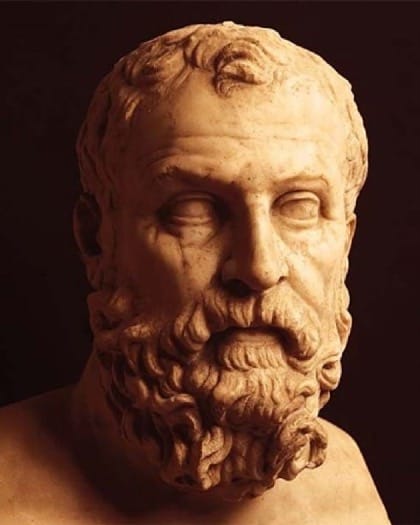
Solon c.630BC-c.560BC
Given the corruptibility of the soul, and its perfectibility through the knowledge of Forms and the ascension of Love it therefore became critical to Plato’s political aims for the polis to be concerned with moral education, and for the ruler to promote the citizenry to harmonize with the natural order of the cosmos. Civic virtue was, firstly, a matter of the soul's ‘inner political governance’: it was imperative that the unruly lower appetites be governed by the higher intellect. At the same time, civic virtue was a matter of participative harmony and of ‘outer political governance’, so that civic order was thereby a reflection of the natural inner order. The government of the state, Plato concluded, could only be placed in the hands of experts, men or women who had achieved self-knowledge and self-mastery and who were skilled in governance. The prototypical ruler would be a sage, someone like Solon, a defender of the moral order. Plato therefore proposed that the government of the polis be vested in a philosopher-king, one who possessed a sense of cosmic harmony. For social order to prevail, each constituent group within society had to be educated to understand its proper place, its role in the overall harmony.
Plato envisioned social order as a natural hierarchy corresponding to the tripartite division of the soul: the philosophers, who corresponded to the intellect, would govern; the military auxiliaries, who corresponded to the animating principle of the psyche, would protect society; and the merchants, producers, and workers, who corresponded to the material and appetitive elements, would ply their trades and serve in their respective roles, under the government of the philosopher-king and auxiliaries as their guardians. The hierarchy, which corresponds to that of the Sacerdotum, Regnum and Commons in traditional doctrines, is found in traditional cultures (such as, notably, in the Hindu caste system derived from Manu) and is based on a cosmological view predicating outer order on inner order, in a cosmic harmony of nature. To ensure that there was civic order through social stratification, Plato proposed the idea of the Noble Lie, whereby each class would be indoctrinated to believe that their souls innately contained traces of metals corresponding to their natures and their respective social ranks:
While all of you, in the city, are brothers, we will say in our tale, yet god, in fashioning those of you who are fitted to hold rule, mingled gold in their generation, for which reason they are the most precious — but in the helpers, silver, and iron and brass in the farmers and other craftsmen. (Republic, III, 415a)
Plato’s political ideas involve many elements which are beyond the scope of this essay to address. For our limited purposes, focusing on Plato’s view of politics and human nature, we wish to highlight the correspondence between the Platonic schema and the presuppositions of our principial world view. A common theme is the underlying harmony in nature which is seen as the basis of order and equilibrium in society. Civic order and its foundation, virtue, derive from the archetypal realm of the Divine Order. ‘As above, so below’ is a well-known adage of the correspondence between Heaven and Earth, between the divine prototype of the macrocosm and its imprint in the microcosm of human nature and society.
However, Plato’s views of government, though they are modeled on a traditional cosmology, must grapple with the dilemma that human nature, despite its divine imprint, is corruptible. In Republic, Glaucon illustrates the dilemma of moral corruptibility by recounting the legend of the Ring of Gyges which confers on its possessor a cloak of invisibility. He tells the story of how a shepherd discovers a golden ring and uses its powers to seduce the consort of the King of Lydia and, with her help, to murder the King and usurp his throne. Glaucon argues that most humans would act immorally if their conduct was beyond detection or sanction.
Suppose now that there were two such magic rings, and the just put on one of them and the unjust the other; no man can be imagined to be of such an iron nature that he would stand fast in justice. No man would keep his hands off what was not his own when he could safely take what he liked out of the market, or go into houses and lie with any one at his pleasure, or kill or release from prison whom he would, and in all respects be like a god among men. Then the actions of the just would be as the actions of the unjust; they would both come at last to the same point. And this we may truly affirm to be a great proof that a man is just, not willingly or because he thinks that justice is any good to him individually, but of necessity, for wherever anyone thinks that he can safely be unjust, there he is unjust. (Republic II.360b-d)
Glaucon’s is an early version of the argument found in Dostoevsky’s The Brothers Karamazov that “If God is dead, everything is permitted”. It is evident that Plato recognized the force of the argument that human nature, without moral discipline, is corruptible. This is implicit in his view of the unsustainability of aristocratic rule by the philosopher-king. Such noble rule, he believed, would degenerate by succumbing to worldly honors and would eventually yield to government by timocracy, then by oligarchy, then by democracy (which Plato regarded as an inferior form of government, analogizing it to a ‘Ship of Fools’), and finally to government by tyranny. Plato’s pessimism about human nature is also evident from his recognition of the need for the Noble Lie to sustain order in his model society. Nonetheless, Plato also recognized that human nature was capable of virtue, love, and of alignment to cosmic order, and this was the centerpiece of his theory of Forms. Plato’s theories reflect the view that human nature is perfectible, that its perfectibility is an accord with the underlying reality, and that justice, in the end, is not merely expediency but a matter of integrity.
It is precisely because Plato’s model of government undermines both political engagement and individual freedom that it is ultimately unworkable.
However, Plato's political philosophy can be criticized as being essentially utopian. His basic model of government described in Republic and Laws is a totalitarian conception sustained by the Noble Lie. In the end, for Plato, communal politics is effectively eclipsed by philosophy in the sense that citizens are slotted into roles that afford them no political freedom to actively engage with rulers in the negotiation of their relationships or of their civic rights and duties. It is precisely because Plato’s model of government undermines both political engagement and individual freedom that it is ultimately unworkable. His vision of society reduces the ruled to the merely instrumental value of serving the state, not of political engagement. Politics, however, requires the active and free engagement of its participants, not by coercion but by processes that allow for engaged dialogue as the basis of internalized assent. The value of Plato’s political theory lies in its emphasis on the importance of predicating outer order on the sense of inner harmony, and the civic virtues of community and justice on the unitive metaphysical vision of the Whole. Implicit in Plato’s philosophy is the importance of the sense of the Sacred as the foundation of Man’s relationship with the shared natural world. This aspect of his political philosophy is stressed in his views on the necessity for moral education and the care of the soul. Education, he recognizes, promotes virtue (Timaeus, 87b) and conduces one to the rule of law (Laws II, 659d). Again, Plato emphasizes education as a matter of enlightened self-interest. Paedeia (education) and arete (virtue) are the basis of civic order. Good education (understood as ‘care of the soul’) makes good citizens (Laws II, 641b). It teaches people the virtue of government which is ‘how to rule and be ruled’ (Laws II, 643e).
The merely human attributes of reason and consensus are inadequate to a telos of order in the absence of a centric orientation and inspiration.
The ‘care of the soul’ is of course common to all faith traditions. The traditions recognize both the corruptibility of the soul and its perfectibility. Understood metaphysically, Man is ‘fallen’ by virtue of being within the influence of the cosmic veil, and is thereby susceptible to forgetting his true Origin and Center, the substance of his being, which is the Spirit.[[11]] At the same time, Man’s equilibrium lies in realizing his true spiritual foundation which is his primordial nature that connects him to all creatures, and, importantly for our purposes, to a community. This view of nature is spiritual. It is fundamentally different in conception from the Hobbesian view of human nature as base and even from the Rousseauian view of the ‘noble savage’ (le bon sauvage) which has merely anthropological rather than spiritual foundations. An example of the spiritual conception of Man can be found in the Koran. In Islam, human nature, in its primordial sense, is that disposition which God has instilled in our souls. It is denoted by the term ‘al-fitra’, as referred to in the following Koranic verse:
And so, set thy face steadfastly towards the [one ever-true] faith, turning away from all that is false, in accordance with the natural disposition which God has instilled into man (fitrat Allah): [for,] not to allow any change to corrupt what God has thus created this is the [purpose of the one] ever-true faith; but most people know it not. (Al-Rum, 30: 30)
As the scriptural passage makes clear, the soul is corruptible and will succumb to corruption insofar as it departs from its primordial nature (fitrat Allah).[[12]] The fitra is the divine norm, and Man is exhorted to exercise freedom in conformity with it. Nature presupposes order, just as order presupposes conformity to the divine norm. These ideas, found in all the faith traditions,[[13]] are reflected in the Muslim understanding of spiritual psychology and the perfectibility of the soul (al-nafs). To provide a brief outline, the Koran refers to three states of the soul: the ‘soul which incites to evil’ (al-nafs al-ammara bi’l-su’) (Yusuf, 12:53), the ‘upbraiding soul’ (al-nafs al-lawwama) (Al-Qiyama, 75:2), and the ‘soul at peace’ (al-nafs al-mutma’inna) (Al-Fajr, 89:27). The ‘soul which incites to evil’ corresponds to the Platonic usurper, which supplants the governance of the Spirit in favour of its own thoughts and desires. The ‘upbraiding soul’ is that of the awakened conscience that upbraids the soul and counsels it to act conscientiously. And the ‘soul at peace’ is the sanctified soul, conformed to the fitra, and in a state of equilibrium with God and the world. ‘Fallen Man’ can therefore ascend, by a combination of effort and grace, to the entelechic station of ‘Primordial Man’.[[14]] Perfectibility requires effort and grace. Grace shapes and transforms man towards God. The merely human attributes of reason and consensus are inadequate to a telos of order in the absence of a centric orientation and inspiration.
Applying these traditional ideas to the domain of politics, we can understand the quest for political equilibrium as a quest for spiritual order. Without meaning to suggest that the only legitimate State is a theocracy – there are many possible forms of government, as we shall see – the search for civic order is essentially an attempt to align society with norms and values rooted in the Sacred. Intrinsically, this is a personal quest to recover our primordial nature and to govern ourselves by its norm, which is reflected as our conscience. Extrinsically, it is a process of engagement with ‘the Other’ in a way that reconciles it with a cosmology based on the Sacred. Order and harmony and a sense of equilibrium are innate to Primordial Man. They are his metaphysical Center, corresponding to an innate sense of the Sacred, which is reflected outwardly in the polis or community.
Plato grappled with the issue of how to achieve political order in a world where, as the Sophists argued (and Hobbes later), humankind was naturally inclined to disorder. Plato disagreed with the portrayal of human nature as inherently corrupt, though he rightly allowed that the soul was corruptible. He recognized that just as the intellect could be usurped by the unruly elements of the self, so too could political order be subverted for immoral purposes or the personal ends of the ruler. His solution for political order was to vest control in the rulership of the philosopher-king, but as we have argued earlier, the solution was unrealistic. In the model society, government was limited to those who could rule themselves, and Plato never properly addressed how those who were intellectually unable to attain to the internal rank of the elite could participate in society except by accepting roles they were assumed to be fit for and by being persuaded to do so based on a Noble Lie. Although Platonic philosophy recognized the correspondence between intrinsic human nature and social order, the Platonic model of government failed to adequately address the fact that, if it was not to be simply utopian, it needed to reflect that civic order requires a greater degree of internalization and political engagement of the citizenry than it allowed. This is best done not by imposing a rigidly stratified order on society, thereby depriving the citizenry of any meaningful political role, or by merely pandering to their individualistic or materialistic self-interest, but rather by inspiring them to cultivate a sacred sense of community in their enlightened self-interest and for the ‘common good’ that corresponds to a holistic vision of society. We will address these ideas in greater detail in the next section of this essay.
Faith and Community
‘community’, as its etymology suggests, is an expression of the intrinsic Oneness of reality
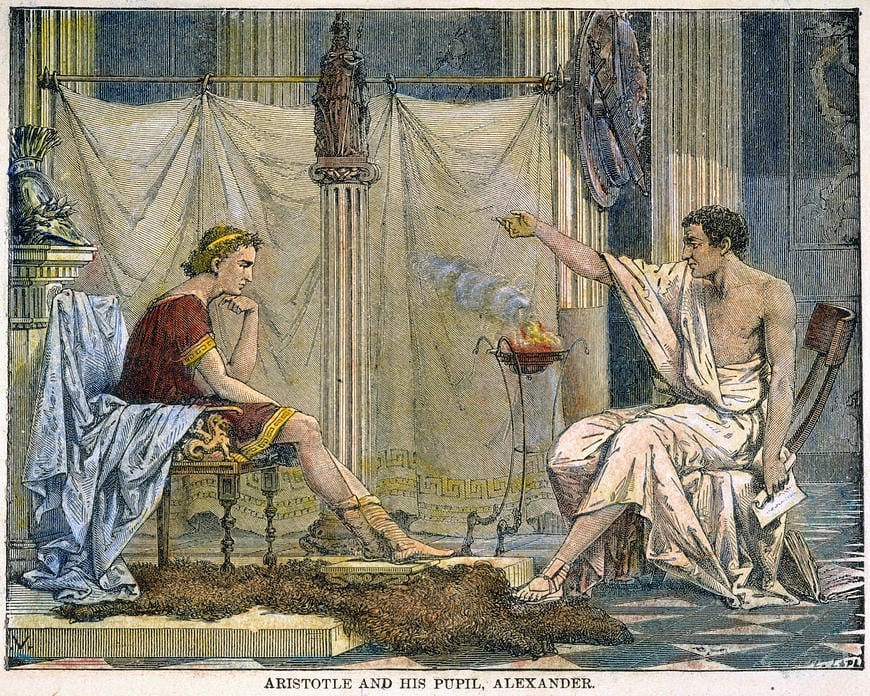
Aristotle, while claiming that Man was a political animal[[15]] who inclined by virtue of his nature to live among other human beings[[16]], also noted that no individual could be self-sufficient. Therefore, he reasoned, human beings needed the support of an ordered community to create laws aimed at the ‘common good’. Man was communal by nature because the community was the optimal means by which each human being could express the function for which he or she was best suited (their ergon). This communal purpose (telos) informed his view of the State, or the polis: ...a State is a sharing by households and families in a good life, for the purpose of a complete and self-sufficient life. (Politics, III, 9.1280b29–34)
For Aristotle, therefore, political society exists for the sake of noble actions, and not merely for the simple aim of living together[[17]]. The political community’s telos was the attainment of ‘the noble life’: ...the common advantage also brings them together insofar as they each attain the noble life. This is above all the end for all both in common and separately. (Politics, III, 6.1278b19–24)
Engraving by Charles Laplante, a french engraver and illustrator.
Unlike Protagoras, for whom political ends could be subjective, or Plato, for whom political ends were defined by objective ideals which were largely unattainable in life, Aristotle argued that perfectibility, though objective, could only be approximated and in its application it would vary situationally. The role of the polis, as he saw it, was to optimize the conditions for the perfectibility of ends so that Man could flourish and attain happiness (eudaemonia), each “in accordance with his own excellence”. Civic order was necessary for this purpose: Just as, when perfected, a human is the best of animals, so also when separated from law and justice, he is the worst of all. (Politics, I, 2.1253a31–3)
For Aristotle, therefore, the community had a necessary utilitarian purpose: it provided its members with a supportive community and inculcated among them the aretai or virtues (justice, courage, temperance, etc.) that they would require to fulfil their ergon to their best ability so that they could have the best chance of living ‘the noble life’ (living in conformity with arete). This was the practical dimension (or praxis) of politics. Though it was aimed at eudaemonia, Aristotelian society, like Plato's model Republic, was nevertheless conceived as authoritarian, run by a technocratic ruler, the politikos, selected from an elite class which possessed the skill to rule. In this regard it approximated what Aleksandr Solzhenitsyn has described as “an authoritarian order founded on love of one’s fellow man.”[[18]]
In advocating authoritarian rule, the classical Greek political theory of governance bore a similarity to that of Thomas Hobbes who, unlike Plato and Aristotle, regarded human beings in much baser terms, operating largely mechanistically and driven by their selfish natures. For Hobbes, civic order was not motivated by the human need for perfectibility or to achieve noble ends, but rather by fear, by the basic need for security and survival. Hobbes believed that people must agree to submit to the rule of an absolute sovereign in exchange for laws that would protect them from each other. His views were criticized by John Locke who astutely observed:
Men are so foolish that they take care to avoid what Mischiefs may be done them by Pole-Cats, or Foxes, but are content, nay think it Safety, to be devoured by Lions. (Two Treatises on Civil Government, Second Treatise, Chapter VII)
Locke proposed a social contract theory of government, rejecting Hobbes' defense of the ‘divine right’ of the absolute monarch to rule over the state as a vice-regent of God. Instead, he argued, the state was formed by the implied consent of people, as a ‘commonwealth’, to accept the conditions of ‘civil society’ in order to protect their natural rights of life, liberty, and estate.
Each of these theories of political society was an attempt by philosophers to justify the existence of the state. Whether authoritarian, utilitarian, or consensual, each theory proposed a basis for legitimizing civic order. Was the state founded on intelligible principles or merely on power? If the former, then what were the constituting principles? And were they consistent with metaphysical premises? The notion of ‘community’, which underlies that of the polis, has a metaphysical foundation. It not only presupposes a transcendent order, but is in fact a reflection of that order. The bonds of community, as Eric Voegelin has suggested in his magnum opus, Order and History, are profoundly spiritual, reflecting the grace of ‘luminosity’ and participatory awareness that are implicit metaphysically in the Biblical statement ‘Let there be Light!’ (Genesis, 1:3). The community is the luminous expression of the oneness of reality as Absolute and of the plurality of reality as Infinite. These are not intrinsically opposed principles though they may appear extrinsically to be so, and both are aspects of the Sacred, denoting Presence and symbolized by Light. We will discuss the pluralistic basis of social order later in this essay. For now, however, we will focus on the idea that ‘community’, as its etymology suggests, is an expression of the intrinsic Oneness of reality. In other words, the very basis of civil society is metaphysical, and so its foundations are principial rather than merely historical, psychological, anthropological, or based on other rationalistic explanations.
These ideas are clearly reflected in Islam, where the doctrine of tawheed (monoreality) provides the political foundation of ‘community’. The Muslim idea of community is based on spiritual kinship and not, as one can clearly note from the very first Muslim community established by the Holy Prophet in Medina during the earliest days of Islam, on sectarian groupings such as race, tribe, ethnicity, gender, or class. The community was the natural expression of faith in God. The Charter of Medina (Dastur al-Madina), established by the Holy Prophet in circa 622, was the founding political charter and governing constitution of the first ‘Islamic State’ and is a good illustration of this understanding of community. The unified community (al-umma wahida) was founded on a cosmopolitan basis that transcended sectarian and religious differences. It was a ‘community of believers’ (ummat al-muminin) established on the basis of belief in the underlying oneness of reality, and, as such, it included both non-Muslims (the ‘People of the Book’ such as the Jewish tribes, who were given stipulated rights, including religious freedom, and equal status as Muslims under the Charter[[19]]) and pagans. Although from a practical standpoint, interpretive authority was vested in the Holy Prophet[[20]] (in a sense, similar to the authority vested in the ‘true philosopher’ in the Platonic model), the governing principles under the Charter were equal rights, justice, equity, and due process, and freedom of religion. The Holy Prophet’s example (Sunnah) confirmed these principles, particularly with regard to his well-known tolerance of other faiths in their religious practices (in keeping with the Koranic precept of ‘no compulsion in matters of faith’, even where these were at odds with Islamic theology (as, for instance, in the case of the exclusivist Judaic doctrine which limited salvation to the covenanted ‘tribes’, contradicting Koranic universalism, or in the case of Christian trinitarianism, which contradicted Koranic monorealism).[[21]] A clear statement of this intrinsic unity upon which community is based is found in the Holy Prophet’s famous sermon given on the occasion of his final pilgrimage (hajj), when he stated:
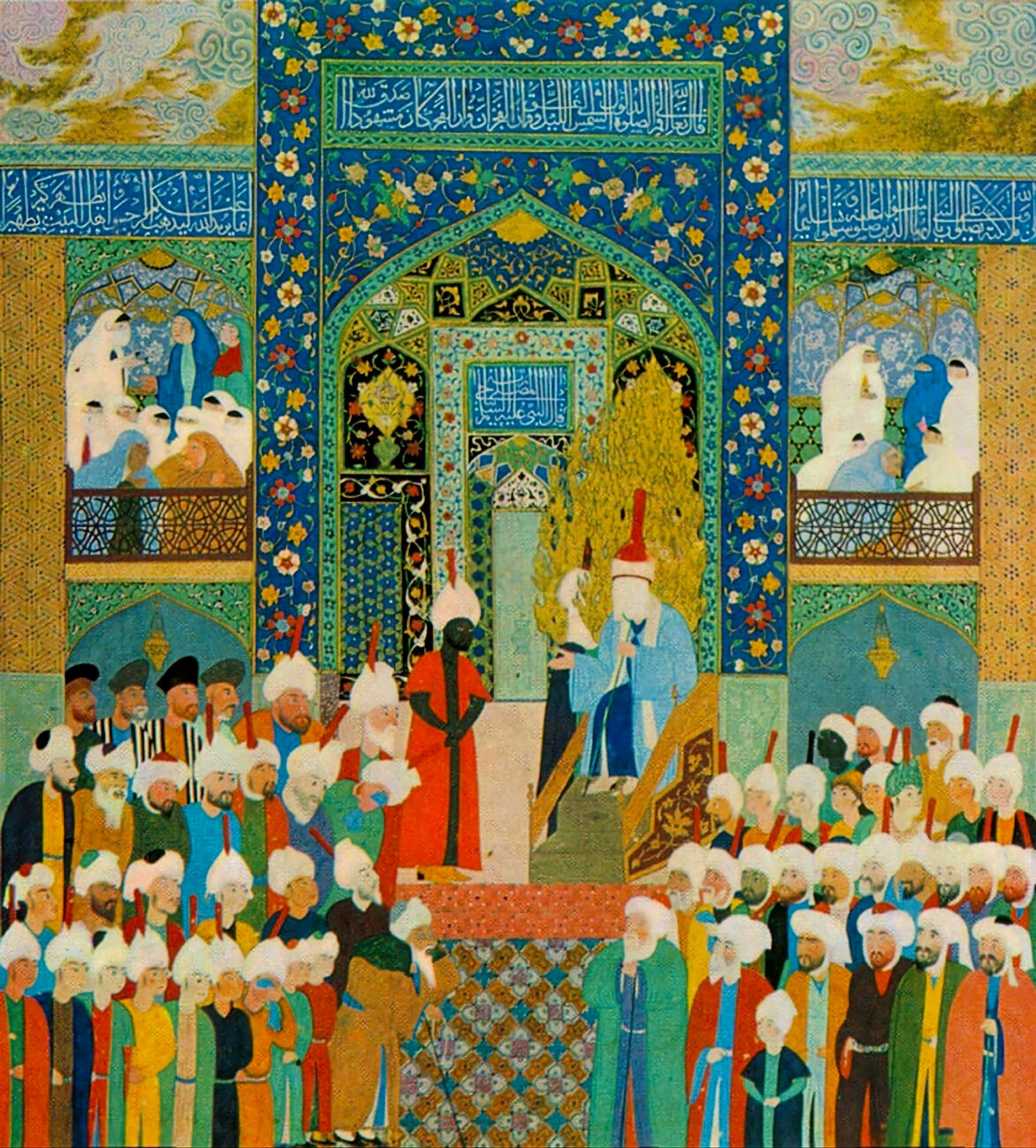
O people! beware! Your God is one, no Arab has any superiority over a non-Arab, and no non-Arab any superiority over an Arab, and no white one has any superiority over a black one, and no black one has any superiority over a white one, except on the basis of taqwa (fear / love of Allah or piety).
Persian miniature of the Last Sermon of the Prophet Muhammad from a 1526 Ahsan al-Kibar manuscript illustrated by Qāsim Ali.
The Arabic term for ‘community’ ‘al-ummah’, derives from the root ‘umm’ denoting ‘mother’. Humankind, as the etymology of the term ‘al-ummah’ suggests, is the offspring of a single mother. They share not only the same Adamic patrimony (Adam being the prototypical Man, representing the fitra or primordial norm) but the same matrix (as offspring from the same womb). Their kinship is also confirmed by the scriptural confirmation that their creation was from a ‘single soul’:
Mankind, fear your Lord, who created you of a single soul, and from it created its mate, and from the pair of them scattered abroad many men and women… (An-Nisa, 4:1) (see also Az-Zumar 39:6)
The natural affinity that gives rise to the kinship of the community is also located metaphysically: the substance of the community’s ‘single soul’ (nafsin waahidatin, referred to in the Koranic verse just quoted) is ‘rahma’. In Islam, God (Allah) is known by his quintessential qualities of Loving Beneficence (Rahman) and Loving Compassion (Rahim). The two Arabic terms are derived from the root 'rahm' denoting ‘womb’. The community is therefore to be understood as subsisting within the womb-like embrace of God. This is affirmed by the following Koranic verse:
My mercy encompasses all things. (warahmatee wasi’at kulla shay-in) (Al-A’raf, 7:156)
The term ‘compassion’, denoted by the Arabic term ‘rahma’, confirms that the ontological substance of humanity as a community is its nurturing spirit. This is the substance (ruh) that was breathed into Adamic clay:
Then He fashioned him in due proportion and breathed into him of His Spirit. (Thumma sawwahu wanafakha feehi min roohihi) (As-Sajdah 32:9)
According to the hadith qudsi known as the Hadith of the Hidden Treasure, love, an aspect of ‘rahma’, is also the motive force of creation:
I was a hidden treasure and, from my overflowing love to be known, I created the world. (Kuntu kanzan makhfiyya fa ahbabtu an au’rafa fa khalaqtul khalq)
Love and the empathetic knowledge of compassion are the quintessence of the Adamic soul and constitute the primordial norm (fitra) of prototypical Man, and thereby of the prototypical community of souls. This norm is a matter of cognition. The intellect knows its natural bond by knowing “its consubstantial content and so the nature of things, and this is why Greek gnosis says, ‘Know thyself’, the Gospels say ‘The Kingdom of Heaven is within you’, and Islam ‘Who knows himself knows his Lord.”[[22]] The soul’s recognition of its spiritual Origin is attested to in the following verse of the Koran, which depicts a Primordial Covenant between God and Man (known as ‘the Covenant of Alast’):
And (remember) when your Lord took their offspring from the loins of the children of Adam and made them testify as to themselves (saying): ‘Am I not your Lord?’ [Alastu bi Rabbikum] —They said: ‘Yea, verily, we so testify’, lest you should say on the Day of Resurrection: ‘Verily, we have been unaware of this’. (Al-A’raf 7:172)
The testament (shahada), 'there is no god if not God' (la ilaha illa ‘Llah), which is a basic Muslim creed, reaffirms the Primordial Covenant referred to in the scripture. In both cases the soul is affirming the reality of the transcendent Spirit, and its spiritual Origin. In the same way, the shahada is implicitly affirmed by the Koranic principle of Return (ma’ad), that all creatures will return to their Source: Surely we belong to Allah and to Him shall we return. (Inna Lillahi wa inna ilaihi raji'un) (Al-Baqarah 2:156) Humanity is intrinsically a reflection of Divine Unity, and thereby of primordial unity, as is attested in the following Koranic verse: Mankind was (originally) one community… (Kana annasu ommatan wahidatan…) (Al-Baqarah 2:213)
True community therefore expresses this normative transcendent unity which, therefore, is rooted in faith and a sense of the sacred. This notion is expressed in all faith traditions[[23]] and is central to ‘Tradition’ as such, as is, for example, illustrated in the following passage from T. S. Eliot: There is not life that is not in community, /And no community not lived in praise of GOD.[[24]] As an expression of wholeness and integrity, community reflects the values of natural kinship, spiritual interconnectedness and empathy for ‘the Other’. The recognition of a communal patrimony is embedded in human nature, in the primordial norm of the fitra, which constitutes the foundation of Man’s communal bond. We are each our ‘brother’s keeper’ and we participate in a ‘sacred web’ of life. Creation, though composed of a plurality of communities (such-and-such a community), is nonetheless a single spiritual community (‘community’ as such). “No man is an island,” as John Donne remarked, stating a self-evident metaphysical truth about community. To be is to be with. There is a participative dimension in life that transcends our individuality and connects us, each to the other. This dimension is what Eric Voegelin terms “the It reality”, and which the term ‘Sacred’ denotes in this essay: every man is really conscious of participating in a process that does not begin with the participants but with the mysterious It that encompasses them all.[[25]]
Political theories that seek to explain the ultimate sense of the political foundations in merely extrinsic ways, by holding that they are based in an implied ‘social contract’ or ‘mutual self-interest’, or on religious, cultural, tribal, ethnic or national identities, fail to locate their true ontological roots.
It is this intrinsic sense of interconnectedness – that is, the sense of the Sacred, whether consciously articulated or not, but reflected in a moral imagination that is vital to any community – that defines the core of a political community, and not its extrinsic ‘constitution’, its laws or its formal institutions. Those may provide an external framework for civic order and may be assented to for a host of complex reasons, but the true basis of civic order is communal virtue, the ethic that manifests the sense of the Sacred and the moral imagination that it draws on. It is vital for modern political societies to cultivate a communal ethic that is pluralistic and cosmopolitan in order to withstand the stresses and strains of globalization and sectarianism in the modern world. Political theories that seek to explain the ultimate sense of the political foundations in merely extrinsic ways, by holding that they are based in an implied ‘social contract’ or ‘mutual self-interest’, or on religious, cultural, tribal, ethnic or national identities, fail to locate their true ontological roots. Without finding an intrinsic basis for community, there is always a danger that polities will lack cohesion and a viable center. It is the natural communal bond between humanity (what Ibn Khaldun referred to as ‘asabiyya or community feeling in the broad sense of ummah, not in the narrow tribal or clannish sense criticized by the Holy Prophet) that is the basis of sustainable civic order. By its reflection of the primordial norm as the criterion of order and justice, the political community’s intrinsic bond is also the basis of civic responsibility and civic engagement, as we will argue later in this essay. The cosmic order shapes the civic order, and both are founded on a vision of intrinsic harmony crystallizing in the ‘community’. Without this synoptic vision of community, and of the moral imagination of the fellowship, orderliness and justice it implies, there can be, as Socrates tells Callicles, only chaos.
The Secular and the Sacred
The divine order is inscribed in the heart and cannot be eradicated by the laws of Man.
In the previous sections of this essay, we have argued that the divine order and norm provides the prototype for human nature and society. The prototype of human nature is the norm of the fitra, and in the case of society it is the ummah. Both are premised on the Sacred. By contrast, modernist conceptions of society are predominantly secular, seeking to privatize or exclude religiosity from public life, especially from the domain of government. But if human beings are endowed with a spiritual nature, albeit one that they are free to reject or deny, then any ordering of society and government in ways that ignore the reality of this spiritual nature is going to prove problematic. One cannot legislate away human nature or the sense of the Sacred. One can ordain that explicitly religious views be excluded from the polis, but their influence cannot be discounted in human motivation. The divine order is inscribed in the heart and cannot be eradicated by the laws of Man.
That said, there is a strong secularist drift in modern societies, particularly in the so-called ‘West’, and this is a factor that has to be recognized in any discussion about politics and the Sacred. The reasons for this are complex and are beyond the scope of this essay, though we have touched on some aspects earlier. The secularist ethos and ideology that has become a pronounced feature of Western politics stands in sharp contrast to the traditional world view, particularly of Muslims. Note, for example, the observations of a recent commentator on this subject, writing about the reception of Muslim political ideas in the Western world: “Islamic scholars had much to say about the political organization of Islamic communities and about the relations of Muslims and unbelievers, but these ideas could have no purchase outside Islam. Even if any Western thinker had been willing to pay attention to them, the Western distinction between the sacred and the secular has no place in Islam, and the Western anxiety about relations between church and state finds no purchase in a faith without the Western conception of a church”.[[26]]
The true fault-line between Western and Islamic conceptions of politics is not the separation between political and ecclesiastical authority, but the secularist tendency to exclude the Sacred from public life. The notion of the homo religiosus is not limited only to Muslims alone but is an intrinsic attribute of human nature. Faith (in Arabic, din) is an aspect of worldly life (duniya), especially where it is understood as a sense of the sacred. To exclude the one at the expense of the other is to create an unhealthy imbalance within oneself and in society. For this reason, politics, though it may legitimately promote religious neutrality, or seek to exclude the Church from the State as it has done in the history of Christendom, cannot properly seek to exclude spiritual conceptions of harmony and responsibility from political discourse. These conceptions are fundamental to any understanding of political order and to the moral legitimacy of the ruler.
The laws of the City of Man may or may not conform to those of the City of God, but however the former may seek to influence or constrain political action, the latter ultimately constitute the political conscience of Man. It is important to bear this in mind when considering the question of political legitimacy.
Authority and Legitimacy
the bonds of governance are founded in principles of love and justice
A basic requirement for sustainable governance is legitimacy. Autocratic and coercive laws, though they may be extrinsically ‘legitimate’, nevertheless lack the weight of moral authority vital to cultivating a sense of community. Without moral authority, underpinned by a universal sense of fairness, modern polities is practically unsustainable, even though political order may be imposed for a time by coercive measures or occasionally shaped by charismatic leadership formed around narratives of nationalistic patriotism, religious supremacy, racial or ethnic superiority, economic or class ideologies, and so on. But such narratives, lacking as they are in a spiritual foundation, are atomistic and sectarian, and, like coercive measures, are intrinsically unsustainable in the long run.
It is inevitable, therefore, that rulers will eventually want to seek legitimacy on moral or religious grounds. So, for example, in Muslim history, during the period of territorial expansion of the Umayyads (661-750), when the caliphate encountered the problem of maintaining political control over the diverse and geographically scattered peoples whom they had conquered, who were resentful with regard to imposed taxes, some basis for legitimacy had to be found by the rulers to maintain political order. For example, Caliph Yazid III (ruled 744) made a political pact with the religious scholars (ulama), promising to govern according to the Koran and the Sunnah. So too the Abbasids (who rose to power in 750) sought to legitimize their rule on the basis of divine authority. Drawing inspiration from Sassanian ideas that regarded the monarch as the protector of religion, the Abbasids impressed the ulama into their service to legitimize their rule. Ibn Muqaffa' (720-756) wrote the influential Risala fi’l-sahaba (754–6) in which he adopted Iranian ideas of patrimonial government, and portrayed the Caliph as the Commander of the Faithful and the Deputy of God on earth. And later, the Mu’tazalite, Al-Jahiz (776-868) expounded a political doctrine that attempted to place the Caliph above the ulama. The problem was that a clear tension had emerged between the ruler and his legitimizers, the ulama, which in a Sunni context of respect for communal consensus (in contrast to the Shi’a doctrine of allegiance or bay’ah to the Imam) required, from the ruler’s perspective, a non-threatening solution to the problem of legitimizing his rule. With the meritocracy of knowledge favoring the ulama, the Caliph’s position became tenuous. There were questions raised about the circumstances in which the Caliph’s authority could be defied if it failed to conform to religious precepts. As a practical matter, who had the right to decide this? It was in this context that the various madhahib or interpretive schools of jurisprudence (fiqh) were developed in Islam, leading to the establishment of the formal law, or Shari’a. The interpretive principles (usul al-fiqh) were, according to Al-Shafi’i (d. 820), rooted in the authority of the scripture and the hadith. The role of the ulama in determining the law was, in the Shafi’ite school, subordinated to community standards. Personal reasoning through analogy (qiyas) was curtailed, and Al-Shafi’i deemed it undesirable to use reason (ijtihad) to draw governing principles to undermine the legitimacy of scripture, hadith and consensus (ijma). In this context, there developed a contest between, on the one hand, the supremacy of the scripture and the hadith (a view endorsed by the Shafi’ite school) and, on the other, the supremacy of intellect (a view endorsed by the Mu’tazilite school). Those who believed in the doctrine of the pristine and supreme revelation relied on the uncreated nature of the Koran, thereby endowing the ulama with the authority to protect orthodox doctrine, and relegating interpretation by purely rational argument to the status of heresy. Knowledge (‘ilm) became defined by the precepts of traditional orthodoxy as expounded by the ulama (possessors of ‘ilm). The literalist Ibn Hanbal (d. 855) emphasized the Koranic requirement of obedience to the State (‘O believers, obey God, and obey the Messenger and those in authority among you’, An-Nisa 4:62) even if the State’s laws were manifestly unjust, so long as they were respectful of formal Islam. This fortified the Caliphs and temporarily consolidated their power, but in doing so it undermined the principle that ‘there is no right higher than truth’, and the practice of ‘speaking truth to power’. It also raised an important question about the responsibility of the ordinary citizen as subject: was it merely to obey the decrees of political authority or was it to obey the principial authority of his conscience? If the latter, an unjust ruler could presumably be rightfully deposed. This was a controversial issue, much debated among early Muslim political philosophers.
The debates of the rhetoricians of the ‘Ilm Al-Kalam eventually gave way to the arguments of the philosophers, particularly those influenced by Aristotelianism (such as Al-Farabi, Ibn-Rushd, and Ibn-Sina) and certain Shi’ites of the ‘Alid tradition (notably the Isma’ilis, especially the Brethren of Purity, Ikhwan As-Safa), who bridged Greek philosophy and Islam. The philosophers (falasifah) emphasized the importance of rationally derived knowledge, promoting it as the guide for moral conduct, but this created a tension between them and the theologians (mutakallimun), who were primarily interested in justifying divine authority, even at the expense of rational proofs. By contrast, the philosophers were in danger of holding reason to be their principal guide even if it potentially undermined theological views. Al-Farabi (c.872-c.950), for example, regarded philosophy as superior to religion, claiming that reason had existed prior to religion in time, and he viewed theology as an imitation of philosophy. While the theologians emphasized the interpretive authority of the ulama and the supremacy of revelation (wahy), the philosophers unsurprisingly emphasized the interpretive authority of the intellectual elite, and saw revelation as the epitome of rational knowledge. Both these views had political implications. Authority predicated on revelation was the prerogative of those who had received the revelation and therefore, practically speaking, of the ulama who were the protectors of traditional orthodoxy. By contrast, authority predicated on reason was, in theory, accessible to a broader range of society, though in practice it was wielded by the elite philosophers and those skilled in the craft of government. In the former case (authority based on revelation), there was a danger that power would be absolutized by a supreme leader or oligarchy claiming to govern on the basis of divine rule, while in the latter (authority based on reason) there was a danger of the anarchy of reason.
Despite the cloak of objectivity of the philosophers, reasoning could be employed by them to justify their ideological preferences. Thus, Al-Farabi, the Brethren, and Ibn Sina, not surprisingly, presented reasoned arguments in favor of government that conduced to the prevailing Imami Shi’i views of their time. For example, Al-Farabi’s treatise, The Virtuous City (Al-Madina al-Fadila), was modeled on classical Greek ideas of government and substituted the idea of the philosopher-Imam for the philosopher-king, based on the Imam’s intellectual superiority which in Shi’ism is the source of his interpretive authority (ta’wil). To the extent that the rationalism of the philosophers had undermined theology, the latter found its champion in the Persian theologian, Abu Hamid Muhammad Al-Ghazali (1058-1111) whose Incoherence of the Philosophers (Tahafut al-Falasif) cast many rationalistic assertions of the philosophers in a heretical light. This work was in turn later challenged by the Andalusian philosopher, Ibn Rushd (1126-1198) in his work, The Incoherence of the Incoherence (Tahafut al-Tahafut).
This brief historical outline highlights a major tension underlying Islamic political theory, that between faith and reason as the criterion of authority. From a metaphysical perspective, the tension is dissolved by ascribing authority instead to a transcendent faculty that harmonizes both faith and reason. The ‘intellect’ (understood as Logos or the cognitive fitra), unlike reason, belongs to the universal order and is not an individual faculty. It is the cognitive faculty of the Spirit, the ordering Principle of all-pervading Reality, and is therefore the criterion of objectivity. As such, it constitutes the primordial norm for both the ruler and the ruled. The intellect’s perception is supra-rational, intuitive, and immediate. It is based on a synoptic vision that directly apprehends integral harmony in theophany, and on a moral imagination founded in empathetic kinship and natural amity rooted in the Sacred. It perceives the Other as ‘kin’, as an aspect of the theophany. This mode of perception, it should be noted, transcends the modernistic limitations of relativistic subjectivity and the disjunctive reductionism of ‘mind’ and ‘matter’.
The basis of legitimacy is … principial. … Specifically, it is found in the principles of verticality (which places God above Man, and the righteous ruler above his subjects) and complementarity (which creates reciprocal bonds of love among the polity).
There is no contradiction in traditional doctrine, therefore, between faith and intellect. The intellect’s knowledge (gnosis) is ontological.[[27]] It is founded in the substance of spiritual ‘being’, and is based on the grace of spiritual insight. This visionary quality of the intellect as an aspect of faith is demonstrated in a famous encounter involving ‘Ali ibn Abi Talib, the Holy Prophet’s cousin and son-in-law, who was reportedly once asked by his companion, Dhi’lib al-Yamani, “Have you seen your Lord?”, to which Imam ‘Ali replied, “I would not worship a lord whom I have not seen.” When asked, “How did you see Him?” the Imam replied, “The eyes cannot see Him according to outer vision; rather, it is the hearts that perceive Him, through the verities of faith.”[[28]] It is through our hearts that we are able to perceive the verities of faith, to realize our natural spiritual bond and to envision the communal harmony which, as the foundation of the kingdom on earth, must reflect the kingdom of heaven. Bearing in mind that ‘the kingdom of heaven is found within’[[29]], it is our sense of the Sacred, embedded within us as the fitra, which orders the reciprocal obligations of the ruler and the ruled, and ultimately informs our political conscience, transcending all theoretical narratives and political artifice as the true basis for social cohesion. In the words of Dr. Nasr, “Man’s responsibility to society, the cosmos, and God issues ultimately from himself, not his self as ego but the inner man who is the mirror and reflection of the Supreme Self, the Ultimate Reality which can be envisaged as either pure Subject or pure Object since It transcends in Itself all dualities, being neither subject nor object.”[[30]]
It is with this backdrop of the intrinsic normative nature of Man as the source of his social responsibility that we can begin to address the question of political authority from the perspective of the scripture and metaphysics. In Islam, political authority is premised on the principle of the Divine Trust. Man, being compacted of both dust and spirit, is simultaneously ‘abd and khalifah, both faithful subject of God and the trusted steward of God on earth. The scriptural foundation for this stewardship, known as amanah or the Divine Trust, is stated in the following Koranic verse:
We offered the Trust to the heavens and the earth and the mountains, but they refused to carry it and were afraid of it. And the human being carried it. Surely he is very ignorant, a great wrongdoer. (Al-Ahzab, 33:72)
Political authority and responsibility are founded in amanah. Humanity, despite the potential for the soul’s corruptibility (Man is ‘a great wrongdoer’), is also spiritually aware of the intrinsic nature of things, which informs his sense of harmony. This is evidenced not only by the soul’s normative nature (fitra) and its affirmation of the Primordial Covenant referred to earlier, but also by its Adamic gift of being ‘taught the Names of all things’ (Al-Baqarah, 2:31: Wa’allama adama al-asmaa kullaha). The metaphysical significance of the Adamic gift of naming is that to know God is also to know all things in the light of the Sacred, to know their essence.
Commenting on this scriptural verse, Dr. Nasr observes that “Man…was given power and dominion over all things by virtue of being God’s vicegerant (khalifah) on earth. But with this function of khalifah was combined the quality of ‘abd, that is, the quality of being in perfect submission to God. Man has the right to dominate over the earth as khalifah only on condition that he remains in perfect submission to Him who is the real master of nature.”[[31]] This combination of dominion and submission derives from the metaphysical nature of the cosmos, where, in Frithjof Schuon’s terminology, “things are in God and God is in things with a kind of discontinuous continuity.”[[32]] This accounts for the paradoxical nature of Man, as both indigent (and therefore corruptible) and noble (and therefore perfectible). By virtue of his indigence, Man is bound to obey God as a servant (‘abd). By virtue of his nobility, Man has authority over creation on the basis of ‘noblesse oblige’, as vice-regent (khalifah). This duality and metaphysical ‘coincidence of opposites’ impacts the theory of political authority and responsibility in two significant ways. The first is through the principle of God’s absolute authority over Man, and the second is through the principle of Man’s derivative fiduciary authority and responsibility. The former affirms the metaphysical principle of divine transcendence, holding that God has absolute rights over Man, who is merely his subject. The latter affirms the principle of divine immanence, holding that God’s subjects are his fiduciaries, simultaneously conferring on them authority to act ‘in the Way of God’ and the responsibility to ‘obey God, and obey the Messenger and those in authority among you’ (An-Nisa 4:62). To quote Schuon, “The “High” accepts the homage of the “low” only on condition that, on the plane of the “low”, the “left” pays homage to the “right”. That is to say that God accepts the homage of men only on condition that the inferior man pays homage to the superior man; the rectitude of the vertical relationship requires that of the horizontal relationship. That is the principle of every human order; whoever says human order, says hierarchy.”[[33]]
The basis of legitimacy is, when viewed beyond its formalistic and legalistic aspects, principial[[34]]; it is founded in the conformity to a hierarchic cosmic order rooted in metaphysical realities. Specifically, it is found in the principles of verticality (which places God above Man, and the righteous ruler above his subjects) and complementarity (which creates reciprocal bonds of love among the polity).
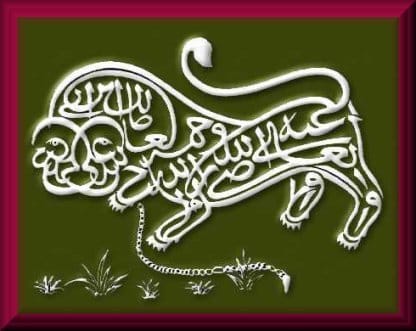
‘Ali Ibn Abi Talib, renowned for his spiritual courage and wisdom, was known as ‘Asadullah’ or the ‘Lion of God’. This script reads: “Ali Ibn Abi Talib, radiya’ llah Ta’aala anhu wa-Karrama wajhahu.” (Ali Bin Abi Talib, may God Almighty be pleased with him and honour him.) The script is Tawqi’, depicting a lion.
A famous statement of these principles in the context of political governance is found in the epistolary admonition by Imam ‘Ali to his governor in Egypt, Malik al Ashtar:
Malik, you must never forget that if you are a ruler over them (the people), then the Caliph is the ruler over you, and God is the supreme Lord over the Caliph.[[35]]
This hierarchic responsibility of stewardship is confirmed by the following hadith: Mind, each one of you is a shepherd, and each one is answerable in respect of his flock. And the Caliph is answerable in respect of his subjects.[[36]] Political order, implying hierarchy, can only be firmly established by a reciprocal bond between the ruler and his subjects. If it is to conform to the natural order, it must be founded in Man’s primordial and fiduciary nature, which is the ultimate source of Man’s obligations to God and thereby to the ummah. Government, according to tradition, must therefore proceed on the basis of trust and reciprocity. As Imam ‘Ali repeatedly emphasizes to Malik in the course of his instructions, the bonds of governance are founded in principles of love and justice, in reciprocal obligations reflecting the communal bond that exists by virtue of the spiritual bond between God and Man. Thus, he states in one of his sermons,
The Almighty God, by entrusting your affairs to me has given me a right over you. And as I have a right over you, so you have a right over me. This incumbency of duties between us is mutual...One-sided obligation is possible only with God. He has rights over His creatures, but they in turn have no rights over Him. This is His privilege. His Power and Authority over His creatures and His equitable assignment of attributes and qualities to each one of them, and His Justice in allotting just rights to every creature, has placed every one of them under obligation to Him. And this obligation upon human beings takes the form of their implicit obedience to Him performed faithfully and sincerely.[[37]]
What undergirds this conception of authority and responsibility is a view of social order founded in spiritual hierarchy and equilibrium, and it is to a fuller discussion of this conception that we will now turn our attention.
Hierarchy and Equilibrium: The Metaphysical Foundations of Order
The essential point to grasp with regard to political order is that it is not to be equated with homogeneity, but with hierarchy.
The term ‘hierarchy’ (etymologically, from the Greek hieros, sacred; and archein, to govern) expresses the idea of sacred order, fundamental to which are two traditional principles: verticality and complementarity, the former reflecting divine transcendence and the latter divine immanence – which, together, are aspects of the unity of the divine reality which is Absolute.
According to the ‘principle of verticality’, things originate in God, ‘descending’ into existence by reflecting divine qualities, but only privatively. It is through this descent into creation that the world is formed through successive levels of being in a centrifugal (and therefore privative) devolution from the Center to the periphery, from the Absolute to the contingent, from the Subtle to the gross, from Light to darkness. The divine Principle, radiating outward, contains within itself archetypes which crystallize as forms within the theophany so that what is peripheral (or, metaphysically speaking, ‘shadow’) in creation is, by the very fact of its existential emanation, always radially connected to the same divine Center (or metaphysical Source of Light). The transcendent intellect perceives the planimetric structure of the cosmos as a radiation from the divine Center and, by this centripetal intelligence, conceives the cosmic order it implies, understanding gradations of reality as greater or lesser expressions of the Light that is central.
The substance of Light, which is also the substance of the soul (ruh), is perceived as Goodness (rahma), the matrix of creation and order: The world is ultimately good, as asserted by various orthodox traditions, because it descends from Divine Goodness.[[38]] Mirroring the revelation or existential ‘descent’ to Earth, is Man's innate spiritual intelligence (‘aql), which is the providential means of his spiritual ‘ascent’ to Heaven. The intellect intuitively perceives both the ordering Principle and its manifestation as divine Presence within the cosmos. The ordering Principle, expressed in the sense of the sacred or the intellectual connection to the divine Center, has its counterpart in the divine Presence, expressed in the sense of community or love for the theophany. To know our sacred origin (perception of the Real) and to align ourselves with its substance (realization of the Real), these are the foundations of order. The sense of the sacred and the natural empathy it evokes are what comprise the primordial norm within human nature and society. The fitra is the operative presence of the ordering Principle in Man (his ‘nature’ and ‘conscience’), while the ummah, theophany expressed as ‘community’, is its normative manifestation as sacred Presence in society.
A further aspect of the metaphysical ‘descent’ into existence is ‘polarization’, the movement from the undifferentiated substance of the Absolute to the differentiated matter of existence. Man exists in the in-between world of ‘metaxy’, which can only be transcended by the ordering Principle. Through the process of creation, the undifferentiated unity in divinis (in Arabic, denoted by the term Dhat) is polarized into differentiated qualities (sifat) representing aspects of its Absoluteness and its Infinity, the former corresponding to its ‘masculine’ qualities of necessity and exclusiveness, and the latter to its ‘feminine’ qualities of freedom and inclusiveness. These dualities, inwardly complementary but outwardly oppositional, pervade creation as the warp and weft of existence. The Fall of Man implies the exchange of unitive for separative vision, of integrity for duality, in a devolution of contraries through which each quality is known in relation to its opposite. According to the traditional ‘principle of complementarity’, these contraries are reconciled within an equilibrium (a ‘coincidentia oppositorum’) that reestablishes their principial unity, thereby harmonizing them into their spiritual substance, and avoiding the dissociation or conflictual opposition of these polar elements.
View of Rome as the City of God, and St. Augustine writing, from 'De Civitate Dei' by St. Augustine of Hippo (354-430) 1459
Applying these doctrines to the realm of politics, civic order is therefore an expression of the Sacred. It is reflected in hierarchic values that reconcile earthly tensions by referring them back, vertically, to their ordering Principle as expressed in our primordial nature, and by viewing them as complementary aspects of divine Presence as reflected in the theophany. The principle of verticality entails that Earth is considered in the light of Heaven, that the City of Man is modeled on the City of God. Authority and values are derived principially, based on a transcendent and planimetric conception of the cosmos, preferencing the ‘vertical’ (implying the Sacred) above all that is merely ‘horizontal’. The principle of complementarity entails that the Other is viewed as an aspect of the theophany, and that equilibrium is sought in the divine balance of the primordial norm (fitra) expressed inwardly as the sense of the sacred, and reflected outwardly as community. Love and benevolent justice, not legality of conduct, is the true criterion of order. In stating this, we are very aware that this prototype of order has yet to be reconciled with the practical reality of the affairs of the world. We will address this below, but it is important to emphasize at this point that the traditional view of order presented here is principial, not utopian.
All men are not equal in fact, and politics has to account for this difference. It cannot do so by seeking to collapse the vertical plane into the horizontal, or to impose a reductive egalitarianism on the complexity of relationships.
It is not based on the modernist delusion of creating, in the words of T.S. Eliot, “systems so perfect that no one will need to be good”.[[39]] It focuses not on outer conformity to ideal forms of society but on inner conformity to the Sacred, expressing itself in a natural communal bond that is the basis of civic order. The essential point to grasp with regard to political order is that it is not to be equated with homogeneity, but with hierarchy. The eradication of diversity through mandatory ‘assimilation’ which is sought in some modernist political conceptions is a false ideal predicated on an illusory egalitarianism. It is belied by the existence of diversity as a fact of life. All men are not equal in fact, and politics has to account for this difference. It cannot do so by seeking to collapse the vertical plane into the horizontal, or to impose a reductive egalitarianism on the complexity of relationships. The true praxis of politics is the pluralistic engagement with diversity, as we will argue below. While order can no doubt be temporarily grafted onto society by external means (as, for example, by force or ideological indoctrination), its true foundation is internal and is based on cultivating bonds of natural affection and a sense of community. Its roots are theocentric, not anthropocentric; spiritual, not material. If order lacks a spiritual foundation, it cannot be sustained. Terrestrial order originates in a higher plane and must therefore reflect its Origin in the principial, primordial and perennial norm which is innate in Man. It is this norm that creates the ‘ladder to Heaven’ and thereby forges the ‘divine equilibrium’ of a ‘just’ order on Earth, rooted in the Sacred.
Freedom and Equality: The ‘Just’ Order
freedom that exceeds its natural bounds ultimately feeds on itself
We have argued that the true foundation of spiritual order must be reflected in the just society. How can this be accomplished without the imposition of undue restraint? This is one of the great challenges of political theory and of government. When, for example, should freedom of expression be restrained? Should publications such as the ‘Charlie Hebdo’ cartoons which recently depicted the Holy Prophet of Islam in a pornographic manner, be legitimized on the basis of the so-called ‘right to free expression’ even if they are likely to scandalize most Muslims? Should such material be allowed as ‘permissible satire’ or be proscribed as ‘hate literature’, bearing in mind that one can stand for the latter position, even while condemning the atrocities perpetrated by those who sought, in the name of religion, to avenge their publication? How should one adjudicate between competing rights and freedoms? Is there a ‘norm of decency’ that could serve as a criterion? The answer ultimately depends on one’s view of human nature, and one’s criterion of a just society. We have discussed earlier the question of human nature and how it corresponds to the sense of the Sacred, and we will now address its application to the issue of freedom and justice.
Create a free Sacred Web Members account
Gain access to this post, limited free articles, and a members' newsletter.