
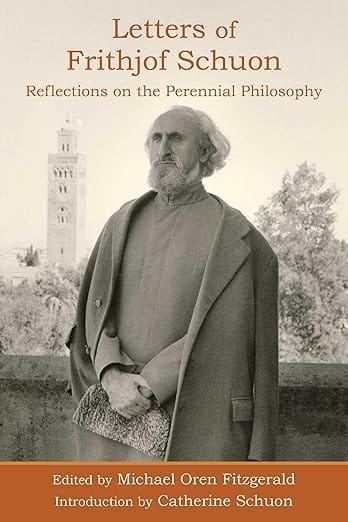
Letters of Frithjof Schuon: Reflections on the Perennial Philosophy, Edited by Michael Oren Fitzgerald | Introduction by Catherine Schuon; World Wisdom, IN (2022); Reviewed by M. Ali Lakhani
One approaches this epistolary anthology with a joyous anticipation for several reasons: first, because of the immense respect one has for Frithjof Schuon as sage and metaphysician, based on his impressive publications, which leads one to hope that his letters will provide further insights into his teachings (an anticipation encouraged by the book’s subtitle); second, because recent reissues of Schuon’s works by World Wisdom, containing excerpts from his letters, leave one wanting more, especially in terms of appreciating his role as a Shaykh and murshid, and his guidance regarding the Tariqah or Way; and third, because there is the hope that the letters will reveal glimpses into a noble life, resonant of greatness and dignity, to which one can aspire. In all three respects, this book delivers.
The book’s editor is Michael Oren Fitzgerald, the author of a previous study on Schuon, titled Frithjof Schuon: Messenger of the Perennial Philosophy (World Wisdom, IN, 2010).The anthology of Schuon’s letters in some ways supplements and complements that study. Fitzgerald informs us in his Editor’s Preface that a collection of over 1,200 of Schuon’s letters has been assembled, of which this book excerpts some 200.The Editor explains that the letters fall broadly into three categories: first, those relating to Schuon’s ideas and published works; second, those offering spiritual and practical advice to his correspondents; and third, those, often addressed to his close friends and intimates, relating to his life.
When he passed away in 1998 at the age of 90, Schuon was known largely for his writings on faith and metaphysics, his trenchant critique of the modernist ethos, his view of the transcendent unity of religions, and his commitment to the Greek transcendentals of Truth, Goodness and Beauty, and concomitantly to a spiritual life centered in intellectual discernment of the Absolute Reality as Truth, concentration on its Goodness and Presence through prayer, and soul‑conforming virtue as Beauty. He was regarded, along with René Guénon and Ananda K. Coomaraswamy, as a leading Traditionalist thinker. Anyone encountering his writings could not but come away impressed by their lucidity and profundity, and indeed T.S. Eliot averred of Schuon’s first publication in English that he had ‘met with no more impressive work in the comparative study of Oriental and Occidental religion.’ Schuon was also an accomplished poet and painter, and much of the remarkable poetry, written late in life, and published after his death, only added to his reputation. In addition to this public reputation, he was also known to a smaller circle as the Shaykh of their Sufi tariqa.
About his personal life, the basic facts were known: he was born in Switzerland, had worked briefly as a textile designer in France, and, after entering into a Sufi order in Algeria under Shaykh Ahmad al‑‘Alawi, he returned to Europe. He subsequently formed a new Sufi tariqa which, inspired by his vision of the Blessed Virgin, was named after her as the Maryamiyya Tariqa. After living for some seventy years in Western Europe, forty of which were spent in the environs of ‘Lake Geneva and the world of the Alps,’ Schuon settled in the United States in later life, drawn there in part by his affinity for Native American spirituality (he was formally adopted into both the Lakota Sioux and Crow tribes).While we know of Schuon’s life through a few biographical sketches and the Fitzgerald study, it is a revelation to discover Schuon through his own letters, and also through an intimate portrait of him penned by his wife, Catherine Schuon (who sadly passed only away in the spring of 2021, prior to the book’s publication). What emerges is a remarkable picture of an authentic sage, a gifted metaphysician, a mystic and a visionary, and of a dignified life lived with exacting standards and discipline through, at times, difficult circumstances.
In her introductory portrait, Mrs. Schuon begins by informing the reader that she always referred to her husband as the ‘Shaykh.’ One can see why: it was not only that she met him as a disciple, but her description reveals him to have been a striking man of extraordinary bearing, unusual discipline and an unmistakable dignity (as photographs of him attest). These characteristics could be seen in the minutest particulars of his life. For example, his posture was always upright, even when sitting; he preferred to eat mindfully, in silence; he bathed or washed only using cold water (‘to take a hot bath occurred to him as little as to smoke a hookah!’); he led ‘a highly disciplined life, punctuated by the times of prayer’ (Mrs. Schuon quotes him as saying, ‘As long as one has not said one’s prayers, one is not a human being’); and his very presence evoked an aura of nobility. His qualities included intelligence, compassion, attentiveness, and an appreciation for a sacred ambience, and he cultivated, and looked for in others, qualities of virtue and beauty. While in some ways he was ‘a man of another age, and he seemed to live more in the world of ideas than in that of everyday facts,’ he also possessed a great presence of mind and a sound practical sense, as the portrait reveals.
He was, as the letters indicate, a man of impressive learning. For example, he had mastered several European and Oriental languages from an early age, and was widely read in religion, history and literature. His perspective on all these subjects was always in the service of Truth. As his wife saw it, having the vantage point from which to affirm this, ‘All his life the Shaykh wanted one thing only: to express the Truth, to draw to the Truth, and to live the Truth.’ From the earliest years he pursued lofty ideals, but being sensitive to those ideals in a world that did not share them, made this burdensome. He sought refuge inwardly and, to the extent possible, by cultivating a sacred ambience. In one of his later letters, he writes, ‘I had from childhood four ideals: the True, the Beautiful, the Sacred, the Great; and this in a world of error, ugliness, profanity, and pettiness; it made me ill, and being ill made adapting to the world around me difficult. I am frankly amazed that I was able to survive it all.’ In his respect for the sacred and his quest for an outer world that conformed to his own spirit, Schuon shared an affinity with the native Indians. He writes in a letter to Leo Schaya of this affinity, ‘I too was engaged in a similar battle since my youth; I wanted to preserve a seemingly vanishing paradise, in myself at least, against the rush of a superior force that flowed all around me, threatening the very kernel of my being while belittling, debasing, and disfiguring everything; and when I was a youth I was nearly shattered by it.’
The letters reveal that from a very young age Schuon’s preoccupations were spiritual. At 18, he writes with a mystic awareness of his own spiritual intuitions. At 19, he writes of his spiritual credo, a personal version of the Vedantic satchitananda, expressing himself with an astounding metaphysical facility. It is clear from this early age that he is aware of the great traditions and is gifted with an inner life that, even in a much older person, would be deemed unusual, to say the least. At 20, he describes himself as a ‘servant of Truth,’ with ‘an earnest longing for the Infinite.’ At 23, he writes of a spiritual calling. At this early age, he corresponds with René Guénon about the possible recovery of Western intellectuality ‘through a knowledge of principles.’ By 24, he is seeking a divine sign to let him ‘plunge’ into Islam. In these early years, one senses deep struggle underway in him, a desire to flee from the profane world toward an inner serenity and in search of an outer ambience to accommodate his spiritual longings. In a letter written at 25, captioned “No Distinction between Mecca and Benares,” one finds a clear esoteric strain evident that is later expressed in his doctrine of the transcendent unity of religions. He writes to a classmate in Basel, ‘Must I explain to you once again that either we are esoterists and metaphysicians who go beyond forms as such, as Christ walked upon the waters, and consequently make no distinction between Mecca and Benares, Allāh and Brahma, or else we are exoterists, theologians, and at best mystics, and consequently live in forms like fish in water, and distinguish Mecca from Benares?’ This tension between form and essence would be central to Schuon’s spiritual life. As his later publications and letters indicate, he was to resolve this tension intellectually, not through an antinomian discarding of forms but through an ability to penetrate them in view of their metaphysical transparency. But for those lacking the practical facility to do this, the path could be perilous, and Schuon’s own use of forms from multiple traditions, appeared syncretistic to some—it was a charge sometimes leveled at him. On this point, his letters show him to be clearly non‑syncretistic, respecting traditional religious forms. He writes to a correspondent to criticize the mixing of practices:‘What you are doing, according to your letter, is doubly dangerous: first because it is a heterogeneous mixture of sacred forms and then because we have no right to impose a doctrinal program on Grace; Grace acts as it wills.’ In another letter, he explains that the ability to see through forms, and therefore to appreciate multiple forms expressing the same Truth, was not syncretistic: ‘Esoterism is not syncretism; forms are what they are and they have a right to exist. Dogmas, while being exclusive and thus “narrow” and “rigid”, are sacred; and what they exclude on the plane of form, they include on the plane of the metaphysical essence that is one.’
In these early years, we see that Schuon had mastered a doctrine drawn from the Vedanta, but he was in search of a method of practice which he eventually found in Islam. Of his religious development, he writes: ‘I went first through Protestant and then Catholic Christianity, and … then for about ten years, before I entered Islam, I was fully under the spell of Hinduism, without however being able to be a Hindu in the literal sense; but I lived in that time no other religion than that of the Vedānta and the Bhagavad Gītā; this was for me the first experience of the Religio perennis. ... In Islam, I found a home in the biblical world.’ In another letter he writes, ‘since it was impossible for me to turn to a Hindu guru because of the laws of caste, I had to look elsewhere; and since Islam contains that method de facto—in Sufism—I finally decided to look for a Sufi master; the outer religious form did not matter to me.’ Summarizing his principal spiritual influences, he writes:‘Doctrine and way; the doctrine radiates a priori from Shankara; the way I received from the Shaykh al‑Alawi; and both gifts, and all further gifts and graces, come from God.’
At 25, Schuon embarked on a decisive journey to Algeria, where he embraced the ambience of Islam. In one of his later letters he explains his motivation: ‘I saw that the spiritual and contemplative way I was seeking could not be realized on the basis of the very superficial culture of Europe. I wished to live in God. I wished not only to love God, but to know Him as well, and the Christianity of our time teaches only the love of God, not the knowledge. Moreover, I knew from an early age that God would charge me with a mission.’ The letters describe his journey to Oran where he breathed ‘the first sepulchral air of Islam,’ and his admission to the Zawiyah in Mostaghanem. These early letters to his childhood friends, Jacob Jenny (who, like Schuon, was soon to embrace Islam) and Lucy von Dechend, are alive with descriptions of Sufi practices and the Islamic atmosphere, and filled with insights about his ‘voyage from multiplicity to unity.’ They reveal an astounding perspicacity, confirming his spiritual and metaphysical gifts. In later letters he discloses more personal details about his initiation, his spiritual practices, visions, and their transformative effects on him. He writes of an encounter with someone in Oran whom he believes to be Shaykh ‘Alawi in a mystical form, after Schuon had parted from the Shaykh earlier in Mostaghanem. This encounter was premonitory, occurring a few days before the latter’s passing away, and it had a profound impact on him (‘Everything had become transmuted before my eyes. Everything was as if transparent, fluid, infinite. Everything was within me; I was in everything, and I felt myself in the farthest distance and the farthest distance in my heart.’). These descriptions do not leave the reader dismissive or skeptical. While there might be a tendency to explain away Schuon’s visions in purely psychological terms, even to dismiss them—which one might do in the case of a lesser figure—his own spiritual stature and the tenor of the correspondence, preceding and contemporaneous with those experiences, lend the events a remarkable, if unsettling, credibility.
Schuon’s spiritual and intellectual gifts are abundantly confirmed by the letters in this anthology.Arranged chronologically, each letter usefully bears the Editor’s caption to encapsulate a key phrase or idea from it. The letters disclose a broad range and depth of knowledge. Schuon quotes freely from sages and scriptures, his sources ranging from the Hindu tradition (Ramana Maharshi, Swami Ramdas, Anandamoyi Ma) to the Christian (Clement of Alexandria, Meister Eckhart) to Muslim (Ibn ‘Arabi, Jilani, Qushayri), and to many others. Among his favorite quotations are the following: from Shaykh Ahmad al‑Alawi: ‘When a man is not like snow in the hands of Truth and does not vanish away in Truth, then Truth is like snow in the man’s hand and vanishes away.’ And he cites the Curé d’ Ars: ‘humility is to the virtues what the string is to the rosary: remove the string and all the beads escape; remove humility and all the virtues disappear.’
He also writes with facility about the arts and literature, discussing, for instance, the virtues of Japanese and European theatre, or addressing Martin Lings on comparative poetry, translation, and the responsibilities of the poet. Among the many topics addressed in his letters are:
• mundane ones (the propriety of gaiety; the dangers of worldliness; choosing a suitable profession; on living spaces; sexuality, marriage and concupiscence)
• matters related to the Tariqah (the qualifications for initiation; the circumstances in which an aspirant from a different religion could take a Master from another faith tradition; how to pray; his special connection with the Virgin Mary)
• metaphysical or esoteric matters (the relativity of religious forms and their messengers; pharisaic tendencies; whether there can be relaxations of the shari’ah in modern times; comparative esotericism; reincarnation; why is there evil in the world; whether animals will enter paradise; the symbolism of spiritual art)
• the religio perennis and comparative religion (the transcendent unity of religious forms; links between Native American spirituality and the religio perennis; Christian and Muslim perspectives on Original Sin and the Fall; ecumenism and universalism)
• views on other teachers (on Guénon; the errors of false masters: the Mahesh Yogi movement, on Gurdjieff, Krishnamurti, Vivekananda, and Aurobandism; on Vatican II, Catholic modernism and the Papacy)
• modernism (the limitations of the modernist mindset; the evolutionist error; scientism; heliocentrism and geocentrism; the modern cult of sincerity; on fascism, Marxism and the quasi‑collapse of Communism)
• temporal and spiritual advice (comforting a bereaved spouse; how to understand death; teaching how to pray; how to deal with anxiety, depression, and suffering)
• personal reflections and comments (on art, literature and music; on solitude; on growing old; on why he writes).
In some letters, Schuon elucidates ideas in his articles (an example of this is his letter to Martin Lings on Protestantism, where Schuon uses the simile of two adults, a child and a cat crossing a river, to elaborate on the differences between the different Christian denominations, and to discuss ideas in his essay on “The Question of Protestantism” in Christianity/Islam: Perspectives on Esoteric Ecumenism).
His correspondents range from well‑known traditionalists like Titus Burckhardt, René Guénon, Martin Lings, Marco Pallis, Lord Northbourne and Seyyed Hossein Nasr, to Native American leaders (like Benjamin Black Elk) and pioneers in understanding that world (like Joseph Brown), to key writers on religion (like Borella, Schaya, or Needleman), to personal friends, to disciples and anonymous correspondents (‘a reader’) seeking guidance on worldly or spiritual matters. Among the correspondents, certain stand out as significant: the early letters to Jakob Jenny and Lucy von Dechend reveal Schuon’s spiritual hunger and his attraction to Islam; the letters to and about Guénon (particularly with Michel Vâlsan) explain the traditionalists’ affinities and differences; and those to Benjamin Black Elk and Joseph Brown disclose Schuon’s deep sensitivity towards Native spirituality.
The anthology is well curated. Among the letters that this reviewer found particularly interesting are the ones captioned by the Editor as follows:“A Mysterious Stranger” (Guénon, 1934),“Truth Must Have Many Forms” (Benjamin Black Elk, 1947),“God, World I, Thou” (Schaya, 1951), “Simple but Consequential Attitudes” (a reader, 1956), “Three Great Crises in Life” (Aristide Messinesi, 1958), “A Critical Age” (Pallis, 1959), “The Essentials of Indian Religion” (Benjamin Black Elk, 1959),“Guénon’s Particularity” (Vâlsan, 1960),“Errors of the Mahesh Yogi Movement” (Pallis, 1961), “A Spiritual Heritage” (Vâlsan, 1973), “Sacramental Sexuality” (a reader, 1973),“Concupiscence”;“Christian Marriage” (a reader, 1974), “Whether, for God, You Are Christian or Buddhist” (a reader, 1975), “Difficulties in Contacts between Whites and Indians” (Joseph Brown, 1977), “My Painting of the Virgin” (Max Schray, 1981), “A Path of Christian Esoterism” (a reader, 1984), “My Message Is in My Books” (Nasr, 1988), and “My Life’s Work” (André Gerth, 1996). This is only a sampling; every letter in the anthology is worth reading.
Given Schuon’s descriptiveness, the letters transport the reader to places as diverse as Marseilles, Saragossa, Oran, Mostaghanem, Sienna, Granada, Sevilla, Athens, Ephesus, Venice, the Alps, and the forests of Bloomington. They contain anecdotes (of smoking the Sacred Pipe with Yellow Tail, for example), and the language is often rich in use of similes (‘We attach ourselves to the fleeting reflections on water as if the water were luminous; but at death we see the sun with immense regret—unless we became aware of the sun in time’). As in his books, Schuon’s writing in his letters is often aphoristic and his ideas are distilled and clear, filled with wisdom. A few examples:
• ‘the main characteristic of our time is a desacralization of the whole world’
• ‘Our right relationship with the world results from our right relationship with God’
• ‘Life is a dream, and to think of God is to awaken’
• ‘What is the world around us but a magic fan, which God is ever opening anew?’
• ‘To know the meaning of life … is to rest at the Center and in the Present’
• ‘There can be no happiness without gratitude, and without joy in little things’
• ‘the desire for happiness must not diminish the desire for salvation’
• ‘To fight sadness, we have no other means than to fix the gaze of the intelligence and the soul on the Infinite, which contains all that is perfect and lovable’
• ‘There is no sanctity without a great victory over the soul’
• ‘There is no spiritual method that does not wound our soul’
• ‘One must know how to “jump over one’s own shadow”; very few succeed in doing this perfectly’
• ‘the “supernatural” is “natural” for man’
• ‘There are only three things that matter: metaphysical discernment, invocatory practice, nobility of character; there is nothing else’
• ‘Metaphysics has no need of the sciences, though the sciences need metaphysics’
• ‘the evolutionist error is simply a “horizontal” substitute for “vertical” emanation’
• ‘the knowledge of Heaven does not a priori depend on the knowledge of earth, it is rather the other way round’
• ‘The essential teaching of every true religion is that this world of vanishing phenomena is unreal and that the unseen world of the Great Spirit is real’
• ‘God, world, I, thou; … And fundamentally there is only God’
• ‘You must detach your life from the awareness of the multiple and reduce it to a “geometrical point” before God’
• ‘Discernment, concentration, virtue: it is these elements and nothing else that one must seek when one has entered a spiritual path as a metaphysician’
• ‘every creature is female and virginal in relation to God’
• ‘Islamic art is contemplative, whereas Gothic art is volitive’
• ‘In a great suffering as in a great joy, it is the experience of it that serves as meditation; and it is the acceptance of a suffering—in view of God—that serves as concentration’
• ‘there is no Mercy without invocation, no Rahmah without dhikr. This is also one of the meanings of the saying: “I am black, but beautiful.”’
• ‘khalwah is not a prison, but a garden separating us from the world’
• ‘False masters are dangerous because they are a mixture of good and evil, and they seduce with the good’
• ‘The meaning of the love of one’s neighbor can be expressed thus: the rift between man and God will be bridged when the rift between “I” and “thou” is bridged’
• ‘one grows slowly into the timeless’
• ‘When man is reduced to nothing, when he thinks he can no longer see anything, then the Name of God sees in him and for him—until the two become one’
At times the writing is filled with an imaginative intelligence and symbolic sensibility that transmutes into Presence the beauty of phenomena that Schuon is describing, as in this passage about falling snow: ‘The blanket of snow presently covering our region reminds me of the spiritual significance of snow as a crystalline element: it illustrates a heavenly blessing, a heavenly descent—falling snow has indeed something paradisal about it—and then of the purifying heavenly Presence, far removed from all the struggle of passions; this is how in Islamic countries I experience the call to prayer, as it floats down from Heaven and extinguishes as it were all earthly noise.’
This is an extraordinary anthology of letters, offering a rare glimpse into the inner life and teachings of a remarkable man—not merely one of the great metaphysicians of any age but a man in whose very being and form nobility is inscribed. The correspondence not only tracks the trajectory of Schuon’s inner and outer life but it clarifies his teachings. One can only hope for, and look forward with great anticipation to, the future publication of the many hundreds of as‑yet unpublished letters.