One Pure Light revealed in Many Colours: The Transcendent Substance Revealed in a Multiplicity of Forms
Religions are like lamps of coloured glass; now a lamp illuminates the dark because it is luminous and not because it is red or blue or yellow or green. [...] it is true that without a given coloured lamp one would see nothing.
Love and faith: the one like the other is a door to knowledge; and knowledge in turn gives rise to both faith and love. Love opens to gnosis because it tends toward union; faith opens to it because it is founded on truth; to love is to want to be united, and to believe is to acknowledge what is true and to become what one acknowledges.
(Both of the above quotations are excepted from the 2008 English edition of the book under review by Frithjof Schuon)
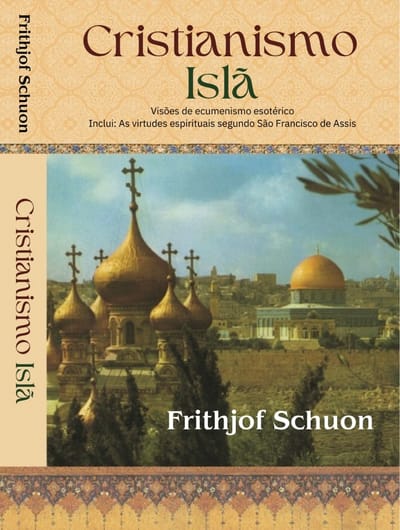
Christianity/Islam: Perspectives on Esoteric Ecumenism by Frithjof Schuon (1907–1998) is considered a classic text of Perennialism and an indelible landmark in the studies of comparative religion, religious studies, and metaphysics. It presents a kaleidoscopic view of religions, which allows us to apprehend the Transcendent Substance manifested in the multiplicity of sacred forms, illustrating that these myriad forms preserve a transcendental Unity, intrinsically common to them all, without mutilating the richness of their formal diversity.
Schuon—the metaphysician, artist, poet, and spiritual master—along with René Guénon (1886–1951) and Ananda Coomaraswamy (1877–1947), is considered one of the leading spokespersons for metaphysical traditionalism or perennialism. Perennialism is not new: it is the Unanimous Tradition present in Plato, Plotinus, St. Augustine, Master Eckhart, Ibn Arabi, Rumi and Shankara, among many other sages and mystics in all the faith and wisdom traditions.
This work, in addition to exploring the doctrinal and metaphysical content of the two great civilizational powers of Christianity and Islam, which act as spiritual centers of attraction, expansion and cultural assimilation, also offers reflections on Protestant evangelism, Eastern Christianity, the importance of the liturgy, the dilemmas of the papacy and celibacy, and the relationship of orthodoxy with exclusivism, all while highlighting the Unity of Transcendental Substance.
This work stands out among various works on ’religious sciences’ for its dual ability: first, to demonstrate parallels of convergence and divergence between the various religious traditions; and secondly, to apprehend the Transcendent Reality of the archetypes manifested in the physiognomic forms of the Sacred – the religions – expressed in beliefs, behaviours, symbols, art, temples, and institutions.
It is esoteric ecumenism, ‘the transcendental Unity of religions’, rooted in the metaphysical apex, which illuminates the different faith traditions by the Light of their Transcendent Substance, and not an exoteric ecumenism, institutional unity, legal structure or convention of spiritual authorities.
Traditional religions are expressions of metaphysical archetypes or paradigms, allowing that each archetype has multiple spiritual and cultural possibilities of manifestation. A given religion constitutes the manifestation of several archetypes, among which one — or some — become more formal characterizations of its particular tradition. This does not mean, however, that a religion cannot, a posteriori, reveal an archetype previously less evident. Thus, a striking sacred archetype of one religion can manifest itself in others, according to the salvific stratagem of the Divine.
Schuon applies the Hindu terminology of Trimarga (the three paths) to make explicit the tripartite salvific architecture of all authentic religions. Known by traditional names such as Moksha, Theosis, deificatio or divinization, Trimarga comprises Karma-mârga or the path of works; Bhakti-mârga or the path of devotion; and Jnana-mârga or the path of gnosis or knowledge. The three paths are not mutually opposed, but complementary, leading to the same goal. The option for one path does not negate the others; the choice does not depend only on personal will, psychological inclination or social situation, but above all on the workings of the spiritual economy of a given religion.
Man‘s telos is to be with the Absolute in order to transcend his own relativity. For this, God offers us the gifts of religions.
These soteriological paths are forms of yoga (bonding)—Karma-yoga, Bhakti-yoga, and Jnana-yoga. Yoga is not reduced to simply physical or psychological exercises; yoga means union—the establishment of a medium between the human and the divine, soul and Spirit, as immanent Atman and transcendent Brahman. In analogical terms, it is an asceticism or Jihad of physical, psychological and social harmonizing, which seeks to unite the soul with her underlying spiritual Reality.
The ‘supernatural nature’ of the human being, or his ‘supersensible forpm’, is theomorphic, as explained by the formula of St. Irenaeus – ‘God became man so that man may become God’ – which synthesizes Christianity and, at the same time, expresses the transcendent end of all religion. This statement explains the supernatural nature of homo pontifex — the man as pontiff or bridge to the Transcendent. Man‘s telos is to be with the Absolute in order to transcend his own relativity. For this, God offers us the gifts of religions.
Though Man can aspire to theosis, it is without violating God’s transcendence. God, the Absolute, has no Alter Ego: He is One, Indivisible, Eternal and Inalienable. However, the Absolute Creator makes Himself, by the gracious volition of His loving nature, accessible to Man through Revelation, including religions suited to particular human capacities and diverse ethnic and linguistic forms and psychic receptivities. This plurality of authentic religions expresses the polyphony of the Sacred — and not a cacophony; religions are like multiple independent melodies, whose divergent scores emanate from the same primordial notes, without whose underlying harmony no melody could exist. Each religion is a prismatic expression of a Path to the Absolute—which does not mean that any path of one’s own choosing will necessarily lead to God.
The ethnic, linguistic, and psychological receptacles of the Revealed Message—the theophany—are not merely passive receptors of the Revelation: they interact with the Message and can absorb it according to their own acceptance of it, and can seek to enter into communion with the Absolute. All who choose to participate in this communion, submitting to the Creator, can, through His grace, hope to experience the alchemy of transformation.
“The immutable truth makes use of the material at hand [...] It is not enough for God to be absolute; the means and circumstances of His manifestation must also be absolute, or appear to be so to the greatest extent possible; a realizational will and the sentiment accompanying it tend to transfer the sublimity of God to the contingent elements that testify to it.” [p.92-93]
the symbolized reality precedes the symbol
This happens with symbols. The sacred symbol is not a mere sign or temporal expression: it is more than a gesture, word, ideogram or image. It communicates the incommunicable, functioning as an archetypal bridge between the human and the divine.
The symbol has the evocative and condensing power of meaning that transcends its merely outward expression. For example, the symbol of the Cross can signify death, resurrection, sacrifice, pain, hope, Christ, the four cardinal points, and even represent the very physiognomic form of the human being. A symbol says more than the form outwardly reveals. It expresses the meaning of a referent: its archetypal reality. This meaning does not derive from convention, nor from arbitrary imposition, but from the intrinsic characteristics of the referent. Therefore, it is essential to emphasize that the symbolized reality precedes the symbol – especially in the case of sacred symbols, in which the archetypes precede and overflow the canonical symbols. As Schuon puts it,
“[...] the reality symbolized was before the symbol. The immutable truth makes use of the material at hand[...] the efficacy of the symbol does not dependexclusively upon an exact perception [...] On the onehand truth is independent of its possible symbols, andon the other hand it consecrates them...” [p.92]
The ‘Letter of the Spirit‘ and the ‘Laws of the Spirit’ are externalizations of the Spirit itself — formal expressions that manifest it without imprisoning it. The Spirit transcends both the "Letters" and the "Laws". God uses human means and man himself not out of necessity, but out of charity, to make himself understood. Thus, he endows human life with charisms and gifts. However, the nature of the Creator infinitely surpasses the creature — mankind itself.
“God makes Himself human in speaking to man, but in His own Nature He transcends the human...” [p.92]
Every religion harbours a revealed Message, a messenger, and a language. In Judaism and Islam, the measure of the messenger (Rasul) is the Message (Risala); in Christianity and Buddhism, the Message resides in the messenger himself.
Prophets Abraham, Moses, and Muhammad, for example, can thus be seen as paths that lead to Truth and Life — not incarnations of Truth and Life. The revealed Message transcends the messenger; by contrast, in Christianity and Buddhism, the Messenger incarnates the revealed Message.
This becomes explicit when Jesus Christ states: "I am the way, the truth, and the life. No one comes to the Father except through me." (John 14). He is the Messenger and the Message; the Channel is the Content itself. He is more than a divine intermediary—He is the Divine Himself incarnate. More than a relative truth that leads to the Absolute Truth, He is the Absolute Truth itself that has become relative.
Within the comparative analysis of the differences in the spiritual economy between Christianity and Islam, Schuon proposes the following reflection: Christianity is not, a priori, an institutional religion — especially in sociological and legal terms — but rather an initiatory confraternity of an esoteric character, centered on mystical and gnostic devotion to Christ, the incarnate God. It was through its expansion and, especially, through the assimilation of the Roman genius — be it Latin (Western) or Greek (Eastern) — that Christianity developed a significant part of its institutional and liturgical dimensions, thus also becoming a religion in exoteric terms.
For Schuon, Islam represents the balance between exoterism — centered on the legalism of divine law, sharia, which operates publicly in temporal life — and esoterism — tariqa, an expression of mystical and gnostic devotion focused on the supernatural.
Christianity is divided into three major lineages: Catholicism, Orthodoxy, and Protestantism — remembering that each of these lineages has several branches. Schuon presents this diversity as the result of the fertilization of the sowing of the Word, especially of the Gospel, in their respective cultural receptacles.
Catholicism represents the fertilization of the Gospel in the Latin or Western Roman genius; Byzantine Orthodoxy, the fertilization of the Gospel in the Greek or Eastern Roman genius; and Protestantism, the fertilization of the Gospel in the Germanic genius.
Schuon did not consider Protestantism in totum as a key piece of modernity, of the proto-Enlightenment or as a prelude to the French Revolution, as many traditionalists maintain. For him, Protestantism constitutes one of the authentic manifestations of Christianity, participating critically in the culture of Western Romanity, without being reduced to an agent of secularization.
Religions each, as luminaries, radiate the One Transcendent Light.
Religions are different forms of manifestation of the content of the Transcendental Substance — like a Colourless Light that becomes visible to human experience through different colours, revealing itself in multiple colours so that the diversity of societies and the plurality of looks and human types can discern it in particular ways.
Many understand the One Pure Light — God — only as a specific sensible form or colouration, just as saffron represents Hinduism, blue Judaism, yellow Buddhism, red Christianity and green Islam. However, this does not exclude other colourings. Religions each, as luminaries, radiate the One Transcendent Light.
The relationship between Transcendental Substance and religious forms is a participation between the One and its multiples expressions. To be aware of this reality is, simultaneously, to value the sacredness of religious institutions and to cultivate esoteric perception. Man experiences his connection with the Transcendental Sacred through religion. Religions are forms that convey us to the Absolute, just as each ethnos links us to anthropos.
Formally, or in terms of orthodoxy, attachment to one religious form excludes attachment to other forms. However, such human limitation does not apply to the content of the Transcendental Substance, which crosses and penetrates different religious expressions.
“In any case the apparent dissonances between the religions are resolved in their underlying harmony, just as the accidents are resolved in the substance.” [p.96]
Each religion, from the perspective of its doctrinal orthodoxy, necessarily considers itself the best and considers the others to be inferior. This hyperbolic self-esteem is vital to its practical spiritual economy—that is, its internal norms and structures of functioning—which it regards as its orthodoxy, the ‘Right Path’, or the Heavenly Way leading to the Absolute. These outwardly divergent spiritual economies, presented by religious traditions, generate exoteric orthodoxies that necessarily tend to exclude each other, which explains, to a large extent, the religious clash.
Within each religion, there are two types of truth: the Absolute Truth and the relative truth, which has a significant participation with the Absolute Truth — being, therefore, one of its most accessible manifestations. An orthodox or traditional religion consists of two cycles: the broad cycle — exoterism — and the restricted cycle — esoterism — between which relations of complementarity, subsumption or contradiction are established, but not of antagonism. “Now a religion, Muslims say, is composed of a sharīʿah and a tarīqah—an exoterism and an esoterism... [ p.60]
Exoterism and esoterism are dimensions of religion, and not two sects — like the populist sect of the exotericists, on the one hand, and, on the other, the sect of the elite, the elite of the initiated. Both are present in dogma, behavior, clothing, architecture, symbols, mysticism, works and gnosis. Exoterism is most evident on the theological, political, and legal planes, while esoterism manifests itself above all on the initiatory level — in mysticism and gnosis.
“In every religion there are three spheres or levels: the Apostolic, the theological, and the political; the first has a certain quality of absoluteness, the other two being more or less contingent, although clearly to very different degrees.” [p.118]
Each religious formation is a ‘theophanic individuality’— a proper manifestation of the Sacred or of God's charity, which is unique and not identical with the others. Each religion has its ‘divine subjectivity‘. The Absolute makes use of human diversity itself so that different eyes, hands and minds can access the Ineffable. This becomes visible to men by means of chromatic scales, in which each collectivity accesses the Absolute through one of its colors.
“When the divine Light descends upon the human plane—“incarnating” itself to some extent—it undergoes an initial limitation, and this results from human language and the requirements of a given collective mentality or cycle of humanity...” [p.107]
The ’exotericist‘, or formalist traditionalist, tends to adopt a hylomorphic posture: he does not recognize the Supersensible Form or the sacred archetype beyond the physiognomic or ’material‘ form of his faith. He regards his religious form as the only legitimate and valuable revelation. “[...] every exoterism contains exclusive andexcessive affirmations intended to buttress its uniquevalue...” [p.92]
Dogmatism is a form of exoterism of a limiting and exclusivist character — which does not necessarily imply that the dogma defended is a heresy or an ideology. However, when dogma is taken to logical extremism, it tends to lose the sense of Transcendent Reality, falling back into an impermeable formalism. In Schuon's terms, the cult of ‘Form’ does not exist to inhibit the cult of ‘Essence’, but to grant access it.
Religion, due to its evident exoteric dimension, is not reduced to an esoteric confraternity, an initiatory cycle or the ‘religion of philosophers’. The Gnostic or mystical faith, being of an introspective character, is part of the intimate cycle of religion, to which not everyone has access – and which, most of the time, the formalist traditionalist, due to his attachment to the ‘exoterism of faith’, does not have eyes to see or sees it occlusively.
we must be careful not to fall into the existential quagmire of modern superstitions, with their reifying idolatries and ideologies
Esoterism enters the mystery of faith beyond what exoterism makes explicit. The mystery of faith is, at its root, the mystery of gnosis.
“What exoterism does not and cannot say—neither Catholic nor Orthodox any more than Protestant—is that the Pauline or Biblical mystery of faith is none other at its root than the mystery of gnosis, which is to say that gnosis is the prototype and underlying essence of faith. If faith can save, it is because intellective knowledge delivers—a knowledge that is immanent while being transcendent, and conversely. The Lutheran theosophers were gnostics within the framework of faith, and the most metaphysical Sufis emphasized faith on the basis of knowledge; no doubt there is a faith without gnosis, but there is no gnosis without faith. The soul can go to God without direct assistance from the pure Intellect, but the Intellect cannot manifest itself without giving the soul peace and life and without requiring from it all the faith of which it is capable.” [p.53-54]
In modernity — the so-called Iron Age or Kali-Yuga — the hylic human type predominates: the man of materialistic character, inclined to sensible forms. Therefore, we must be careful not to fall into the existential quagmire of modern superstitions, with their reifying idolatries and ideologies. Even in embracing an orthodox or traditional religion, it must be recognized that we are not free from falling into subjectivism or dogmatic formalism, which reduces religious tradition itself in a one-dimensional way to its idiosyncratic conception or to formalistic worship — transforming salvific faith into a juridical apparatus of power, with rules of a purely compulsory and external character, as an imprisoning ‘official ideology’.