Whatever may pass for poetry in this world of changing fashions, it is unusual to find poems nowadays that bear the hallmark of translucence. Brian Keeble’s poems do. The ‘light’ they evoke, emanating from the Spirit, is an antidote to the darkness in a wasteland of a world thirsting for meaning. Like all poetry that illuminates, these poems make the unseen face of the soul visible to the Imagination, the Eye of the Heart which perceives the Infinite and Eternal as a ‘wondrous pattern’ of archetypes of connecting wholeness and presence. Keeble draws from the same ‘ancient springs’ of Tradition as poets such as William Blake, William Butler Yeats, and his own friend and mentor, Kathleen Raine, among others.
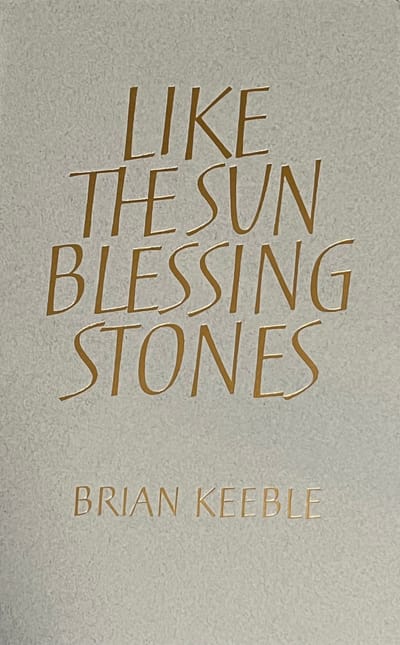
The title of Keeble’s latest volume of poetry signals to the attentive reader the metaphysical nature of its content and of the symbolic imagery he will employ. The poems are infused with a sense of the sacred, of theophany radiating through the ‘signs’ around and within us, which point to Transcendence. Their subject is the connection between the higher and lower orders of being, and the possibility of spiritual illumination through revelation and grace, through archetypes mirrored in the Imagination, the faculty of inner vision. The two epigraphs about ‘light’, confirm these themes: [‘All that is made manifest is light’ (Ephesians 5:13)] [‘The Sun’s Light when he unfolds it/ Depends on the Organ that beholds it.’ (Blake, K760)]. The fifty-one poems are sourced in the poet’s deep schooling in traditional metaphysics, its ‘first principles’, and they engage with Permanent Things. As Keeble announces in ‘Taliesin’s Plea’, ‘The poet’s proper trade is / As the sharp plough share / Preparing soil for seed / That light be drawn down / To lift from timeless dark’ (p. 48).
From the first poem (‘As It Is In the Beginning’) with its themes of ‘poiesis’ as creation and of scriptural allusion to the Logos (‘Each word an echo / Of a single Word / . . . / Pronounced in silence / Even as stones / Are silent . . . / Speaking every / Resonance of good’, p. 9) to the final poem (‘On Knowing and Being’) with its Eckhartian epigraph (‘The eternal procession is the revelation of Himself to Himself’) and its description of knowing and being as ‘Two rivers running together’ (p. 82), one is aware of the poet’s focus on metaphysical interiority.
This is generous writing indeed.
In the construction of many of the poems, the reader is led through the poet’s arguments, often by a combination of simple diction with sinuously complex structures, unexpected line-breaks and sentence formulations which demand, and deserve, slow attentive reading, leading not to discursive conclusions but to fresh insights, opening vistas of Being. It is as though the reader is not only being drawn into the intimacy of the poet’s processes of inward excavation but is, as it were, being invited to share in the very crafting of the poem. This is generous writing indeed.
The sequence of eight poems, ‘Regarding Mutability’ (previously published in Temenos Academy Review 26), can be read as a dialogue between soul and Spirit, a meditation on endurance in the face of death (several other poems also reflect on mortality), the illusory and contingent nature of existence, underpinned by the conviction of an underlying Reality, time’s ‘tributary source’ (p. 20), piercing the seeming transience and impermanence of generation by opening ‘To powers that have elsewhere a life unborn’ (p. 19).
Another example of this ontological piercing of the world of appearances is ‘The Betrayal’, where the poet’s vision looks beyond occlusion to intuited translucence of, and faith in, the Unity of Being seen in a visionary flash of wholeness: ‘decay and ruin / Obstruct the way’ of the ‘soul’s path—leaving dearth / Where there should be that moment when / The fields of swaying corn once more / Are a pledge of single vision that brings / Together sun and soil to show / Soul’s providence must hold to what / The holy lightning flash makes whole’ (p. 61).
But faith is accompanied by humility, the poet’s recognition that language fails in the face of ineffability of ‘The seed and root of each / Unknowable word that love / May stammer in its praise’ (p. 21); and the poet struggles to express the vision: ‘I would sing apt / praises but the / words dissolve’ (p. 22).
Among the many themes addressed are:
—epistemology (‘No eye discerns except / In granting sense must be / Eclipsed to yield its light’) (‘Bright Moon’) (p. 24);
—ontology (‘without source / the one font / over-flowing / the never born / none is / born without’) (‘I AM’) (p. 34);
—cosmology (‘It is my presence / That the light presents / As distant star so near / And far cohere’) (‘Far is Near’) (p. 65);
—perfectibility (‘Where no two blooms on a single stem can form / . . . / . . . prescribes each flower finds / A singular perfection . . . / (in) its own allotted self’) (‘The Task’) (p. 76);
—love and union (‘Love’s life is won / By means that know no passive mime, / But moves to seed its paradigm. / . . . Transfiguring what division hides’) (‘The Interval’) (p. 72);
—love and decay (‘Love is a flower. No flower ever sought / To outwit time in intervals of drought, / As if it had no want of refreshing times / To feed its roots’) (‘Love’s Time’) (p. 50);
—providence (‘a living hope / in the sun’s radiant gift / beyond the soil’s provision’) (‘The Promise’) (p. 80);
—transcendence (‘our native place beyond / the rhythms of this passing bloom’) (‘Witness’) (p. 52); and (‘realm / Unseen, unheard beyond the reach / And tumult our distractions build’) (‘Love’s Silence’) (p. 62);
—translucence (‘Veil after veil / dissolving an elsewhere / claimed by silence. / . . .a knowledge / inexplicably consoling’) (‘Cloud Readings’) (pp. 77–8);
—Imagination and grace (‘You self-disclose / To prove Your signature is signed / In light’) (‘Four Poems of True Vision’) (p. 68); (‘love transfigures what my eyes / Regard: that transience veils / The pulse of vision’s saving grace’) (ibid.) (p. 69); and
—poiesis (‘The poet’s word can do no more / Than be a mirror image held / Of things themselves unseen’) (‘The Poet’s Word’) (p. 45); (‘Truth is translucent when / The poet’s hand is firm’, and seen through ‘a poet’s true eyes’) (‘True Eyes’) (p. 53).
This volume is a capstone achievement to Keeble’s poetic output. His poems deserve to be more widely read.
In ‘Ebb Tide’ (p. 23), Keeble refers to the ‘failing light’ of the ebb tide and its ‘heaped up dross of receding waves’, perhaps a reference to his own failing light with the declining powers that we all confront through the passage of time, and perhaps a reference also to the spiritual entropy of our times. But his message is ultimately hopeful and affirmative: ‘seeing light’s transfiguring eyes’ with the hope that ‘the shore’s golden grains / Might serve as fruitful seed to restore’ such vision of the ever-replenishing theophany.
This volume is a capstone achievement to Keeble’s poetic output. His poems deserve to be more widely read.
This review was first published in Temenos Academy Review 28, with whose kind permission it is published here.