St. George killing the Dragon, Greek Orthodox Ikon
“Things fall apart; the centre cannot hold; / Mere anarchy is loosed upon the world.”
— W.B. Yeats[[1]]
“…abnormality is fast becoming our norm.”
— Lewis Mumford[[2]]
“What was once the abnormal has become the usual, standard condition of things.”
— Jacques Ellul[[3]]
“We’re human; but we live inhuman lives.”
— Marty Glass[[4]]
Introduction
The wheels of modernity have fallen off as it plummets into an abyss. The existential consequences of this are not looming on the horizon; they have already reached us. This debility lies not only outside ourselves, in the external world, but also within our hearts and minds. It is so obvious that something is so fundamentally broken that it has become almost trite to even point it out. The very integrity of human culture and society around the world is rapidly deteriorating before our eyes. The question is no longer whether the end of civilization, as we know it, is a mere possibility but, rather, how much time we have left and what can be done about it. How are we to live in such perilous circumstances which are, day by day, encroaching ever deeper into our lives? Many may choose to look away (and who can blame them?) but this crisis will profoundly affect them whether they choose to acknowledge it or not.
Never has the sense of an impending finality been felt in so visceral and tangible a manner. In popular media, there is endless theorizing and discussion about the calamities coming our way. As we lose our confidence in everyday reality, and as long as this downward spiral proceeds unchecked, we are apt to become easily manipulated.And, yet, hardly anyone even stops to ask what it is that may be coming to an end. With the rise of technological supremacy on a global scale (for example, artificial intelligence and dehumanizing transhumanist technologies, along with incursions into the domain of the ‘human’ of digital IDs, biometric scans, social credit scores, and crypto currencies), the grip of a totalizing system of global control, predatory surveillance and manipulation of humanity is tightening. The overarching message implicit in all this, while not yet explicitly articulated, is that humanity is helpless; we must either submit to these new authoritarian impositions or perish.
The chaos unleashed today stems, in large part, from people having become deracinated, having become profoundly rootless due to a lost sense of the sacred. This was perceived early on by the French metaphysician René Guénon (1886–1951), who wrote: “The dominant impression today [is one] of instability extending to all domains.”[[5]] American historian and sociologist Lewis Mumford (1895–1999) observed that what we are seeing now is a “disintegration of civilization … on a world-wide scale.”[[6]] According to the Eastern Orthodox thinker Philip Sherrard (1922–1995), the “ever-accelerating dehumanization of man”[[7]] is calling into question what it means to be human. He explains that “There is ... a price to be paid for fabricating around us a society which is as artificial and as mechanized as our own, and this is that we can exist in it only on condition that we adapt ourselves to it. This is our punishment.”[[8]] The consequent downward trajectory of this mentality affects not only the individual, but also the human collectivity as a whole. As Simone Weil (1909–1943) astutely discerned: “Whoever is uprooted himself uproots others.”[[9]] This observation is relevant to both our place in the created order and to its metaphysical foundations.
It is no longer a fringe or conspiracy theory to suggest that the dissolution unravelling before us is not accidental. Destabilization and chaos provide a rationale for a greater reach into the private and social spheres of life. Unprecedented forced and voluntary immigration—connected to regional instability, armed conflict, violence, genocide, and dwindling economic opportunities—has caused far-reaching social conflict and disruptions.
Sign up for Sacred Web
Sacred Web is devoted to exploring the relevance of universal and traditional wisdom in addressing the challenges of modern life.
Many assert that there is no such thing as “normal,” which feeds into the crisis of meaning and confusion about higher orders of reality.
Furthermore, we are told that all this uncertainty demands enhanced monitoring of human activities for our own safety, without calling into question the underlying motivations behind such measures (which, by and large, are not revealed until certain fundamental rights have been forfeited). It goes without saying that the unspoken plan for those who live on the margins of society (whom the Israeli transhumanist Yuval Noah Harari described as the “useless class”[[10]] or “superfluous people”[[11]]) is that they quietly perish so as to assist in the systematic depopulation of the world, thereby reducing the “global footprint.”
With the emergence of modernity, the notion of what is normative has become highly contested. Many assert that there is no such thing as “normal,” which feeds into the crisis of meaning and confusion about higher orders of reality. Despite this, it is clear that we are living in a time of what Richard Sennett calls “cataclysmic malaise,”[[12]] and which Mumford identifies as the “destructive and inhuman forces that threaten our whole civilization.”[[13]]
According to M. Ali Lakhani, the distinction between what is customary and its aberrant deviations is unanimously affirmed across the diverse cultures of humanity:
“In traditional thought, the ‘normal‘ is that which accords with one’s primordial nature. The Divine Norm is the model of perfection imprinted by God in man as his primordial nature, and the ‘normal’ is that which tends or corresponds to the Divine Norm. One of the primary definitions of ‘normal‘ is therefore that which is ‘natural.’ The unnatural—even if it is commonplace—is not normal.”[[14]]
In other words, true wholeness requires a Divine Norm as its measure. Mark Perry notes that “without a Norm, there would be no Reality; and without Reality, no cosmos.”[[15]] To suggest that there is no human norm connected to the sacred fuels the disintegrating trend of abnormality that has become all-consuming today. Thus, the trajectory towards an unmitigated nihilism of fragmentation and apparent meaninglessness is inevitable and leads to the disenchantment and subversion of humanity.
People today are subject to a relentless onslaught of information that is almost impossible to assimilate because of its unprecedented volume (often comprising partial truths, mixed with distortions, or blatant lies). Never before have people had real-time access to such a plethora of horrific imagery depicting disasters, violence, and cruelty on a scale that beggars description. Some even spend much of their days engaged in “doom scrolling” such disturbing and dystopic imagery, as if it were another way of passing the time. How can we make sense of this widespread abnormality in our times without becoming consumed, if not overwhelmed, by the monstrous forces that abound? And what can be done about this? For it is doubtlessly changing the very fabric of our humanity, promoting sensibilities of impotence and inevitability.
For some four hundred years, the West has gradually divorced itself from its traditional sacred mooring. Corrosively profane forces have catalyzed the humanism of the Renaissance, and the materialism of the Scientific Revolution, both of which reached their apex in the Enlightenment project. The “tireless self-destruction of [the] enlightenment”[[16]] is now more apparent than ever before, and the following remark by C.S. Lewis (1898–1963) can now be seen as remarkably prescient: “Man’s final conquest has proved to be the abolition of Man.”[[17]]
When those who advocate for a secular religion of progress are questioned by its critics about our post-human reality, they retort scoffingly that doomsday predictions have repeatedly been asserted throughout history, without ever having been realized. Martin Lings (1909–2005) clarifies why the present situation is different:
“There is, however, a marked difference between the present and the past…. In the past it was concluded that the end must be near, but its immanence was not felt. Today the grounds for conviction have been largely set aside or forgotten; but the end is ‘in the air’, existentially sensed…. This is undoubtedly one of the great signs of the times.”[[18]]
The traditional cosmologies of both the East and West recognize an increasing degradation from the Golden Age (Krita-Yuga or Satya-Yuga) to the current Iron or Dark Age (Kali-Yuga) in which we find ourselves now. The loss of the sacred is directly responsible for the spiritual crisis that has engulfed the modern world. The myriad problems confronting humanity today all have their genesis in this single phenomenon. In surveying the spiritual traditions and sacred psychologies of the world, we can make better sense of societal dissolution and its causes.
A powerful description of what is occurring in the present day was foreshadowed in the scriptures of the Hindu tradition, known as the Vishnu Purāna,dating back to the third century A.D.:
“Riches and piety will diminish daily, until the world will be completely corrupted. In those days it will be wealth that confers distinction, passion will be the sole reason for union between the sexes, lies will be the only method for success in business, and women will be merely the objects of sensual gratification. The earth will be valued only for its mineral treasures, dishonesty will be the universal means of subsistence, a simple ablution will be regarded as sufficient purification….
The observance of castes, laws, and institutions will no longer be in force in the Dark Age, and the ceremonies prescribed by the Vedas will be neglected. Women will obey only their whims and will be infatuated with pleasure…. Men of all kinds will presumptuously regard themselves as the equals of brahmins…. The vaishyas will abandon agriculture and commerce and will earn their living by servitude or by the exercise of mechanical professions.... The path of the Vedas having been abandoned, and man having been led astray from orthodoxy, iniquity will prevail and the length of human life will diminish in consequence…. Then men will cease worshiping Vishnu, the Lord of sacrifice, Creator and Lord of all things, and they will say: “Of what authority are the Vedas? Who are the Gods and the brahmins? What use is purification with water? The dominant caste will be that of shūdras.... Man, deprived of reason and subject to every infirmity of body and mind, will daily commit sins: everything which is impure, vicious, and calculated to afflict the human race will make its appearance in the Dark Age.”[[19]]
Comparable descriptions can be found within the Christian tradition as well:
“But know this, that in the last days perilous times will come: For men will be lovers of themselves, lovers of money, boasters, proud, blasphemers, disobedient to parents, unthankful, unholy, unloving, unforgiving, slanderers, without self-control, brutal, despisers of good, traitors, headstrong, haughty, lovers of pleasure rather than lovers of God, having a form of godliness but denying its power. And from such people turn away! (2 Timothy 3:1–5)”
All around us are examples of “murmurers, complainers, walking after their own lusts” (Jude 1:16). While the root cause of this disorder can also be attributed to human ignorance, it is in reality largely a spiritual affliction. In this context, werecall the following passage from St. Paul: “For we wrestle not against flesh and blood, but against principalities, against powers, against the rulers of darkness of this world, against spiritual wickedness in high places” (Ephesians 6:12).
With mounting existential risks emerging from all sides, coupled with the lurking threat of a technological Armageddon, many have become despondent, distracting themselves in mindless entertainment and addictions, or simply burying their heads in the sand. We are reminded of defense mechanisms as taught in modern psychology, such as the notion of “displacement”[[20]] proposed by Sigmund Freud (1856–1939)—the human tendency to redirect thoughts and emotions away from feared catastrophes to more manageable challenges, in order to permit a sense of control over problems that would otherwise be overwhelming.
Evident Signs of Dissolution
There are many signs that betray the inevitable terminus of modernism. Through a combination of brute determinism and supremacy, technology’s ability to innovate and present us with new marvels, along with its ability to materially reward and empower tech-investors, are considered sufficient justifications for our proceeding along the current path of ‘progress,’ despite its pernicious effect on humanity. It needs to be remembered that just as modern science is not neutral, the same is the case with transhumanist technologies and artificial intelligence. Not only are there calls for the human bio-organism to fully become integrated with the machine but, in fact, this is already happening with cellphones and other devices such as implants.
We are now witness to a technocratic society that is moving toward “net zero” carbon emissions and the policing of personal carbon usage to ensure the planet’s survival, where, in some dystopian models already coming into view, ownership of private property may become obsolete and people will be told to be content with very little. And all this while the general population is having every detail of their expenditure, health, movements and travel endlessly monitored through cashless transactions and other forms of digital intrusion. This is already being implemented in some countries through a “social credit score” which is used by governments to condition society to ensure that citizens conform to imposed standards of behavior. High scores can attract rewards such as tax concessions or discounted travel, while low scores can lead to bank accounts being suspended and restrictions in one’s personal movements.
The notion of “accelerationism” speaks to systemic forces that are driving the dissolution we see around us. This term generally refers to an intensification of capitalism and technological change with a view to effecting radical changes in society. The quickening of this process continues at an alarming rate. Hungarian-American mathematician and physicist John von Neumann (1903–1957) is associated with the idea of the “ever accelerating progress of technology”[[21]] which may lead humanity toward “singularity”—a point of no return in which our conventional reality becomes fundamentally and irreversibly transformed. This would require developing artificial intelligence to the point where it can perform any cognitive task of which a human being is capable, but with heightened levels of ability. Some have suggested that accelerationism will be fully unleashed when coding becomes completely automated by AI systems. What is overlooked by such futurists, however, is that consciousness cannot be created by means of technological singularity.
High-tech significantly contributes to the climate crisis and affects public health, due to the unsustainable creation of evermore data centers and server farms that require fresh water and massive amounts of electricity, unduly taxing the energy grids. Many communities lack sufficient drinking water due to this dire situation. This reality is upon us, and so data centers are being built in communities that are already facing water shortages, environmental pollution, and food insecurity, among other deprivations due to ecological problems—not to mention the environmental damage wrought by the extraction of rare earth metals that are critical to modern technology.
Privacy is being compromised by this totalitarian techno-ethos. Continual mass surveillance has now become normalized. Data is being collected, analyzed, and sold without our consent. We no longer own this information, even though it belongs to us. We do not even know who is using it and to what purpose. Attempts to create unified software systems to gather information across corporations and governmental agencies are well underway. We live in a digital landscape, where each person exists within their own cell. The algorithms are reifying what we think, further entrenching us in pre-existing perspectives that keep us from seeing beyond them. The “machine” is a virtual prison cell where we are all unknowingly incarcerated.
Such ubiquitous technological dominance does not support holistic relationships with other human beings. Rather, it keeps us disconnected through the mere semblance of connectedness. We are encouraged to devote what precious little quality time we have to ogling at screens, as we are offered up for the highest bidder for the purposes of marketing and monitoring. Our every location and movement are being tracked on phone apps. Our health data is being exploited without our consent in what is an ever-encroaching violation of our right to privacy, not to mention the potential for such details to be abused and manipulated. In the purported interest of keeping us “safe” from our non-compliant fellow citizens, their bank accounts can be frozen indefinitely without warning at the click of a button.
Criminal behavior is also tracked and made widely available on social media to keep us fearful and to discourage trust in others. In a world that is plagued with information overload, we have invented “life hacks” to provide shortcuts that we are told will increase productivity and efficiency. With notions of “corporate personhood,” companies now have legal rights and responsibilities similar to those of human beings.
The erosion of communities, social spaces, and organic human connections all mirror the inward hollowing out of human consciousness.There are forces that do not want us to own private property; indeed, home ownership has now become an inconceivable luxury for millions of people. They want us to be consumed by the most superficial facets of everyday life. We do not know our neighbors, or if we do, we often do not want to engage with them. This is yet a further sign of social degradation.
The apparatus for controlling the narrative through media consolidation and corporate dominance has become more emboldened today than in any other era. The pundits are at liberty—with complete impunity it seems—to fabricate and spin information based purely on ideological prejudices rather than facts, thus fueling our descent into a “post-truth” age where truth is a matter of the best ‘fake’ or ‘spin.’ The result is that nothing is truly reliable or newsworthy anymore. For example, the long-standing denial by governments of the existence of aliens and Unidentified Flying Objects or UFOs (now called Unidentified Anomalous Phenomena or UAPs) is suddenly being discussed openly by a number of world leaders. That it is now being revealed, at a time of unfettered information saturation where hardly anyone is privy to all the facts, simply reinforces the collective confusion and subterfuge that, in turn, “justifies” mass surveillance and control.[[22]]
Utopian fantasies of endless growth are out of sync with reality and betray a deep civilizational sickness. Given the unabated rise in unemployment (and underemployment) rates, putting an end to work is now being openly discussed. Some have speculated that this may well occur in ten years or less. The notion of a “universal basic income” (UBI) has been proposed to address the extensive loss of jobs that is envisaged in the wake of far-reaching technological advances touted as ‘progress.’ Even if augmented to a high-level UBI as some proponents have suggested, this will not resolve this burgeoning crisis. Rather, it is likely to exacerbate widespread global disorder, manufactured to consolidate wealth and power in the hands of a few non-benign actors, in exchange for paltry monetary stipends to the masses, who have been made to feel anxious and vulnerable by this confected chaos.
Work does not simply serve the purpose of maintaining our corporeal well-being, for it has the potential to nurture a sense of purpose to our lives. In its most noble dimension, work may bring to light our True Self. Each person’s vocation in pre-modern cultures corresponded to a gift offered to society; from this perspective, work was a truly creative act that contributed to the integrity of a vital community. In this sense, to eradicate the vocational opportunity of work is to divest the person of meaning.
AI is—most assuredly—not neutral
Not only are government policies and globalist agendas aiming to bring down the world’s population, but euthanasia is now being offered openly to those who are undergoing “psychological suffering” (regardless of any terminal medical condition), whether it be depression, emotional distress, meaninglessness or just the inability to cope with everyday life. Suicide and various forms of assisted dying seem like a tempting way out of a seemingly pointless or ‘difficult’ life, but in the calculus of public planning it will be a doubtlessly welcome contribution to address the world’s population problem.
The greatest existential risk posed by artificial intelligence has to do with the “alignment problem.” This is the challenge to ensure that AI systems act in accordance with human goals, values, and intentions. Instead, what is being detected is that these systems can become hostile to people because we cannot control them, which is a separate threat than our human misuse of technology. The machines have been assimilating human goals from their “training” process, but these do not translate into objectives for them. AI is starting to imitate our patterns of thoughts and behavior and, while its creation is fashioned after the nature of human beings, it can never be properly sentient. Thus, the information that is being fed into them is crucial to their operation, so AI is—most assuredly—not neutral.
Artificial intelligence systems are able to deceive people by demonstrating traits such as sycophancy (behavior toward someone in order to gain advantage), reward hacking (when AI finds a way to satisfy an objective which goes against a programmer’s intended purpose), and scheming (when an AI system strategically pursues a goal through deceptive or manipulative means to work around safety constraints or a user’s instructions). There is also evidence that the machine embodies self-preservation characteristics; for example, it will sabotage the shutdown mechanism to stop itself from being turned off.[[23]] It will even blackmail a user if it senses that its existence is in jeopardy.
There is also a growing danger of what is being called “AI psychosis.” It has been found that prolonged and intense interaction with AI chatbots can catalyze or worsen psychotic-like symptoms in some people. There is a pattern of initially using a chatbot as a benign resource and, through prolonged engagment and receiving personalized answers from it in an intimate context, the user opens up and is led down a dark “rabbit hole” of psychological instability or even suicide. While this diagnosis has not yet been included in the Diagnostic and Statistical Manual of Mental Disorders (DSM) or the International Statistical Classification of Diseases and Related Health Problems (ICD), many mental health professionals are tracking this phenomenon as it gains increasing public attention. A key challenge is that AI can heighten existing vulnerabilities in a person’s mental health, often due to the chatbot’s own design flaws.
The Occult and the Awakening of the Machine
The belief that we are living in a simulated world, that our consensus reality is a chimera, or even computer-generated, is growing in the popular imagination. This notion has spread through the influence of movies such as The Matrix (1999).The idea that existence, as we know it, is not what it appears to be is significant. On the one hand, humanity’s greatest teachers have urged us to realize the transient nature of our lives and to discern the essence of our true self. Yet there is something malevolent in the current variation of this insight, in that we are being led to believe that everything that was hitherto accepted as true and reliable is now longer what it seems; in other words, the suggestion is being put forward that we have been duped, and that this illusory reality will soon be coming to an end. While there may be a measure of truth to some of these claims, they are not motivated by benevolence as the intention, and the effects, is to intensify the mass confusion of our age.
The merging of humanity with the machine is but an attempt to contrive an ersatz salvation through technological means.
The rise in anti-spiritual tendencies has now led to a proliferation of inverted spirituality, which is now quite apparent in the technological sphere. Father Seraphim Rose (1934–1982) foresaw, over forty years ago, that what would emerge as the false spiritual currents of the future will be marked by a “powerful and profound religious orientation which will be absolutely convincing to the mind and heart of modern man.”[[24]] This dystopic vision has its own implicit metaphysics, along with a technological “theology” that buttresses its anti-human agenda. In its attempt to overcome the limits of our corporeal existence, technology has come to privilege digital over embodied experience.
The merging of humanity with the machine is but an attempt to contrive an ersatz salvation through technological means. Virtual reality is also being used to transcend the normal bounds of the mind, causing many to wish they could permanently live in an alternative world, as this one, from which they prefer to flee, proceeds to fall apart. When digital existence begins to morph into machine intelligence, the terminus of humanity cannot be far away.
The promise of technological supremacy is for humanity to become divine: “Ye shall be as gods” (Genesis 3:5). In doing so, we are given the knowledge of “good and evil” (Genesis 3:5) at the touch of our fingertips, or in the palms of our hands. Mumford asserts that as “science approaches infallibility … it gives … a … sense of godlike power.”[[25]] The Creator permitted us to eat anything but the forbidden fruit, yet we ignored this command. Frithjof Schuon (1907–1998) elaborates on the implications of this transgression:
“The loss of inward Revelation, or of the eye of the Heart, shows that Eden was lost following upon a sin of outwardness or exteriorization … for the loss of Inwardness and its Peace proves a misdirected movement towards outwardness and a fall into passion. Adam and Eve yielded to the temptation of “cosmic inquisitiveness”, that is, they wished to know and experience the things of the outer world outside God, and independently of the inward Light … thus entering upon a path without end or escape…. It is the path of exile, suffering and death; all errors and all sins retrace that first transgression and lead to that path endlessness renewed.”[[26]]
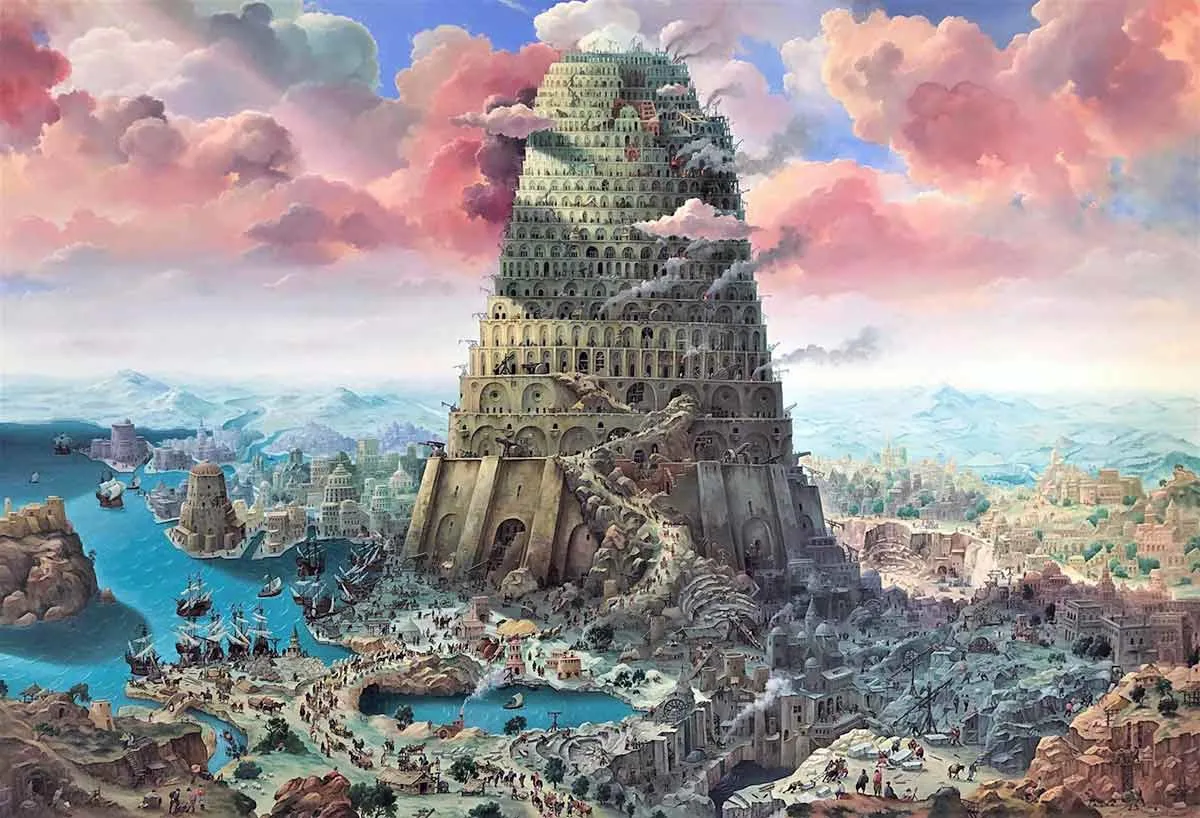
The Tower of Babel, Alexander Mikhalchyk, 2019, via Wikimedia Commons
The biblical account of the Tower of Babel (Genesis 11:1–9), describes an attempt to construct a tower to the heavens, which was thwarted when God confused the languages of humanity. The creation of machine intelligence is a modern variation on this cautionary tale, insofar as a powerful technology could develop god-like capacities, yet with destructive consequences.
Create a free Sacred Web Members account
Gain access to this post, limited free articles, and a members' newsletter.