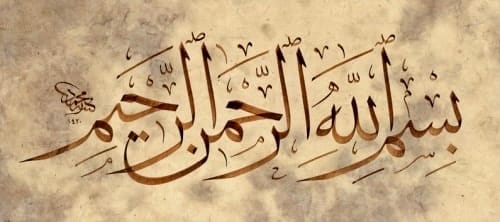
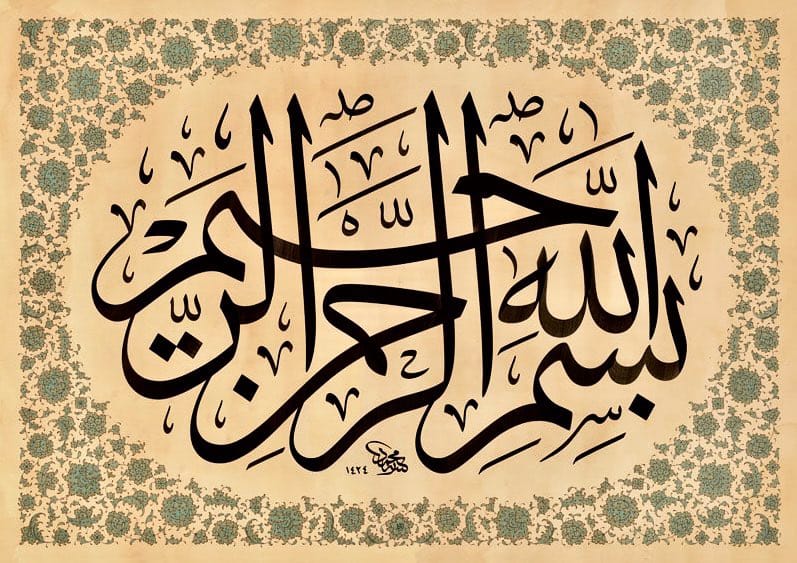
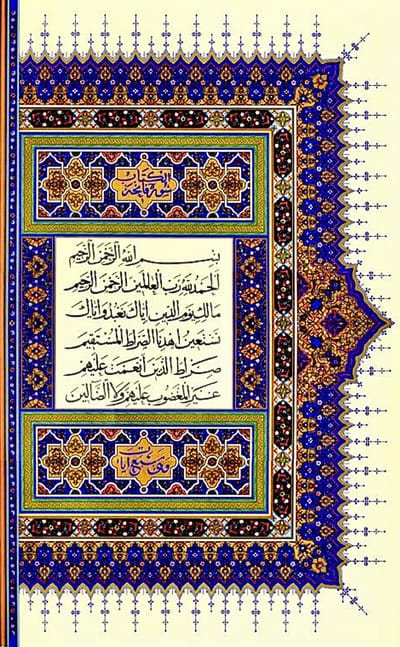
The Opening (Al-Fatiha) in Thulth script, inscribed by Haji Maqsud Sharif Tabrizi, dated 974 (AH)
1. "In the Name of Allah, the All-Beneficent, the All-Merciful,"
2. "All praise is due to Allah, the Lord of the worlds,"
3. "The All-Beneficent, the All-Merciful,"
4. "Master of the Day of Judgment,"
5. "You alone do we worship, and You alone do we ask for help,"
6. "Guide us to the Straight Path,"
7. "The Path of those You have blessed—not of those who incur wrath, nor of those who are astray”.
PREFATORY REMARKS
The Basmala, the invocatory opening of Sura Al-Fatiha
The Sura Al-Fatiha is the opening sura (chapter) of Islam’s Holy Book, the Qur’an (Recitation). It is also its very heart.
The Arabic term ‘fatiha’, literally means ‘opening’, but it also connotes ‘revelation’, ‘explanation’ and ‘achievement’. In its alchemical meaning: what is opened is the inner eye, the eye of the Heart; what is revealed is the all-encompassing sacred Presence; what is explained is the way to the Center of one’s being, to one’s true nature; and what is achieved is self-mastery, the victory of attaining the abode of Peace (dar-as-salaam). The term ‘islam’ thus denotes both ‘submission’ (of the soul to the Spirit) and ‘peace’ (the serenity and beatitude attained by the soul when it is centered, through submission, in the Spirit). The very name ‘fatiha’ therefore is an invitation to enter upon a spiritual pilgrimage to the sanctum of the Heart. This is what the Qur’an refers to as ‘haramanaaminan’, the ‘sanctuary secure’ (28:57, 29:67).
Esoterically, the ‘opening’ denotes the meeting point of the human and the divine in the transcendent space in the soul, known as the ‘Heart’. It is the liminal portal to the Absolutely Real, the sacramental point of convergence between manifest reality and its hidden substance. The Way to the Heart is a ‘Straight Path’ (1:6) by which the soul, infused with awareness of the all-pervasive spiritual reality, conforms herself to the Spirit. This awareness and conformance constitute the ladder leading to the Heart, that transcendent Center which is the soul’s origin and end, her depth (Self) and apex (Spirit), which are intrinsically One, and the basis for her equilibrium (Peace) in the world. The soul’s journey to the Heart is a return (ma’ad) from the peripheral exile of forgetfulness (ghafla) to a spiritual homecoming in the cardial Center, a transformation from the Outer Man to the Inner Man (the term ‘Man’ is used here and elsewhere in this paper, as anthropos, not in a gendered sense). The soul becomes aware of her spiritual nature (fitra), and, being aware of the Spirit in all things (taqwa), develops a natural bond of wholeness and spiritual kinship with the sacred web of creation (the ‘Sacred’ is the imprint of the Absolute Reality in contingency) thereby discovering the peace of being-at-one, in peace and in equilibrium, with all. This spiritual bond implies responsibilities: endowed with the capability of innate spiritual awareness or Intellect (‘aql), the soul is entrusted with stewardship (amanah) of the world, and is impelled by a sense of intrinsic connection to live in harmony with all, as a ‘community’ (umma). To deviate from this is ‘to go astray’ (1:7).
Al-Fatiha’s foundational importance can be seen in its designation by Prophet Muhammad (peace and blessings be upon him) as ‘Umm al-Kitab’, or ‘Mother of the (holy) Book’[[1]]. The Sura was revealed in Mecca early in his mission[[2]], and, as though to underline its central importance, it was reputed by Hadith to have been subsequently retransmitted to the Prophet by an angel descending from a sealed door on the occasion of his Mi’raj or Heavenly Journey.[[3]] The handing down of this divine message after its initial revelation is symbolic of ‘Tradition’ as the hermetic link between Eternity and Time. ‘Tradition’, both by its etymology and special use, is the transmission of eternally revealed truth through time in formally sanctioned ways so as to preserve its principial ‘orthodoxy’ or authentic spiritual content, whose true meaning would otherwise be eroded by time or lost in translation. Inasmuch as the Mi’raj itself symbolizes the potential of the soul to be resurrected and reintegrated into the Spirit, Al-Fatiha can also be regarded as indicating the Way for the soul’s spiritual transformation.
Sign up for Sacred Web
Sacred Web is devoted to exploring the relevance of universal and traditional wisdom in addressing the challenges of modern life.
The Sura is of such doctrinal and devotional importance that, according to accepted tradition, no prayer is valid unless preceded by Al-Fatiha.[[4]] Its “seven oft-repeated verses”[[5]] are recited daily as part of every devout Muslim’s canonical prayer, and so it is instructive to reflect on the Sura through the prism of prayer. Prayer is a way for the human to commune with the divine. It is the soul’s remembrance (dhikr)of God, the polishing of the mirror of the Heart through contemplation, the soul herself being the ‘Temple’ of such ‘contemplation’, as she bears the divine imprint of harmony in her very nature (fitra) (30:30). The substance of this primordial nature is universal and One, in keeping with the principle of the Oneness of Reality (tawhid), and it therefore transcends and precedes any formal religious colouring or affiliation.[[6]] This integrating substance constitutes the bond between Man and God, and thereby between soul and Spirit, whose signs (ayat) are immanently present within the world of the ever-renewing theophany (tajalli). The soul is bidden by the Qur’an to cultivate spiritual awareness (taqwa) because the world (dunya) is a place of forgetfulness (ghafla), where the distracted soul is always at risk of losing sight of her true spiritual provenance and noble purpose within the clouds of illusion. Hence, the ordinance, ‘So remember Me; and I will remember you. And be grateful to Me and do not deny Me.’ (2:152). What is to be remembered is the innately spiritual nature of reality, present in the signs of the theophany and in the innermost recesses of the self.
The term used in the Qur’an to denote God is ‘Allah’ (Subhanahu wa ta'ala - glorified and exalted is He), about which more will be said later. The term denotes the quintessential and all-pervasive reality which, in keeping with the principle of tawhid, is beyond all attempts to define it reductively, as radically One and Absolute in a manner that would derogate from its Infinite Presence. Allah can neither be reduced to the conditions of existence nor be excluded from it. The term therefore denotes a reality that is both transcendent and immanent, Absolute and Infinite. As the principle of all-encompassing Infinitude and All-Possibility encompassed in Absoluteness, this core reality is necessarily inscribed in the Heart of the soul as her immanent Self, providing her with a portal to her spiritual substance. Thus, in the words of the Dominican mystic, Meister Eckhart (c.1260-c.1328), ‘The eye with which I see God is the same eye with which God sees me’ (Sermon 12).
Al-Fatiha is a dialogic prayer of invocation, glorification, petition and response
Prayer, in this understanding, is the opening of the inner Eye to the soul’s liminal awareness of her own nature, which, like that of God, in whose image she is created, is profoundly loving. In Arabic, the term ‘fatiha’ is a feminine noun, inviting us to focus on the feminine qualities of the divine substance, present in the Heart, such as compassion and nurture, qualities also indicated by the term Rahma (discussed below). The idea of an ‘opening’ is itself indicative of the feminine inclusiveness of the divine reality, and reminds us that the Infinite is a facet of the Absolute, containing everything in an all-encompassing embrace of Oneness.
The term ‘fatiha’ also suggests the feminine quality of receptivity. Man is by nature intrinsically faithful, receptive to ‘Revelation’, understood in the broadest sense, that is, through the soul’s sensitivity to the spiritual signs of the theophany, in the ‘innermost self’, in the ‘outermost horizons’ (41:53)[[7]], and in the messages conveyed by divine messengers throughout time, including through the revealed scriptures of all the faith traditions.[[8]] This propensity for spiritual sensitivity or ‘witnessing’ is the deeper significance of the Shahada which is the credal affirmation of every Muslim (discussed below). Thus, from the point of view of the one who prays, the term ‘fatiha’ invites an attitude of openness to transcendence, and the receptivity of the devotee in the act of worship. Prayer is to be undertaken piously, devoutly, open-heartedly, and in a manner reverent to the presence of the Sacred. God-consciousness (taqwa), with its corollary of reverence for the Sacred and of compassion, is thus a central quality of faith, and a hallmark of one who is on the Straight Path.[[9]]
In terms of its structure, Al-Fatiha is a division between (in the first half of the text) affirming the transcendent status of the dominion and sovereignty of God as the creative and sustaining matrix of existence, and (in the second half) affirming Man’s dependence on God; and, in view of that dependence, it includes a plea for God’s guidance to help Man be on the Straight Path. God is invoked, as the One reality, whose nature (the model for Man) is goodness and mercy, to whom all gratitude, praise and glory are due. God is acknowledged to be the soul’s origin and end, and her sovereign judge. Man is the petitioning creature, subsisting in a state of privative contingency, a servant dependent on God for guidance, sustenance, bounty and mercy. In this sense, the Sura also resembles The Lord’s Prayer taught by Jesus (peace and blessings be upon him) in his Sermon on the Mount (Matthew 6:9–13). It too follows the structure of Invocation, Exaltation (of God’s sovereign and archetypal status), and Petition.
Al-Fatiha is a dialogic prayer of invocation, glorification, petition and response, offered by the invoking and beseeching servant (Man) to the responding master (God). According to a Hadith, Allah, the Glorious and Exalted said, “I have divided the prayer between Myself and My servant equally and My servant shall be granted what he asked for.” Therefore, when the servant says, 'All praises and thanks are due to Allah, the Lord of the worlds', Allah says, “My servant has praised Me.” When he says, The All-Merciful, the Most Merciful, Allah says, “My servant has extolled Me.” When he says, 'Master of the Day of Judgement,' Allah says, “My servant has glorified Me.” When he says, 'You Alone we worship and Your aid Alone do we seek, Allah says, “This is between Me and My servant and My servant shall have what he requested.” When he says, 'Guide us to the Straight Path, the Path of those whom You have favoured, not [the path] of those who have earned Your anger, nor of those who have gone astray,' Allah says, “This is for My servant and My servant shall have what he asked for.” [[10]]
Through the recitation of Al-Fatiha the devotee not only enters into dialogue with God but also thereby receives the purifying benefit of His gracious response (‘My servant shall be granted what he asked for.’) One can appreciate therefore why Al-Fatiha is also regarded as a healing prayer and why the Prophet called it Al-Ruqya (‘the healing’) [[11]]. Muslims also refer to it as Al-Shifa’ (‘the cure’).
For the prayer to be efficacious, certain necessary preparations are undertaken by the devotee as a condition of entering into the dialogue with God. These are purifications of the body, mind and heart, including bodily ablutions (wudu) (5:6), mental purification (ikhlas) of mind, pledging concentration and sincerity of intention (niyyah), and the recitation of a ritual formula to ward off malign spiritual influences (a'oodhu billahi minash-shaytaanir-rajeem) (‘I seek refuge in Allah from the accursed Satan’). After that preparatory purification, the devotee is ready to begin the recitation of the healing prayer.
THE BASMALAH
The Basmala
Al-Fatiha begins with the Invocation. The first words of the Sura are ‘Bismillahir Rahmanir Rahim’ (In the Name of Allah, the All-Beneficent, the All-Merciful). This formula, known as the ‘Basmala’, precedes every sura except the ninth chapter of the Qur’an, At-Tawbah [[12]], and is customarily used to inaugurate any new enterprise in a Muslim’s life.[[13]]
The initial phrase ‘Bis‘mi’ (In the Name), begins with the Arabic consonant, Ba, written as follows:
Esoterically, the entire Qur’an is said to be contained within Al-Fatiha, which in turn is said to be contained in the Basmala, which in turn is contained in its first letter, Ba. The ineffable origin of the Ba, moreover, is said to be occulted within the Dot (Nuqta) beneath the Ba, signifying the Hidden Essence of God. One recalls here that creation arises from a primordial point of Origin (the Hidden Treasure[[14]] represented by the punctum or Nuqta) whose Nothingness contains All-Possibility. Mystical interpretation symbolically likens this ‘point vierge’ (to use the expression of Louis Massignon in Hallajian metaphysics, a term later borrowed by the Cistercian monk, Thomas Merton) to the Heart, the meeting-point of Man and God. According to a non-canonical Hadith, accepted in Sufi and other esoteric traditions, ‘Ali Ibn Abi Talib (the Prophet’s cousin and son-in-law, the fourth Caliph of Islam, the first Shi’a Imam, and one of the pre-eminent esoteric interpreters of Islam) is reputed to have said, ‘I am the Dot beneath the Ba.’ [[15]] ‘Ali was also understood, according to a canonical Hadith, to have been proclaimed by the Holy Prophet as ‘the Gate to the City of Knowledge’ [[16]], which gnostic (irfani) traditions equate with the archetype of the Heart and of gnosis.
creation is the descent of Essence into forms, while gnosis reverses the journey transformatively, through a gnostic ascent from forms to Essence
The multi-layered levels involved in this symbology (Qur’an > Fatiha > Basmala > Ba > Nuqta) point to implications for cosmology and hermeneutics. First, reality is planimetric and hierarchical, enfolding layers or levels which emerge through the process of creation, proceeding from the hidden and transcendent Essence to the materially manifest and sensible world of forms. Second, as an epistemological corollary of the Hadith of the Dot beneath the Ba, reality can only be interpreted by those who possess its hermeneutical understanding (ta’wil) and the ability to trace outer appearances back to their principial Source. To restate this differently, creation is the descent of Essence into forms, while gnosis reverses the journey transformatively, through a gnostic ascent from forms to Essence. The passage from the outer to the inner is understood as a return to the realm of the Hidden Treasure, to the mystery of the transcendent Dot beneath theBa. It is a journey of kenotic self-naughting (fana’ fi’Llah) into the plenitude of the sanctum of the Heart (baqa’ bi’Llah).
The word ‘Ba’, meaning ‘in’ or ‘with’, implies connection with(in) something, and points to the deep bond with the Oneness of Reality. Like terms such as ‘religion’, ‘covenant’, ‘yoga’, ‘sangha’, ‘yantra’, ‘anattā’, ‘dao’, ‘qi’, ‘anam cara’, ‘logos’, henosis’, ‘manitou’, among many other similar terms in all faith traditions, the word Ba relates to a fundamental aspect of faith, namely, the underlying reality of the Spirit’s integrating ‘wholeness’ which characterizes a soul’s potential for holiness, healing and harmony (‘wholeness’ is the basis of ‘holiness’ and wholesomeness, and of being ‘hale and hearty’ – the latter expression denoting ‘being of good Heart’). The connection of the soul is, inwardly and vertically, with God and, outwardly and horizontally, with the created theophany – the latter connection subsisting intrinsically in view of the former, as implied by the symbolism of the Cross. This is the sacred ‘connection’ of love, in accord with the twin Supreme Commandments (love of God and love of neighbour) in the Judeo-Christian traditions. The aim of religion, therefore, is to reconnect the soul with her Spirit, and thereby with the harmonic ‘peace’ which is her natural disposition.
‘Bis‘mi’ (In the Name) derives from ‘ism’, the Arabic for ‘name’. The Invocation is premised on a certain alchemy of naming: the invoker connects with the invoked by ontologically recognizing the nature of the named. Through invocation, the invoker becomes the Invoked (this is the basis for all invocatory prayer practices, such as the Jesus Prayer in Hesychasm, Japa or Mantra practices in Hinduism, or Nembutsu in Buddhism).
Inasmuch as creation is a divine Self-Disclosure, a theophany (tajalli) of qualities radiating from the divine treasuries (khaza'in), each creature is a sign of God (ayat Allah). Nothing in creation can exist without qualities or attributes loaned to it by God from the divine treasuries: ‘And there is not a thing but with Us are the treasuries thereof, and We send it not down except in a known measure.’ (15:21) To know a quality or attribute of a creature is therefore not only to connect with its nature but also with an aspect of God, its Source and Font. One recalls here that Adam, as archetypal Man, was ’taught the names’ (wa-'allama Aadamal asmaaa'a) (2:31), signifying humankind’s innate ability to witness God through his qualities resplendent in the theophany. This witnessing is understood by Muslims to be a covenantal obligation of humanity, and a feature of taqwa. In the pre-existential Covenant of Alast, the Qur’an records (7:172) that humanity was asked by God to attest to the divine reality as a condition of being granted the gift of existence.[[17]] This primordial witnessing of the primacy of spiritual reality, of the Absolute over the contingent, of essence over existence (refuting the basic premise of modernist ‘existentialism’) is replicated in the Muslim’s credal Shahada, and is a central declaration of faith.[[18]]
Al-Fatiha, opens with the Invocation, In the Name of Allah, the All-Beneficent, the All-Merciful, as a way for the invoker to connect with God by remembering the quintessential qualities of the divine nature being invoked.
The fact that Man can connect with God simply by invoking Him in the Heart, particularly through His Most Beautiful Names (asma ul-husna), is therefore a fundamental feature of prayer. Invocation is a form of dhikr. As the Qur’an states, ‘Allah – there is no god except Him. He has the Most Beautiful Names.’ (20:8); ‘Call upon Allah or call upon the Most Compassionate—whichever you call, He has the Most Beautiful Names.’ (17:110) And so, Al-Fatiha, opens with the Invocation, In the Name of Allah, the All-Beneficent, the All-Merciful, as a way for the invoker to connect with God by remembering the quintessential qualities of the divine nature being invoked. The Basmala thereby serves as a formula for both taqwa and dhikr.
The term used to name God is ‘Allah’. This appellation is not unique to Muslims. All Arabic-speaking or Semitic monotheists, including Jews and Christians, have long invoked God by the term ‘Allah’. The appellation had currency before the historic advent of Islam in seventh century Arabia, and is still used by non-Muslims to this day. For example, Jews, Catholics and Copts in Arab cultures refer to God as ‘Allah’ in their own vernacular and prayers. It is sometimes said that the name is a combination of the definite article ‘the’ (al) and the Arabic for ‘god’ (ilah), to emphasize the uniqueness of the single deity of monotheists, but the appellation ‘Allah’ is best regarded as sui generis.
We have referred earlier to the Dot beneath the Ba, the Nuqta, the primordial point representing the Hidden Essence of God. When this Essence expresses itself, its first manifestation is as the letter ‘Alif, symbolizing the Origin. The ‘Alif is, felicitously, the beginning of the Name, ‘Allah’, which is written (‘Alif - lam -lam - ha) as follows, from right to left:
The ‘Alif, is a vertical downward stroke of the Pen (al-Kalam, the figurative instrument of revelation), and represents the metaphysical descent of God from the Hidden Essence into the realm of the manifest. What is veiled in the Essence is thereby revealed in form as Being – the substance of Love. It is unconnected to the letters which follow, denoting the transcendent quality of divine Being. Its detachment does not negate its nature of love, rather it affirms that detachment is the foundation of compassion. The remaining cursive strokes of the Name, the vertical repetitions of ‘lam’ and the terminus of the circular ‘ha’, can also be understood as replicating a spiritual passage – of the Spirit as soul from its emanation into the world, the domain of remembrance and forgetfulness, of ‘ups and downs’ (the two ‘lams’ in upward and downward strokes, respectively), on to its eventual expiration in metaphysical Nothingness (the ‘ha’) and the return to Essence. Similarly, the bodily motions of the salat or Muslim prayer, alternating between standing, bowing, rising and eventual prostration, also resonate with this spiritual journey of the soul. All that is bestowed with life by the inspiring Breath of the All-Merciful (An-Nafas Ar-Rahmani) must inevitably close in a final moment of expiration, returning thereby to the Source whence it emerged.
While Allah is ineffable and beyond human grasp, through manifestation and by the grace of His loving nature, Allah, as the source of love and peace can be known through a return to the soul’s cardial Center for, as Islam teaches, Allah resides in the Heart. And while unmanifest Essence cannot itself be known, its manifest reality can be known. The teaching is consistent with all the faith traditions. For example: ‘I am Atmā, the Self, residing in the heart of all beings’ (Bhagavad Gita, 10:20); ‘This entire cosmic manifestation is pervaded by Me in My unmanifest form. All living beings dwell in Me, but I do not dwell in them.’ (Bhagavad Gita, 9:4) ‘The kingdom of God is within you’ (Luke, 17:21). The non-theistic faith traditions, while they do not expressly speak of God, affirm that the path to peace is inward, to the ontological source of compassion. Thus, for example: ‘Peace comes from within. Do not seek it without.’ (Dhammapada, 39); and: “Attain complete emptiness, Hold fast to stillness. The ten thousand things stir about; I only watch for their going back. Things grow and grow, But each goes back to its root. Going back to the root is stillness. This means returning to what is.” (Tao, 16)
The divine Name ‘Allah’ is invoked in some esoteric practices through an intake of breath (inspiration) followed by a release (expiration), as a reminder not only of the gift of life and dependence of Man on God, but also as a form of awareness of the living Presence of the Spirit as it alternates in expansion (bast) and contraction (qabd) from the innermost Center to the outermost circumference. In some Sufi practices, the Name is also rhythmically chanted: ‘Al-Laah’, with an intake of breath on ‘Al’ and an outward release on ‘Laah’. The rhythmic repetition of these intonations or chants, with their sonorous reminders of, on the one hand, the cataphatic aspects of God (the term ‘al’ is a definite article in Arabic, hence the affirming of God in the theophany) (‘Wheresoever you turn, there is the Face of God’ – 2:115), and, on the other, of the apophatic aspects (the term ‘la’ is a negation in Arabic, hence denying any equivalence between the transcendent God and His creatures) (‘There is none like unto Him’ – 112:4), is a dhikr-Allah. This parallels the first half of the Shahada where the phrase ‘la ilaha’ (‘there is no god’) constitutes the apophatic negation, and the phrase ‘illa Allah’ (‘if not Allah’) is the cataphatic affirmation. These two aspects, the negation of the reductive ‘idol’ and the affirmation of the theophanic ‘icon’, are reminders within the sacred Name itself of the existential condition of Man, and of the primordial connections between Man and God and with the theophany. To invoke the Name is to be mindful not only of this reality but it is also, through the transformative alchemy of invocation, to partake of the divine nature, which is denoted by the terms ‘Rahman’ (All-Beneficent) and ‘Rahim’ (All-Merciful). The epithets in the Basmala are later repeated in the third verse of the Sura, underlining their significance, and it to the meaning of these attributes we turn next.
THE DIVINE NATURE: THE RAHMAN-RAHIM MATRIX
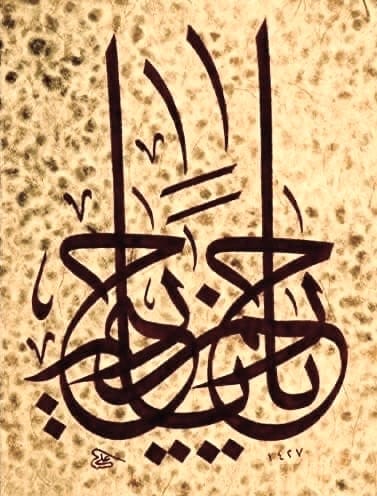
‘Ya Rahman, Ya Rahim’
Does God have a nature? If so, is this not to limit His power? The answers are ‘yes’ and ‘no’, respectively. Yes, because the divine nature is founded on radical love, inscribed in the Heart. No, because God loves from a natural internal impulse, and not out of any externally imposed constraint. In William Blake’s controversial formulation (in The Marriage of Heaven and Hell), ‘Jesus was all virtue, and acted from impulse, not from rules.’
Al-Fatiha states that Allah is Rahman and Rahim, which denote God’s beneficent goodness and compassionate mercy, respectively. Rahman refers to the intrinsic nature of a beneficence so intense that it simply overflows in its goodness like a fountain of light. The Sun cannot but be radiant, and its light is universal in its effects, so that its nourishing radiance is not directed to any particular creature, but benefits all alike. Light (as in the Ayat al-Nur or Verse of Light – 24:35) is a simile for the nature of God as Rahman. Rahim, without derogating from the quality of Rahman, refers to the particular directing of God’s goodness, for example towards a suppliant or a deserving servant. God’s mercy (Rahim) is a facet of His intrinsically beneficent nature (Rahman). Some exegetes have therefore distinguished the terms as follows: ‘Al-Rahman’ points to an attribute that is existent in God, and ‘Al-Rahim’ points to its interaction with the recipient of mercy. According to Tabari, Ar-Rahman denotes the One who shows mercy in this world and the Hereafter, while Ar-Rahim denotes the One who shows mercy in the Hereafter (uniquely). The terms are etymologically cognate with the Arabic word for ‘womb’, and the qualities they describe collectively signify the maternal attributes which are the creative and sustaining springs of the theophany. In a word, these qualities denote ‘Love’. Allah is explicitly associated with ‘Love’ by the name ‘Al-Wadud’, but the Rahman-Rahim matrix encompasses the spiritual reality of creation, sustenance, and the reintegration of the soul into the Spirit, all conducted through the operation of Love’s divine alchemy.
Besides the Basmala and Fatiha, several Qur’anic passages affirm the pre-eminence of the beneficent, compassionate and loving nature of God. While Allah undoubtedly possesses the power to act contrary to His Nature, the Qur’an explains, ‘kataba 'alaa nafsihir rahmah’ (‘He has decreed upon Himself mercy (as a law)’) (6:12). In other words, God chooses not to transgress the boundary of his own loving nature — not because He is unable to do so, but because He wills to be loving. He is the prescriber of laws and bounds, which He could revoke at any time. But God chooses, without derogating from His own powers, to be true to His own divine nature. And, without derogating from divine transcendence, since Man is made in the finest of forms (Laqad khalaqnal insaana fee ahsani taqweem; ‘Indeed, We created humans in the best form’) (95:4), human beings are also enjoined to be beneficent, compassionate and loving.
The existence of ‘evil’ in the world is not evidence of any limitation on God’s powers or goodness. Rather, what is termed evil is either the experience of suffering or the consequences of sin. In the first case, Man is a creature and therefore in a state of privation; the privative consequence of creatures not being God is ‘suffering’. In the second case, Man is given the freedom to choose God or to reject Him, but some people choose to do evil or simply ‘go astray’; their ‘sins’ are not willed by God but are ‘allowed’ as a consequence of God allowing Man the freedom to choose good over evil for the sake of Love, and the evil which results from them is the effect of abusing the freedom to conform to the Heart’s archetype of goodness. As we discuss later, the privative conditions of Man, and the entrusting of free will to souls endowed with a conscience, are a test. In the end, Man will be judged by God for his intended deeds and consequences.
Among the many signs of divine goodness and the love of God is the very miracle of sustained creation – in the regenerative renewal of life through the seasons, the healing that occurs physically and spiritually through time, the budding spring of hope after the winter of despair, and, generally, the presence of what the poet Gerard Manley Hopkins calls ‘the dearest freshness deep down things’. Those who possess spiritual humility are gratefully aware that God has endowed all creatures with a variety of attributes from His divine treasuries, and that, beyond all our outward differences there is an underlying commonality sustained by love. Thus, Allah declares in the Qur’an, ‘Wa-rahmatee wasi'at kulla shai' (‘ButMy mercy [Rahma] encompasses all things.’) (7:156)
To evidence God’s Mercy, no community throughout history has been left without divine guidance. The love of God is not limited by time or by any unjust or Deistic neglect of His creatures. Throughout history, we are reminded, God has sent messengers to guide humanity, and in this context the Qur’an comments ‘Wa-maaa arsalnaaka illaa rahmatal lil'aalameen‘ (We have sent you [O Prophet] only as a mercy [Rahma] for the whole world.’) (21:107). Indeed, the Recitation itself is ‘a healing and mercy’: (‘Wa-nunazzilu minal quraani maa huwa shifaaa'unw Wa-rahmatullil mu'mineena’) (‘We send down the Qur’an as a healing and mercy for the believers.’) (17:82)
So pre-eminent in Islam is the quality of Rahman that an entire sura of the Qur’an is named after it (Sura Ar-Rahman, the 55th chapter), reminding humanity of God’s beneficence and favours. Each poetic verse evokes the wondrous aspects of God’s generosity and goodness, and the sections conclude with a repeated rhetorical refrain addressed to the created communities of both humanity and the jinn, ‘Fabi-ayyi aalaa'i Rabbikumaa tukazzibaan’ (‘Which, then, of your Sustainer's powers can you disavow?’).
Here is an example (55:1-30), in the translation of Muhammad Asad:
THE MOST GRACIOUS (Ar-Rahman) has imparted this Qur'an [unto man].
He has created man: He has imparted unto him articulate thought and speech.
[At His behest] the sun and the moon run their appointed courses; [before Him] prostrate themselves the stars and the trees.
And the skies has He raised high, and has devised [for all things] a measure, so that you [too, O men,] might never transgress the measure [of what is right): weigh, therefore, [your deed] with equity, and cut not the measure short!
And the earth has He spread out for all living beings, with fruit thereon, and palm trees with sheathed clusters [of dates], and grain growing tall on its stalks, and sweet-smelling plants.
Which, then, of your Sustainer's powers can you disavow?
He has created man out of sounding clay, like pottery, whereas the invisible beings He has created out of a confusing flame of fire.
Which, then, of your Sustainer's powers can you disavow?
[He is] the Sustainer of the two farthest points of sunrise, and the Sustainer of the two farthest points of sunset.
Which, then, of your Sustainer's powers can you disavow?
He has given freedom to the two great bodies of water, so that they might meet: [yet] between them is a barrier which they may not transgress.
Which, then, of your Sustainer's powers can you disavow?
Out of these two [bodies of water] come forth pearls, both great and small.
Which, then, of your Sustainer's powers can you disavow?
And His are the lofty ships that sail like [floating] mountains through the seas.
Which, then, of your Sustainer's powers can you disavow?
All that lives on earth or in the heavensis bound to pass away: but forever will abide thy Sustainer's Self,full of majesty and glory.
Which, then, of your Sustainer's powers can you disavow?
On Him depend all creaturesin the heavens and on earth; [and] every day He manifests Himself in yet another [wondrous] way.
Which, then, of your Sustainer's powers can you disavow?
These beautiful verses, along with many others in the Recitation, remind Man to look about God’s creations with eyes that do not take the Creator and Sustainer for granted.
God’s benevolence is not only evident in nature but in the differences which distinguish individuals and religions. It is the pre-eminence of the qualities of Rahman-Rahim which are the foundation for religious pluralism. For those who would argue that the deity of Islam is different to that of other faiths, the Qur’an states, ‘Wa-ilaahukum illaahunw waahid(ul); laaa ilaaha illaa Huwar Rahmaanur Raheem’ (And your God is one God. There is no deity except Him, the All-Beneficent, the All-Merciful.’) (2:163) This accords with universal teachings on the subject, as for example in the Vedas: ‘Truth is One; the wise call it by many names.’ (‘Ekam Sat Vipra Bahudha Vadanti’)(Rig Veda, 1:164.46)
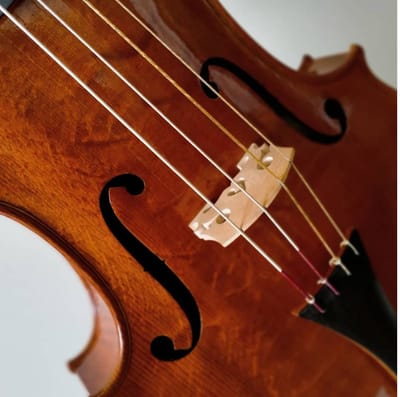
Individual gifts from God are to be shared for the common good through a principle of complementarity, just as different strings of a musical instrument combine to make harmonious music, not discordant sounds
The Qur’an informs us that differences among peoples are ordained so that they might be tested in order to transcend them, and that they may thereby come to know the other (lita'arafu) as intrinsically one. True spiritual kinship transcends outer differences through a pluralistic spirit exemplified in these words from Prophet Muhammad’s celebrated Farewell Sermon: ‘O people! beware! Your God is one, no Arab has any superiority over a non-Arab, and no non-Arab any superiority over an Arab, and no white one has any superiority over a black one, and no black one has any superiority over a white one, except on the basis of taqwa (fear / love of Allah or piety).’ Through knowledge of their underlying spiritual nature, people are not to oppose one other as adversaries but to learn to live harmoniously. Individual gifts from God are to be shared for the common good through a principle of complementarity, just as different strings of a musical instrument combine to make harmonious music, not discordant sounds. Instead of seeking their own good at the expense of others, individuals are to vie with one another in good deeds (yusaari'oona fil khairaat) (2:148, and 3:114). Here are two examples, from the Recitation, of these pluralistic messages:
O mankind, indeed we have created you from male and female and made you peoples and tribes that you may know one another. Indeed, the most noble of you in the sight of Allah is the most righteous of you. Indeed, Allah is Knowing and Acquainted. (49:13)
If Allah had so willed, He would have made you a single community, but (God's plan is) to test you in what He has given you: so, vie with one another in good deeds. You will return to God, and Allah will show you the Truth of the matters in which you dispute. (5:48)
Not only is the Rahman-Rahim matrix the metaphysical bedrock of the divine nature, but its radical love is the foundation of human nature (fitra) too. It is only through spiritual humility that one can value others who are different than oneself for, in the words of the famous hymn about ‘all creatures great and small’, ‘the Lord God made them all.’ The insight of the spiritual vision of underlying harmony, sustained by love, is an invaluable antidote to the corrosive effects of our cynical times. It is the basis for meaning and hope in a world which, lacking this foundation, would otherwise be purposeless and nihilistic.
One can better understand now the significance of the words in the Basmala, and can appreciate why of all His Beautiful Names, the Qur’an states that Allah prefers to be invoked by the name ‘Rahman’: (Qulid 'ul laaha awid 'ur Rahmaana ayyam maa tad'oo falahul Asmaaa'ul Husnaa.) (Say, [O Prophet] 'Call upon Allah or call upon Ar-Rahman; whichever [name] you call – to Him belong the most Beautiful Names.') (17:110)
SPIRITUAL AWARENESS: GRATITUDE, PRAISE, AND PERFECTIBILITY
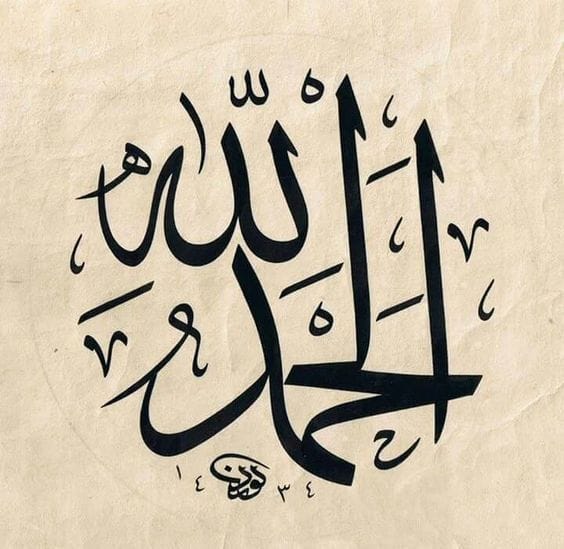
Alhamduli’Llah
Following the Invocation of the Basmala, the Sura continues with the Verse of Praise (‘Ayah Al-Hamd’): ‘Alhamdu lillaahi Rabbil 'aalameen.’ (All praise is due to Allah—Lord of all worlds) (1:2)
Create a free Sacred Web Members account
Gain access to this post, limited free articles, and a members' newsletter.