Jodo Shinshu, or Shin Buddhism as it is known in the West, is the largest school of Buddhism in Japan. It is a species of Pure Land Buddhism, that form of Buddhism that Frithjof Schuon recommended as the most accessible for Westerners.
Shin Buddhism is distinguished by its doctrine of, in the words of Alfred Bloom, “pure grace”. It teaches that at the present juncture in the cosmic cycle, humanity’s spiritual competencies are so reduced that salvation is only possible through faith. By totally placing one’s fate in the hands of Amida Buddha (the Buddha identified by Jodo Shinshu as the supreme Buddha), one is granted faith. This faith guarantees the believer’s Buddhahood immediately after their death. This is expressed in the Tradition as birth in the Amida’s paradise (i.e. the Pure Land).
This utter reliance on the power of the Buddha to accomplish the devotee’s enlightenment entails a complete negation of the capacities and qualities of the believer. This doctrine has a leveling consequence on the social attitudes of Jodo Shinshu. Contrary to Buddhism generally, and the Confucian civilization in which much of Mahayana Buddhism is situated, Shin Buddhism de-emphasizes hierarchical relations. Instead, laypeople and clergy are encouraged to regard each other as on-dōbō on-dōgyō (friends and fellow practitionerson the same spiritual path). In the epistles of Rennyo Shonin, we find repeated affirmations such as the following:
“…with the one thought-moment of taking refuge in Amida, other-power faith is decisively settled, no distinction at all is made between male and female, old and young… no distinction at all is made between layperson and priest or between male and female.” – Gobunsho, Fascicle I, Letter 2
For Western Shin converts, this spirit of sexual equality is often particularly attractive. They are then, perhaps unsurprisingly, not infrequently perturbed by the fact that Amida Buddha is male. This short article will serve as an apologia for Amida’s masculinity.
It is not uncommon in Western Shin Buddhist circles, to hear women express dissatisfaction at the fact that ultimate reality is – despite the proclaimed sexual egalitarianism of the Tradition – portrayed as a man. What is more, that they are enjoined to submit themselves totally to this man rankles. It smacks of what is, in their view, the male chauvinism of the Abrahamic religions. Bowing at the feet of a man strikes many female converts as an insult to their womanhood, as does the identification of supreme truth with a masculine figure. Indeed, one suspects this disquiets the minds of not a few male converts also. Not only is this ‘Abrahamic patriarchalism’ out of keeping with hegemonic modern Western culture, but many Shin converts come to Buddhism precisely because they are alienated from Christianity but still seek to fulfil their spiritual yearnings. Many of this latter type have something of phobic reaction to anything in Buddhism that resembles Christianity – even when it is entirely indigenous to the Tradition. This includes a male savior.
In defending the Traditional identity of Amida Buddha as male, we must first clarify an elementary point. Amida’smanhood is not biological. He is not male in the sense of being possessed of XY chromosomes. Indeed, Amida has no body, male or female, in the physical sense. Rather, Amida’sbody is a Sambhogakaya (reward body). To understand what this means requires dwelling briefly on the Trikaya (three body) doctrine of Mahayana Buddhism.
A Buddha is taught to possess three bodies. The first of these, ontologically speaking, is the Dharmakaya (law body). The Dharmakaya is the impersonal Absolute. It is, in Schuonian terms, “beyond being” or in Guénonian terms, “non-being”. This latter term is particularly appropriate as another name for the Dharmakaya is Śunyata (emptiness). The second body, the Sambhogakaya, is the personal Absolute of Mahayana. It is called a ‘reward’ body because it is this individuated body that the Buddhist attains upon their Nirvana. The third body, the Nirmanakaya (manifestation body) can be understood as the Buddhist analogue of the Avatara. It refers to all material manifestations of the Buddha, including but not limited to the historical Buddha, Siddhartha Gautama.
There are two ways in which these three bodies can be divided into two. The first two can be regarded as Nirvanic, transcending this material world of becoming Buddhists call samsara. Now one can appreciate that there is no question of Amida being male in any physical sense.
In Jodo Shinshu doctrine, the three bodies are also divided into two, but this time with latter two, the Sambhogakaya and Nirmanakaya, being grouped together under the heading “Dharmakaya-as-skillful-means” while the Dharmakaya proper is called the “Dharmakaya-as-Suchness”. This categorization communicates that the latter two bodies are manifested so as to make ultimate reality, which transcends conceptual thinking, accessible and intelligible to ordinary beings. Amida’s body appearing male is not then some arbitrary caprice, but has a specific symbolic import.
Amida is pure Yang to the believer’s Yin.
Male and female are symbols of the active and passive or receptive principles. To demonstrate this with a crude example, the male sexual organ plays the active part in the sex act, while the female is passive and receptive. One hopes the materiality of this example can be excused, but only material examples are likely to be persuasive to the skeptic, and those not in need of them need no examples to be convinced of this truth anyway. The active and passive principles are widely familiar in the terms of the Chinese Tradition as Yang and Yin. Men are born men, and women women, as a consequence of a karmic preponderance of one or the other principle. So, men are men because they are of the active principle, not active because they are men.
Amida is male because he plays the active role in Shin Buddhism. The believer is completely receptive – indeed Shin Buddhists often claim that theirs is a school of ‘no practice’. More accurately, the sole Shin Buddhist practice is to listen deeply to the Shin teaching – as receptive a practice as could be. Amida is pure Yang to the believer’s Yin.
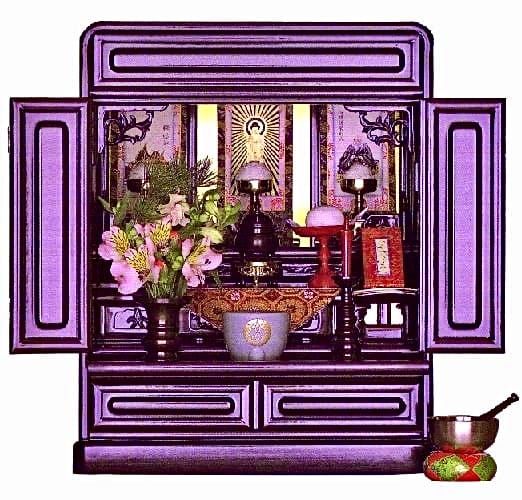
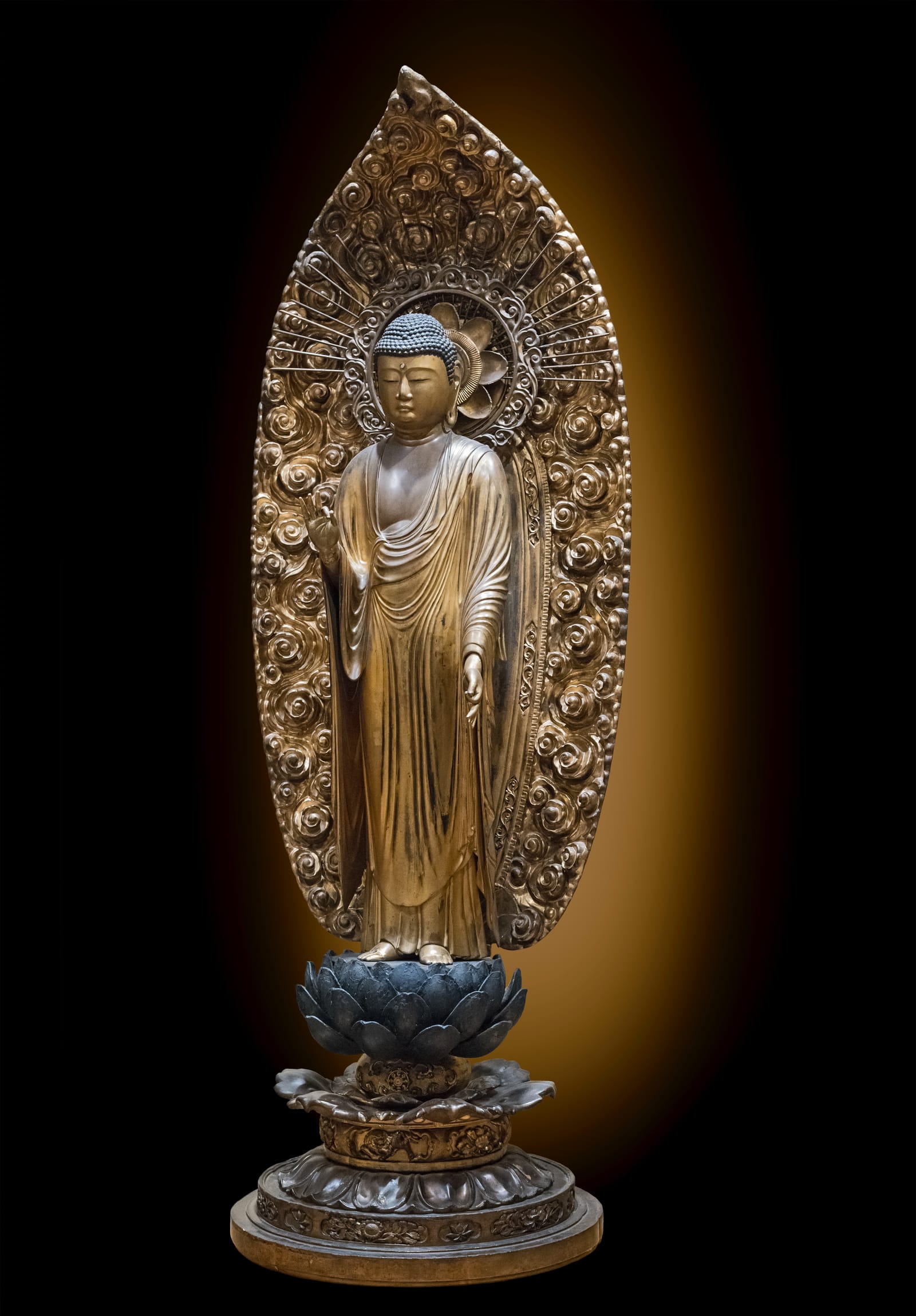
Lest the reader think I am making an undue synthesis of Chinese Tradition and Buddhism here, Yin-Yang symbolism has long been integrated into the liturgical symbolism of Shin Buddhism. In the layout of a Jodo Shinshu shrine, one will find flowers (ideally real, not plastic imitations) placed on the left side of the shrine while a candle is placed adjacent on the right. The flowers represent the creatures of samsara, subject to unceasing change (hence the importance of organic flowers that wilt and decay) while the light of the candle represents the activity of Amida’s illuminating wisdom. Left is Yin, while right is Yang. So, the altar layout represents how Amida’s salvific light acts on the passive beings of samsara.The activity of the Buddha vis-à-vis the receptive faithful is also communicated by the object of worship in the altar, which is often an image or statue of Amida standing, with one hand outstretched at a downward angle, and sometimes with one foot forward and/or with His body leaning forward. Before and below this image, devotees are seated.
Amida Buddha through his activity impregnates the believer – whether their current form is male or female – with the embryo of the believer’s future enlightenment.
It is important in this regard to recall what Coomaraswamy stated in Spiritual Authority and Temporal Power In The Indian Theory of Government concerning relations between castes. The active principle is relational, which is to say it is passivity is relative. What is the active element in relation to one thing, is the passive in relation to another. And so Coomaraswamy wrote that while the kshatria (warrior) caste is symbolically masculine as it relates to the vaishya(merchant) caste, it is feminine in its relationship to the brahmin (priestly) caste. Just so, all are then female vis-à-vis Amida Buddha’s supreme activity.
This symbolism goes further. Faith in Shin Buddhism is equated with Buddha Nature – that element of the Absolute which is immanent in all conditioned things. Faith/Buddha Nature is the seed of the Shin Buddhist’s future Buddhahood implanted in him/her by Amida. It is instructive in this regard that the original Sanskrit term for Buddha Nature is tathagathagharba (Buddha embryo). Amida Buddha through his activity impregnates the believer – whether their current form is male or female – with the embryo of the believer’s future enlightenment. Now we are in a position to appreciate why it is that Amida is male.
It is readily recognized that the preceding may not be fully satisfying to some proportion of that segment of Shin converts who are discountenanced by Amida’s maleness. They may observe, correctly, that the argument I have proposed not only explains Amida’s being male but gives metaphysical justification to the leading role the male sex has Traditionally had in society. This hierarchical relationship is, however, not of itself inherently abusive or unjust. It is legitimate so long as it is characterized by a complementarity and noblesse oblige. The masculine element is justified in its leading position, and practically speaking spontaneously so, by the greater service it renders to the feminine element. Conversely, the masculine element owes its status to the existence of the feminine beneath it. The relationship of the masculine and feminine can therefor be likened to that between the head and the neck respectively. This relationship is also mirrored in Shin doctrine, once again attesting to the principial importance of Amida’s masculinity. As is often referred to in Shin Buddhist sermons, Amida’s status as a Sambhogakaya Buddha is, by His own design, contingent upon His ability to deliver beings from samsara.
From this vantage point we can also understand why it is that the Nirmanakaya Buddha is always male. According to Shin doctrine, Siddhartha Gautama was the manifestation of Amida Buddha for the purpose of unveiling to humanity the possibility of enlightenment through faith. This active role that the Nirmanakaya plays regarding humanity gives symbolic justification for His male form.
Before concluding, let us return to the supposedly chauvinistic character the Abrahamic religions touched on earlier. The universal religions of Christianity and Islam caste the personal Absolute as masculine for much the same symbolic reasons that Jodo Shinshu does. Islam and Christianity are primarily religions of grace, as is Shin Buddhism. All three came into being at a fairly late date, as a compassionate response from Heaven to the spiritually debased state of humanity at this advanced stage in the Kali Yuga. This character, as an active rescue operation upon a passive and prostrate humanity is why the Divine chose to disclose itself in male form in all three instances. This also accounts for the receding into the background of the Divine feminine. Think here not only of the manifold goddesses of the ethnic religions, but also within the universal religions. Consider the relatively greater prominence of the Blessed Virgin in Catholicism and Orthodoxy compared to Protestantism and Islam, or – to bring things full circle – the sidelining of Amida Buddha’s accompanying Bodhisattvas Avalokiteshvara and Mahasthamaprapta.