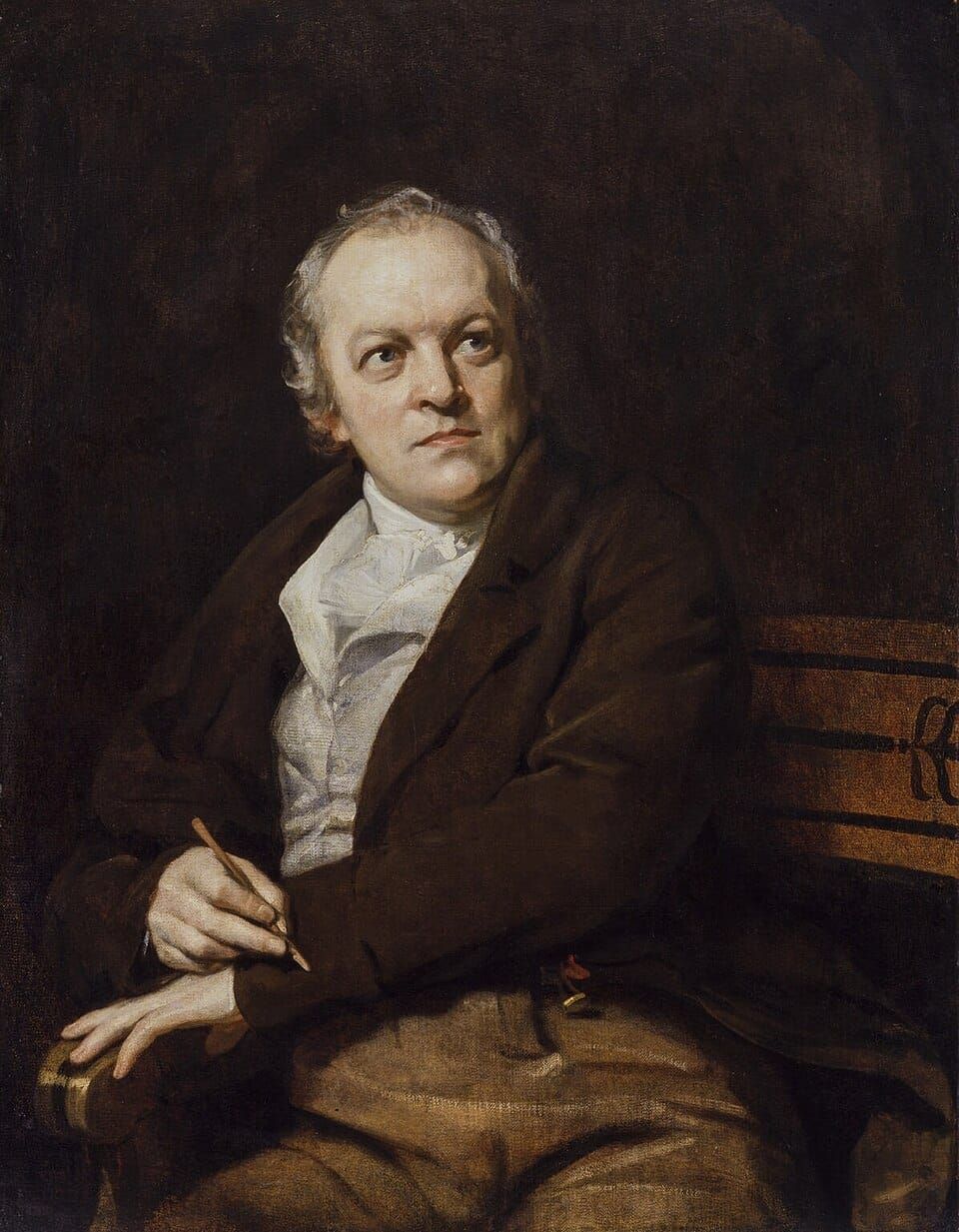
Introduction
In recent years Blake studies have expanded substantially, both in volume and in disciplinary range. William Blake is now discussed across literary criticism, art history, theology, political theory, visual culture, the history of print and related fields. This development is unsurprising. Blake’s writings and images address religion, liberty, authority, childhood experience, the body, the soul and the relation between word and image. His work therefore continues to attract interpretation because it resists simple classification and because its different media are closely interdependent. The poems cannot be fully separated from the designs; the designs frequently modify the force of the poems; and the prose annotations and letters clarify central principles that recur throughout the art. Any adequate introduction to Blake must therefore acknowledge both the range of modern scholarship and the difficulty of reducing his work to a single critical method.
The expansion of Blake scholarship also raises a problem. The more Blake is explained, classified and situated within academic frameworks, the more necessary it becomes to ask whether such treatment is consistent with the principles expressed in the work itself. This essay proceeds from the view that Blake would not have approved of many academic approaches to his art. He was not sympathetic to institutional authority, and he repeatedly opposed systems that subordinated imaginative freedom to rules, hierarchies and received opinion. Although he had formal artistic training and was familiar with the authority of the Royal Academy, his mature work is strongly resistant to the regulation of art by taste, system or professional judgement. His objections to orthodoxy extend across religion, politics, morality, philosophy and criticism. On this basis, the academic attempt to stabilise and categorise Blake is useful only if it remains aware that his art itself challenges the authority of fixed categories.
there is an important distinction between attentive interpretation and critical enclosure
This argument is not intended as a wholesale rejection of scholarship. Blake’s work requires careful reading, historical awareness and close attention to verbal and visual detail. The prophetic books are difficult, and the illuminated works reward sustained analysis. However, there is an important distinction between attentive interpretation and critical enclosure. To read Blake profitably is not simply to master his symbolic vocabulary or assign his work to established intellectual categories. It is also to recognise the central importance of imagination in his thought. Blake’s statements on vision, mental reality and the permanence of imagination are not incidental. They are essential to his account of art, religion and human perception. A critical approach that treats these claims only as historical curiosities, or translates them too quickly into conventional academic terms, risks weakening the force of Blake’s own position.
The present essay therefore approaches Blake through close attention to his own assumptions about imagination, religion and artistic practice. It gives particular importance to his claim that the Gospel is the Forgiveness of Sins and to his opposition to vengeance, accusation and State Religion. It also treats his visual art as more than illustration. The images considered here are read as arguments in visual form, presenting states of spiritual and psychological experience through composition, gesture, colour and symbolic association. Cain, Judas, Job, Newton, Nebuchadnezzar, the child-soul, the angels of good and evil, and the repeated images of books, trees, stones, bodies and light are not approached as isolated motifs. They are considered as parts of a wider imaginative system in which religious doctrine, moral psychology and artistic form are closely connected.
For this reason, the essay argues that the most profitable readings of Blake are creative and imaginative. Such readings should not abandon historical knowledge, textual accuracy or sustained visual analysis. Rather, they should recognise that Blake’s own method was not narrowly analytical. He joined poetry, design, engraving, theology and polemic in works that require active interpretation from the reader. A reading that merely classifies the work from a distance is therefore inadequate. Blake’s art asks to be understood in terms of the imaginative procedures by which it was produced. Critical method should consequently be responsive to invention, analogy, symbolic relation and visionary claim, rather than treating these features as problems to be explained away.
imagination is primary; forgiveness is central to Christianity; earthly domination is opposed to the kingdom of heaven; the letter is subordinate to the spirit; and perception cannot be reduced to the evidence of the corporeal eye.
The essay begins, accordingly, with Blake as a lucid and deliberate thinker rather than as an obscure eccentric. His more difficult works are grounded in several recurrent principles: imagination is primary; forgiveness is central to Christianity; earthly domination is opposed to the kingdom of heaven; the letter is subordinate to the spirit; and perception cannot be reduced to the evidence of the corporeal eye. These principles inform the subsequent readings of Blake’s writings and artworks. The essay does not claim to provide a complete account of Blake. Instead, it offers a form of interpretation that aims to remain consistent with the imaginative and religious commitments of the work itself. The paradox of Blake’s modern reception is therefore accepted at the outset: academic study may preserve his work, but it cannot possess it fully if it ignores Blake’s resistance to institutional authority and his insistence on the primacy of imagination.
Lucid Master
“This world of Imagination is Infinite & Eternal”
Despite the difficulty of his prophetic books and the complexity of his vision, William Blake was capable of defining core principles in language that everyone could understand. Blake’s primary concern was religion, and he promoted the Religion of Jesus, which he summarised as the Forgiveness of Sin.
According to tradition, Joseph of Arimathea brought Christianity to England and built a cathedral in Glastonbury within decades of Christ’s death. For Blake, Britain could therefore be imagined as the seat of the most ancient and eternal religion, and as the home of the everlasting gospel.
Blake’s artworks are replete with symbols that can be interpreted as representations of religious states and ideas. Blake declares that the sun is not a disc of fire resembling a guinea, but the dwelling place of a heavenly host praising its creator. He depicts material bodies as spiritual forms and represents spiritual forms through the physical media of colour and line. He produces allegories of human passions and treats thoughts as substantial things. He is constantly aware of the relationships of cause and effect connecting the material to the non-material. Thieves are punished by themselves. Our fundamental innocence is untouched by whatever we encounter as we gain experience, but experience tends towards petrification and the diminution of energy. Accordingly, figures are chained, showing how spirits are bound to the earth, and would-be comforters are frustrated in their missions, to the benefit of fear, resignation, and despair.
The prophetic books are not merely difficult; they also demand sustained attention. When we turn to the illuminated manuscripts, we find passages such as this:
To the Deists, from ‘Jerusalem’
He never can be a Friend to the Human Race who is the Preacher of Natural Morality or Natural Religion; he is a flatterer who means to betray, to perpetuate Tyrant Pride & the Laws of that Babylon which, he foresees, shall shortly be destroyed with the Spiritual and not the Natural Sword. He is in the State named Rahab; which State must be put off before he can be the Friend of Man.
You, O Deists, profess yourselves the Enemies of Christianity; and you are so: you are also the Enemies of the Human Race & of Universal Nature. Man is born a Spectre or Satan, & is altogether an Evil, & requires a New Selfhood continually, & must continually be changed into his direct Contrary. But your Greek Philosophy (which is a remnant of Druidism) teaches that Man is Righteous in his Vegetated Spectre, an Opinion of fatal & accursed consequence to Man, as the Ancients saw plainly by Revelation, to the entire abrogation of Experimental Theory: and many believed what they saw, and Prophesied of Jesus.
Man must & will have Some Religion: if he has not the Religion of Jesus, he will have the Religion of Satan, & will erect the Synagogue of Satan, calling the Prince of this World, God, and destroying all who do not worship Satan under the Name of God. Will any one say: “Where are those who worship Satan under the name of God?” Where are they? Listen! Every Religion that Preaches Vengeance for Sin is the Religion of the Enemy and Avenger, and not of the Forgiver of Sin; and their God is Satan, named by the Divine Name. Your Religion, O Deists, Deism, is the worship of the God of this World by the means of what you call Natural Religion and Natural Philosophy, and of Natural Morality or Self-Righteousness, the Selfish Virtues of the Natural Heart. This was the Religion of the Pharisees who murder’d Jesus. Deism is the same & ends in the same.
Voltaire, Rousseau, Gibbon, Hume charge the Spiritually Religious with Hypocrisy; but how a Monk, or a Methodist either, can be a Hypocrite, I cannot Conceive. We are Men of like passions with others, & pretend not to be holier than others; therefore, when a Religious Man falls into Sin, he ought not to be called a Hypocrite; this title is more properly to be given to a Player who falls into Sin, whose profession is Virtue & Morality, & the making Men Self-Righteous. Foote, in calling Whitefield Hypocrite, was himself one; for Whitefield pretended not to be holier than others, but confessed his Sins before all the World. Voltaire! Rousseau! You cannot escape my charge that you are Pharisees & Hypocrites; for you are constantly talking of the Virtues of the Human Heart and particularly of your own, that you may accuse others, & especially the Religious, whose errors you, by this display of pretended Virtue, chiefly design to expose. Rousseau thought Men Good by Nature: he found them Evil & found no friend. Friendship cannot exist without Forgiveness of Sins continually. The Book written by Rousseau, call’d his Confessions, is an apology & Cloke for his sin, & not a confession.
But you also charge the poor Monks & Religious with being the causes of War, while you acquit & flatter the Alexanders & Caesars, the Lewis’s & Fredericks, who alone are its causes & its actors. But the Religion of Jesus, Forgiveness of Sin, can never be the cause of a War, nor of a single Martyrdom. Those who Martyr others, or who cause War, are Deists, but never can be Forgivers of Sin. The Glory of Christianity is To Conquer by Forgiveness. All the Destruction, therefore, in Christian Europe has arisen from Deism, which is Natural Religion.
Artwork
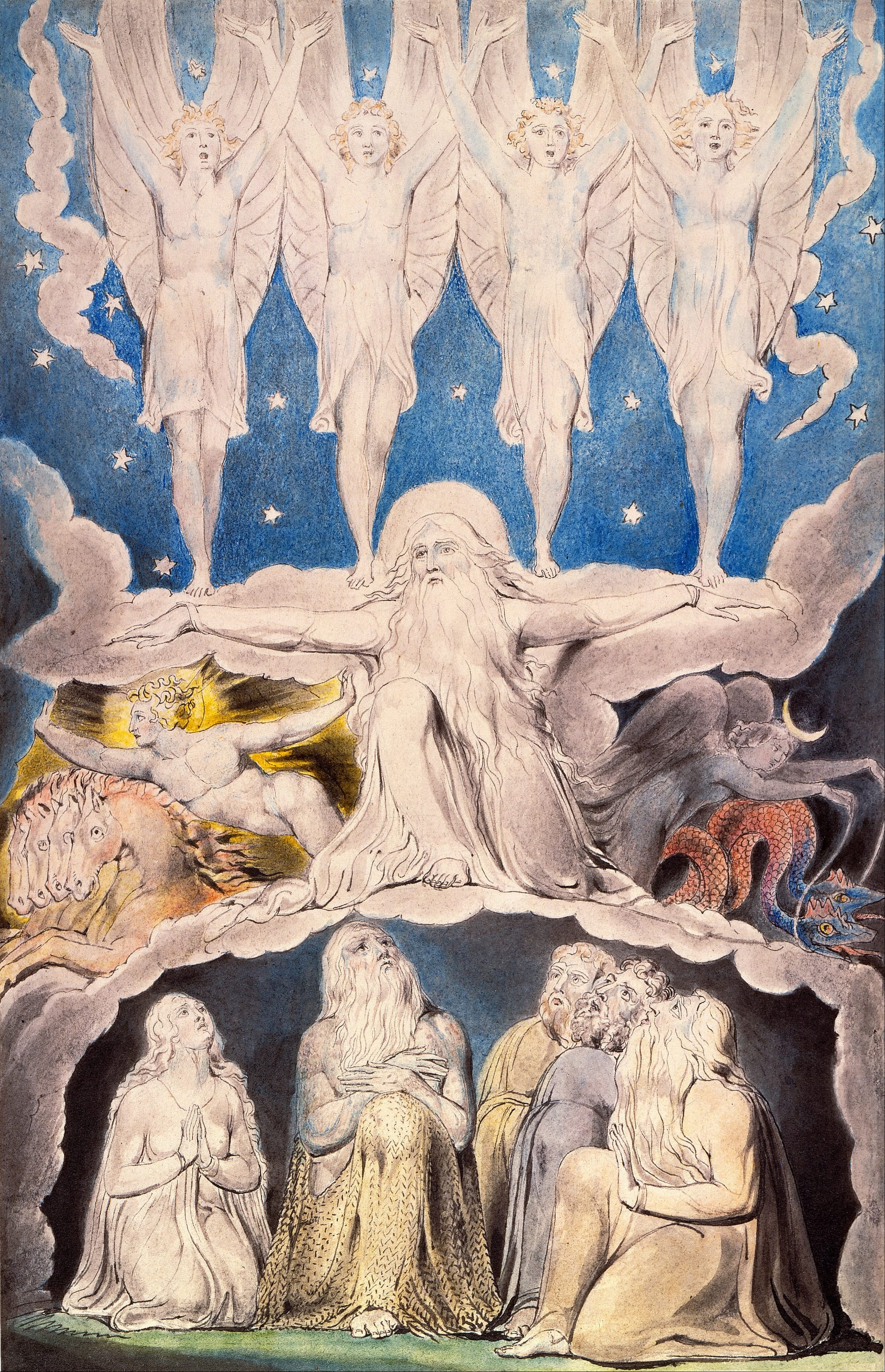
‘When the Morning Stars Sang Together’ depicts a Golden Age, in which the sun rides a chariot pulled by four horses and the moon a chariot pulled by two serpents or dragons. Creation fills the border: a cow and a sheep are at ease and go unmolested by a lion.
The text reads, “Let the Earth bring forth Cattle & Creeping thing & Beast”.
The scene is witnessed by stars grouped in configurations of seven and three, by an angel crowned with stars, and by a sorrowful Creator illuminated by a light beyond light, brighter than the sun.
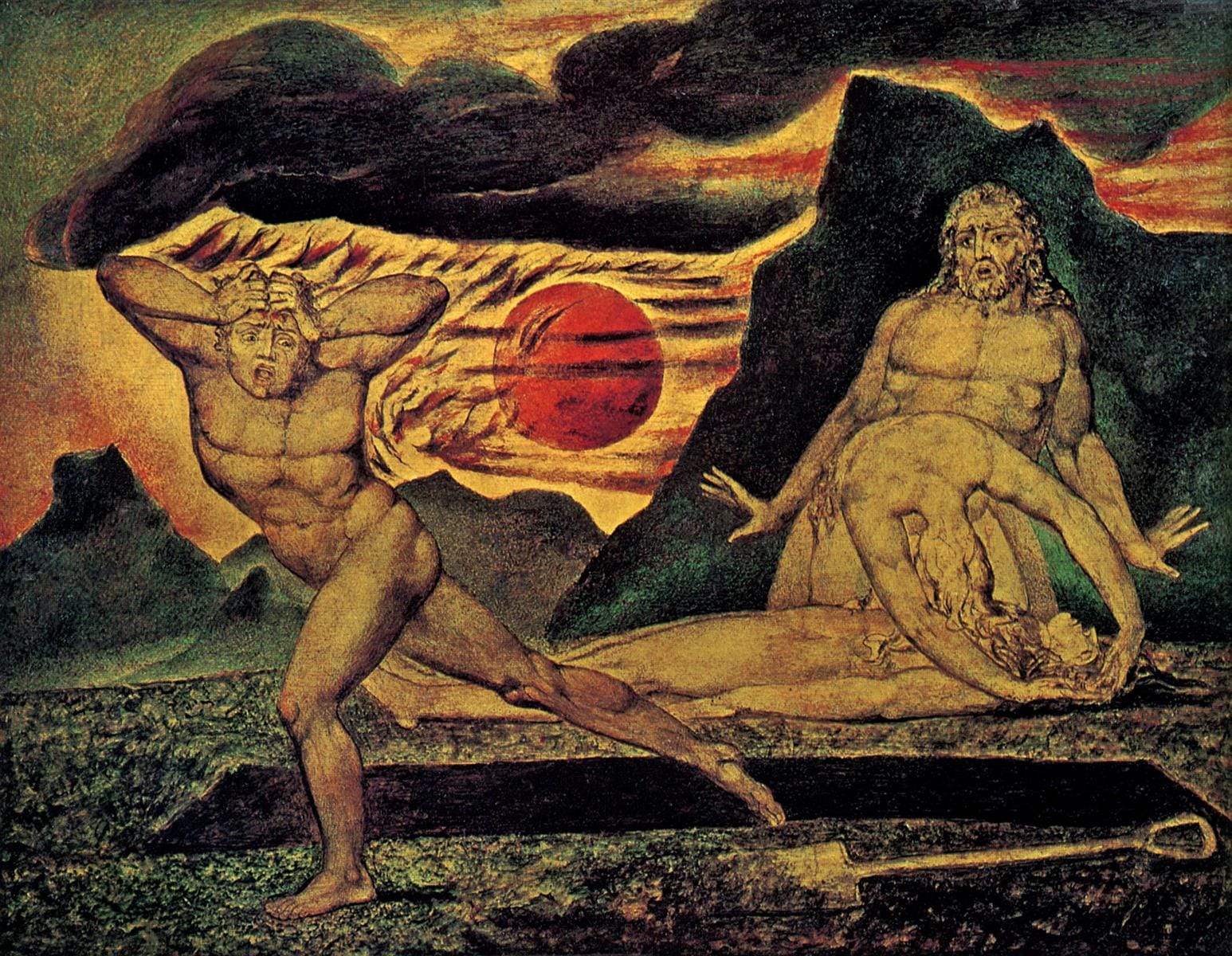
In ‘The Body of Abel Found by Adam & Eve’, an anguished Cain has emerged from the grave he has prepared for his brother and gouged the mark on his own brow, a sign of self-knowledge and dread born of his sudden immersion in a state of living death. He deeply regrets what he has done. Blake identifies Cain’s primary error as a wilful descent into unprofitable earth, as witnessed by the gravedigger’s shovel beginning to merge with the ground. Cain’s act represents another fall into matter, still grosser than that inherited by his parents after their expulsion from Eden. Cain is not condemned by Blake, but pitied in light of the doctrine of the Forgiveness of Sin.
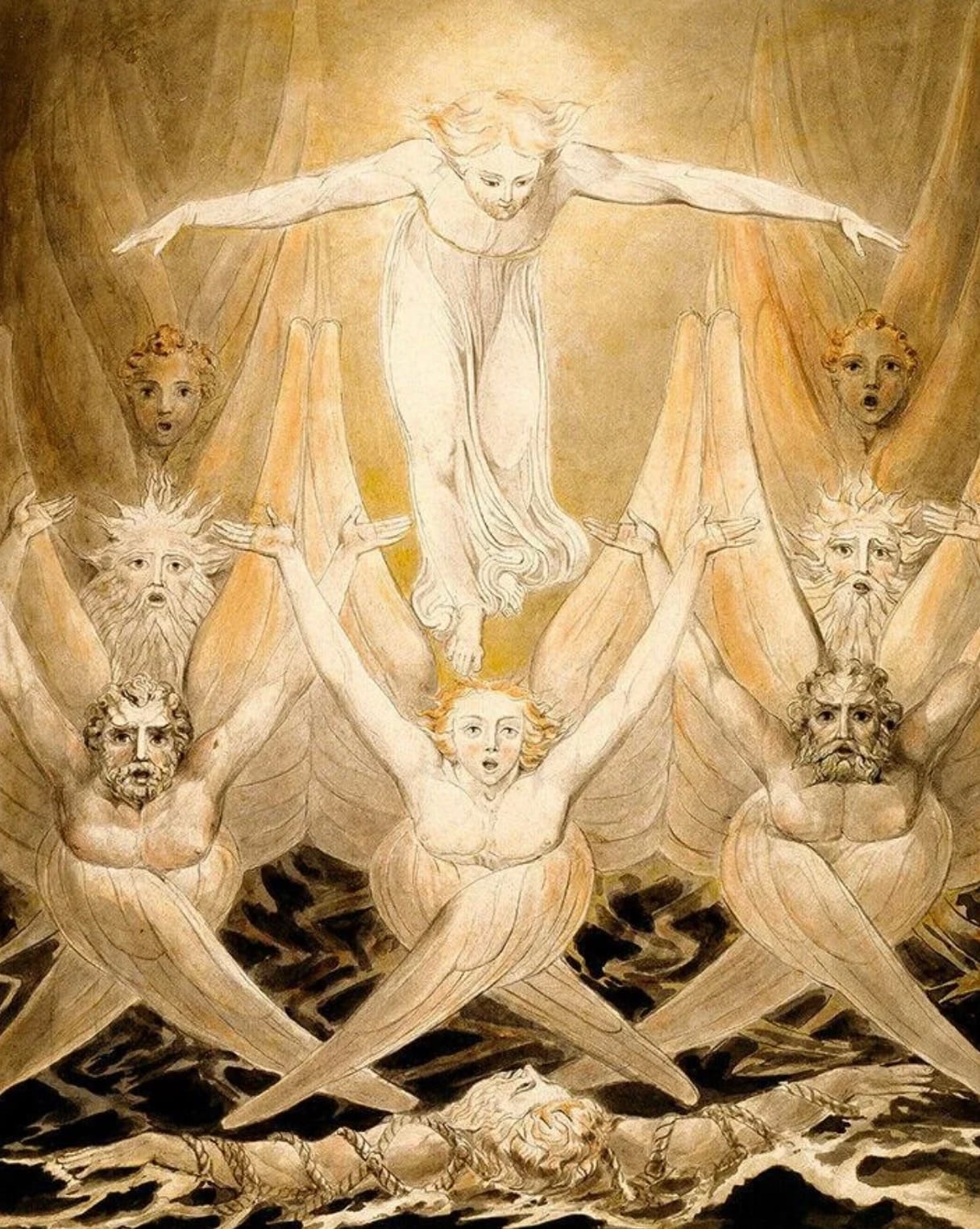
Although ‘David delivered out of Many Waters’ likens David to Christ through echoed posture, and the bound David suggests the bound Jesus Christ to come, this generally orthodox message is contrasted with Blake’s depiction of the accompanying angels, who grow progressively more mindless as they ascend in ranks towards the throne. For Blake, angels have no will of their own, except for rebellious Lucifer and his companions. Blake identifies servitude with self-dissolution and individual freedom with a creative state. David is not an entirely elevated figure. In ‘Bathsheba at the Bath’ he is tiny compared with the vastness of Bathsheba, whose beauty is so great that it fills the world and can be appreciated by far distant men. David’s earthbound lust diminishes his stature, as does his admiration for the physical beauty that prompts it.
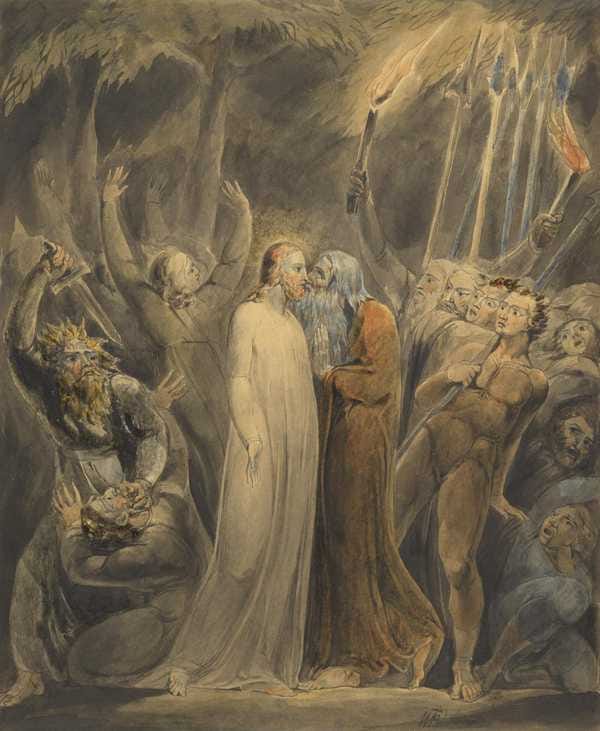
In ‘Judas Betrays Him’, even Judas’s co-conspirators are horrified by his act of betrayal. They shrink back from the scene and from the radiant form of Jesus. Judas is depicted as a Druid, a representative of the old religion of blood and vengeance that Blake despised. He clasps his hands in prayer and appears sorrowful and ashamed. Christ looks directly into Judas’s eyes, while the traitor diverts his gaze upwards; Christ’s open hand points downwards in answer, indicating the fate of his betrayer.
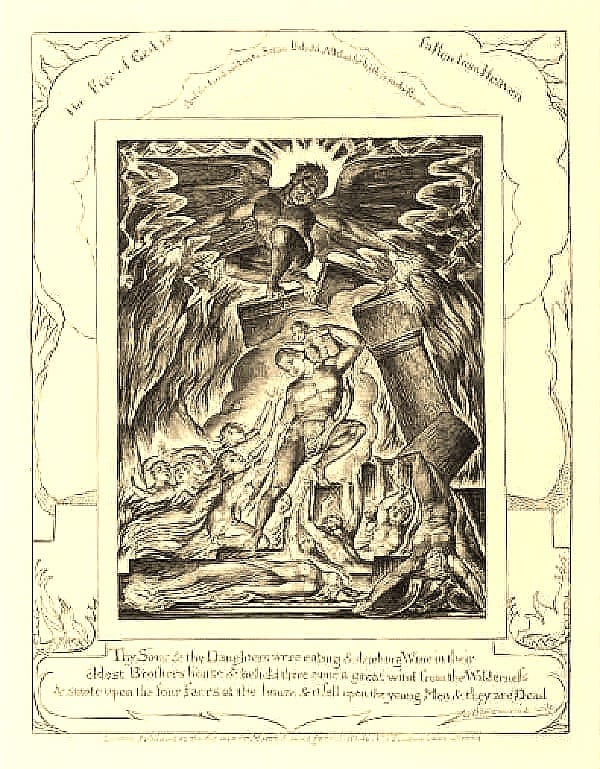
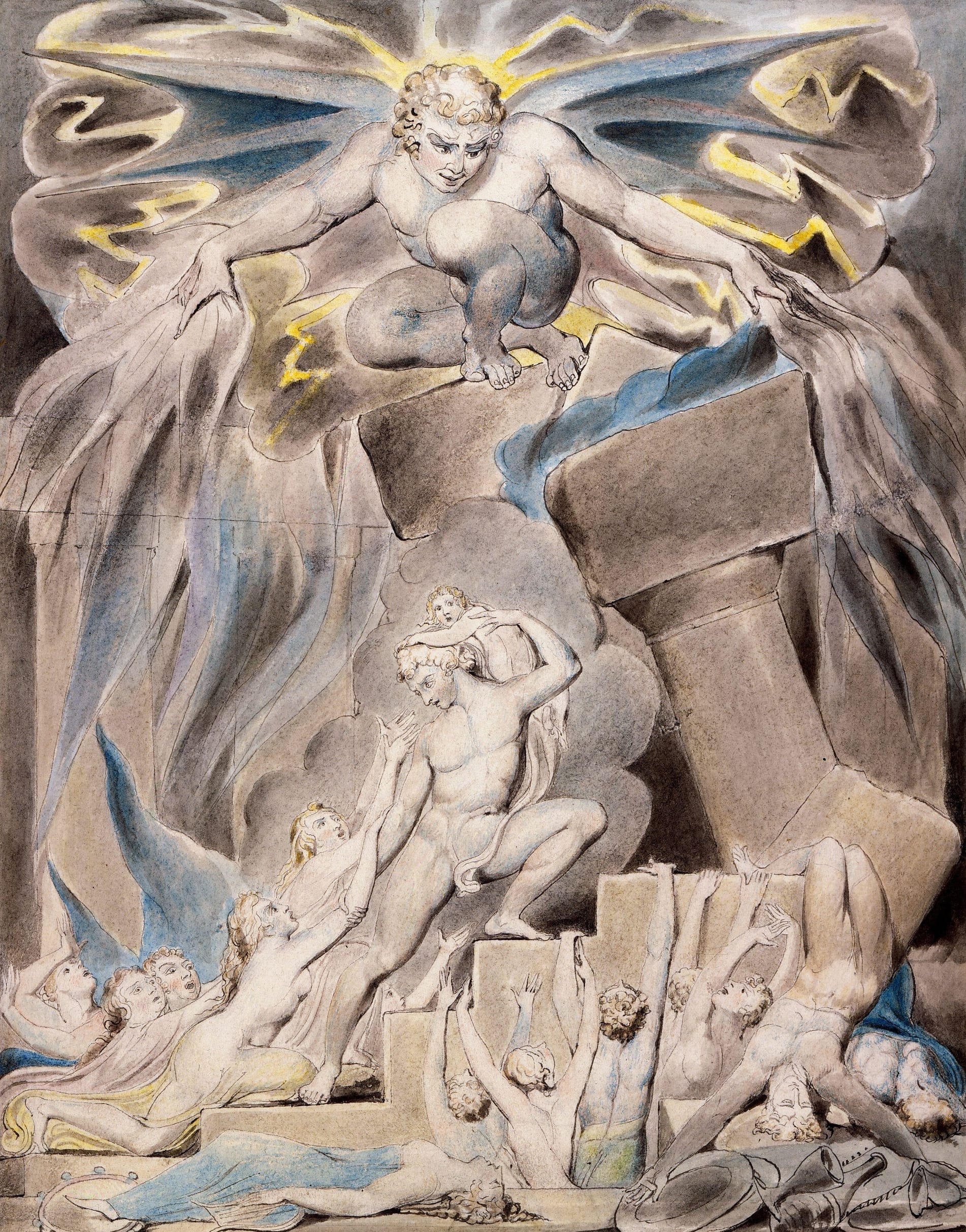
Blake accompanies ‘Job's Sons & Daughters Overwhelmed by Satan’ with the saying ‘The Fire of God is fallen from Heaven’, illustrating Satan’s delight in destruction and showing that Satan’s delight is man’s dismay.
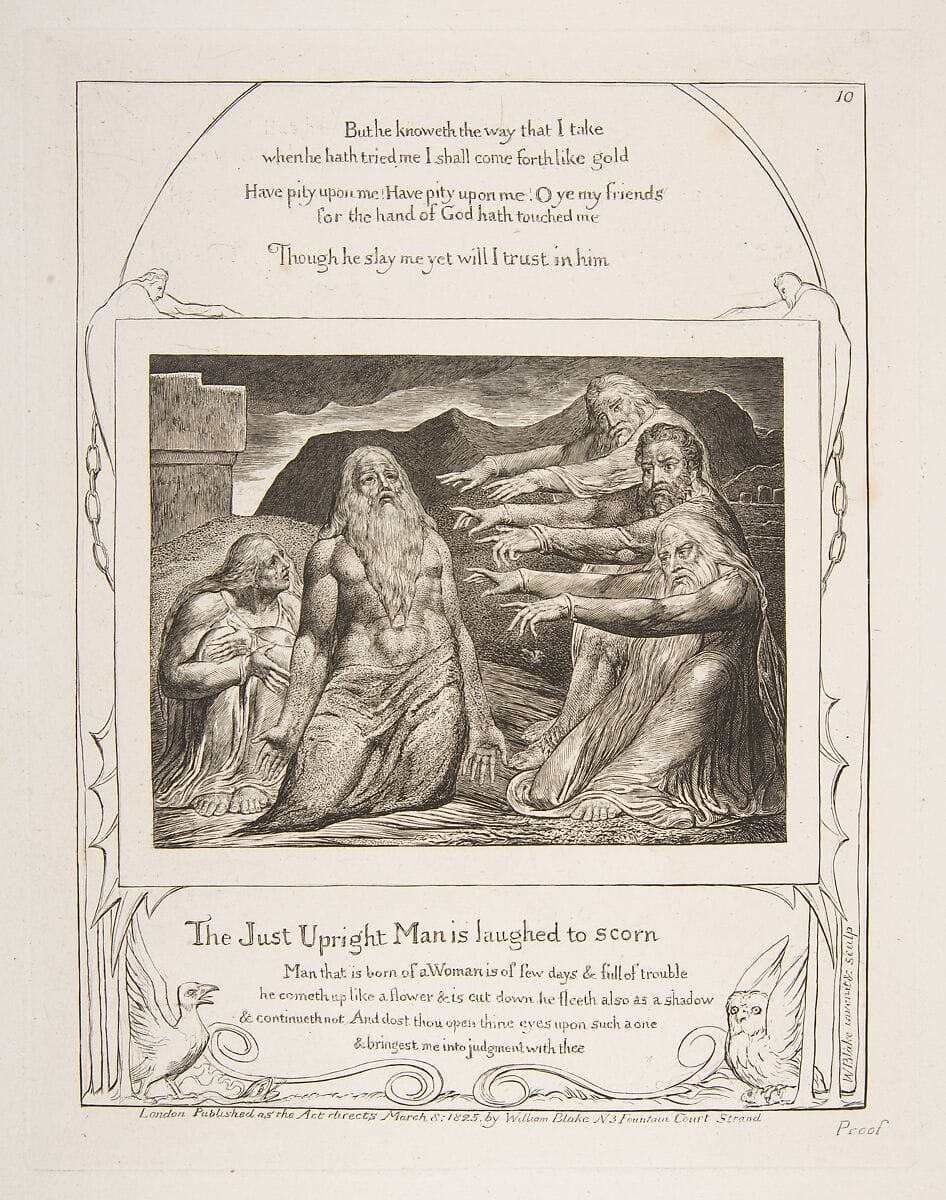
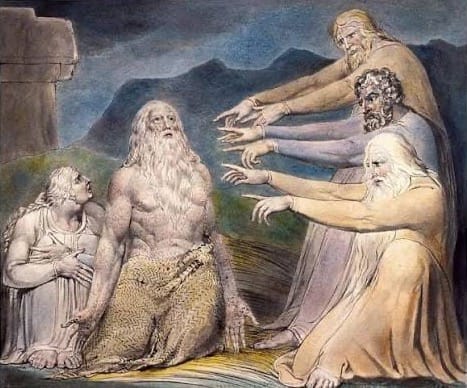
The title of ‘Job Rebuked by His Friends’ links the supposed friends of Job to Satan by virtue of their function. In the border to the left, a bird triumphs over a serpent; in the border to the right, the owl of wisdom triumphs over a rat. In the landscape beyond the three supposed friends there are three standing stones, identifying those who are concerned with the things of the earth with petrification. Job addresses a being beyond his false friends, and beyond the ultimate false friend, Satan: a being who
“...knoweth the way that I take:
when he hath tried me
I shall come forth like gold."
Yet Job’s proclamation smacks of earthly pride and vanity, and the question accompanying Blake’s depiction of ‘The Lord answering Job out of the Whirlwind’ is, “Who is this that darkeneth counsel by words without knowledge”.
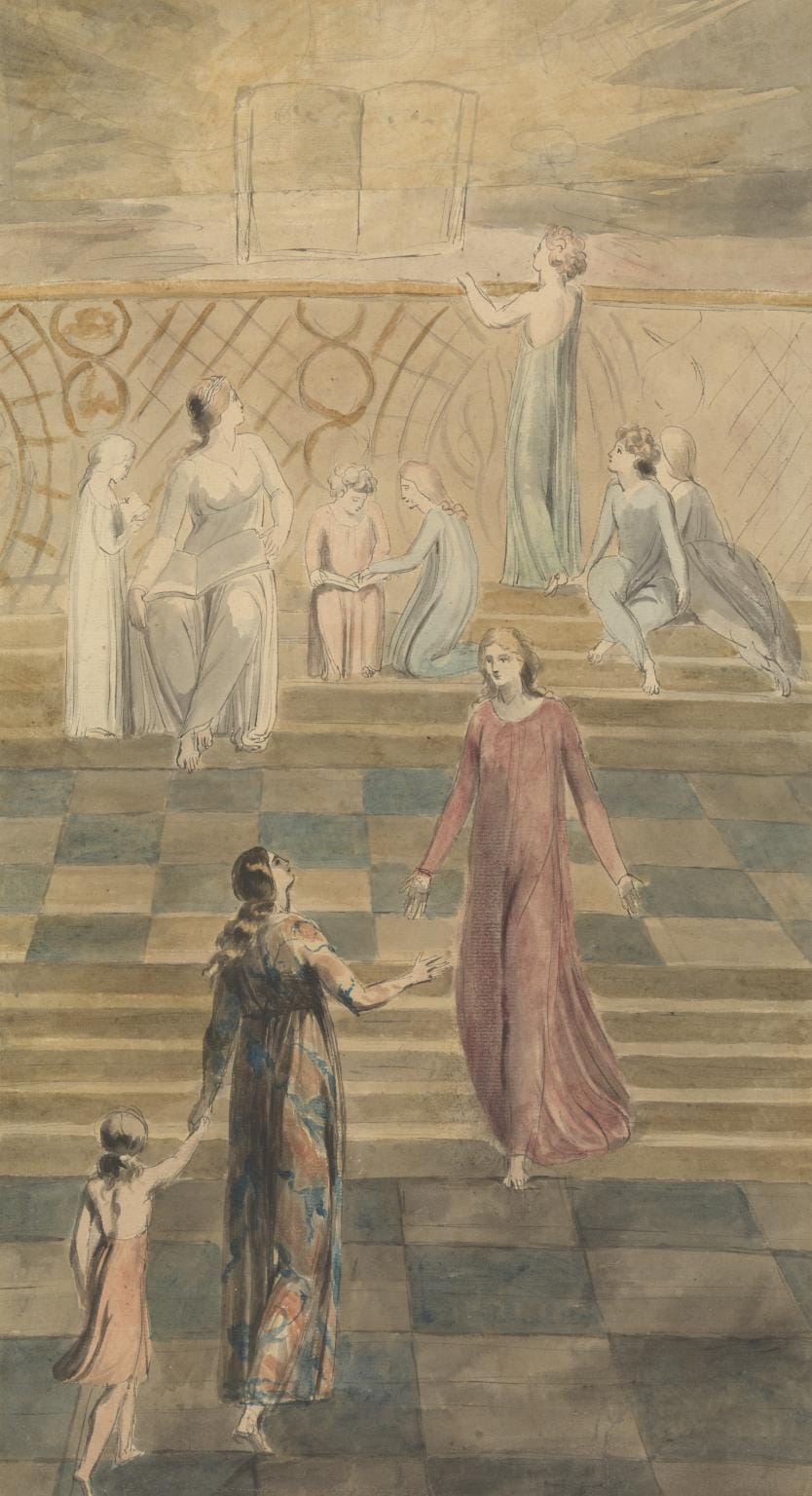
‘An Allegory of the Bible’ presents a transcendent world view. A young girl is conducted by the kindly grace of an older companion to the figure of Christ, who will guide her to a gathering of people receiving instruction from blank books. She will become one of these students. The fiery volume that forms the centrepiece of the altar in the background contains no text, and like the books of instruction, it shows that the letter kills, but the spirit enlivens.
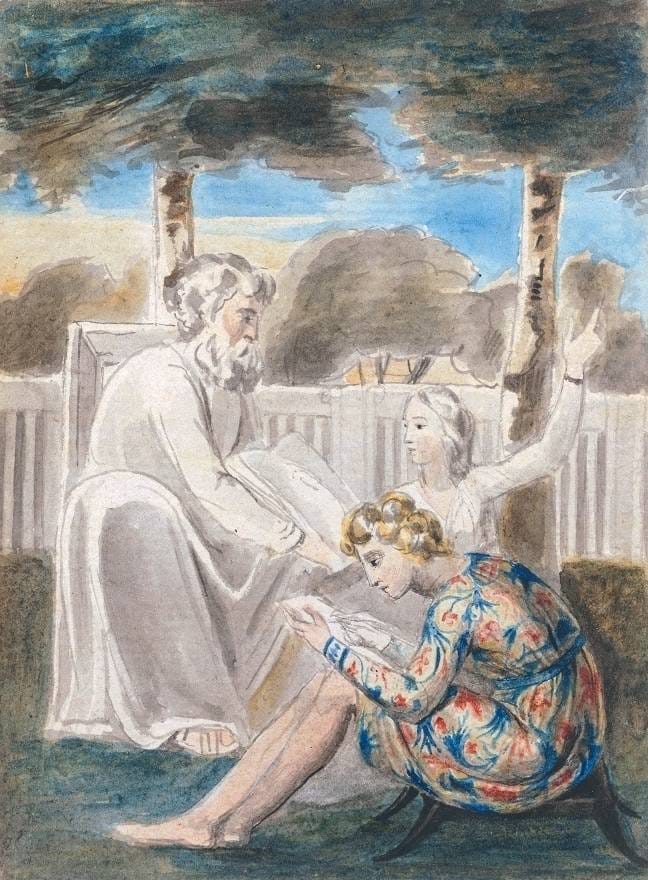
‘Age Teaching Youth’ shows an old man who has no more use for books, having digested their contents. His robes are stone-like and resemble gravestones. He shows a book to a young girl, who has no interest in it; she indicates that her wisdom comes from the skies, or from nature. An older woman in the foreground (commonly identified as a youth, indicating that the gender of many of Blake’s figures is indeterminate) is engrossed in a different text; this is what the girl will become. The gorgeous apparel of this earnest student is an indicator of her vanity. The two trees behind the figures represent the Tree of Life and the Tree of Knowledge of Good and Evil; beyond them, clouds merge like the entwined foliage of the trees. For Blake, enlivening wisdom is found in a particular form of personal experience rather than in conformity to doctrine.
"Good & Evil are Riches & Poverty
a Tree of Misery propagating
Generation & Death."
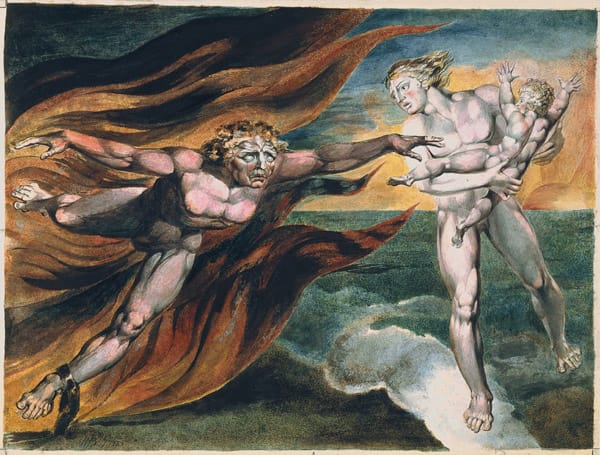
‘The Good and Evil Angels’ is one of Blake’s better-known paintings. The evil angel has no hope of taking possession of the child, who represents the soul, for he is blind and tethered to the earth by a metal band attached to his ankle. Yet the good angel is also impotent in this matter; he looks alarmed despite the powerlessness of his adversary to gain final victory. It is in the nature of what is commonly defined as good to fear what is commonly defined as evil. Thus both angels are possessed of good and evil despite initial appearances. The good in the ‘evil’ angel consists of energy and effort despite limitation, and the evil in the ‘good’ angel is groundless fear.
Blake represents the soul as a child in both ‘Age Teaching Youth’ and ‘An Allegory of the Bible’. The soul will not submit to the wisdom of this world, but it will embrace the teachings of the book of light that is life with interest and enthusiasm. The ‘good’ and ‘evil’ angels emanate from the child, and the fact that neither can gain final victory, and that both are admixtures containing their polar opposites, indicates the nature of the child’s being.
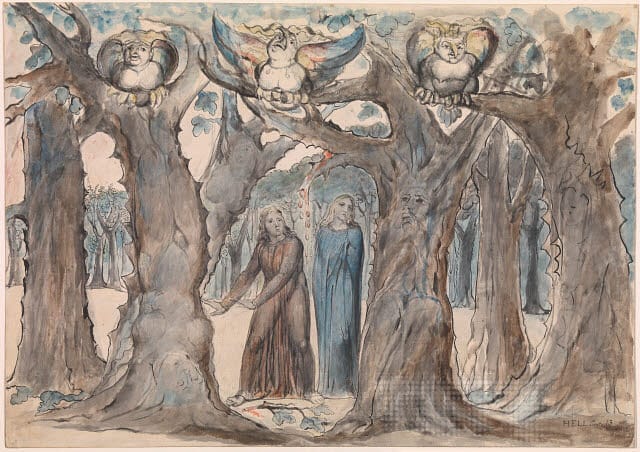
Engaging with, and arguably improving on, Dante, ‘The Wood of the Self-Murderers: The Harpies & the Suicides’ shows figures enclosed in three of the five trees in the foreground. These include an inverted figure in the second tree from the left, which also shows another figure in its major offshoot branch. The bleeding and broken branch of the central tree indicates that salvation is present in the scene, recalling that Christ was crucified between two thieves. The work also relates to the common perception of trees, in which human forms can be observed, often upside down, as we walk through woods.
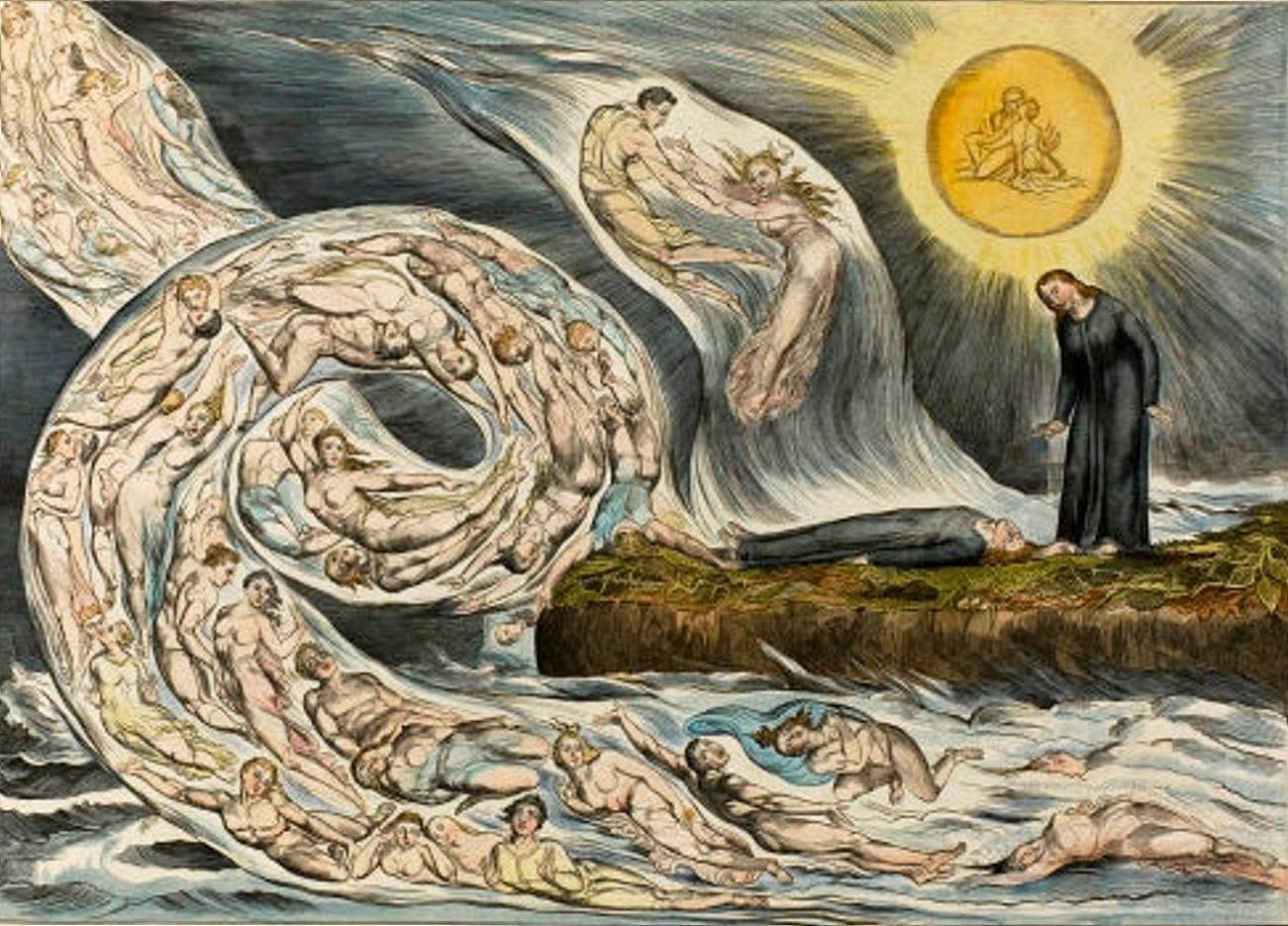
‘The Circle of the Lustful’ is a work of pity and compassion. The soul of a dead man rises through the love of Christ and is made bright and eternal. The lovers in a containing circle ascend heavenwards to indicate that the dead will be raised incorruptible by virtue of their love for others.
Blake treats the Pastorals of Virgil as a foreshadowing of something greater to follow. Suggestions of light beyond light rise above the figure of Colinet resting against a tree, and the underlying theme of the work is confirmed by the addition of the motto “I am the good shepherd…”. Cruciform constructions inform Colinet’s arduous journey, with only the brilliance of the rising sun and the moon in its phases to sustain him as he travels.
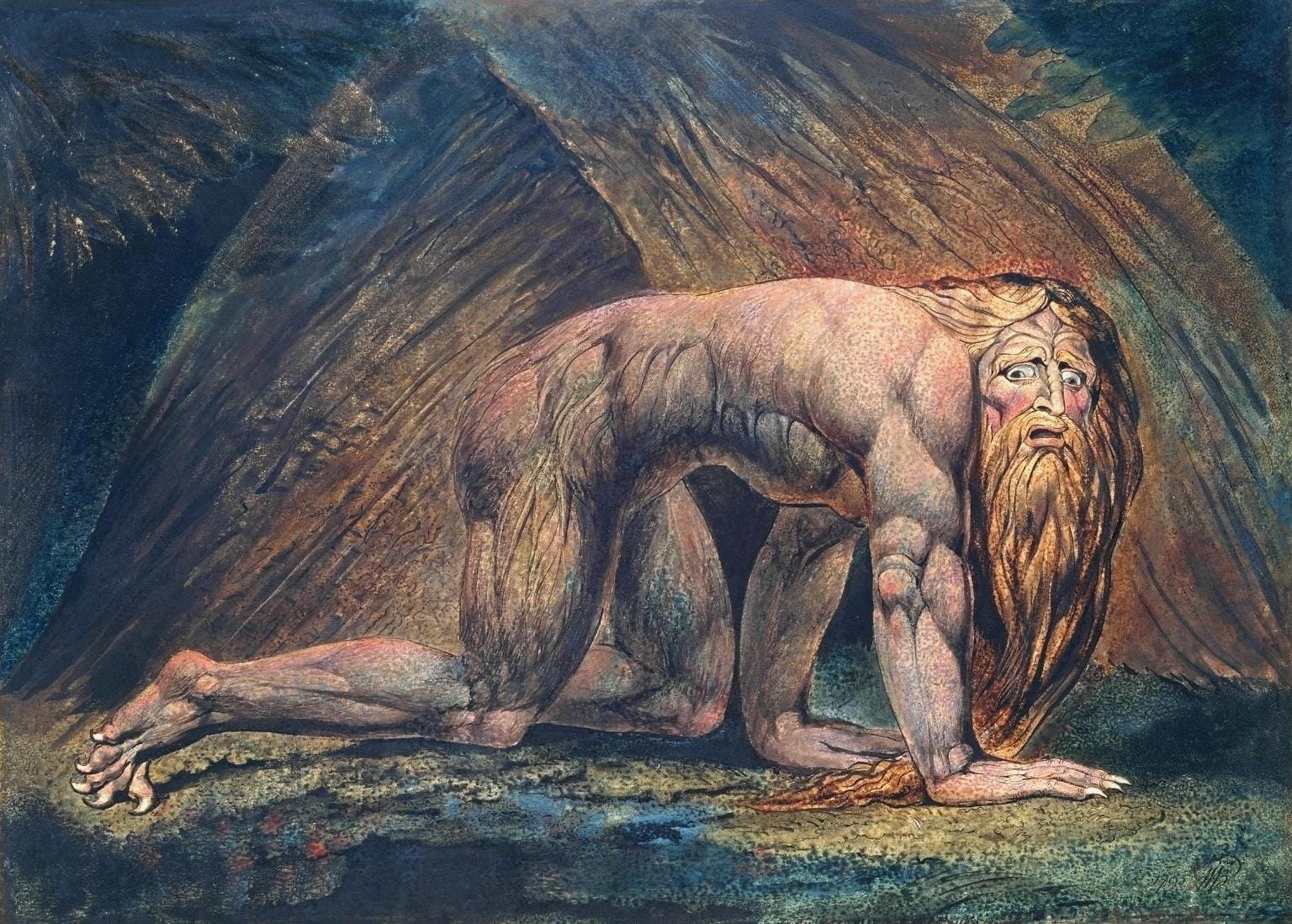
The frottage technique employed on ‘Newton’ and ‘Nebuchadnezzar’ precedes Max Ernst by almost two centuries. ‘Nebuchadnezzar’ illustrates the horror of man becoming beast and beast becoming man. It also shows the beast merging with stone. It is another illustration of the consequences of being over-concerned with the things of the earth: a process of petrification.
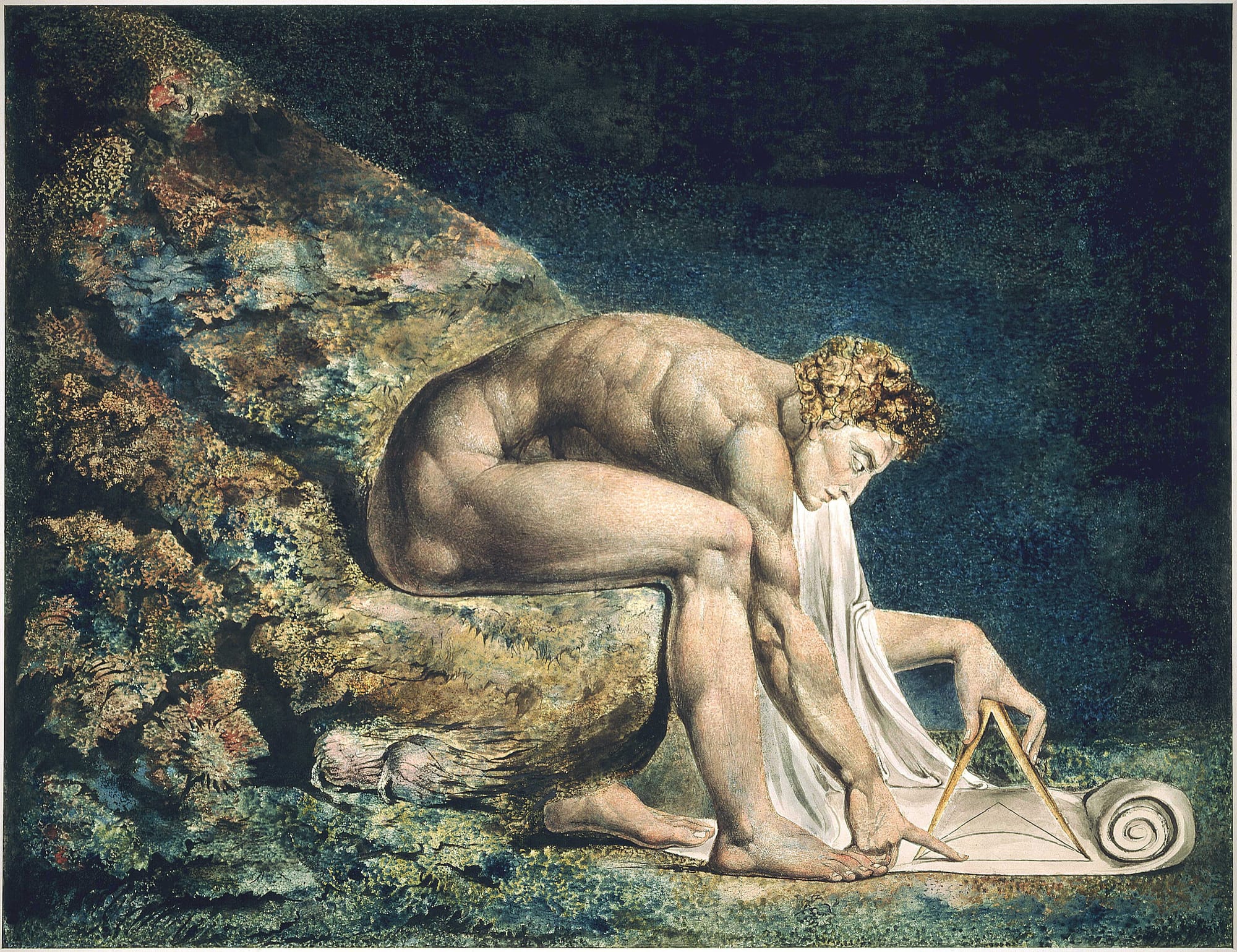
Somewhat contrary to expectations, ‘Newton’ is portrayed as a heroic, if Satanic, figure. His finger rests on the base of an equilateral triangle, which he traverses with a semi-circle. He is engaged in a work in progress, drawing an alchemical diagram in accordance with the Theorem of John Dee:
“It is by the straight line and the circle that the first and most simple example and representation of all things may be demonstrated, whether such things be either non-existent or merely hidden under Nature’s veils.”
It is interesting to note that Christ holds a giant pair of compasses in ‘Christ in the Carpenter’s Shop: the Humility of the Saviour’.
William the Teacher
Blake disdains authority and takes orthodoxy as a starting point for flights of fancy. Yet he presents himself as a teacher by virtue of being one who knows and is “...under the direction of Messengers from Heaven, Daily and Nightly”.
He teaches that Satan is the product of an inverted crucifixion, that he delights in destruction and that his delight is man’s dismay.
He teaches that murderers emerge from the graves of those they slaughter and pass through the world in a state of anguish, wounding their own flesh before merging with the earth. He teaches that a beast with the hands of a man clutches its meal of human meat with a display of malevolent mirth and that the human characteristics of giants fade until they become stones. A beast emerges from the stone and eyes the sheltering cave beyond it.
He teaches that thieves and serpents are creatures of fire swimming in fire and that serpents emerge from the genitals of prone and falling thieves.
He teaches that the companions of an evil man are horrified by his actions and that his prayers are prayers of sorrow and shame. An evil man cannot withstand the gaze of Christ but shrinks back in horror from his radiance.
He teaches that the scientist is an alchemist dealing in circles and straight lines, engaged in work that is always in progress but fails to reach completion.
He teaches that the man of God resembles the Son of God, and that the letter kills but the spirit enlivens.
He teaches that the beauty of women fills the world of men and that the lust of men diminishes their stature and makes them afraid of what they desire. Winter is an old and sorrowful man, carrying a split staff, wrapping his arms around himself against the cold, many miles from his destination. Beneath Sol and Luna, the brightness of the moon in all its phases matching the brilliance of the rising sun (the sun might be rising or setting; it could be the sky of dawn or sunset), we see crosses erected by the roadside just beyond a milestone before encountering the cloven tree from which Winter cut his staff.
He teaches that spirits are bound to earth by fear, resignation, and despair, and that by transcending these forces the earthly might rise to spiritual realms. He teaches that everything has a soul and that some men possess the ability to render these souls visible, painting visions framed by stars. He teaches that the soul will not readily submit to the wisdom of this world, so poor and tired that even its masters disdain it, but that it will embrace the teachings of the book of light that is life with interest and enthusiasm. He teaches that the man of God resembles the Son of God, and that the letter kills but the spirit enlivens.
He teaches that Christ has pity on the dead and approves of earthly love. Christ makes love bright and eternal and leads lovers to embrace in the heart of the sun. He teaches that the dead will be raised by their love for others.
He teaches that the sun rides a chariot pulled by four horses and the moon rides a chariot conveyed by two dragons and that stars align themselves in order. He teaches that the angels are crowned with stars and that the light behind the Creator is brighter than the sun.
In Beulah
Beulah is the land of vision, soul, and imagination. The everlasting gospel sings of the soul and the imagination, not created for destruction like the natural man, but manifesting the love and grace of eternity and giving rise to the eternal body of man. Anything seen from the land of Beulah is touched by the land from which it is seen:
“The characters of Chaucer’s Pilgrims are the characters which compose all ages and nations: as one age falls, another rises, different to mortal sight, but to immortals only the same; for we see the same characters repeated again and again, in animals, vegetables, minerals, and in men; nothing new occurs in identical existence; Accident ever varies, Substance can never suffer nor decay… Every age is a Canterbury Pilgrimage; we all pass on, each sustaining one or other of these characters; nor can a child be born, who is not of these characters of Chaucer.”
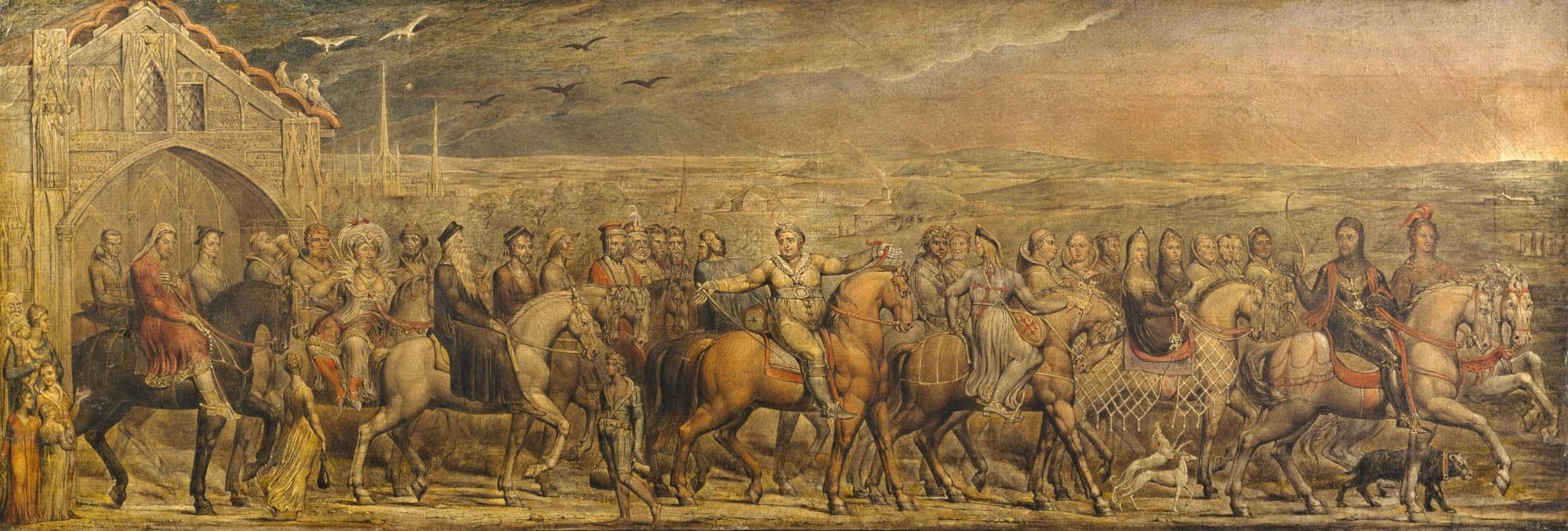
That sets the scene. Let us conclude:
From Blake’s description of his lost painting of The Last Judgement
The nature of Visionary Fancy, or Imagination, is very little known; and the Eternal nature and permanence of its ever-Existent Images is considered as less permanent than the things of Vegetative and Generative Nature. Yet the Oak dies, as well as the Lettuce; but its Eternal Image and Individuality never dies, but renews by its seed. Just so the Imaginative Image returns, by the seed of Contemplative Thought. The Writings of the Prophets illustrate these conceptions of the Visionary Fancy, by their various sublime and Divine Images, as seen in the Worlds of Vision.
This World of Imagination is the World of Eternity; it is the divine bosom into which we shall all go, after the death of the Vegetated body. This world of Imagination is Infinite and Eternal; whereas the World of Generation, or Vegetation, is Finite and Temporal. There Exists in that Eternal World the Permanent Realities of Everything which we see reflected in this Vegetable Glass of Nature. All Things are comprehended, in their Eternal Forms, in the divine body of the Saviour, the True Vine of Eternity, the Human Imagination; who appeared to me coming to Judgment among his Saints, and throwing off the Temporal that the Eternal might be established. Around him were seen the Images of Existences, according to a certain order, suited to my Imaginative Eye.
Whenever any Individual rejects Error and embraces Truth, a Last Judgment passes upon that Individual.
Around the Throne Heaven is opened, and the nature of Eternal Things displayed, all springing from the Divine Humanity. All beams from him. He is the Bread and the Wine; he is the Water of Life. Accordingly, on each side of the opening Heaven appears an Apostle. That on the right represents Baptism; that on the left represents the Lord’s Supper. All Life consists of these two, - throwing off Error and Knaves from our company continually; and receiving Truth, or Wise Men, into our company continually. He who is out of the Church, and opposes it, is no less an Agent of Religion than he who is in it; to be an Error and to be cast out is a part of God’s design. No man can embrace True Art till he has explored and cast out False Art, or he will be himself cast out by those who have already embraced True Art. Thus my picture is a history of Art and Science, the Foundation of Society, which is Humanity itself. What are all the Gifts of the Spirit but Mental Gifts? Whenever any Individual rejects Error and embraces Truth, a Last Judgment passes upon that Individual.
Annotations to Blake’s Prose Works (from ’Blake: Complete Writings, ed. Geoffrey Keynes)
I see myself engaged in a fervent, ecstatic, ill-disciplined study of Blake’s work in Uxbridge library in 1979, at the age of 17. What led me there? I can’t say with any certainty, but I can hazard a guess: the singing of the hymn ‘Jerusalem’ at school assemblies in childhood (the heritage of Albion unfolding in the innocent and receptive ear); references to the doors of perception, clear sight and infinity in the NME. The first art show that ever truly moved, or fulfilled, me was an exhibition of Blake’s prints at the Serpentine Gallery in Hyde Park, which I attended as a result of my studies in Uxbridge. The fascination abides, is returned to, and breeds further fascination.
My beloved J, whom I look upon as she sleeps and identify as the source of my life’s happiness, was raised in the village of Lavant, near Chichester in West Sussex. And Blake was in Lavant too. On 22 November 1802, he wrote to Thomas Butts of “walking from Felpham to Lavant to meet my Sister...above a twelve-month ago...”. In the same letter, he includes a poem, which contains the lines:
"May God us keep
From Single vision & Newton's sleep...”,
which are directly quoted by Jhonn Balance in the Coil song ‘The Dreamer is Still Asleep’.
Blake insisted that the sacred was located within humans, not fenced off and curated by the Church or other external institutions.
Blake and his wife Catherine were fond of a certain Harriet Poole, a friend of Blake’s Chichester-born patron William Hayley, who lived in a villa in Lavant. When his initial enthusiasm for his retreat in Felpham, ten miles distant, faded, Blake wrote to his brother James on 30 January 1803 of his intention “To take a house in some village further from the Sea, Perhaps Lavant...”. But, as the history of Blake makes clear, this never happened. Nevertheless, the current keepers of the Earl of March pub, which rises above Lavant village green, are happy to suggest that the beginning of the poem known as ‘Jerusalem’, from the preface to ‘Milton’, was composed there as Blake looked upon the rolling hills around him. Although this is unlikely, it remains possible, because the countryside surrounding the village remains a perfect example of England’s green and pleasant land.
In his introduction to the Complete Writings, Keynes writes: “Blake insisted that the sacred was located within humans, not fenced off and curated by the Church or other external institutions... In the Blakean cosmos, sense and sexuality, pleasure and pain, grace and sin are all part of the continuum of the diverse – none are considered transgressions.”
Blake was vehemently opposed to priests as officers of a State Religion, which had nothing to do with God (and to the State Religion of the Jews, which represented itself as an embodiment of the will of God, but which Christ opposed).
“...our Lord is the word of God & every thing on earth is the word of God & in its essence is God.”
- ‘Annotations to Lavater’
So, in God we live and move and have our being.
“The Religions of all Nations are derived from each Nation’s different reception of the Poetic Genius, which is every where call’d the Spirit of Prophecy.”
- ‘All Religions are One’
truth-based reality is not to be found in what Blake termed ‘State Religion’, which emphasises ‘State’ to the detriment of ‘Religion’.
All religions are particular expressions of the same underlying, truth-based reality, which enabled Blake to write approvingly of ‘the Edda of Iceland’. This truth-based reality is not to be found in what Blake termed ‘State Religion’, which emphasises ‘State’ to the detriment of ‘Religion’.
“The Gospel is Forgiveness of Sins and has no Moral Precepts; these belong to Plato & Seneca & Nero.”
- ‘Annotations to Watson’
Forgiveness is an expression of expansive generosity. Moral precepts are grounded in oppression and restraint.
“The Kingdom of Heaven is the direct Negation of Earthly domination.”
- ‘Annotations to Bacon’
The kingdom of heaven is within. The aspiration towards earthly domination is grounded in the illusion of an extra-personal field of combat, in which one must quest and subdue.
“What is Liberty without Universal Toleration?”
- ‘Annotations to Boyd’s Dante’
Liberty without toleration is the vain conquering impulse of directed armies.
“Man varies from Man more than Animal from Animal of different Species...”
Rudolf Steiner suggests that the wisdom experience of a whole animal species is roughly equivalent to the wisdom experience of a single human being.
and
“...Man Brings All he has or can have into the World with him. Man is Born Like a Garden ready Planted & Sown. This World is too poor to produce one Seed.”
- ‘Annotations to Reynolds’
So ‘Man’ is superior to ‘the World’ in Blake’s scheme.
“Visions of these eternal principles or characters of human life appear to poets in all ages; the Grecian gods were the ancient Cherubim of Phoenicia, but the Greeks, and since them the Moderns, have neglected to subdue the gods of Priam. These gods are visions of the eternal attributes, or divine names, which, when erected into gods, become destructive to humanity. They ought to be the servants, and not the masters of man, or of society. They ought to be made to sacrifice to Man, and not man compelled to sacrifice to them; for when separated from man or humanity, who is Jesus the Saviour, the vine of eternity, they are thieves and rebels, they are destroyers.”
- ‘A Descriptive Catalogue’
The ‘gods’ are visions of principles and attributes, which should not be separated from man or humanity, and should not be worshipped as divine beings. Blake directly equates ‘man or humanity’ with ‘Jesus the Saviour, the vine of eternity’.
“The Prophets describe what they saw in Vision as real and existing men, whom they saw with their imaginative and immortal organs, the Apostles the same; the clearer the organ, the more distinct the object. A Spirit and a Vision are not, as the modern philosophy supposes, a cloudy vapour, or a nothing; they are organized and minutely articulated beyond all that the mortal and perishing nature can produce... Spirits are organized men.”
- ‘A Descriptive Catalogue’
So there are organs of perception that enable certain individuals to see clearly spiritual beings that are not generally apparent. We may deduce that any non-material being seen repeatedly, and maintaining consistency of form, is real.
There is no particular merit associated with the perception of visionary beings, unless we take this widening of the field of vision to be positive in itself, on the grounds that to see more is to see better. The ‘real and existing men’ that the prophets saw in vision appeared for particular purposes, as the ordained messengers of God. The organised spirits seen by Blake were also embodiments of ideas, which he attempted to describe in a series of Prophetic Books that tend towards obscurity because of their dependence on the experience of their author. There is little doubt that Blake gained greatly from his visionary capacity, although perhaps he paid for it in terms of the ‘Nervous Fear’ that he also experienced. There is a kind of calm, blissful emotion associated with the perception of certain types of non-material beings and the landscapes, or mindscapes, they inhabit; but the question remains: what value does personal experience have to anyone other than the person who experiences it?
“Every thing is Eternal.”
- ‘A Vision of the Last Judgement’
The living acceptance of this saying enables apprehension of the psychedelic multiverse.
“The Modern Church Crucifies Christ with the Head Downwards.”
- ‘A Vision of the Last Judgement’
Not only does ‘the Modern Church’ (the bureaucratic church, or State Religion) fail to understand the meaning of Christ, but it works cruelty and oppression through its deliberate perversion of doctrine.
“Mental Things are alone Real; what is call’d Corporeal, Nobody Knows of its Dwelling Place; it is in Fallacy, & Its Existence an Imposture. Where is the Existence Out of Mind or Thought?”
This is a succinct description of the moment-to-moment experience of immediate reality. Physical objects owe the substance they possess, or seem to possess, to the machinations of the mind.
and
“I question not my Corporeal or Vegetable Eye any more than I would Question a Window concerning a Sight. I look thro’ it & not with it...”
- ‘A Vision of the Last Judgement’
“A Poet, a Painter, a Musician, an Architect: the Man Or Woman who is not one of these is not a Christian.”
It is safe to assume that by ‘a Christian’, Blake means ‘a servant of humanity’, because ‘man or humanity’ is ‘'Jesus the Saviour...’
“All that we See is Vision, from Generated Organs gone as soon as come, Permanent in The Imagination, Consider’d as Nothing by the Natural Man.”
- ‘The Laocoon’
The Generated Organs of the Natural Man may be considered blank screens, reflecting the repository of data from which the Imagination derives meaning.
As previously quoted: “What Book is for Vengeance for Sin & whatever Book is Against the Forgiveness of Sins is not of the Father, but of Satan – the Accuser & Father of Hell.”
- ‘Notes on the Illustrations to Dante’
Who, then, is the ultimate author of the individual books of the Bible, or the author of the Koran? And how have these strange admixtures of mercy and vengeance come to be accepted as unities? The fundamental principles of the Gnostic worldview explain the apparent inconsistency and contradiction.
“The Greek & Roman Classics is the Antichrist.”
Presumably because the Greeks and Romans were the fathers of the Moral Precepts that stand against the Gospel of the Forgiveness of Sins.
Blake’s version of the Lord’s Prayer, from ‘Annotations to Thornton’, suggests correspondences between his conception of Satan and the Demiurge of the Gnostics, and presents worldly authority, in the guise of Caesar, as a function of Satan, the God of this World:
“Jesus, our Father, who art in thy heaven call’d by thy Name the Holy Ghost, Thy Kingdom on Earth is Not, nor thy Will done, but Satan’s, who is God of this World, the Accuser. Let his Judgment be Forgiveness that he may be consum’d in his own shame. Give us This Eternal Day our own right Bread by taking away Money or debtor Tax & Value or Price, as we have all Things Common among us. Every thing has as much right to Eternal Life as God, who is the Servant of Man. His Judgment shall be Forgiveness that he may be consum’d in his own Shame. Leave us not in Parsimony, Satan’s Kingdom; liberate us from the Natural Man & Kingdom. For thine is the Kingdom & the Power & the Glory & not Caesars or Satan’s. Amen.”
“...every Mortal loss is an Immortal Gain.”
- Letter to William Hayley, 6 May 1800
The implication is that mortal gain is predicated on immortal loss: what does it profit a man to gain the whole world and suffer the loss of his own soul?
“In my Brain are studies & Chambers fill’d with books & pictures of old, which I wrote & painted in ages of Eternity before my mortal life; & those works are the delight & Study of Archangels.”
- Letter to John Flaxman, 21 September 1800
We exist as individual beings in Eternity before we are born into this world, and we engage in individual work there. Do we return there after we die? If the reports of Blake’s joy at the approach of death are to be trusted, he seemed to think so. And we shall find out for ourselves.