"It is the Spirit that quickeneth; the flesh profiteth nothing."
—John, 6:63
"The forces do not work upward from below, but downward from above."
—Hermes
It is often supposed that emanation, creation, and evolution cannot be reconciled. Either the world proceeds of necessity out of God Himself, or God freely chooses to make the world from nothing, or the world contains its cause within itself; its source is either transpersonal, personal, or infrapersonal. The following considerations[[1]] are designed to show that a reconciliation of these points of view is permissible if it is understood that the cosmogonies in question reflect various angles of approach. This is not to say, however, that each of these perspectives is equally adequate. If the “infrapersonal” explanations of physical science are to have any worth, their dependence upon the “personal” account of theology must be fully acknowledged, even as the personal must in turn admit the priority of the “transpersonal” truths of pure metaphysics. Whatever value there may be in the idea of evolution becomes apparent only in light of creation, and then only to the measure that the doctrine of creation is itself illumined by emanation.
The primary aim of this article is to present an account of an evolving world per ascensum fully consistent with the principles presupposed per descensum by metaphysics and theology. Not all Platonists have been Christians, of course, nor have all Christians been Platonists, but there is such a thing as Christian Platonism. This should be sufficient to show that doctrinal positions which include creation within the perspective of emanation, whether widely persuasive or not, are already a matter of record, and that it is not therefore illegitimate to speak of the metaphysician and theologian as sharing certain common “principles.” The question remains, however, whether these principles might serve to inform an evolutionary understanding of the physical world. In its transformist or Darwinian versions, the theory of biological evolution has been for good reason thoroughly rejected, not only by orthodox theologians, but more importantly by those among our contemporaries who have most forcefully propounded an integral metaphysics, and who have done the most to promote in that light an esoteric interpretation of the doctrine of creation ex nihilo.[[2]] It is therefore essential that the reasons for this rejection be carefully considered before presenting a truly principial theory of evolution, one which is fully consistent with the “degrees of Reality” and which acknowledges the prerogatives of a scientia sacra. We aim in this way to avoid the absurdities which usually accompany modern scientific cosmogonies while at the same time “saving the appearances” in the sequence of certain natural forms.
But before proceeding to an evolutionary explanation of things, we would do well to be reminded first of the distinguishing features of a fully metaphysical theology and of the account of the cosmos provided by an “emanational creation.”
Either the world proceeds of necessity out of God Himself, it was said, or God freely chooses to make that world from nothing. Tertium non datur. Or so at least it has seemed to those who eagerness to protect the freedom, and hence the sovereignty, of God has caused them to neglect not only the meaning of “nothing” in the crucial phrase ex nihilo, but also the absoluteness and infinity of God Himself. “Nothing” must here signify either one of two things: that the world is fashioned from no “thing”, from no already determinate entity or entities, and of course it is not, for to speak of a cosmos is to speak of limitation, and the origin of limited “things” must of necessity be unlimited; or that the world is made ex nihilo praeter Deum, from nothing other than God, for the Source of being by which existing things are is quite evidently not an absolute vacuum, nor is such a conception even possible: Ex nihilo nihil fit. But if when one says that the world is created from nothing, it is accordingly meant that the source of the world is supraformal and Divine, then the expression is clearly not a negation, but simply the transposition into theological terms, of emanation. The conception of “nothing” is far from a luxury, of course. It serves to remind us of the impotence and contingency of creatures, of their distance from the God whence they come, and of the “presence of absence” in their make-up; and it can provide in this way a useful corrective for metaphysical expositions in which the discontinuous character of emanation has not been sufficiently stressed, and which therefore risk the error of pantheism. But this error is by no means an inevitable feature of every transpersonal cosmogony.
Nor apart from the transpersonal and metaphysical is the personal or creationist perspective free from certain risks of its own, for it tends not to consider with due care the implications, and even more so the limits, of the Divine Qualities or Names, of which freedom is only one. Theologians who mistrust metaphysicians for fear that the necessity of manifestation, unlike the gift of creation, will compromise the absoluteness of God, and thus His freedom from determination, seem not to have recognized that absoluteness imposes its own limits, not extrinsic to be sure, but intrinsic and proceeding from the essence of the Divine Reality Itself. To call God omnipotent is not to say that He can do anything, lest the goodness of sovereignty be marred by a purely arbitrary deployment. It is to say instead that He cannot be constrained “from the outside in.” But God may, and indeed must, be constrained by His essence, which He cannot negate, any more than a man can lift himself off the ground. Obviously God cannot lie, because He is the truth, and to lie would be to undo the truth of His Word—that Word which He not only speaks, but which, “being of one substance with the Father”, He Himself is. Though perhaps somewhat less obvious, it is equally certain God cannot but manifest Himself, whether we call the result of this Self-expression an emanation or a creation. Again the necessity flows from the essence. If absolute, God is “loosened” or freed from all limits; He is unbounded and infinite. But having no bounds, nothing being able to contain or enclose Him, God cannot but pass “outside” of Himself and into the nothing, from which, as it were by displacement, He makes His creatures come into being. “None is good but God”, and it is the very nature of the only Good to “communicate Itself” (St. Augustine).
Although we are using a “personal” language in order to show that the emanational perspective need not be opposed to theological considerations of God and “His” Essence or “His” creatures, it should be clear that if the theologian took Divine Sovereignty with complete seriousness, as he claims to be doing in rejecting the idea of cosmic necessity, he would be obliged to admit the priority of the transpersonal, and hence the legitimacy (to say the least) of metaphysics. For a Reality truly sovereign and truly free is not precisely a being at all, let alone a person, for these, like all categories, must impose their own determinations. Freedom and necessity are thus seen to be one, and their apparent opposition may be resolved. The world is able to proceed of necessity from out of the Divine so as to serve as a manifestation of its Source precisely because God is free from all the constraints that might otherwise condition His nature and interfere with His being true to Himself, or with His wish to express Himself through His Word. The inevitability of the world is in this sense intended.[[3]]
The universe is never a fait accompli. It is in each instant, or better between every instant, being brought forth—by God, the theologian will say, from God, in metaphysical terms; or as above, and according to a certain fusion of perspectives, by God from nothing other than God.
A few remarks should perhaps be added concerning the “tense” of emanation and creation. The theological account of the origination of things is for various reasons less likely than the metaphysical to admit that God is “always” making the world, even though the eternality of creatures in divinis is necessarily implied by their inevitability, just as their inevitability is by Divine power, for “it is alike impious and absurd to suppose that there was a time when Goodness did not do good and omnipotence did not exercise Its power” (Origen). The theologian often objects, not in this case that God has suffered demotion, being constrained to act in a way He would otherwise not, but that the creation has benefited from an unjustified, and blasphemous, promotion, being accounted “as old as” God. But this is to neglect the fact that not all ontological dependence exhibits itself in chronological succession, as the filiation and procession of the second two Persons of the Holy Trinity should be enough to establish. Whenever there is a mind there is thought, and whenever a sun there is light, and yet the relationship remains in both instances causal and asymmetrical. And so, despite its eternality, “the universe was created by God, and there is no substance which has not received its existence from Him” (Origen). Whatever their disputes as to whether the world has “always” existed, the metaphysician and the theologian are agreed that “as long as” there has been a cosmos, God has “always” been responsible for it. The universe is never a fait accompli. It is in each instant, or better between every instant, being brought forth—by God, the theologian will say, from God, in metaphysical terms; or as above, and according to a certain fusion of perspectives, by God from nothing other than God. The personal and transpersonal explanations are thus alike in insisting that the contingency of all that is other than the Supreme Reality is such that the cosmos cannot stand on its own, however briefly, but requires, in order to be, the continuous infusion of uncreated power. Whether one thinks of the world as an emanation or a creation, the tense of the process is present: it is streaming forth; it is being made.
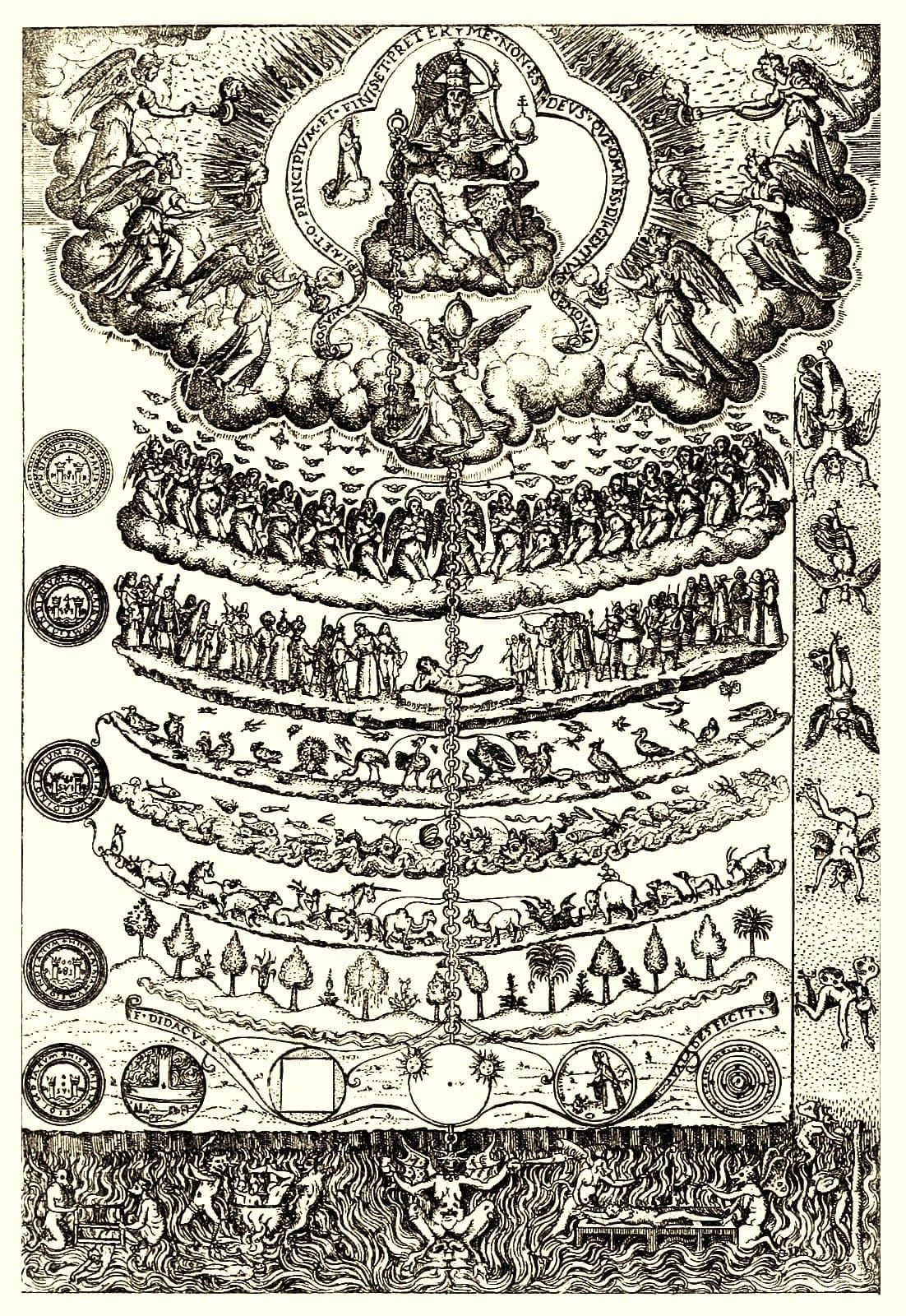
The world as a whole, an ordered whole, and not successively or piece by piece, is a continuous production of God or (one might say) eduction from God, according to one's angle of vision—with the “process” in either case being a movement “from above to below.” Altogether different of course is the explanation of the world provided by the transformist or Darwinian account of evolution, which rests upon a total negation of God, the true Source of all creatures, and which purports to account for the variety of natural forms by means of strictly natural processes, “upwards from below.” Six reasons for rejecting the theory may be adduced. If these reasons are only briefly considered here, it is because the chief point of this article is not to examine in full all the many problems with the transformist theory, but to present a very different view of evolution, one which takes these criticisms seriously, which builds upon them, and which conforms to the metaphysical perspective they in part reflect.
…the Darwinian doctrine simply cannot compete at the same level of truth with either metaphysics or theology
In the first place, the explanation of order by “natural selection”, as even its more honest proponents admit, is no more than a theory, and one moreover which can never be tested, let alone proved.[[4]] Like all scientific theories, it is inevitably tentative and probabilistic, being not even so solid or certain as the empirical data it is meant to explain, themselves of course always subject, if not to doubt or denial, then to continual reinterpretation. Having therefore only provisional force, because an origin strictly inductive, the Darwinian doctrine simply cannot compete at the same level of truth with either metaphysics or theology. Of these, the former proceeds from noesis or intellection, which involves the direct apprehension of the Real as Object by virtue of the Real as Subject; it is a matter of theoria, not theory, and rests upon the knowledge of like by like, when What truly is so becomes aware of Itself. The latter, theology, though not equally certain with respect to its mode of reception, is equally true in its content; for theological thinking—one must add, in its orthodox forms—is dependent on Revelation, and Revelation is intellection quenched as it were in the form of result: not knowledge, as Plato would say, but true opinion, orthodoxy. Opinion per se, however—whatever so-and-so happens to think at this moment about his more or less regular contacts with the more or less fluid domain of so-called physical “things”—is comparable to neither; and a thought dependent on the data of sense cannot but be an opinion.
The second reason is this. Like all scientific theories, transformist evolution (even supposing its validity) is limited to the strictly material or terrestrial plane, which is only a part of the cosmos, the least real and accordingly the least intelligible. As he attempts to explain what he sees, the Darwinian theorist neglects to remember that what can be physically sensed is not only much less than the whole, but less real than the “parts” of the whole which it is not, as the images of a dream are less real than the objects of waking perception. And yet this quite partial character of his hypothesis—and by “partial” I mean both “biased” and “incomplete”—is seldom if ever considered. Just the reverse: it is often assumed instead, not that all that is said about fossils applies in addition all the way up to the angels, though this would be more than absurd enough, but that there is no “up” in the first place, nothing besides matter at all. De non apparentibus et non existentibus eadem est ratio. The indefensible presumption of this materialism should be obvious.
A third observation naturally follows, and it concerns the reductionism implicit in the transformist cosmogony, its attempt to explain the more by the less. I have said that the scientific evolutionist often assumes that matter is all that exists, or matter-energy if a greater subtlety is required. But even when he does not so assume, or says he does not, the theory invariably leads its proponent to think that if there is something more or higher than physical substance, it can be approached only by way of the lower, and only as the product, result, or extension of processes and forces first apprehended, or inferred, at the empirical level. But if the lower explains the higher, then the lowest will explain most of all, and one is left to conclude, however preposterously, that something is derived from nothing, quod absit. It as though the evolutionist had transferred the creationist cosmogony, uninformed by metaphysics, onto the material plane, together with the problems already considered, but without the theologian's God, and the result is doubly absurd: the creation of something from nothing by nothing. Logic itself compels one to see that “every productive cause is superior to that which it produces”, and that “whatever is produced by secondary beings is in a greater measure produced from those prior and more determinative principles from which the secondary were themselves derived” (Proclus).
What can be seen even through the most powerful of electron microscopes, or read on the screen of some other highly sophisticated detection apparatus, is still only “surface”, and still therefore a matter of shape. Form is quite different.
The fourth problem with the transformist position is that it mistakes temporal or chronological succession for ontological causation and so falls prey to the sophism post hoc, ergo propter hoc. Neither the metaphysician nor the theologian denies, or needs to deny, that the fossilized vestiges of various species of organic life appear in the geological record in an order of increasing complexity. Nor must he posit some extraordinary act of God by virtue of which that record was made to appear as it does by a miraculous “pre-fabrication”, after the fashion of certain “scientific creationist” schemes. Instead he accepts the fact, though a priori and not by induction, that the various kinds of plants and animals have appeared successively over time, with the sensible manifestation of humanity coming near the end of the process. But appearance is one thing, and Reality quite another. To admit that reptiles roamed the earth before the appearance of mammals, or more precisely that they entered into the substance of physical bodies in advance of the mammals, does not entail the admission that the latter, by whatever temporal and biological channels one might wish to propose, therefore came from the former, though they may in a sense have come through them, as I shall later suggest. The metaphysician teaches instead, and quite the reverse, that the order in which the various species have been deployed over time, and thus the evolutionary sequence of their disclosure in matter as physical organisms, is just the opposite of their “original” order as archetypes or Divine ideas. Inasmuch as the world is the reflection of God, inasmuch as reflections invert, this is precisely what one should expect—a kind of chiastic reduplication of the higher in the lower. It is essential of course to remember that the procession of the world out of God is eternal, hence in temporal terms both continuous and instantaneous. When it is said that man's appearance on earth toward the end of the cosmological “process” is the inverted reflection of his theological and metaphysical primacy in the Divine Logos, it should be understood that this primacy refers to the “spatial” super-ordination of human beings over animals in a purely ontological, static, and vertical sense, and not to their being an initial effect in a series of sequential creational acts. Man's primacy is that of the microcosm, of a “container” with respect to its “contents.”
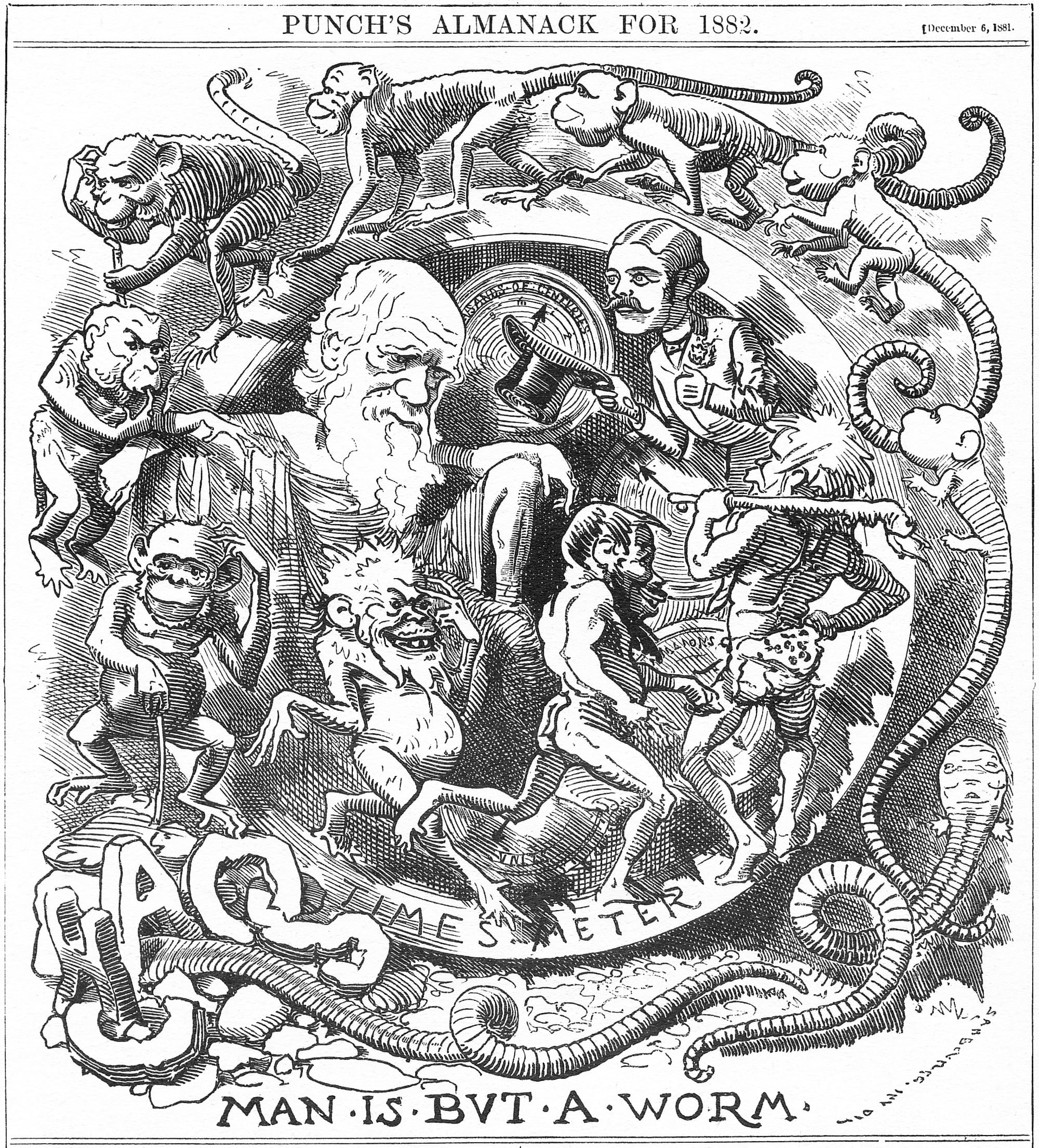
Fifthly, the Darwinian conception of evolution is utterly blind to the essential distinction of form from shape. By the word “species” it means to signify what many individual organisms have in common: a notional abstraction derived by generalization from particular facts and serving as a linguistic tool for classification. But these facts are all of an empirical, material kind and have to do solely with structural resemblances and other physical features susceptible to measurement and quantification. A species thus considered, ab extra ad intra and as it were by dissection, is therefore dependent on shape, even as shape is a function of surface. By “surface” we do not mean only the most outwardly external plane of an organism's solidity, the place where its skin (or some similar feature) meets the air, but also whatever relatively inward part of its physical substance could be exposed to the air, in fact or in principle, if our techniques were sufficiently refined. In this sense, what can be seen even through the most powerful of electron microscopes, or read on the screen of some other highly sophisticated detection apparatus, is still only “surface”, and still therefore a matter of shape. Form is quite different. By “form” the metaphysician means to refer to that quality by virtue of which a physical object, whether living or not, transfers the attention of those who perceive it through itself and along a kind of ontological corridor up and into its celestial archetype. Form is liquid where shape is solid, though solids of course nonetheless display the various forms; form is transparent or diaphanous whereas shape is opaque; form insists that it not be confused with surface. As shape is the place where empirical apprehension must necessarily stop on its way in the direction of being, form is the place where being willingly pauses on its way in the direction of knowledge. Form is on the “other side” of the existence of things from species and shape. Not at all derived from those things or dependent upon them, they are rather derived from it. It is what accounts for the qualitative existence of the animals or plants that possess it in common—whose commonality or similarity, however, far from being the measure or the standard of form, is as much an indication of the fragmentation and incompleteness of these particular creatures as it is a reminder of that which is whole, and which they seek to emulate, which is, once again, their form. A truly adequate cosmological explanation of the world is an explanation of forms and their hierarchical order, and of That which they wish to express. But all this, for obvious reasons, is quite beyond the expectations of a strictly empirical scientific method, the kind of method that has generated the transformist doctrine.
The sixth and final problem with this theory, the most fatal of all, is its failure to account for the mind of the theorist himself, and thus its suicidal self-contradiction. If the Darwinian is correct that the body of man, his brain included, like the bodies of the other animals, is the result of the operation of certain subordinate forces, whether physical, chemical, or biological; and if he is correct to assume that the mind is in some way a function of organic tissue and that thoughts are the result of electrical transmissions in the cerebrum: then precisely because of his claims he is not correct, nor could be “correct” whatever he said. For from this point of view, no idea, including the theory of evolution, is true; none is conformed or adequate to the actual nature of things in a way that its competitors are not. If the transformist is right, all ideas, including his own, and thus all possible theories, are already equally conformed to the real, because they are all equally determined to be what they are by their respective biochemical histories. And so to repeat, if he is right he is not. Truth, like the mind which thinks it, requires a freedom from all conditioning, hence a freedom from all “horizontality”, all physical process, and thus from the whole of nature, which is by definition a concatenation of effected causes and caused effects. Nothing is true—including the statement that “nothing is true”—unless the power of knowing within us “came down from Heaven”, having proceeded out of the only completely unconditioned Reality: the Source of emanation and the God of creation. “In Him was life, and the life was the light of men.”
Let us be clear. The evolutionism which must be repudiated is in no sense the claim that there has been a sequence in the appearance of the forms of life on this planet, nor that changes have occurred and continue to occur in the physical constitution of the various species of plants and animals
In sum, the Darwinian theory of evolution reflects in various ways, and as considered in its several particulars, each of the more or less typical tendencies of modern critical thinking: it is by turns empiricistic, materialistic, reductionistic, historicistic, nominalistic, and relativistic. It is a veritable “hydra of heresies.” And it is for this reason that the theory has been the object of so severe a reproach on the part of both the metaphysician and the orthodox theologian. Let us be clear. The evolutionism which must be repudiated is in no sense the claim that there has been a sequence in the appearance of the forms of life on this planet, nor that changes have occurred and continue to occur in the physical constitution of the various species of plants and animals, for these facts, to the degree that the data of sense can provide us with “facts”, are amply attested by the geological record, by the techniques of radiometric dating, and by the observations of breeders.[[5]] What must be rejected instead is the attempt to explain such changes in strictly physical terms as if that explanation accounted not only for intra-specific differences between individual organisms, but for the existence and variety of species as such, and as if those species had developed ex nihilo from the simple to the complex, with the inanimate giving rise to the animate, the animate to the sentient, and the sentient to the self-conscious—the last of which must clearly be first in any intelligible causational series. Efforts to describe physical phenomena at the level of empirically observable causes alone are one thing, and are as useful in certain limited cases as they are unobjectionable. But it is quite another to insist, as the more hyperbolic of Darwinians often do, that an empirical explanation renders all other accounts of the same phenomena impossible, or that it can account in addition for the origin of non-empirical realities, or (worst of all) that it somehow proves that only such things exist as can be empirically measured. Herein lie the absurdities mentioned earlier.
The question remains, however, whether it is possible to formulate a view of the cosmos from an infrapersonal angle that is free from these several defects. Can the major forms of life in this world be described according to the temporal order in which their appearance occurs per ascensum, but so as to protect the metaphysical and theological truth of their “original Origin”—from and by God per descensum? Is it possible to envision the chronological order among the kingdoms on earth in such a way as to see, by a kind of noetic transposition, their ontological order in God?
In order for this question to be answered in the affirmative, it is essential that one first understand the purpose of cosmologies in general—perhaps we should say of traditional cosmologies or “natural sciences”, lest they be confused with fields of study like astrophysics, which though it may purport to consider the cosmos as a whole suffers in obvious ways from the same limitations as the other empirical sciences. The traditional intention is basically this. Whatever shape it takes, and whatever the symbols or language it might employ, a true cosmology, by virtue of its conformity with metaphysical and theological principles, must be such as to make the natural a means of support for our awareness of the supernatural, whence nature proceeds and upon which it is permanently and perpetually dependent. A vision of the world which is not conducive to this intellection, and hence to the actualization of what is highest in man, simply cannot be admitted as valid. The strictly utilitarian tendencies of our age notwithstanding, the only good reason for an infrapersonal approach to the cosmos is that it might serve as an aid on the spiritual path toward the transpersonal. If it fails to do this, it has lost its very reason for being. Indeed this is the most fundamental danger with Darwinian evolutionism, that it causes a man to forget where he came from, thus abolishing his nobility.
Nevertheless, provided that this danger is kept in full view, the metaphysician and theologian need not in principle be opposed to the idea that the world is evolving. There is after all nothing etymologically wrong with the word “evolution”, nor anything intrinsically absurd about every activity or process which it might be used to signify.[[6]] As we have seen, the transpersonal explanation is agreed that the cosmos becomes what it is through an “unwinding” or explication of What is already inside, which is “turned out” or evolved into what It is initially not but can then be seen in. As long as the true nature of this original “inwardness”, which is of course God in His immanent presence—“the dearest freshness deep down things”—is not debased by confusion with something created or relative; as long as we recognize that if matter can be said to evolve, it is only because of the presence within it of the Supreme Reality, which it expresses and seeks to return to; and as long as we realize that the world is not what the materialist thinks, but at once a symbol, a veil, and a channel: then an evolutionary cosmogony can be legitimately entertained, not simply as an acceptable theory, but as a genuine theoria, a vision opening up into metaphysical insight. If it is the case that the cosmos is a message sent by God from Himself to Himself, then we may expect the metaphysical truth of emanation, which considers the world as proceeding from God, and the theological truth of creation, which explains the world as fashioned by God, to be open to a corresponding scientific “truth”, according to which the world is envisaged on its way back to God; and we would not be wrong in calling this last process an “evolution.”
The distinctive features of an evolution consistent with God and conformed to His nature have already been anticipated indirectly, and by contrast, in our treatment above of the six Darwinian errors. The task now is largely one of organization and synthesis as we present a sketch, not of course of transformism, but of what might be called an “emanational evolution.” The word sketch should be stressed. What follow are no more than leading thoughts, provocations and pictures, designed to suggest a possible line of reflection. There is certainly no intention of exhausting the topic, nor do we aim to anticipate all the conceivable objections. It should be emphasized in any case that the temporal terminology with which we are obliged to speak is not to be taken literally, for obviously God is not Himself subject to the developments here envisioned; only in seeming does the deployment of creatures “take time.” The difficulty, of course, is that our discursive thought must by definition do its work in that seeming and with the materials thus afforded. Hence “stage and sequence are transferred, for clarity of exposition, to things whose being and definite form are eternal” (Plotinus). This caveat must be kept in mind throughout.
By “emanational evolution” we mean two things: the deployment of form in matter as shape and the explication in the substance described by that shape of certain qualities or attributes. The total process may be called emanational since both of its “stages”, both the deployment and the explication, proceed in the first place per descensum from higher, immaterial planes. The cosmogony here presented, though it offers a reason for the cosmos “from beneath”, thus begins “from above”, in accordance with the stipulations already established. More precisely, it begins by analogy and, for the sake of maieusis, with the act of knowing, which itself proceeds also from the higher to lower, “for everything that is known is known not according to its own power, but rather according to the capacity of the knower” (Boethius). And it begins by implication with that One which is the principial Knower, and knowing Principle, wherever the knowledge of being arises. The metaphysical scientist or cosmologist begins in this way with the Self as Subject.[[7]]
From the point of view of pure metaphysics, however, the true development must be understood very differently: not to the exclusion of all that exceeds the material order, but in full view of the “higher”, and as an extension or prolongation of the earth's pre-material history.
The Self is truly Subject only in Its recognition of Itself as such, and only in knowing Itself as the Knower It is, hence only to the extent that It “becomes” an object as well. One says “as well”, but of course the Principle from which we are starting, and which these altogether inadequate words are meant to evoke, is not an object as well as or in addition to Subject. Rather than both It is neither, though within this “non-dual” transpersonal primacy, It is nonetheless rather more like what is meant by a subject than by an object. If we allow as a provisional means the language of change and transformation in the case of the strictly changeless and impassible, it can be said that what was “once” purely Subject “becomes” Its own object in the “midst” of Its act of knowing, for we are speaking of something whose very nature is such that It cannot but radiate outside of Itself , outside Its “initial” subjectivity, thus taking the form of “whatever is left”—that is, the object, in whatever modality one might wish to imagine. Of course, to speak in these temporal terms is only symbolic, as we have already noted. What are here being pictured as the stages of a process in time are in fact the multiple states of a single, non-temporal Essence.[[8]] The stages are no more than superimposed “translucencies” of varying colors through which one is intended to glimpse, as “through a glass darkly”, the infinity of that Essence.
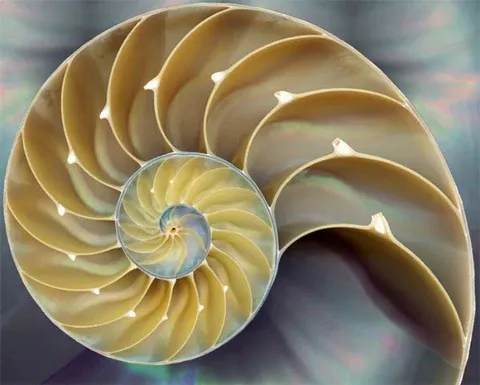
It may prove helpful to make use of an image. Consider a point. The geometrical point is after all the closest of all mathematical forms to the nature of the Subject and to the root of intellection. Altogether independent from objects, even from the dot that serves as its representation, but which is already more extended than an actual punctum, the point is pure inwardness, uncompromised by any equivalent externality to which it might otherwise be thought to correspond. It is “an inside without because prior to an outside.”[[9]] And yet again like the Subject, the point tends to search for itself, to spill over the edges of its invisible and dimensionless essence into the dimensions of the things that are seen. In seeking itself, it produces in the first place a line, a figure we may mistake for a collection of discontinuous “points”, but which (as Zeno implied) is more like an effort or energy suspended between them, or better expended by one such point—stretched as it were between itself in the form of subject and itself as found in the object. This line, one might say, is the line of knowledge, connecting the Self or Principle with each of Its innumerable objectifications.
But the point is not “satisfied” with the line, which actualizes its possibilities in but a single direction. It searches for breadth in addition to length, projecting itself at right angles to its original motion. In this way, the plane is “evolved”, which in metaphysical terms is the demarcation of a particular level of being—in this case, below the Divine but above the visibly human—a plane which provides for the “clothing” of the as-yet-immaterial entities that dwell upon it. No longer quite pure in its initial inwardness, the point as expressed in this dimension is nevertheless still intangible, invisible, and unresisting—still fluid because having no depth or physical substance, containing as yet nothing external in any material sense. Here is the field, in traditional cosmological language, of the subtle body and its world, the mundus imaginalis.
And yet, still unquenched in its thirst, the Subject as point become line and then plane must “explode” once again, in this case into the solid.[[10]] It is now for the first time that the energy of ontological knowing becomes coagulated or fixed, as what was before a “gas” and then a “liquid” now becomes “solid”, possessed of three dimensions. What had been an idea in the “celestial” world, an ontological ray projected by the Supreme Knower, and what then was condensed on the “intermediate” plane, is now frozen by the dimension of depth as it enters the “terrestrial” order, which is the familiar world of material objects and empirical perceptions, the world studied by the physical scientist and Darwinian. It is of course here, at the level of matter, that the evolution of species is usually assumed to begin, by which “evolution” is normally meant: first the production of life from inorganic substances, and then the development of the various living species from simple to complex, culminating in man. From the point of view of pure metaphysics, however, the true development must be understood very differently: not to the exclusion of all that exceeds the material order, but in full view of the “higher”, and as an extension or prolongation of the earth's pre-material history.[[11]]
the entire process, whether in its involutionary or evolutionary “stages”, and whether outside or inside the material plane—deployment or explication—is all of one piece: it is an evolution or “opening out” of none other than God throughout its entire extent.
This “history”, the emanational sequence by virtue of which the physical plane proceeds by way of the subtle or animic order from out of its principial Source, is sometimes referred to as an “involution”, a word which calls attention less to the metaphysical movement in divinis from within to outside—to evolution per se—and more to the cosmic receptacle into which the movement enters, into which the Subject is incarnated or emptied, “Who being in the form of God made Himself of no reputation, and took the form of a servant, and was made in the likeness of man.” From another point of view, however, the one which is here being stressed, the entire process, whether in its involutionary or evolutionary “stages”, and whether outside or inside the material plane—deployment or explication—is all of one piece: it is an evolution or “opening out” of none other than God throughout its entire extent. For it is one and the same Subject—or, to make use of our image again, the very same point—which accounts for the whole, for all of the degrees of Reality and all of their innumerable contents. Of course to see that this is so requires a method of investigation and a perceptual sensitivity quite different from the ordinary empirical orientation. Things must be approached from within, with a view to their forms, not to their shapes. We have said that one of the problems with transformist evolution is its inadequacy to the full range of the cosmos, that it looks at only a part of the whole. But the problem is also that it looks only at a part of the whole. Its approach to the world is therefore bound to eclipse the metaphysical transparency of natural forms, which are intended by God to be His self-expression, the expression of “even His eternal power and Godhead”, but which can be seen as such only if men look not at but along or perhaps even through the creatures around them.
If they were so to look, what they would see is that the production of solids from their source in the point is not the end of the story. The radiantly explosive energy of the Subject is not yet exhausted, nor can it be. But having as it were no more room to expand, all the dimensions being filled with Its presence, It cannot but turn in Its movement toward the center of the things it has made. This center must certainly not be confused with some sort of spatial position, half-way between the front and the back, or the top and the bottom, of a particular solid entity. It is rather the “inside without because prior to an outside” of the point itself, into which, as into Itself, the Subject now proceeds. The resulting introsusception marks the beginning of an act of return, of remanation and recapitulation. And yet it is also “more of the same”—simply another manifestation of the Self's unfathomable plenitude.
Unlike a mineral, not all of a living being is all that it is all the way through. Certain aspects, even when they are not as clearly distinct as the individual organs of the higher species, assume a certain priority as providing the channels or openings through which life may enter the entire being.
Having then, to repeat, no more room for itself, in “need” of expansion but lacking an adequate space, the point undertakes something “new” and begins to move along a novel course. It begins to display in the solids once made a range of qualities or attributes, unveiling itself in the how not the what, in the kind not the fact, of the already existing material objects. Thus no sooner are the solids crystallized than, by virtue of the same pre-material emanational energy that first produced them, there begins to burgeon inside a series of “higher dimensions.” An interiorizing action is initiated, according to which the manifestations of the Subject become increasingly central to the creatures in question. At first the point, having just completed its third and final “spatial” deployment, presents itself in a uniform way throughout a particular object, equally in length, in breadth, and in depth, and in the form of a special property, as for example in the attractive power of the lodestone or the crystalline structure of the diamond. Such a property is everywhere all that it is, as much in the parts as in the whole, a piece of a given substance having “as much” of the quality—to use the uselessness of such language—as any other. The Source of the substance, for those who have eyes to see, is thus written upon its very surface.
But the surface of things is far too confining for the Subject. It needs the amplitude afforded by Its own infinity, and soon becomes “discontent”, diving below the surface of physical objects, going “indoors”, and there presenting Itself in the guise of a process. Here is the beginning of life in its organic expression and as unfolded on the inside of matter. What one immediately notices in looking along such a process, however—along a vital or physiological function—is that a certain specialization among the parts of the whole has been introduced. Unlike a mineral, not all of a living being is all that it is all the way through. Certain aspects, even when they are not as clearly distinct as the individual organs of the higher species, assume a certain priority as providing the channels or openings through which life may enter the entire being. These aspects are to the substance of a living creature what the plane is to the solid; they are its conditio sine qua non—in it, but not of it. Quite the contrary, it is dependent on them. But more to the purpose, where mineral properties had been too restrictive, the more inward character of biological process provides the Subject with additional opportunities for expansion, as is evident in growth. Although the manifestation of the Subject in organic life has become in a sense itself restricted to certain more or less specialized aspects of an entity, in a way that the properties of a diamond are not, these aspects are actually open along a metaphysical passageway to far wider possibilities than inorganic matter per se can allow for, and it is thus that there enter into the being the “uncreated energies” that are necessary for the unfolding of its life. It is in this sense that the plant kingdom, though emerging later in the temporal sequence, may be said to be higher than the mineral, for the plant provides a greater degree of openness to its source.[[12]]
The metaphysician is not saying that matter evolves into life, or life into sentience. ... The only evolution is that of the point, which is the Divine Self as Subject. The forms of existence through which It “passes”, in a strictly non-temporal and instantaneous way, do not themselves change.
Now we encounter yet another development, a further “evolution” of the point. Although the plant is able to grow and blossom in a way that the mineral cannot, it remains subject to limitations, which the Subject must still overcome, limitations visibly expressed in its attachment to the earth. If unrestricted emanation is to continue, therefore, an altogether different access must be provided through which the point might be enabled to pass into an even more resplendent qualitative expression. Here, it would seem, is the metaphysical explanation for the birth of sentience and the power of locomotion, the two most telling features of the kingdom next to develop, that of the animals. An even more pronounced interiorization has here taken place, for while an animals's movement is already a sign of deeper capacities evident even to a purely empirical outlook, the power of conscious response which gives rise to this movement, and which can be seen (once again) only by “looking along” the locomotion, is even further within than the power of life, and yet, precisely because it is further inside, it is correspondingly closer to an exteriorization or evolution on the other side of the creature, the side opposed to the facet discerned by the purely sensory eye—even as form is on the further, but shape on the hither, side of material objects. As the point strives to make room for itself in a space that is already exhausted, channels are established through which there can flow the greater intensity of sentience. It is in this way that the flower is opened to the butterfly, a blossom released from its stem.[[13]] Nevertheless, this release or liberation could not have been accomplished by the plant on its own. The flower has served as a portal for creative, causative Power, but is not itself that cause. Even as apart from the plane the line would remain invisible, in proportion as the plane apart from the solid would be intangible, so in the absence of life would consciousness be hidden from the organs of sense. On the other hand, the plane could not exist at all apart from the line, nor the solid without the plane, nor any dimension were it not for the point; and were it not for the Subject, neither matter, nor life, nor sentience would ever have been deployed or explicated—Subject through matter as life, and Subject through life as sentience.
It is worth pausing to emphasize the radical difference between this view of the sequence of forms and that of the Darwinian or transformist theory. The metaphysician is not saying that matter evolves into life, or life into sentience. Nor, on a smaller scale, do amphibians evolve into reptiles, or reptiles into birds; Galapagos finches are always finches, and peppered moths are always moths.[[14]] The only evolution is that of the point, which is the Divine Self as Subject. The forms of existence through which It “passes”, in a strictly non-temporal and instantaneous way, do not themselves change, for they are the unalterable images of celestial ideas—the distinct and immutable shadows cast by the Divine Sun as It shines upon the eternal archetypes of Its myriad creatures.[[15]]
There is obviously a final chapter, a final stage to be sketched, and this is the case of man himself, and hence of the mind which theorizes with a view to the truth: man, in whose various levels of being there is uniquely exhibited, emerging through the sentience he shares with the animals, the life he shares with the plants, and the body he shares with the minerals, an incomparably different quality, his consciousness—one should perhaps say “potential” or “virtual” consciousness—of Self.[[16]] Here the centripetal, intropulsive, and interiorizing tendency of the point has “at last” caught up to itself, having step by step provided ever more extended possibilities for irradiation, “until” the level is reached where it “becomes” the field of its very own motion and expression. The circle has been closed; the goal is attained. Intellection has fulfilled its reason for being and has realized in the only fully adequate way the plenitude of its unconditioned freedom, within the limitless “space” of its very Self. For to say man, the last of the species to appear on the earth, is to say capacity for the Absolute and the Infinite, for the Supreme Reality, since it is only in man, of all creatures, that the Subject is able to find a sufficient accomodation for Its full intensity. No mere bodily, three dimensional entity as such can hope to contain the fons et origo of all things, nor do the “dimensional” qualities, whether property (as a recapitulation of the solid), life (as a recapitulation of the plane), or sentience (as a recapitulation of the line) ever more than approach It. Its energy is such that It can be fully manifest only in a mode which is equally infinite and therefore equally without dimension—equally like a point. But this is precisely what Self-consciousness is, what intellection and noesis are: an unbounded instantaneous inwardness, which, like the attributes of life and sentience, is not at all of the human body, but which unlike these lower qualities is not even in it, because not expressed even as it were on its “edge”, as the plane and the line can be seen on the sides and the corners of solids. “Word as He was, so far from being contained by anything, He rather contained all things Himself” (St Athanasius).[[17]] The act of ontological knowing issues from a central and hidden point so concentrated as to exceed altogether the reach of the body and, hence, the all too limited means of empirical research. Although as this sketch has been intended to show man's intelligence can be said to evolve through what is beneath it in the order of being, it evolves even so, and can only evolve, from the higher and indeed as the Highest. What is length, breadth, and then depth on the way “down” to the earth becomes triply and inversely displayed on its way “in”, and in a certain sense “up”, as the qualities of physical substance—in property, process, and sentience—the prematerial construction of matter being mirrored in the succession of creatures. And yet none of the dimensions would be what it is, nor would the dimensional qualities be recognized for what they are, if it were not for the point, the sovereign Subject, which is both beginning and end.[[18]]
As announced at the outset, the aim of this article has been to provide an account of the world per ascensum which is in full conformity with the view per descensum, propounded by metaphysics and theology; and we have therefore been obliged to insist throughout that none “hath ascended up to Heaven, but He that came down from Heaven, even the Son of Man which is in Heaven”—hence that no infrapersonal or evolutionary explanation of the world can have the slightest value unless it acknowledges, and repeatedly stresses, the absolute supremacy of God, our ultimate Source.[[19]] Nonetheless we have also assumed that the sequence in the terrestrial appearance of certain forms of existence is not without a symbolic message, and that reading that message in the light provided by traditional authorities might help to point certain of our contemporaries, who wish to make so much of the “facts” and who often falsely suppose them to be incompatible with a Divine explanation, back and up to principles. For truths are always consistent with Truth.
Whatever the benefits of this reading, and quite apart from the question of whether it might prove as convincing to the theologian as to the metaphysician, it is worth emphasizing once again that the picture presented here is precisely a “picture”—no more than a sketch, a possible darshana. Simply because a certain vocabulary and particular images have been used as maieutic means, no one should imagine that all others have been thereby excluded. We readily admit that this cosmogony does not, cannot, and need not stand opposed to other equally effective “impersonal” visions, provided of course that they are equally subject to the irrefragable truths of pure metaphysics, concerning which there can be no compromise. It is to be understood in any case that the sufficient reason for having a view of the cosmos is not that it might correspond in some more or less mathematical way to the world as it is in itself, which is as far beyond perfect comprehension as it is below perfect being. The aim instead is to provide various keys or supports for intellection, that uncreated power of knowing What is and being What knows by which we are enabled to transcend this world altogether—though then only in seeing, through a prayerful looking along it, that this same world is “already” the kingdom of God.
Adveniat regnum tuum, fiat voluntas tua, sicut in caelo et in terra.
[[1]]: This is a revised version of an article first published by Dialogue and Alliance, Vol. 4, No. 4, Winter 1990-1991. Permission to reprint is gratefully acknowledged.
[[2]]: We are referring to the authors of the “traditionalist” or “perennialist” school, especially Frithjof Schuon, whose influence will be noticed throughout these observations. For an introduction to Schuon's work, see our Advice to the Serious Seeker: Meditations on the Teaching of Frithjof Schuon (Albany, New York: State University of New York Press, 1997)
[[3]]: This synopsis is meant to reflect a perspective much more thoroughly developed by Schuon in “Dialogue between Hellenists and Christians”, Light on the Ancient Worlds, trans. Lord Northbourne (Bloomington, Indiana: World Wisdom Books, 1984); “Creation as a Divine Quality”, Survey of Metaphysics and Esoterism (Bloomington, Indiana: World Wisdom Books, 1986); “Ex Nihilo, In Deo”, The Play of Masks (Bloomington, Indiana: World Wisdom Books, 1992); and “Theological and Metaphysical Ambiguity of the Word Ex”, The Eye of the Heart: Metaphysics, Cosmology, Spiritual Life (Bloomington, Indiana: World Wisdom Books, 1997)
[[4]]: Of course the theory has been accepted as indisputable fact by the majority of the “educated public”, doubtless to the delight of those like Richard Dawkins (The Blind Watchmaker: Why the Evidence of Evolution Reveals a Universe Without Design [New York: W. W. Norton, 1986]) whose explicit and unabashed intention is to dethrone the Divinity of traditional theism. One hopes that books like Michael Denton, Evolution: A Theory in Crisis (Bethesda, Maryland: Adler and Adler, 1986), Phillip E. Johnson, Darwin on Trial (Downers Grove, Illinois: InterVarsity Press, 1993), and Michael Behe, Darwin's Black Box: The Biochemical Challenge to Evolution (New York: The Free Press, 1996) will help in exposing the common fallacy that transformism cannot be scientifically challenged. Their detailed examinations of the physical evidence against evolution, drawn among others from the disciplines of paleontology, comparative anatomy, and molecular biology, might be usefully studied as an empirical complement to the strictly metaphysical arguments presented here.
[[5]]: “Modern science is right when it describes the succession of geological periods, but not when it tries to describe the origins of life or of intelligence. Modern cosmology cannot be something other than geology, paleontology, and astronomy; and there exists not the least difficulty in combining them either with Semitic creationism or with Indo-Greek emanationism, for the simple reason that facts are always compatible with principles” (Schuon, unpublished letter to the author).
[[6]]: The term obviously had a pre-Darwinian history. The earliest English uses recorded in the Oxford English Dictionary are by two of the Cambridge Platonists, Henry More and Ralph Cudworth, whose understanding of the world and its creatures was quite far from transformist. And when Dr Samuel Johnson later wrote that “he whose task is to reap and thresh will not be contented without examining the evolution of the seed”, it is clear he was speaking of how oaks come from acorns, and not men from the “lower primates”. On the other hand, these philological data should not blind us to the fact that the connotation of the term has certainly changed since the eighteenth century, and that its user today must be extremely cautious lest he be thought a Darwinian.
[[7]]: No attempt is here made to defend the Platonism and Vedantism implied by these assertions, though the substance of the defense is implicit in our reference above to the sixth of the Darwinian mistakes. An explicit and extended consideration of the primacy of consciousness can be found in our book The Form of Transformed Vision: Coleridge and the Knowledge of God (Macon, Georgia: Mercer University Press, 1987).
[[8]]: “The concept of multiple states permits us to envisage all these states as existing simultaneously in one and the same being, and not as only able to be traversed successively in the course of a ‘descent’ which supposedly passed not only from one being to another, but even from one species to another” (René Guénon, The Multiple States of Being, trans. Joscelyn Godwin [Burdett, New York: Larson Publications, 1984], 73).
[[9]]: This locution is borrowed from Coleridge, as is the point as image of the Subject. Suggestions for several additional features of our “sketch” can be found in Coleridge, Biographia Literia, ed. James Engell and W. Jackson Bate (Princeton: Princeton University Press, 1983), Ch. 12; and in “Hints Toward the Formation of a More Comprehensive Theory of Life”, Selected Poetry and Prose of Coleridge, ed. Donald A. Stauffer (New York: Random House, 1951). Similar employments of the geometrical point can be found in St Clement of Alexandria, and Guénon makes use of the image throughout his Symbolism of the Cross, trans. Agnus MacNab (London: Luzac, 1975).
[[10]]: The word “explode” is deliberately used, and it could in fact be repeated below with respect to each of the “stages” and forms of existence envisioned, in order to denote the discontinuity between various levels and the suddenness with which they arise. Martin Lings has pointed out that the teaching of Jalal ad-Din Rumi concerning rebirth “from vegetable to animal and from animal to man”, analogous in certain respects to the sequence we are about to discuss, has sometimes been misinterpreted as an anticipation of Darwinian “evolutionism”, in spite of the fact that in Rumi “there is no gradual development but a series of sudden transformations”, and even though “the mineral, vegetable, animal, and human states are envisaged”—both in Rumi and here—“as already existing and fully developed. The evolution in question is that of a single being, from the lowest to the highest states, from the periphery to the centre” (Lings, The Eleventh Hour: The Spiritual Crisis of the Modern World in the Light of Tradition and Prophecy [Cambridge, England: Quinta Essentia, 1987], 28n).
[[11]]: “A minus always presupposes an initial plus, so that a seeming evolution is no more than the quite provisional unfolding of a pre-existing result; the human embryo becomes a man because that is what it already is; no ‘evolution’ will produce a man from an animal embryo. In the same way the whole cosmos can only spring from an embryonic state which contains the virtuality of all its possible deployment and simply makes manifest on the plane of contingencies an infinitely higher and transcendent prototype” (Schuon, Understanding Islam, trans. D. M. Matheson [London: Unwin, 1963], 108-109n).
[[12]]: A qualification to this principle is in order, however, since the “metaphysical transparency” (Schuon) of a given creature depends not only upon the plane of being it occupies, but upon its relative “centrality” on that plane—its proximity to the point at which that plane is intersected by the axis mundi—not to mention other imponderables. While plants may in general be “higher” than minerals, because of the organic life that is in them, a precious gem remains a more lucid theophany than a weed. The same qualification must be applied to the relative positions in the great chain of being of plants and animals, and of animals and man. A noble animal, like an eagle or a lion, is “more Divine” than a human being who lives below himself. We do not in any case mean to propose a rigid system.
[[13]]: “The insect world, taken at large, appears as an intenser life, that has struggled itself loose and become emancipated from vegetation... We might imagine the life of insects an apotheosis of the petals, stamina, and nectaries round which they flutter, or of the stems and pedicles, to which they adhere” (Coleridge, “Theory of Life”, 594).
[[14]]: The variations within certain populations of finches, first noted by Darwin in the Galapagos Islands during his 1831-36 voyages on the H.M.S. Beagle, are well known. As for this particular species of moth, “Kettlewell's observation of industrial melanism in the peppered moth (Biston betularia) has been cited in countless textbooks and popular treatises as proof that natural selection has the kind of generative power needed to produce new kinds of complex organs and organisms”, even though in this case there was never any change of the kind alleged by transformists (Johnson, Darwin on Trial, 176).
[[15]]: “Evolution is the unfolding of a given virtuality and not the passage of a given possibility to a quite different possibility” (Schuon, unpublished letter to the author). “The form of a peripheral being, whether it be animal, vegetable, or mineral, reveals all that the being knows, and is as it were itself identified with this knowledge; it can be said, therefore, that the form of such a being gives a true indication of its contemplative state or dream... Needless to say, the object of knowledge or of intelligence is always and by definition the Divine Principle and cannot be anything else, since It is metaphysically the only Reality; but this object or content can vary in form in conformity with the indefinite diversity of the modes and degrees of Intelligence reflected in creatures” (Schuon, The Transcendent Unity of Religions [Wheaton, Illinois: The Theosophical Publishing House, 1984], 56).
[[16]]: Notice the emphasis on the preposition through, not “from”. Man's consciousness of himself, his power of self-reflection, can obviously come only from the Self, on pain of the contradiction referred to earlier in considering the sixth of the Darwinian errors. Failure to attend to this crucial “prepositional” difference can result in a kind of “optical illusion”, which is perhaps at the root of that impossible compromise popularly known as “theistic evolutionism”, whose proponents contend that God somehow manages to create the world by means of the process described by Darwin. It should be clear by now that the metaphysical or emanational “evolution” here envisaged has nothing in common with this absurdity.
[[17]]: The saint adds that “man, enclosed on every side by the works of creation and everywhere beholding the unfolded Godhead of the Word, is no longer deceived concerning God” (our italics).
[[18]]: “When all is said and done, there are only three miracles: existence, life, intelligence; with intelligence, the curve springing from God closes on itself, like a ring which in reality has never been parted from the Infinite” (Schuon, Light on the Ancient Worlds, 42). “As regards manifestation, it may be said that the ‘Self’ develops Its manifold possibilities, indefinite in their multitude, through a multiplicity of modalities of realization, amounting, for the integral being”—represented here by the point—“to so many different states, of which states one alone, limited by the special conditions of existence which define it, constitutes the portion or rather the particular determination of that being which is called human individuality” (René Guénon, Man and His Becoming According to the Vedanta, trans. Richard C. Nicholson [New York: The Noonday Press, 1958], 29-30).
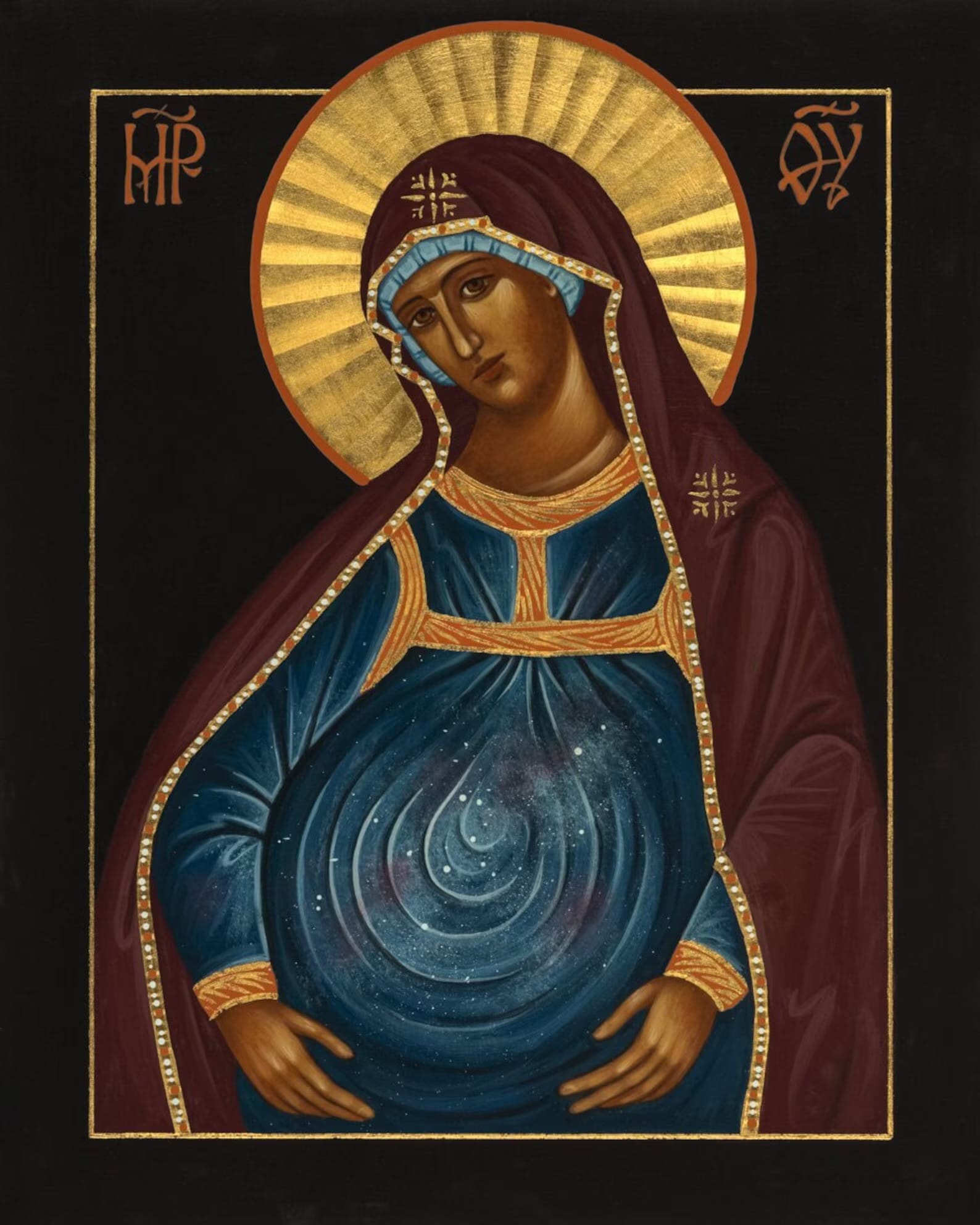
[[19]]: Though far less has been said of a specifically “personal” nature or in dogmatic terms, and far more along metaphysical lines, the theological bases for an acceptable interpretation of evolution should be deducible from this and other traditional Christian teachings alluded to at various points throughout this article. Further support can be found in the dogma of the early Church regarding the Blessed Virgin as the Theotokos or “Mother of God”, and in the metaphysical insight it affords concerning the substance of materia prima, a substance which is not unconnected (when rightly considered) to that “material matter” through which the “message” sent by God from Himself passes on its way of return. Even as that Man was born of Mary in Whom was “recapitulated the ancient making of Adam” (St Irenaeus)—that is, the eternal emanation of primordial man in divinis—the Virgin being the earthly expression of the “fecundation latent in eternity” (Eckhart): so there proceed out of matter, and by virtue of the “dimensional” elaborations described above, the forms of the minerals, plants, and animals, which were likewise “already” eternally made, and through the material “coagulations” of which the idea of Man is enabled to move in its “progress” towards full disclosure on earth. As St Anselm writes, “The Holy Ghost and ‘the power of the Most High’ wonderfully begat a Man from a Virgin Mother. Thus with respect to the others it lay in Adam, that is, in his power, that they should have being from him, but with respect to this Man it did not lie in Adam that He should exist in any way, any more than it lay in the slime that the first man, who was made from it, should come from it in a wonderful way, or in the man, that Eve should be of him, as in fact she was made. But it did not lie in any of them, in whom He was from Adam to Mary, that He should exist. Nonetheless, He was in them, because that from which He was to be taken was in them, just as that from which the first man was made was in the slime, and that from which Eve was made in him. He was in them, however, not by the creature's will or strength, but by the Divine Power alone.”