Now it came to pass, as they went, that he entered into a certain village: and a certain woman named Martha received him into her house. And she had a sister called Mary, which also sat at Jesus' feet, and heard his word. But Martha was cumbered about much serving, and came to him, and said, Lord, dost thou not care that my sister hath left me to serve alone? bid her therefore that she help me. And Jesus answered and said unto her, Martha, Martha, thou art careful and troubled about many things: But one thing is needful: and Mary hath chosen that good part, which shall not be taken away from her.
— Luke, 10:38-42
A candle is not there to illuminate itself.
— Nawab Jan-Fishan Khan
One sometimes encounters the view that human beings should look to their own salvation and leave the world to its own fate. In extreme cases, this view extends to an attitude that is completely contra mundum, a retreat from all worldly relations, even a disregard for the body and the physical world it represents. In less extreme instances, it manifests in an ascetic tendency taking the form of voluntary privations and renunciations. To what extent is this view justified from the standpoint of traditional philosophy, and how is one to integrate the necessary disciplines of tradition with the demands of living in the modern world?
It is as though the common experience of living is but a rude dream from which we must awaken.
Despite any apparent expressions to the contrary, the aim of life for the traditionalist is not to escape the world by renouncing it, merely to be detached from it. This is not a mere semantic distinction, rather it represents a substantive difference in how one sees and experiences the world. To be freed of the psychic knots of the world, the “escape” to be achieved is ontological, that is to say, it is a “passage from distinctive or mental consciousness to unitive or cardiac consciousness” (Schuon), from separative selfhood to an interiority at once integral and integrating, both transcendentally detached and immanently participatory—through love. The outlook to be achieved involves both a recognition of the metaphysical transparency of things and a reordering of our very being to accord with that of reality. This reordering occurs beyond the level of our ordinary psychological experiences of living—in that transcendent dimension accessible by each of us, which integrates and effaces our subjective experiences within an objective and participatory view of the world that alone merits the appellation “Real.”
In all ages and cultures there have been examples of a few privileged human beings who have attested to experiencing this transcendent dimension, in comparison with which the solid world of our senses appears insubstantial and illusory. It is as though the common experience of living is but a rude dream from which we must awaken. In Hinduism, this phenomenal aspect is one of the meanings of maya, the samsaric world of illusion and forgetting—the cosmic dream. Similarly, in Islam, one can cite the famous Hadith: “All who live in this world are asleep, and when they die they awaken.”
All traditions identify sanctity with love and compassion.
But the recognition of Transcendence does not mean devaluing its Presence as the ground of creation. Rather, it means heightening our sense of Reality, developing a sense of the Sacred. The Sacred is immanently Present in the world, and so to idolize the phenomenal world is to miss the theophany. Though traditional metaphysics invites us to discern the reality of Transcendence—the source of the illumination that pervades and constitutes this world—it teaches us also to appreciate how all that it immanently pervades and illumines is sacred and holy by the very grace of its illumination. Once enlightened, the soul perceives through the Eye of the Heart, which experiences reality at its deepest core and in its participatory being as love. The lover is incapable, by virtue of the love which is its cardial nature, of renouncing the world—with which it is, in this sense, co-extensive. This is why all traditions identify sanctity with love and compassion. Herein lies the nobility of the boddhisattvic ideal: to recognize the salvific nature inherent in all creation and to conform oneself to that nature by serving as an instrument of grace for the salvation of all beings.
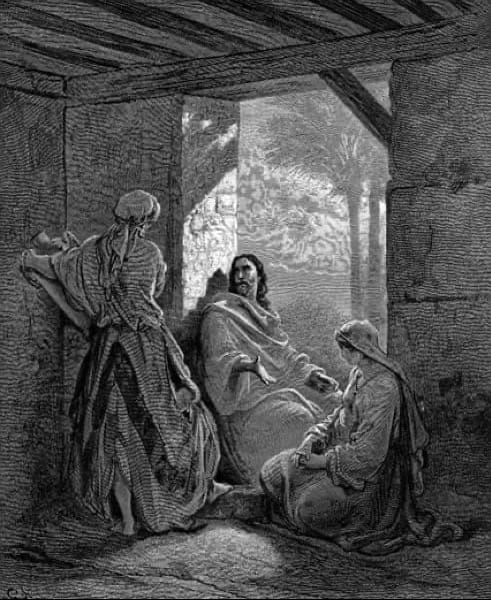
In Eckhart’s unconventional and controversial reading of the famous passage in Luke (quoted in the epigraph) about his visit to the sisters, Mary and Martha, in Bethany, he anticipates the Reformation’s critique of monasticism by refusing to read the words of Jesus as a repudiation of praxis/action (represented by Martha) in favour of theoria/contemplation (represented by Mary). His interpretation is founded on the integrating quality of the Spirit, on love, which was central to his teaching. So Eckhart views Martha as the more spiritually mature sister because of her ability to combine the “one thing needful” (apprehending and conforming to her “real” and loving nature) with her cares of the world—that is, attending to the mundane, not at the expense of necessary interiority, but in harmony with it. In Eckhart’s reading, Martha pleads with Jesus about her sister, not because she selfishly wants Mary’s help, but because she wants her to awaken from the paralysis of an unintegrated view of reality—one that essentializes transcendence and thereby ignores God in the details of His creation. Martha wants Mary to be with God in the world, to be like her, “among cares”, yet not “within cares.”
In Sermon 9 (Walshe/McGinn), Eckhart states:
We suspect that
she, dear Mary, sat there a little more for her own happiness than
for spiritual profit. That is why Martha said, "Bid her rise, Lord,"
fearing that by dallying in this joy she might progress no further.
...Martha feared that her sister would
stay dallying with joy and sweetness, and wished her to be like herself.
Therefore Christ spoke as if to say, 'Never fear, Martha, she has
chosen the best part: this will pass. The best thing that can befall a
creature shall be hers: she shall be blessed like you.'
In Eckhart’s reading, Jesus was not rebuking Martha. Mary was, as Martha saw it, at a different stage of spiritual progress, which—unlike Martha—had not integrated life and spiritual need, Mary had indeed chosen that “good part,” given her level of spiritual development, which was to sit at Jesus’s feet and tend to the spiritual needs of her soul so that she could develop the ability to integrate action with contemplation, and thereby function spiritually in the world like her sister Martha.
In Sermon 3, Eckhart explains this in terms of the tension between action (Martha) and contemplation (Mary), noting that both arise from the same integrated source and ground:
The one thing is noblest, the other very profitable. Mary was praised for choosing the best; but Martha's life was of very great profit, for she served Christ and his disciples. Master Thomas says the active life is better than the contemplative, insofar as in action one pours out for love that which one has gained in contemplation. It is actually the same thing, for we take only from the same ground of contemplation and make it fruitful in works, and thus the object of contemplation is achieved. ... God's purpose in the union of contemplation is fruitfulness in works: for in contemplation you serve yourself alone, but in works of charity you serve the many.
For Eckhart, then, happiness lies in the spiritual maturity of combining life and faith, of living in both worlds at the same time, not merely in “basking in religious feelings.”
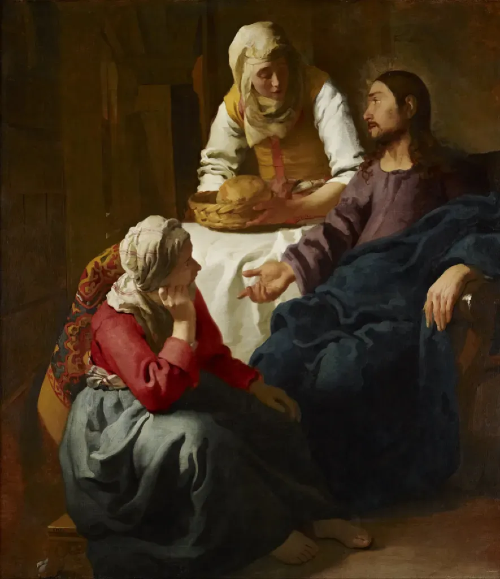
The more conventional reading of the Mary/Martha passage is to fault Martha with being too “cumbered” to attend to the “one thing needful.” But does this imply an abandonment of the cares of the world in the cause of personal salvation? From the traditional perspective, Eckhart’s reading is not incompatible in an essential sense with the conventional interpretation of the text. It is not the world we have to exclude, but our cumbersome, “intermediary” selves—not renunciation we must achieve, but detachment. The goal is not to flee the world but to see it in the light of God (visio Dei), and in doing so to respond to its sacredness out of the one Light from which all was made. This entails that we live consecrated lives, detached and “unencumbered” by mere worldliness, as vessels for the Spirit to pour through: to be a passage for its Light.
It is through this integral vision that our lives in the world can be integrated, so that each task, indeed our very lives, become acts of worship consecrated to the sublime.
In Sermon 3, Eckhart expressly evokes the shining of a light as the image of an integrated life in his discussion of Mary and Martha. He refers to the Spirit as “the inwardly born and yet hidden Word that lies secreted in the soul,” and he states:
It must be within you in thought, in intellect, and in will, and it must shine forth, too, in your deeds. As Christ said, “Let your light shine forth before men” (Matt. 5:16).
The good works of those like Martha, become the Light. The focus on the “one thing needful” (the attunement of our selves to what is essential, to be a passage for Light) is precisely what is required of us in order to perceive the world afresh, with new eyes that give it its proper worth, as theophany, so that we can integrate it in our activities. For those who live in the modern world, dominated by metaphysical ‘shadow’ of phenomena, it is through metanoia or by reorienting to the transcendent Light, that we can hope to harmonize with the world that is inwardly one with us. It is through perceiving the intrinsic wholeness that binds us, that we are able to embrace the world through our works, not passionately with appetitive desires but compassionately with love. Seen as theophany, what once might have seemed ordinary and mundane, becomes, by the grace of illumining and bonding vision, extraordinary and radiant—in a word, ‘Sacred.’
God, whose Spirit was breathed into Man, must be seen beyond Maya as Atma, not as merely disconnected phenomena but as signs of spiritually connected Presence. The world must be seen in its sacred Light as a projection of the Divine, as Wholeness—the Face of God that is everywhere. This Face is, as Jesus teaches, what enables us to love one’s neighbour as oneself. It is through this sacred vision that our lives in the world can be integrated, so that each task, indeed our very lives, become acts of worship consecrated to the Sublime.
How is this consecration to be achieved in practice in the modern world? The world we live in offers us seemingly great freedoms, perhaps more so than in any other period of history. Technological advances have improved our material comforts, information is more readily available than ever before in history, medical sciences have developed the capability of improving our health and quality of life, and this—and much else—has served to increase our sense of freedom. But, by its outer pull of (in Guénonian terms) solidification and dissipation, it also distracts us from Wholeness—and wholesomeness—and the binding spiritual Center that is within us all.
It is as though outwardness, unaccompanied by spiritual interiority, has resulted in a heightened sense of isolation, of aloneness.
So our freedom has paradoxically diminished as it has grown. We have grown apart from one another in love. Our traditional foundations have gradually eroded as our material pursuits have expanded. It is as though outwardness, unaccompanied by spiritual interiority, has resulted in a heightened sense of isolation, of aloneness. There is an addictive quality to our mundane pursuits. We are seduced by the illusory world and, as we satiate ourselves in its unreality, our malaise grows. As our pleasures increase, our joys diminish. Our freedoms are curtailed by the pressures of living, the demands of time, and the compulsions of the material world. As these pressures, demands and compulsions grow, so too does our sense of apathy and spiritual discontent. Modern lifestyles, with few exceptions, allow little room for traditional pursuits. Such pursuits, especially formal practices such as centering prayer or rituals, are often regarded as anachronistic and irrelevant to the needs of the modern age, and are increasingly privatized.
Given the destabilization and diminishment—if not eradication—of the traditional world, one may ask whether it is any longer realistic for human beings, except by retreating from the world, to live consecrated lives. The answer depends on how one apprehends one’s vocation. According to Tradition, Man’s fundamental vocation is to “become what one is”. What we are transcends our atomized outer reality. The Qur’an repeatedly emphasizes that human beings have been made diverse in order to “know each other”—in other words, to know that there is a transcendent unity which binds them and their differences too. We have within us the intelligence to reconcile all that is peripheral through knowing the Center. But to know that harmonizing Principle of objectivity, we must be it. It is only the Spirit in us that can know the Spirit in all. In the words of Abu Sa’id al-Kharraz: “God cannot be known except as a synthesis of opposites.” This coincidentia oppositorum, which is central to the traditional understanding of reality, contains the key to the art of living. Consecration is integrate ourselves cardially with the Sacred by conforming to the sacred Principle which binds us as One. Thereby we can live in harmony, viewing our outward differences as inwardly complementary, and integrating our faith in our daily lives. To attain this is to be like Martha (in Eckhart’s interpretation), one who lives in “both worlds” at the same time, living through faith and being (in the phrase of the Sufis) “in the world, but not of it.” It is to be like Arjuna on the Battlefield of Kurukshetra, “doing his dharma” (doing what he must do in the world as a vessel of the Divine) while leaving the outcomes and fruits to the Deity.
At its core, life is the calling of Love.
While certain attitudes and temperaments may at times lead one either into the world and away from faith, or even away from the world by renouncing it for the sake of faith, it is important to remind ourselves that any movement away from the world or from faith is eventually surpassed by a return to consecrated living precisely because one can never escape one’s highest vocation—to be integrated with the Real. “There lives the dearest freshness deep down things,” says the Jesuit poet, Gerard Manley Hopkins, and it is that “freshness” we always seek—the Spirit that never stales. Man is drawn to what he intrinsically is. The Sacred continually summons us. Life is, at its core, the calling of Love.
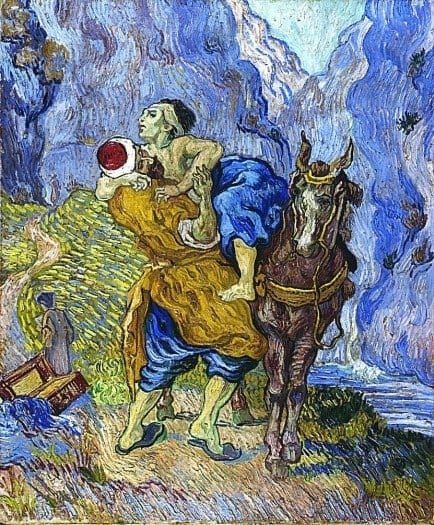
In the Gospel of Luke, the Mary/Martha story (10:38-42) is immediately preceded by the parable of the Good Samaritan (10:25-37). Here, Jesus teaches his disciples that to attain to eternal life one must integrate faith and action in love. The love for God entails the love of the neighbour: “Thou shalt love the Lord thy God with all thy heart, and with all thy soul, and with all thy strength, and with all thy mind; and thy neighbour as thyself.” (Luke 10:27) And when asked by his questioner who was one’s neighbour, Jesus replied with the famous parable: one’s neighbour was the one who, like the Good Samaritan, acted with compassion, love and care. In the parable, it was the Samaritan (who belonged to a group traditionally despised by the Judeans as their enemy) who in fact behaved in a neighbourly manner by compassionately tending to the Jewish traveller who had been attacked by the thieves and left for dead by them. More importantly, the victim had been ignored and neglected by the Jewish priest and the Levite who, passing by, had turned away from helping their own Jewish kin. The Samaritan, a stranger, had looked beyond the racial, ethnic, and tribalistic aspects—otherness—that tend to divide us as human beings, to the core of what connects us. Unlike the priest and the Levite who were ready to abandon the robbed traveller, the Samaritan had cared for him out of empathy. Here is the passage from Luke:
33 But a certain Samaritan, as he journeyed, came where he was: and when he saw him, he had compassion on him,
34 And went to him, and bound up his wounds, pouring in oil and wine, and set him on his own beast, and brought him to an inn, and took care of him.
35 And on the morrow when he departed, he took out two pence, and gave them to the host, and said unto him, Take care of him; and whatsoever thou spendest more, when I come again, I will repay thee.
36 Which now of these three, thinkest thou, was neighbour unto him that fell among the thieves?
37 And he said, He that shewed mercy on him. Then said Jesus unto him, Go, and do thou likewise.
The Samaritan had acted out of a deeper knowledge of selfhood intrinsic to faith.
Drawing from this, and from the Mary/Martha passage that follows, how then are we to relate to the world? The teaching suggests that faith requires us to engage with the world empathetically, through love.
Knowledge, through faith, deepens us, and blossoms within us and in our lives into love.
First, we must, like Mary, contemplate the Real in order to know it beyond its outer and contingent manifestation, To know—or contemplate—is to become aware of its all-embracing Oneness. We thereby recollect who we are (spiritual kin), are conscious of our intrinsic nature (good and loving), and become aware of our purpose (to love God and one’s neighbour as oneself). The aim of contemplation is not to retreat from the world, but to engage with what is sacred in it—to engage wholesomely with the Spirit within us all. Once we can perceive the Sacred in the here and now, in the very core of our being and in the minutiae of living, then our “doors of perception” can be said to be cleansed. And once we see (in the poet Hopkins’ words) He who “fathers-forth whose beauty is past change,” we will naturally yearn to “praise Him.” Knowledge, through faith, deepens us, and blossoms within us and in our lives into love. We remember then that we are merely journeying through this world, toward a destination that is profoundly present, and so we rejoice in being ‘at One’ in its Presence in each moment of our journey.
Our intelligence then deepens our wills so that we, like Martha, can act out the corollary of out contemplation: to conform to what is Real. This requires us to be detached by reposing the soul in the Spirit, incarnating its presence as Love. Thereby we combine theoria (seeing the Divine Face) with praxis (conforming our wills to the Supreme Commandment—loving God and the neighbour). As we contemplate the Real, we mould our actions to align with it, to be true to our God-given nature, the objective Norm of humanity. Again, this requires an engagement with life that is the antithesis of renunciation. We honour God within His creation by conforming to our Adamic Nature—the light and love breathed into us as the Divine Spirit. This primordial Nature is the Norm of human perfectibility, and we incarnate its sacred Presence through our loving actions, thereby eschewing the tenebrous and hubristic choices of Iblis/Satan, who turns the translucent icon to the opaque idol. As human beings, composed of both worldly dust and transcendent spirit, we can choose to see the world as spiritually opaque (idol), or as spiritually translucent (icon).
“Know Thyself,” said the Delphic oracle. For only by knowing what is sacred within ourselves can we know what is sacred in all, and thereby realize it in our living. It is this gift of principial knowledge that gives humanity the normative vision to recognize one’s neighbour as oneself, and to embody love, for all souls naturally incline to the Truth, Goodness and Beauty which are aspects of the Reality we are privileged to participate in. For this reason and capability, humankind was entrusted to be a steward of creation, accountable to the Creator for its care.
Those who know, love, and in loving they live good and noble lives, spiritually profitable and charitable.
The “one thing needful,” therefore, is to faithfully live one’s life, integrating contemplation with action. To know entails the responsibility to be integrated in the world through loving action. Those who know, love, and in loving they live good and noble lives, spiritually profitable and charitable, true to their trust of uplifting the dignity of all, conformed to their normative nature. This does not require that we be naive; rather we must be wise as serpents and gentle as doves (Matthew, 10:16), while reposing inwardly in the Spirit, detached from the outer tugs of the contingent world. And so we become vessels for its Light.
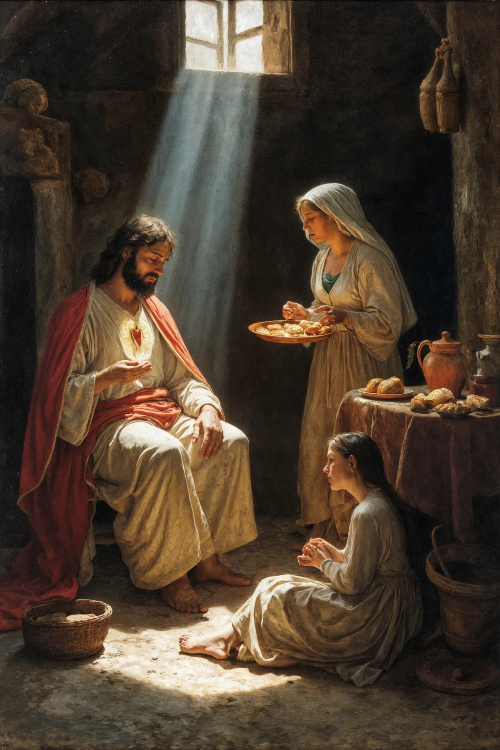
Thus, in his Summa Theologiae (in Secunda Secundae Partis, Question 188, Article 6), Saint Thomas Aquinas wrote, "Sicut enim maius est illuminare quam lucere solum, ita maius est contemplata aliis tradere quam solum contemplari."
It is a greater thing to give light than simply to have light, and in the same way it is a greater thing to pass on to others what you have contemplated than just to contemplate.
Eckhart, like Aquinas before him, affirmed the importance of integrating contemplation in action through the Light that shines through our being as Love. That is the essence of living a life consecrated to the Sublime.
our real purpose is to be a candle of love, lit by the sacred flame, so that we may serve to light all the dark and empty corners of this world.
What do conformity and conformance mean in practical terms? It means consecrating our lives to the Sacred through Love.
To do this, we must learn to be spiritually literate. As with any other form of learning, this requires guidance and an attitude that facilitates learning. We must learn how to learn, to develop a receptivity for the Spirit, a sense of the Sacred, so that we perceive the world through the Heart as theophany, as the radiance of the divine.
And we must inculcate within ourselves virtues that incarnate love, conforming our wills and appetites to our higher intelligence. This too requires guidance, discipline, and grace. For the human will is recalcitrant and refractory. It is easily tempted and can seduce the other faculties to serve its own ends. It is by refining our faculties of perception and disciplining our wayward passions that we can hope to become the Light. The Light we seek is within. It is we who must open the door to let it in, to consecrate our lives to the Sacred, to live out our faith as Love.
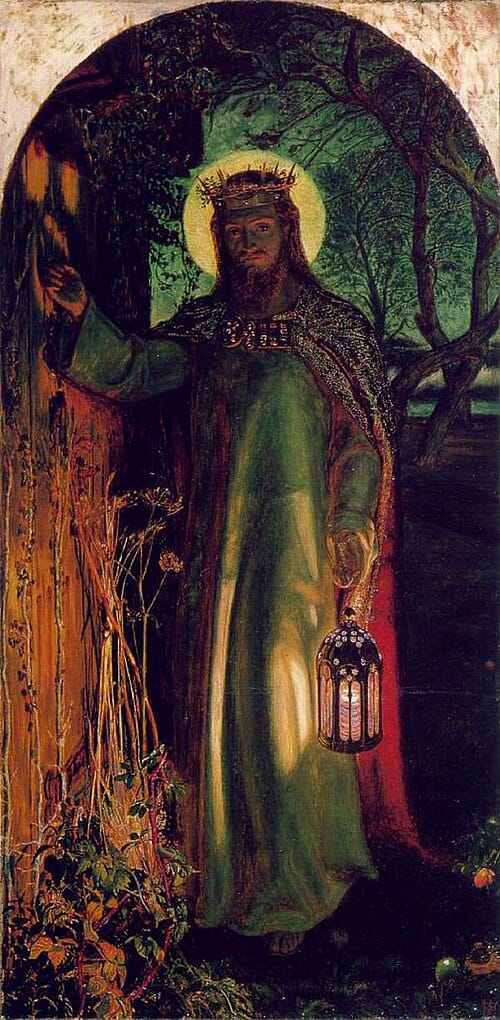
By these methods we may hope to achieve our real purpose in this temporary terrestrial abode: to be a candle of Love, lit by the sacred flame, so that we may serve to light all the dark and empty corners of this world.
Let us conclude with words of Nasir Khusraw:
The sun has the power of turning stone into ruby
Which no force of elements can turn again into its original state –
I am like that ruby now, and the sun is he
By whose light this dark world becomes lit.