'Kurukshetra is indeed the place of sacrifices to the gods.'
— Jabala Upanishad
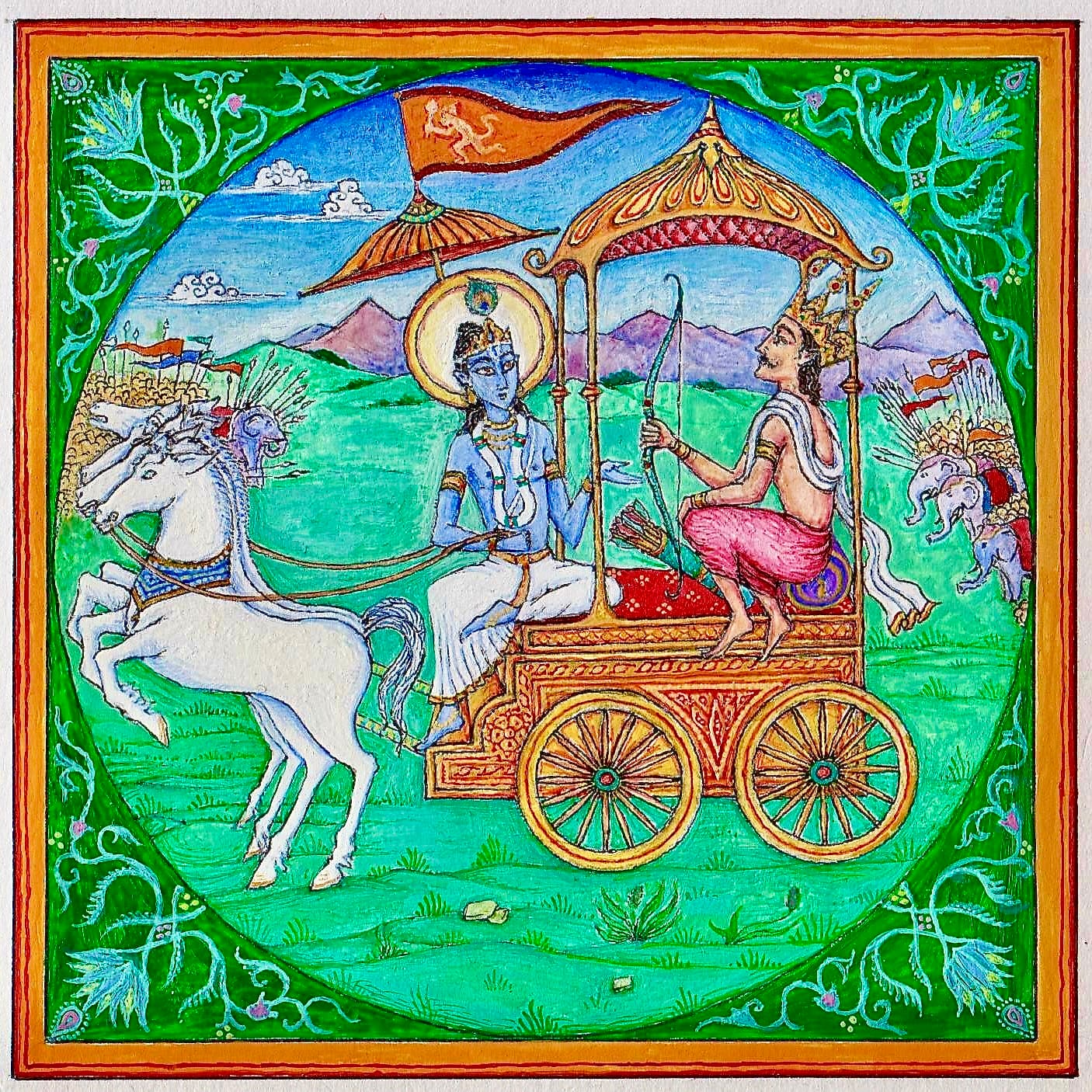
The scene of the image is the famous battlefield of Kurukshetra where the opposing armies of Pandavas and Kauravas face each other in the climactic combat of the great war of the Mahabharata. This field of warfare symbolizes the battlefield to be found within the individual being — it is in the Kurukshetra of the heart that we must each face the great existential questions addressed in the Bhagavad Gita.
The Satapatha Brahmana states: 'Kurukshetra is for the gods the resort of the gods; and for all the creatures it is the abode of Brahman, place of liberation, salvation.'
Between the gathered armies stands the Chariot of Arjuna. This Chariot, in which Lord Krishna is the driver and Arjuna the rider, has been understood as symbolic of the bodily vehicle, subtle and gross: the horses are the energies, impulses, and instincts controlled by the Charioteer, representing the Spirit.
Here, Lord Krishna is the transcendent Atman, and Arjuna is the conditioned selfhood, jivatman. Atman is the controller of the Chariot but is detached from and does not participate in the battle.
A similar symbolism of the chariot as the 'vehicle of human life', the 'radiant vehicle' or the soma pneumatikon (1 Corinthians 15), is encountered in Western and Platonist traditions — the 'subtle vehicle of the soul' as the Pythagorean-Platonist commentator Hierokles terms it.
Lord Krishna's name means 'Black' (the dark hue being typically depicted in blue) and Arjuna's colour is 'White' (typically rendered in bright colours, and here in red). René Guénon remarks in his Essai sur le Noir et le Blanc (Essay on the Black and the White) in Symboles de la Science Sacrée (Symbols of Sacred Science), that Arjuna, the 'white', and Krishna, the 'black', are the mortal and the immortal facets of Being, the 'me' and the Self'.The Black symbolizes night, the transcendent darkness of the unmanifest, of non-manifestation, while White represents the day and the contingent realm of the manifestation. These are complementary aspects of non-dual Reality. It is a symbolism reiterating the famous Upanishadic image of the two birds in a tree, one partaking of the fruits and the other bird watching on in silence.
The wheels of the Chariot convey their own special meanings and solar symbolism. The central axle (aksha) from which the spokes emanate radially is a symbol of the Cosmic-Centre or Axis Mundi — the two wheels of Heaven and Earth whose revolutions are connected by the axial pole. Here we also note a cognate symbolism with the two hemispheric halves of the World-Egg (Brahmanda) from which creation emerges (‘omne vivum ex ovo’).
The Parasol (chhatra) embodies a related symbolism, of spiritual dignity, which serves as the protective sheath against mortal sufferings sustained in the battles of life. As Arjuna’s royal standard, it indicates the innate dignity of Man, and is linked with the symbolism of the cranial dome.
Above the Chariot flies the flag bearing the Golden Emblem of Lord Hanuman, the heroic devotee of Lord Rama who, like Lord Krishna, is the Avatar or the god Vishnu, the font of cosmic order and the sustainer and protector of the universe.
In summary, the image of the Chariot on Kurukshetra represents the Inner Spirit and Intellect of the Inner Man, which sustains and guides the Outer Man on the Battlefield of Life.