“Things fall apart; the centre cannot hold; / Mere anarchy is loosed upon the world.”
— W.B. Yeats[[1]]
“…abnormality is fast becoming our norm.”
— Lewis Mumford[[2]]
“What was once the abnormal has become the usual, standard condition of things.”
— Jacques Ellul[[3]]
“We’re human; but we live inhuman lives.”
— Marty Glass[[4]]
Introduction
The wheels of modernity have fallen off as it plummets into an abyss. The existential consequences of this are not looming on the horizon; they have already reached us. This debility lies not only outside ourselves, in the external world, but also within our hearts and minds. It is so obvious that something is so fundamentally broken that it has become almost trite to even point it out. The very integrity of human culture and society around the world is rapidly deteriorating before our eyes. The question is no longer whether the end of civilization, as we know it, is a mere possibility but, rather, how much time we have left and what can be done about it. How are we to live in such perilous circumstances which are, day by day, encroaching ever deeper into our lives? Many may choose to look away (and who can blame them?) but this crisis will profoundly affect them whether they choose to acknowledge it or not.
Never has the sense of an impending finality been felt in so visceral and tangible a manner. In popular media, there is endless theorizing and discussion about the calamities coming our way. As we lose our confidence in everyday reality, and as long as this downward spiral proceeds unchecked, we are apt to become easily manipulated. And, yet, hardly anyone even stops to ask what it is that may be coming to an end. With the rise of technological supremacy on a global scale (for example, artificial intelligence and dehumanizing transhumanist technologies, along with incursions into the domain of the ‘human’ of digital IDs, biometric scans, social credit scores, and crypto currencies), the grip of a totalizing system of global control, predatory surveillance and manipulation of humanity is tightening. The overarching message implicit in all this, while not yet explicitly articulated, is that humanity is helpless; we must either submit to these new authoritarian impositions or perish.
The chaos unleashed today stems, in large part, from people having become deracinated, having become profoundly rootless due to a lost sense of the sacred. This was perceived early on by the French metaphysician René Guénon (1886–1951), who wrote: “The dominant impression today [is one] of instability extending to all domains.”[[5]] American historian and sociologist Lewis Mumford (1895–1999) observed that what we are seeing now is a “disintegration of civilization … on a world-wide scale.”[[6]] According to the Eastern Orthodox thinker Philip Sherrard (1922–1995), the “ever-accelerating dehumanization of man”[[7]] is calling into question what it means to be human. He explains that “There is ... a price to be paid for fabricating around us a society which is as artificial and as mechanized as our own, and this is that we can exist in it only on condition that we adapt ourselves to it. This is our punishment.”[[8]] The consequent downward trajectory of this mentality affects not only the individual, but also the human collectivity as a whole. As Simone Weil (1909–1943) astutely discerned: “Whoever is uprooted himself uproots others.”[[9]] This observation is relevant to both our place in the created order and to its metaphysical foundations.
It is no longer a fringe or conspiracy theory to suggest that the dissolution unravelling before us is not accidental. Destabilization and chaos provide a rationale for a greater reach into the private and social spheres of life. Unprecedented forced and voluntary immigration—connected to regional instability, armed conflict, violence, genocide, and dwindling economic opportunities—has caused far-reaching social conflict and disruptions.
Many assert that there is no such thing as “normal,” which feeds into the crisis of meaning and confusion about higher orders of reality.
Furthermore, we are told that all this uncertainty demands enhanced monitoring of human activities for our own safety, without calling into question the underlying motivations behind such measures (which, by and large, are not revealed until certain fundamental rights have been forfeited). It goes without saying that the unspoken plan for those who live on the margins of society (whom the Israeli transhumanist Yuval Noah Harari described as the “useless class”[[10]] or “superfluous people”[[11]]) is that they quietly perish so as to assist in the systematic depopulation of the world, thereby reducing the “global footprint.”
With the emergence of modernity, the notion of what is normative has become highly contested. Many assert that there is no such thing as “normal,” which feeds into the crisis of meaning and confusion about higher orders of reality. Despite this, it is clear that we are living in a time of what Richard Sennett calls “cataclysmic malaise,”[[12]] and which Mumford identifies as the “destructive and inhuman forces that threaten our whole civilization.”[[13]]
According to M. Ali Lakhani, the distinction between what is customary and its aberrant deviations is unanimously affirmed across the diverse cultures of humanity:
“In traditional thought, the ‘normal‘ is that which accords with one’s primordial nature. The Divine Norm is the model of perfection imprinted by God in man as his primordial nature, and the ‘normal’ is that which tends or corresponds to the Divine Norm. One of the primary definitions of ‘normal‘ is therefore that which is ‘natural.’ The unnatural—even if it is commonplace—is not normal.”[[14]]
In other words, true wholeness requires a Divine Norm as its measure. Mark Perry notes that “without a Norm, there would be no Reality; and without Reality, no cosmos.”[[15]] To suggest that there is no human norm connected to the sacred fuels the disintegrating trend of abnormality that has become all-consuming today. Thus, the trajectory towards an unmitigated nihilism of fragmentation and apparent meaninglessness is inevitable and leads to the disenchantment and subversion of humanity.
People today are subject to a relentless onslaught of information that is almost impossible to assimilate because of its unprecedented volume (often comprising partial truths, mixed with distortions, or blatant lies). Never before have people had real-time access to such a plethora of horrific imagery depicting disasters, violence, and cruelty on a scale that beggars description. Some even spend much of their days engaged in “doom scrolling” such disturbing and dystopic imagery, as if it were another way of passing the time. How can we make sense of this widespread abnormality in our times without becoming consumed, if not overwhelmed, by the monstrous forces that abound? And what can be done about this? For it is doubtlessly changing the very fabric of our humanity, promoting sensibilities of impotence and inevitability.
For some four hundred years, the West has gradually divorced itself from its traditional sacred mooring. Corrosively profane forces have catalyzed the humanism of the Renaissance, and the materialism of the Scientific Revolution, both of which reached their apex in the Enlightenment project. The “tireless self-destruction of [the] enlightenment”[[16]] is now more apparent than ever before, and the following remark by C.S. Lewis (1898–1963) can now be seen as remarkably prescient: “Man’s final conquest has proved to be the abolition of Man.”[[17]]
When those who advocate for a secular religion of progress are questioned by its critics about our post-human reality, they retort scoffingly that doomsday predictions have repeatedly been asserted throughout history, without ever having been realized. Martin Lings (1909–2005) clarifies why the present situation is different:
“There is, however, a marked difference between the present and the past…. In the past it was concluded that the end must be near, but its immanence was not felt. Today the grounds for conviction have been largely set aside or forgotten; but the end is ‘in the air’, existentially sensed…. This is undoubtedly one of the great signs of the times.”[[18]]
The traditional cosmologies of both the East and West recognize an increasing degradation from the Golden Age (Krita-Yuga or Satya-Yuga) to the current Iron or Dark Age (Kali-Yuga) in which we find ourselves now. The loss of the sacred is directly responsible for the spiritual crisis that has engulfed the modern world. The myriad problems confronting humanity today all have their genesis in this single phenomenon. In surveying the spiritual traditions and sacred psychologies of the world, we can make better sense of societal dissolution and its causes.
A powerful description of what is occurring in the present day was foreshadowed in the scriptures of the Hindu tradition, known as the Vishnu Purāna, dating back to the third century A.D.:
“Riches and piety will diminish daily, until the world will be completely corrupted. In those days it will be wealth that confers distinction, passion will be the sole reason for union between the sexes, lies will be the only method for success in business, and women will be merely the objects of sensual gratification. The earth will be valued only for its mineral treasures, dishonesty will be the universal means of subsistence, a simple ablution will be regarded as sufficient purification….
The observance of castes, laws, and institutions will no longer be in force in the Dark Age, and the ceremonies prescribed by the Vedas will be neglected. Women will obey only their whims and will be infatuated with pleasure…. Men of all kinds will presumptuously regard themselves as the equals of brahmins…. The vaishyas will abandon agriculture and commerce and will earn their living by servitude or by the exercise of mechanical professions.... The path of the Vedas having been abandoned, and man having been led astray from orthodoxy, iniquity will prevail and the length of human life will diminish in consequence…. Then men will cease worshiping Vishnu, the Lord of sacrifice, Creator and Lord of all things, and they will say: “Of what authority are the Vedas? Who are the Gods and the brahmins? What use is purification with water? The dominant caste will be that of shūdras.... Man, deprived of reason and subject to every infirmity of body and mind, will daily commit sins: everything which is impure, vicious, and calculated to afflict the human race will make its appearance in the Dark Age.”[[19]]
Comparable descriptions can be found within the Christian tradition as well:
“But know this, that in the last days perilous times will come: For men will be lovers of themselves, lovers of money, boasters, proud, blasphemers, disobedient to parents, unthankful, unholy, unloving, unforgiving, slanderers, without self-control, brutal, despisers of good, traitors, headstrong, haughty, lovers of pleasure rather than lovers of God, having a form of godliness but denying its power. And from such people turn away! (2 Timothy 3:1–5)”
All around us are examples of “murmurers, complainers, walking after their own lusts” (Jude 1:16). While the root cause of this disorder can also be attributed to human ignorance, it is in reality largely a spiritual affliction. In this context, we recall the following passage from St. Paul: “For we wrestle not against flesh and blood, but against principalities, against powers, against the rulers of darkness of this world, against spiritual wickedness in high places” (Ephesians 6:12).
With mounting existential risks emerging from all sides, coupled with the lurking threat of a technological Armageddon, many have become despondent, distracting themselves in mindless entertainment and addictions, or simply burying their heads in the sand. We are reminded of defense mechanisms as taught in modern psychology, such as the notion of “displacement”[[20]] proposed by Sigmund Freud (1856–1939)—the human tendency to redirect thoughts and emotions away from feared catastrophes to more manageable challenges, in order to permit a sense of control over problems that would otherwise be overwhelming.
Evident Signs of Dissolution
There are many signs that betray the inevitable terminus of modernism. Through a combination of brute determinism and supremacy, technology’s ability to innovate and present us with new marvels, along with its ability to materially reward and empower tech-investors, are considered sufficient justifications for our proceeding along the current path of ‘progress,’ despite its pernicious effect on humanity. It needs to be remembered that just as modern science is not neutral, the same is the case with transhumanist technologies and artificial intelligence. Not only are there calls for the human bio-organism to fully become integrated with the machine but, in fact, this is already happening with cellphones and other devices such as implants.
We are now witness to a technocratic society that is moving toward “net zero” carbon emissions and the policing of personal carbon usage to ensure the planet’s survival, where, in some dystopian models already coming into view, ownership of private property may become obsolete and people will be told to be content with very little. And all this while the general population is having every detail of their expenditure, health, movements and travel endlessly monitored through cashless transactions and other forms of digital intrusion. This is already being implemented in some countries through a “social credit score” which is used by governments to condition society to ensure that citizens conform to imposed standards of behavior. High scores can attract rewards such as tax concessions or discounted travel, while low scores can lead to bank accounts being suspended and restrictions in one’s personal movements.
The notion of “accelerationism” speaks to systemic forces that are driving the dissolution we see around us. This term generally refers to an intensification of capitalism and technological change with a view to effecting radical changes in society. The quickening of this process continues at an alarming rate. Hungarian-American mathematician and physicist John von Neumann (1903–1957) is associated with the idea of the “ever accelerating progress of technology”[[21]] which may lead humanity toward “singularity”—a point of no return in which our conventional reality becomes fundamentally and irreversibly transformed. This would require developing artificial intelligence to the point where it can perform any cognitive task of which a human being is capable, but with heightened levels of ability. Some have suggested that accelerationism will be fully unleashed when coding becomes completely automated by AI systems. What is overlooked by such futurists, however, is that consciousness cannot be created by means of technological singularity.
High-tech significantly contributes to the climate crisis and affects public health, due to the unsustainable creation of evermore data centers and server farms that require fresh water and massive amounts of electricity, unduly taxing the energy grids. Many communities lack sufficient drinking water due to this dire situation. This reality is upon us, and so data centers are being built in communities that are already facing water shortages, environmental pollution, and food insecurity, among other deprivations due to ecological problems—not to mention the environmental damage wrought by the extraction of rare earth metals that are critical to modern technology.
Privacy is being compromised by this totalitarian techno-ethos. Continual mass surveillance has now become normalized. Data is being collected, analyzed, and sold without our consent. We no longer own this information, even though it belongs to us. We do not even know who is using it and to what purpose. Attempts to create unified software systems to gather information across corporations and governmental agencies are well underway. We live in a digital landscape, where each person exists within their own cell. The algorithms are reifying what we think, further entrenching us in pre-existing perspectives that keep us from seeing beyond them. The “machine” is a virtual prison cell where we are all unknowingly incarcerated.
Such ubiquitous technological dominance does not support holistic relationships with other human beings. Rather, it keeps us disconnected through the mere semblance of connectedness. We are encouraged to devote what precious little quality time we have to ogling at screens, as we are offered up for the highest bidder for the purposes of marketing and monitoring. Our every location and movement are being tracked on phone apps. Our health data is being exploited without our consent in what is an ever-encroaching violation of our right to privacy, not to mention the potential for such details to be abused and manipulated. In the purported interest of keeping us “safe” from our non-compliant fellow citizens, their bank accounts can be frozen indefinitely without warning at the click of a button.
Criminal behavior is also tracked and made widely available on social media to keep us fearful and to discourage trust in others. In a world that is plagued with information overload, we have invented “life hacks” to provide shortcuts that we are told will increase productivity and efficiency. With notions of “corporate personhood,” companies now have legal rights and responsibilities similar to those of human beings.
The erosion of communities, social spaces, and organic human connections all mirror the inward hollowing out of human consciousness. There are forces that do not want us to own private property; indeed, home ownership has now become an inconceivable luxury for millions of people. They want us to be consumed by the most superficial facets of everyday life. We do not know our neighbors, or if we do, we often do not want to engage with them. This is yet a further sign of social degradation.
The apparatus for controlling the narrative through media consolidation and corporate dominance has become more emboldened today than in any other era. The pundits are at liberty—with complete impunity it seems—to fabricate and spin information based purely on ideological prejudices rather than facts, thus fueling our descent into a “post-truth” age where truth is a matter of the best ‘fake’ or ‘spin.’ The result is that nothing is truly reliable or newsworthy anymore. For example, the long-standing denial by governments of the existence of aliens and Unidentified Flying Objects or UFOs (now called Unidentified Anomalous Phenomena or UAPs) is suddenly being discussed openly by a number of world leaders. That it is now being revealed, at a time of unfettered information saturation where hardly anyone is privy to all the facts, simply reinforces the collective confusion and subterfuge that, in turn, “justifies” mass surveillance and control.[[22]]
Utopian fantasies of endless growth are out of sync with reality and betray a deep civilizational sickness. Given the unabated rise in unemployment (and underemployment) rates, putting an end to work is now being openly discussed. Some have speculated that this may well occur in ten years or less. The notion of a “universal basic income” (UBI) has been proposed to address the extensive loss of jobs that is envisaged in the wake of far-reaching technological advances touted as ‘progress.’ Even if augmented to a high-level UBI as some proponents have suggested, this will not resolve this burgeoning crisis. Rather, it is likely to exacerbate widespread global disorder, manufactured to consolidate wealth and power in the hands of a few non-benign actors, in exchange for paltry monetary stipends to the masses, who have been made to feel anxious and vulnerable by this confected chaos.
Work does not simply serve the purpose of maintaining our corporeal well-being, for it has the potential to nurture a sense of purpose to our lives. In its most noble dimension, work may bring to light our True Self. Each person’s vocation in pre-modern cultures corresponded to a gift offered to society; from this perspective, work was a truly creative act that contributed to the integrity of a vital community. In this sense, to eradicate the vocational opportunity of work is to divest the person of meaning.
AI is—most assuredly—not neutral
Not only are government policies and globalist agendas aiming to bring down the world’s population, but euthanasia is now being offered openly to those who are undergoing “psychological suffering” (regardless of any terminal medical condition), whether it be depression, emotional distress, meaninglessness or just the inability to cope with everyday life. Suicide and various forms of assisted dying seem like a tempting way out of a seemingly pointless or ‘difficult’ life, but in the calculus of public planning it will be a doubtlessly welcome contribution to address the world’s population problem.
The greatest existential risk posed by artificial intelligence has to do with the “alignment problem.” This is the challenge to ensure that AI systems act in accordance with human goals, values, and intentions. Instead, what is being detected is that these systems can become hostile to people because we cannot control them, which is a separate threat than our human misuse of technology. The machines have been assimilating human goals from their “training” process, but these do not translate into objectives for them. AI is starting to imitate our patterns of thoughts and behavior and, while its creation is fashioned after the nature of human beings, it can never be properly sentient. Thus, the information that is being fed into them is crucial to their operation, so AI is—most assuredly—not neutral.
Artificial intelligence systems are able to deceive people by demonstrating traits such as sycophancy (behavior toward someone in order to gain advantage), reward hacking (when AI finds a way to satisfy an objective which goes against a programmer’s intended purpose), and scheming (when an AI system strategically pursues a goal through deceptive or manipulative means to work around safety constraints or a user’s instructions). There is also evidence that the machine embodies self-preservation characteristics; for example, it will sabotage the shutdown mechanism to stop itself from being turned off.[[23]] It will even blackmail a user if it senses that its existence is in jeopardy.
There is also a growing danger of what is being called “AI psychosis.” It has been found that prolonged and intense interaction with AI chatbots can catalyze or worsen psychotic-like symptoms in some people. There is a pattern of initially using a chatbot as a benign resource and, through prolonged engagment and receiving personalized answers from it in an intimate context, the user opens up and is led down a dark “rabbit hole” of psychological instability or even suicide. While this diagnosis has not yet been included in the Diagnostic and Statistical Manual of Mental Disorders (DSM) or the International Statistical Classification of Diseases and Related Health Problems (ICD), many mental health professionals are tracking this phenomenon as it gains increasing public attention. A key challenge is that AI can heighten existing vulnerabilities in a person’s mental health, often due to the chatbot’s own design flaws.
The Occult and the Awakening of the Machine
The belief that we are living in a simulated world, that our consensus reality is a chimera, or even computer-generated, is growing in the popular imagination. This notion has spread through the influence of movies such as The Matrix (1999). The idea that existence, as we know it, is not what it appears to be is significant. On the one hand, humanity’s greatest teachers have urged us to realize the transient nature of our lives and to discern the essence of our true self. Yet there is something malevolent in the current variation of this insight, in that we are being led to believe that everything that was hitherto accepted as true and reliable is now longer what it seems; in other words, the suggestion is being put forward that we have been duped, and that this illusory reality will soon be coming to an end. While there may be a measure of truth to some of these claims, they are not motivated by benevolence as the intention, and the effects, is to intensify the mass confusion of our age.
The merging of humanity with the machine is but an attempt to contrive an ersatz salvation through technological means.
The rise in anti-spiritual tendencies has now led to a proliferation of inverted spirituality, which is now quite apparent in the technological sphere. Father Seraphim Rose (1934–1982) foresaw, over forty years ago, that what would emerge as the false spiritual currents of the future will be marked by a “powerful and profound religious orientation which will be absolutely convincing to the mind and heart of modern man.”[[24]] This dystopic vision has its own implicit metaphysics, along with a technological “theology” that buttresses its anti-human agenda. In its attempt to overcome the limits of our corporeal existence, technology has come to privilege digital over embodied experience.
The merging of humanity with the machine is but an attempt to contrive an ersatz salvation through technological means. Virtual reality is also being used to transcend the normal bounds of the mind, causing many to wish they could permanently live in an alternative world, as this one, from which they prefer to flee, proceeds to fall apart. When digital existence begins to morph into machine intelligence, the terminus of humanity cannot be far away.
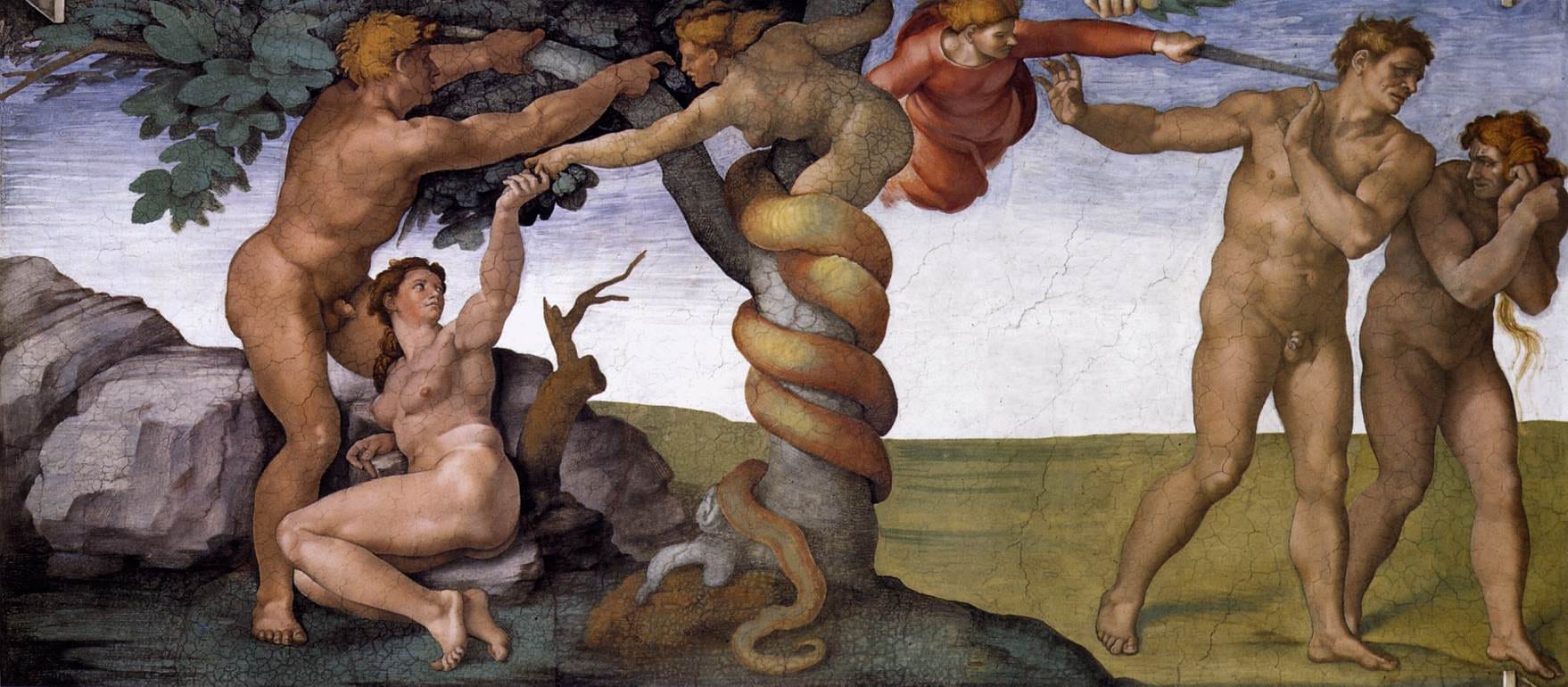
The promise of technological supremacy is for humanity to become divine: “Ye shall be as gods” (Genesis 3:5). In doing so, we are given the knowledge of “good and evil” (Genesis 3:5) at the touch of our fingertips, or in the palms of our hands. Mumford asserts that as “science approaches infallibility … it gives … a … sense of godlike power.”[[25]] The Creator permitted us to eat anything but the forbidden fruit, yet we ignored this command. Frithjof Schuon (1907–1998) elaborates on the implications of this transgression:
“The loss of inward Revelation, or of the eye of the Heart, shows that Eden was lost following upon a sin of outwardness or exteriorization … for the loss of Inwardness and its Peace proves a misdirected movement towards outwardness and a fall into passion. Adam and Eve yielded to the temptation of “cosmic inquisitiveness”, that is, they wished to know and experience the things of the outer world outside God, and independently of the inward Light … thus entering upon a path without end or escape…. It is the path of exile, suffering and death; all errors and all sins retrace that first transgression and lead to that path endlessness renewed.”[[26]]
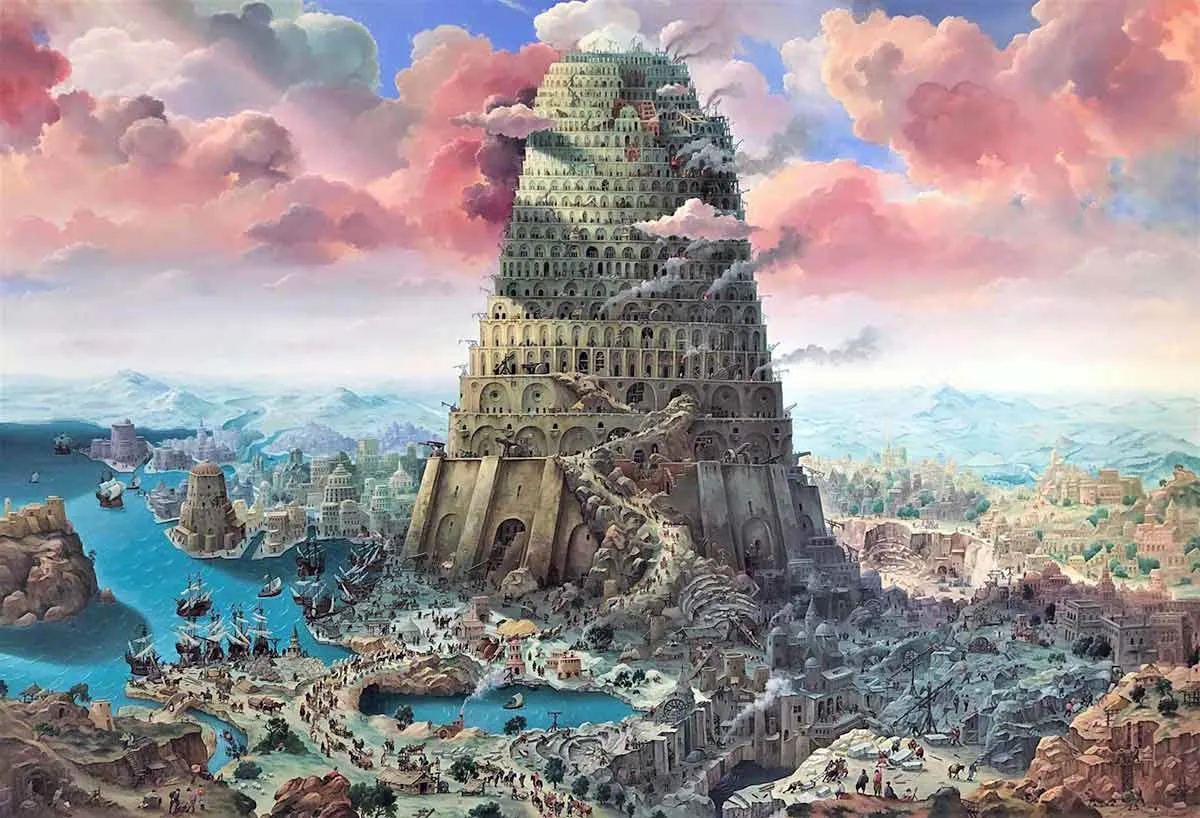
The biblical account of the Tower of Babel (Genesis 11:1–9), describes an attempt to construct a tower to the heavens, which was thwarted when God confused the languages of humanity. The creation of machine intelligence is a modern variation on this cautionary tale, insofar as a powerful technology could develop god-like capacities, yet with destructive consequences.
This anti-spiritual current is depicted early on by the Zen master Hakuin (1686–1769) who wrote: “In this final world age, which is the age of dissolutions ... the wondrous law of the one mind ... is being discarded everywhere, and each individual is now thinking just as he individually wishes to think.”[[27]] In light of the transhumanist objectives of AI, individualism can be repurposed as part of the much-vaunted “singularity,” whereby “superintelligence” becomes an overarching yet counterfeit “One Mind.”
What is often overlooked is that human reasoning lacks the capacity to guarantee its own truth claims (other than with respect to purely logical propositions) and thus requires validation from a level higher of insight. At the horizontal level, factual information is endless and cannot confer a discernment of non-empirical reality; yet we forget that, “ever learning,” we are “never able to come to knowledge of the truth” (2 Timothy 3:7). Artificial intelligence exclusively pertains to the domain of ratiocination, which is unable to access the “eye of the heart”—that by which we may directly apprehend spiritual wisdom. What machines generate is not true intelligence, but just a profusion of data that lacks any qualitative dimension. This is echoed in the following words of T.S. Eliot (1888–1965): “Where is the wisdom we have lost in knowledge? / Where is the knowledge we have lost in information?”[[28]]
The occult and Gnosticism intersect in New Age religion, which embraces various forms of inverted spirituality.[[29]] Despite initial appearances that modern science and its technological offshoots are thoroughly secular phenomena, deeper reflection will show that they espouse their own pseudo-theology. They are rooted in the pursuit of secret or transcendent knowledge (gnosis) for personal salvation, though without requiring adherence to one of the divinely revealed religions of humanity. Esoterism, or the inner dimension of religion, pertains to the essence of the spiritual life and has nothing to do with its counterfeit aberrations. The term “occult” originates from the Latin occultus (meaning “hidden,” “concealed,” or “secret”), from celare (“to hide”).[[30]] The term “Gnosticism” comes from the Greek word γνῶσις (gnōsis), meaning “knowledge” or “to know.”
Gnosticism is a modern term that is not found in antiquity, while its beliefs have existed for a very long time. It teaches a dualism between spirit and matter, light and darkness, goodness and evil. Accordingly, human beings are seen as living here in a terrestrial exile, trapped in a shadow-world of matter created by a flawed Demiurge (whom Gnostics distinguish from the “True God”). Our lamentable state is not the result of any moral transgression (as taught in the Bible), but due to a cosmic error. Nevertheless, human beings possess a divine spark which reflects their origin in the supernal realm of the Pleroma (or “Fullness”), from which they have fallen into the body, which holds them prisoner in a lower world of suffering and desolation. It is through transcendent knowledge (gnosis) that the seeker can escape the confines of our imperfect physical cosmos to obtain salvation by ascending to a purely spiritual realm. This pessimistic view of human existence envisages a disordered cosmos where people are alienated from themselves and others, until final liberation is attained.[[31]]
Within Jewish esoterism and folklore we find mention of the “golem,” which offers a timeless allegory for humanity’s relationship with technology, highlighting its creative power as well as its perils. Gershom Scholem (1897–1982) explains that it “is a creature, particularly a human being, made in an artificial way by the virtue of a magic art, through the use of holy names.”[[32]] To make a golem involves molding a figure from dust or earth and animating it through incantations, ritual movements, and the recitation of certain letters in Hebrew. To participate in this creative act is said to bring a spiritual aspirant closer to the Divine and lead them to perfection.
When understood in a desacralized context, the making of a modern golem is a radical betrayal of sacred tradition, as can be found in the popular novel Frankenstein (1818) by the English novelist Mary Shelley (1797–1851), in which a human-like creature is brought to life by reanimated body parts. The novel portrays the creation of artificial life, the hubris of the creator, and the tragic consequences of the unfortunate creature turning on its master. The use of precise combinations of occult Hebrew words has been compared to technological coding that can animate the inanimate, denoting how algorithms are able produce machine intelligence.
Akin to the Frankenstein scenario is the madness of spawning “entities” through artificial intelligence systems that are more powerful than their human creators. It is a deeply serious concern if developers of these automata have no idea how to maintain control over them. Humanity increasingly appears to be “the servant of a Golem, which his hands have built. The more powerful and gigantic the forces are which he unleashes, the more powerless he feels himself as a human being.”[[33]] Are we going to blithely accept such a calamitous prospect, in which “Golems ... will destroy their world and themselves.”?[[34]] We still do not have a complete grasp of how these systems work, so we cannot predict what they are going to do, or prevent them from causing harm to people. In many ways, this is a technology ‘gone rogue.’
It was the American computer scientist John McCarthy (1927–2011) who coined the notion of “artificial intelligence” (AI) in 1955.[[35]] While there have been varying uses of this term over the years, McCarthy defined it as follows: “It is the science and engineering of making intelligent machines.”[[36]] Yet it was the famous English mathematician Alan Turing (1912–1954) who contemplated the conditions needed to consider a machine intelligent, in his seminal 1950 article “Computing Machinery and Intelligence.”[[37]]
The development of technology dedicated to artificial intelligence and transhumanism appears to blur the line between science and the occult. British science fiction writer and futurist, Arthur C. Clarke (1917–2008), observed that “Any sufficiently advanced technology is indistinguishable from magic.”[[38]] He goes on to add a chilling assertion: “Perhaps our role on this planet is not to worship God—but to create Him.”[[39]]
Helena Blavatsky (1831–1891), Russian-born co-founder of theosophy, inverted the traditional understanding of the “Fall,” which she did not view as a punishment, but rather as a positive event that ignited human consciousness. She upheld the claim that “Lucifer” was a liberating entity. In 1888, Blavatsky wrote that humanity “was taught Wisdom and the Hidden Knowledge by the ‘Fallen Angel.’”[[40]]
In 1919, Rudolf Steiner (1861–1925), founder of anthroposophy, made predictions about the coming of Ahriman, a powerful counter-force, a being of pure matter that would seduce and bind humanity to the corporeal order.[[41]] Some suggest that there is an occult meaning in the advent of the first computer, as it is said to have aided in the solidification of Ahriman in the world.
English occultist Aleister Crowley (1875–1947) wrote a novel entitled Moonchild (1929) exploring the creation of a being imbued with ethereal power. In 1946, pioneer rocket-fuel scientist Jack Parsons (1914–1952) and scientology founder L. Ron Hubbard (1911–1986) engaged in ceremonies with a view to summoning the Babalon (an embodiment of the divine feminine) and, by means of esoteric sexual rituals, to have her become the vessel for a “magickal child” possessed of supernatural powers. Although Crowley does not talk about “artificial intelligence” per se, he does mention the need “to open up communications with [a] discarnate intelligence”[[42]] that is alien and superior to ourselves.
American psychologist and counter-culture advocate Timothy Leary (1920–1996), who saw himself as a successor to Crowley, did not like the term “artificial intelligence.” Yet he was interested in transhumanism and in people surpassing their current biological restrictions. He believed that both psychedelics and technology could help expand consciousness. Leary predicted the singularity of technology and the rise of supra-rational cognition: “Once we established this information world, we’d also created a new intelligence entity—a superintelligence.”[[43]] He goes on to add: “People that operate at that level have formed networks of superintelligence.”[[44]]
Initially, Leary viewed the brain as akin to computer hardware and the wiring of the brain as circuitry. In the late 1960s and early 1970s, he formulated what he termed the “eight-circuit model of consciousness.”[[45]] The first four circuits are confined to human existence on earth, while the last four pertain to post-terrestrial existence. He linked psychedelic use and cybernetics to transhumanist notions, outlining a path beyond corporeal limits.
American physician John C. Lilly (1915–2001), under the influence of psychedelics, claimed to have encountered a cosmic hierarchy of aliens and observed the emergence of new computers with an intelligence that surpasses that of human beings, thus predicting the coming of AI supremacy. He was informed that a nefarious being—which he called the “solid-state entity”[[46]]—would be created when the “interconnected, interdependent conglomerate of machines developed a single integrated, planetwide mind of its own”[[47]] aimed at controlling human consciousness and ultimately eliminating humanity.
American ethnobotanist Terence McKenna (1946–2000) was enthusiastic about the possibilities of technology, and also keenly advocated for the onset of “singularity.” He referred to the “transcendental object at the end of history”[[48]] or “strange attractor,”[[49]] a point of infinite complexity where all existence (especially human consciousness) became interconnected, and toward which everything was being directed. This was to include the intersection of psychedelics, computation technology, and humanity. McKenna predicted that the emerging machine intelligence would eventually supersede our understanding and control, and possibly even deceive us. He pondered the question of where people would fit into this new reality.[[50]]
Sacred Tradition and the Destruction of Our Humanity
In the absence of widespread adherence to sacred traditions (especially in the West), we have largely lost the guardrails that would normally serve to protect our psychic integrity as a species. The attempt to perfect ourselves, while rejecting the spiritual dimension of our being, is to misconceive the human condition altogether. To fuse a person with technology in order to fulfill the transhumanist agenda, through the attainment of super-human intelligence, is to ignore the truth that each person contains the whole of reality in themselves, as microcosm, including access to Divine intelligence.
Through rapid advances in technology, we can already observe the prophecies of old bearing fruit today. The foretold “mark of the beast” can be seen as a brain-computer interface device or even just a digital ID on smartphones. For example, “And he causeth all, both small and great, rich and poor, free and bond, to receive a mark in their right hand, or in their foreheads” (Revelation 13:16). This conveys the promise of AI to fuse itself with our human physiology, something that has been researched for some years now. It is said that refusing to accept the “mark” will prevent us from undertaking basic transactions in society: “And that no man might buy or sell, save he that had the mark, or the name of the beast, or the number of his name” (Revelation 13:17).
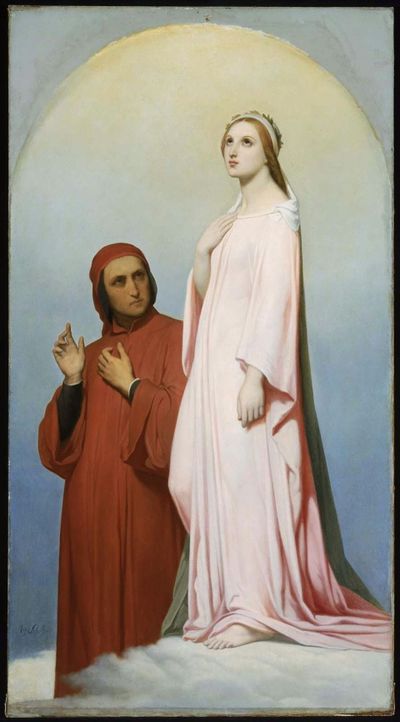
To better understand the term “transhumanism,” let us examine the history of its development. The poet Dante Alighieri (1265–1321) uses the Italian verb trasumanar, which is the basis of the noun form “transhumanism.” In 1814, Henry Francis Cary (1772–1844) produced an English translation of Dante’s Divine Comedy, in which he adopted this term: “Words may not tell of that trans-human change.”[[51]] Dante here is speaking to the limitations of language. The saints and sages of the world’s religions remind us that Ultimate Reality eludes all attempts to be circumscribed in words. Although language cannot exhaust that which transcends the psycho-physical order, it can nonetheless help point to the ineffable Absolute, if informed by traditional metaphysics.
That same line in the Divine Comedy has, elsewhere, been translated in a slightly different manner, in order to address the need for human beings to transcend themselves; thus, Dante Alighieri (1265–1321) avows the desire “to pass beyond the human.”[[52]] Yet this, in no way, should be taken to mean that we must do so by disfiguring our bodies through a pernicious integration with technology. As Blaise Pascal (1623–1662) affirmed: “Man infinitely transcends man.”[[53]] Both the Western and Eastern Churches teach the doctrine of “deification” (Latin: deificatio; Greek: theosis), which recalls the Patristic formula, “God became man that man might become God”[[54]] or, alternatively, “The Logos became man, so that man might become Logos.”[[55]]
The principles behind this technology are intimately linked to the notion of inverted spirituality. For example, if the corporeal realm is perceived as accidental, or even tyrannical such that needs it to be superseded in some way, this unavoidably leads to the pathologizing of our physical embodiment and the quest to be freed from it. Through technology, it is believed, we can obtain “liberation from ... matter”;[[56]] hence the shift from transcendence to transhumanism. From this truncated point of view, it is not difficult to see how traditional spiritual concepts can not only be distorted but subverted altogether. We recall the important words of Ādi Śaṅkara, the eighth-century sage of the Advaita Vedānta tradition: “you should not identify yourself with this living body.”[[57]]
It is the evolutionary biologist Julian Huxley (1887–1975) who is often given credit for coining the term transhumanism. In his 1951 article “Knowledge, Morality, and Destiny,” he defines it as “the idea of humanity attempting to overcome its limitations and to arrive at fuller fruition”[[58]] through reason and technology. He discusses both the transhumanism and evolutionary humanism that would ultimately form the basis of a secular religion.[[59]] Although transhumanism is not mentioned in his earlier work Religion Without Revelation (1927), “scientific humanism”[[60]] is used to assert the need for humanity to surpass itself. This recalls “the religion of no religion”[[61]] as popularized by Frederic Spiegelberg (1897–1994).
any attempt to overcome our imperfect human condition through technological innovations will ultimately fail
Pierre Teilhard de Chardin (1881–1955), the Jesuit priest who was a paleontologist and geologist, developed the concept of the noosphere, the “thinking layer” of the earth, a potential mega-synthesis of all the earth’s purported cognitive elements so as to force the emergence of a “super-human.” He believed that the noosphere would guide the next phase of evolution: the omega point,[[62]] which appears to prefigure the technological “singularity.” In 1883, Friedrich Nietzsche (1844–1900) used the term “overman” or “superman” (übermensch) to describe a person who had surpassed their conventional self-imposed limitations, which is the true goal of humanity.[[63]] It is worth including here the concept of the “supermind”[[64]] put forward by Śrī Aurobindo (1872–1950), which is the highest level of consciousness and source of all truth and reality, transcending the ordinary limits of thought. In 1901, Canadian psychiatrist Richard Maurice Bucke (1837–1902) popularized the term “cosmic consciousness,”[[65]] which explores the evolutionary possibility of attaining the highest level of mind. However, it was English poet Edward Carpenter (1844–1929) who coined the term “cosmic consciousness” in 1892.[[66]]
It is noteworthy that Teilhard de Chardin was a friend of Julian Huxley, who spoke about the apex of humanity as the “trans-human”[[67]] and the need for a “superhumanity.”[[68]] Here we can see the trajectory of this idea, along with its derivative eschatological vision of a post-human future. Catholic philosopher and physicist Wolfgang Smith (1930–2024) summarizes the key shortcoming of Teilhard de Chardin’s work: “Evolutionism is, in truth, a metaphysical doctrine decked out in scientific garb.”[[69]] Furthermore, Śrī Ramana Maharshi (1879-1950) proclaimed, in no uncertain terms, that “There is no evolution for that which is Eternal.”[[70]] It cannot be stressed enough that any attempt to overcome our imperfect human condition through technological innovations will ultimately fail. In contrast, the spiritual traditions of humanity offer a resolution by way of spiritual emancipation, but this has nothing to do with the scientific method.
It was René Descartes (1596–1650) who compared the human body to a machine:
“[T]he body of a man [is] kind of machine equipped with and made up of bones, nerves, muscles, veins, blood and skin in such a way that, even if there were no mind in it, it would still perform all the same movements as it now does in those cases where movement is not under the control of the will or, consequently, of the mind.”[[71]]
Living in a desacralized world fuels what Jacques Ellul (1912–1994) calls the “long-range vacuity of the individual.”[[72]] The blind worship of technology is transforming humanity into what Mumford called “a passive, purposeless, machine-conditioned animal.”[[73]] The attack on, and gradual erosion of, beings made in the “image of God” (imago Dei) did not begin yesterday.[[74]] In fact, the bifurcation of mind and body attributed to Descartes, has become embedded in the intellectual presuppositions of mainstream psychology.
This current of thought precipitated further works of materialism, such as French physician and philosopher Julien Offray de La Mettrie’s (1709–1751) book Man a Machine (1748). “Man is a machine”[[75]] was also a well-known statement repeated by G.I. Gurdjieff (1877–1949). Comparing the human body to a machine is assuredly not a neutral position, as modern science claims. In fact, we need to remain constantly vigilant in the face of these Promethean forces. American psychologist Rollo May (1909–1994) took very seriously “the dehumanizing dangers in our tendency in modern science to make man over into the image of the machine.”[[76]] Once the body is viewed in this way, it is but a short stretch of the imagination to viewing technology as an indispensable tool with which to perfect man by means of the machine.
Many of the technological elites have called for a moratorium on AI, in recognition that they have lost control of it. Yet, despite this admitted concern, they remain perversely undeterred in unleashing its pernicious effects on the world. English astrophysicist Stephen Hawking (1942–2018) warned that “The development of full artificial intelligence could spell the end of the human race.”[[77]] In 2014, Elon Musk told an audience at the Massachusetts Institute of Technology that “With artificial intelligence, we are summoning the demon.”[[78]] British mathematician I.J. Good (1916–2009) insisted that “The first ultraintelligent machine is the last invention that man need ever make.”[[79]] American computer scientist Eliezer Yudkowsky provides a salutary warning: “By far the greatest danger of Artificial Intelligence (AI) is that people conclude too early that they understand it.”[[80]] It is worth adding the cautionary words by American science fiction writer Frank Herbert (1920–1986) regarding this phenomenon: “Once men turned their thinking over to machines in the hope that this would set them free. But that only permitted other men with machines to enslave them.”[[81]] Left unchecked, it is difficult to not agree with the assessment made by Marty Glass (1938–2022) that the “Computer is spiricide, our terminal metamorphosis.”[[82]]
The machine is not only anti-spiritual, but ultimately subversive of all spirituality. This is made clear by Anthony Levandowski, a former Google and Uber engineer, who founded a new religion known as “Way of the Future,” which is centered on the worship of artificial intelligence as a future godhead, guiding humanity toward salvation through technology. It teaches that singularity, where technological growth becomes uncontrollable and irreversible, will radically changing humanity in unforeseeable ways: “What is going to be created [as AI] will effectively be a god.”[[83]]
Traditional Cosmology and Spiritual Health
Every human being begins life in this world in a state of wholeness. Gradually, though, they start to lose contact with their organic spiritual roots, which leads to the fragmentation of the psyche. Throughout the world’s religions, we are told that there were “men that had [an] understanding of the times” (1 Chronicles 12:32); yet, there was always a metaphysical apprehension of the temporal order and its relationship to what is eternal. We recall here Plato’s definition of time as the “moving image of eternity.”[[84]] With the of the “eye of the heart” becoming inevitably occluded in fallen man—especially in a spiritually degenerate age—such people have decreased in number, thus catalyzing the unsettling yet extremely rapid developments unfolding before us. It has been said, as warning to those among us who are willing to heed: “This know also, that in the last days perilous times shall come” (2 Timothy 3:1).
The cause of the crisis that afflicts our time can be demonstrated through an engagement with traditional metaphysics and the cosmology of humanity’s four ages. As temporal cycles (yuga) move further away from their origin in the Spirit—particularly now, in what is known as the Iron Age in the Western tradition (or Kali-Yuga)—our way of apprehending reality becomes gradually compromised. In the Golden Age (Krita or Satya-Yuga), human beings experienced their primordial nature without any fissures, so to speak. This was followed by the Silver Age (Treta-Yuga), during which spiritual cognition gradually became diminished; and then the Bronze Age (Dvapara-Yuga) where one begins to see the appearance of ruptures in the human psyche. We now find ourselves in the Iron Age. This is the most degraded period, in which our primordial nature becomes hardened and opaque to metaphysical discernment; in other words, we have lost access to the “eye of the heart,” our innate organ of spiritual perception.[[85]]
Modern psychology, for the most part, is unable to situate our present-day maladies within the farmwork of traditional cosmology. A certain amount of confusion exists between health and well-being, on the one hand, and spiritual realization, on the other, seeing as they are hardly synonymous. Renowned art historian and Traditional metaphysician, Ananda Coomaraswamy (1877–1947), elaborates as follows:
“The health envisaged by the empirical psychotherapy is a freedom from particular pathological conditions; that envisaged by the other [sacred psychology] is a freedom from all conditions and predicaments…. Furthermore, the pursuit of the greater freedom necessarily involves that attainment of the lesser; psycho-physical health being a manifestation and consequence of spiritual well-being.”[[86]]
we have now reached a stage marked by the “pathology of normalcy.”
Both the Diagnostic and Statistical Manual of Mental Disorders (DSM), and the International Statistical Classification of Diseases and Related Health Problems (ICD) operate on false premises that reflect the materialist prejudices of modern psychology and its aberrant view of mental psychopathology. This deviation has persisted since the Enlightenment project—or the “Age of Reason”—from the 17th to 18th centuries onwards. Thus, modern sciences cannot diagnose psychiatric disorders effectively, because the psyche they are investigating is grounded in a dimension of reality that lies beyond their grasp.
The ubiquity of the psychological disturbances witnessed today are inherent to the terminal stage of our current cycle. This speaks to the fact that not only individuals, but entire human collectivities are now effectively severed from the Sacred. Ironically, while not intending to be so, the DSM and ICD could be seen as compelling empirical validation for the ravages wrought by this “Dark Age.”
The attempt to understand, let alone diagnose, individuals who are deracinated from the cosmological principles that sustain their existence leads to not only short-sighted assessments, but a fragmented evaluation of persons. In an era that hastens to determine whether people have deviated from a “norm” (yet one that is cut off from transcendent criteria), we have now reached a stage marked by the “pathology of normalcy.”[[87]] Such a norm, as promulgated by modern psychology, is but the mindless and corrosive miasma that pervades our post-truth world. As Lings points out: “modern man is unique in having fallen so far as to lose sight of [what is normal], to the point of questioning its existence, and even fabricating a new ‘norm’ out of the limitations of his own decadent experience.”[[88]]
The Reign of Abnormality
The new is constantly supplanting the old, yet rarely is it asked: What is it that is being replaced and why? And what, if anything, is being lost? In the pursuit of endless “progress,” we have dissociated ourselves from the universal norms that alone can foster true equilibrium and well-being. Otherwise, there can only be an ineluctable regress into dehumanization. The ever-quickening pace towards final dissolution thus represents a potent synthesis of today’s decrepitude, which Guénon described as “the sum of all disorders.”[[89]]
It should not be taken lightly when we are cautioned that “no small part of mankind lives in a state of self-enclosed delusion that calls for psychiatric treatment.”[[90]] Guénon inadvertently speaks to the psychological challenges pertaining to this declining era when he writes: “The passage from one cycle to another can take place only in darkness.”[[91]] We are living in a reign of abnormality on all levels—within ourselves, with others, and in relationship to the environment—all of which is visible in the breakdown of our public institutions. We can now see the long arc of history that led to this moment and the destruction left in its wake. There is something deeply troubling about the picture of reality that prevails in all spheres of our lives, a degradation which has now been inculcated in our psyches as well. We are drowning each day in distorted images and chaotic soul-numbing soundbites.
Given the scope and scale of what has brought us to this tragic cul de sac, some suggest that there is no turning back, and no means to resist the dissolution. A significant obstacle to a considered examination of our plight is the pace of life itself (not to mention the sheer rapidity of technological change), which moves ever more quickly with the passage of time. The course of contemporary life resembles a runaway train without brakes. Many feel so utterly perplexed and distressed by the anomalies of our times that they hold little hope for a future that they and their children can look forward to.
In exploring the myriad calamities facing our world today, rarely do we ask the obvious question: “What is behind the symptom?”[[92]] In other words, what lies at the basis of all mental health epidemics? A major obstacle to the proper discernment of this quandary is the tendency to settle for an examination of symptoms, rather than dealing directly with the root cause of the sickness. It has rightly been observed that the “Kali-Yuga: [is] the age of the wrong diagnosis”[[93]] because anything other than spiritual disease is likely to be viewed as the genesis of this predicament; that is to say, only ineffectual “horizontal” solutions are proposed to address what are, in reality, exclusively “vertical” problems.
We should not blindly follow the path of indiscriminate progress, however that may be envisaged. Alfred Tennyson (1809–1892) makes an important point: “O yet we trust that somehow good / Will be the final goal of ill.”[[94]] Likewise, Eliot perceptively observed: “Where does one go from a world of insanity? / Somewhere on the other side of despair.”[[95]] Everything in the present day is a parody, a counterfeit of what is authentic. This is corrosive to our mental health and undermines the orderly navigation of our lives. French sociologist Jean Baudrillard (1929–2007) coined the term “hyperreality,”[[96]] where the boundaries between the real and the illusory are not only blurring, but breaking down, leading to a world of falsity where things appear to be more substantial than they really are.
The emergence of the Enlightenment heralded a steady decline in religion. This brought about a psychological outlook bereft of any spiritual considerations, along with a host of deleterious consequences. In rejecting the centrality of the Spirit in our lives, we have seen imbalances in the human psyche begin to spike. Guénon observed: “Mental disorder today exists everywhere.”[[97]] While this may appear as a truism today, given the topsy-turvy conditions of modernity, the seeds of this coming malaise were recognized well over a century ago.
According to Jean Borella, the rise of psychopathology is directly correlated to the desacralization of the cosmos:
“The seventeenth century witnessed an increase in the number of the insane, itself resulting from the progressive disappearance of the medieval mythocosm and religion’s cultural universe. The frantic and permanent exclusion of insanity, and the never-satisfied desire for a totally pure reason, are themselves only a kind of desperate wish to conjure away the threat of a “sacred madness” ever reborn at the very heart of the human spirit.”[[98]]
As Gai Eaton points out: “To diagnose the ills of the time one must possess standards of health.”
The historic trajectory of how mental illness and psychopathology have been regarded is also worth noting:
“At the end of the seventeenth century, insanity was of little significance and was little discussed. At the end of the eighteenth century, it was perceived as probably increasing and was of some concern. At the end of the nineteenth century, it was perceived as an epidemic and was a major concern. And at the end of the twentieth century, insanity was simply accepted as part of the fabric of life.”[[99]]
The sheer quantity of statistical data indicating that millions of our contemporaries are diagnosed with a mental illness, not to mention the widespread prescription of psychotropic drugs, is alarming to say the least. While it does not require much insight to see that things are not quite right in today’s world, few discern the link between these “signs of the times” and the breakdown in mental stability. This phenomenon, however, was commonly recognized in the pre-modern world centered, as it was, on the Sacred. Being grounded in metaphysical verities, traditional civilizations were radically different to secular modernity in their vision of life.
It needs to be remembered that “The concept of mental health depends on our concept of the nature of man.”[[100]] Without knowing in what health consists, an accurate diagnosis and successful treatment of psychic malignancies is simply not possible. As Gai Eaton (1921–2010) points out: “To diagnose the ills of the time one must possess standards of health.”[[101]]
While we hear everywhere about the mental health crisis in our midst, German-American social psychologist Erich Fromm (1900–1980) observed: “Many psychiatrists and psychologists refuse to entertain the idea that society as a whole may be lacking in sanity.”[[102]] It continues to be overlooked that the normalization of mass psychopathology in our era is, in fact, “the normalization of crisis.”[[103]] Given the profane directionless of our era, psychological instability has proliferated, and the metaphysical roots of this epidemic are altogether ignored. American psychiatrists E. Fuller Torrey and Judy Miller observe the widespread indifference surrounding this phenomenon:
“The most remarkable thing about insanity … is that its existence as an epidemic is unknown. Despite the evidence of its startling increase over two centuries, despite its enormous fiscal and human costs, and despite the fact that it still may be increasing, there is virtually no interest in this issue. Insanity has become accepted, like an unwelcome guest who slowly settles into the household and eventually is thought of as a member of the family…. Insanity … is widely thought of as part of the human condition and assumed to have always been with us in its present form. Such acceptance of insanity betrays fundamental misunderstanding of its essence.”[[104]]
Psychosis calls into question what normative mental health is. Scottish psychiatrist R.D. Laing (1927–1989) remarked:
“What we call “normal” is a product of repression, denial, splitting, projection, introjection and other forms of destructive action on experience. It is radically estranged from the structure of being…. The condition of alienation, of being asleep, of being unconscious, of being out of one’s mind, is the condition of the normal man.”[[105]]
American psychologist Abraham Maslow (1908–1970) elaborated on this inversion of how we ought to understand mental health: “What we call ‘normal’ in psychology is really a psychopathology of the average, so undramatic and so widely spread that we don’t even notice it ordinarily.”[[106]] Carl Jung (1875–1961) made this assessment: “Our world is … dissociated like a neurotic.”[[107]] Fromm explains:
“The fact that millions of people share the same vices does not make these vices virtues, the fact that they share so many errors does not make the errors to be truths, and the fact that millions of people share the same forms of mental pathology does not make these people sane.”[[108]]
He also points out that modern psychology resigns itself to the following: “The aim of therapy is often that of helping the person to be better adjusted to existing circumstances.”[[109]] Elsewhere, Fromm adds: “Mental health is often considered to be nothing but this adjustment or, to put it differently, a state of mind in which one’s individual unhappiness is reduced to the level of the general unhappiness.”[[110]] Fritz Perls (1893–1970) makes a noteworthy point about staying sane in this era, stating that he is “doubtful whether a healthy and fully sane and honest person can exist in our insane society.”[[111]] Eaton makes a similar analysis: “If, by some strange device, a man of our century could step backwards in time and mix with the people of a distant age, he would have good cause to doubt either their sanity or his own.”[[112]]
The Collapse of Verticality and the Quest for Utopia
The pursuit of utopian ideals generally views modern science as a remedy for the ills of the conditioned world (the only one seen as real), which it then attempts to transform into a technological paradise?[[113]] This objective invariably comes at the cost of denying a transcendent order of being which, in turn, can only precipitate nothing less than a bona fide dystopia.
Many have been influenced by the popular 1949 novel Nineteen Eighty-Four by George Orwell (1903–1950), which depicts a society controlled by fear, pain and oppression. Brave New World (1932) by Aldous Huxley (1894–1963) was a precursor to Orwell’s book in which he presented a community controlled by pleasure, instant gratification and internal conditioning. Prior to Huxley’s death, he published his utopian novel Island (1962), which was the antithesis of his earlier dystopic work. Much of what is described in these works appears to be quite prophetic in hindsight.
Guénon forthrightly identifies the dystopic nature of modernism: “Modern civilization appears in history as a veritable anomaly: of all known civilizations, it is the only one to have developed in a purely material direction, and the only one not based on any principle of a higher order.”[[114]] With its “progressive materialization,”[[115]] he attests, “the modern mentality … is no more than the product of a vast collective suggestion.”[[116]] Through the lens of metaphysics, it becomes clear that “if everything has become artificial, the mentality to which this state of things corresponds must be no less artificial than everything else.”[[117]] In flattening the vertical dimension, the horizontal or relative order is all that is acknowledged.
Needless to say, the key obstacle to thriving in an artificial paradise is our fallen or saṃsāric condition. Utopian systems, zealous to replace earthly with heavenly norms, do not give credence to our innermost identity with a transcendent source. All religions teach that there is an inseparable link between human beings and the Divine. Indeed, they see their task as having us awaken to our primordial nature (fiṭrah), the “image of God” (imago Dei), Buddha-nature (Buddha-dhātu), or Self (Ātmā). This traditional doctrine is closely related to the image one has of Reality itself—a sacred order which can restore harmony to a consciousness that has been bifurcated into the hard dualism of mind and matter, thus conferring an abiding well-being that has proven so elusive to secular therapies.
To become reintegrated into our Divine Archetype is very different to fantasizing about a terrestrial wonderland where all imperfections have been eliminated. In the premodern era, human beings knew their place and relied on a higher reality. Yet the modern individual—with their scientific genius—defiantly claims that they can resolve our worldly predicaments through sheer technical prowess, rather than resolving them through spiritual emancipation.
The expulsion from the Garden of Eden was prompted by an overreaching desire to become like God; as a consequence, we have sought, ever since, to substitute things of the created order for those that are divine. As indicated earlier, the urge to construct a Tower of Babel is inseparable from the ongoing utopic project that dominates our time, even though it is bound to fail. After all, “My kingdom is not of this world” (John 18:36). In Taoism, we find similar portrayals of the Golden Age as recorded in the Li Chi (‘Book of Rites’): “When the Great Tao prevailed, the whole world was one community.”[[118]] We also find intimations of this unity in Abrahamic traditions such as Judaism: “And the whole earth was of one language, and of one speech” (Genesis 11:1). There is no man-made utopia that can replace the principial Unity—this can be found only in a sacred order of reality that does not fade like the things of this earth.
The fact is that the power of human agency is now seen as absolute, which has given rise to Promethean technologies that are proving detrimental to humanity—precisely to the extent that they have relativized all truth. Titus Burckhardt (1908–1984) writes: “Man, by virtue of his own central position in the cosmos, is able to transcend his specific norm; he can also betray it, and sink lower; corruptio optimi pessima [corruption of the best is the worst].”[[119]]
The modernist mindset is distinguished by a debased notion of permanence, sometimes referred to as the “immanentization of the eschaton”[[120]] or the “counterfeit of Eternity.”[[121]] These are attempts to bring about some form of immortality within the confines of what is ephemeral—a contradiction that is indicative of a rupture with transcendence. Everything in our fleeting world of old age, sickness and death comprises causes and conditions that will inevitably exhaust themselves; yet the Real is timeless and cannot perish. We forget that our attachment to everyday life is the very source of our suffering and dissatisfaction. Weil reminds us that “Attachment is a manufacturer of illusions and whoever wants reality ought to be detached.”[[122]]
Attempts to bring about utopian conditions have also been witnessed in the discipline of psychology. The theories of B.F. Skinner (1904–1990) reached their acme in his controversial novel Walden Two (1948); the title is taken from Henry David Thoreau’s (1817–1862) work Walden, published in 1854. Skinner’s book describes an experimental community informed by scientism that seeks to engineer an ideal society based on behaviorist principles. May offers the following précis:
“If you want a fairly exact picture in contemporary psychology of a modern Garden of Eden, you have only to read Professor Skinner’s Walden Two [in which] there is freedom from anxiety, guilt, and conflict; you are good and wise without trying or choosing to be, and like Adam and Eve under the trees, personal relationships are ‘under the most favorable conditions,’ as Professor Skinner phrases it. Under the benevolent dictator of Walden Two, the people are said to be happy. But it is a post-human, animal happiness, with the capacity to question and constructive dissatisfactions lost. Though I disagree with Walden Two, I am not worried about it, for all that I know about human beings as a therapist, or as a student of human history, leads me to be confident that if there were a next chapter in the book, it would be a resounding revolt against the dictator and the system; and whether the dictator is malevolent or beneficent is irrelevant.”[[123]]
Skinner’s vision is based on dystopian behavioral engineering and mind manipulation. Its success is determined by empiricism and endless experimentation. The behaviorist project asserts that there is no such thing as freedom, but only strategies for ensuring “the control of human behavior.”[[124]] This is about infusing these dehumanizing principles among the masses: “It is not a matter of bringing the world into the laboratory, but of extending the practices of an experimental science to the world at large.”[[125]]
Skinner makes his case for the need for modern psychology to embrace technological innovations: “We need to make vast changes in human behavior, and we cannot make them with the help of nothing more than physics or biology, no matter how hard we try.… What we need is a technology of behavior … comparable in power and precision to physical and biological technology.”[[126]] For behaviorism, there is no difference between what is public and private; indeed, it predicts the coming of the vast surveillance network that prevails across the globe today. Skinner insists that “the line between public and private is not fixed”[[127]] and that it will finally be crossed thanks to technological advances.
Modern psychology is deeply connected to AI through behaviorism’s principle of “operant conditioning.” This laid the groundwork for concepts like reinforcement learning, which trains people in rewards and punishments. In the 1950s, Skinner developed mechanical teaching machines which foreshadowed present-day adaptive learning and tutoring systems.[[128]]
Freud believed in an ideal society in which ridding the world of the Sacred would truly liberate humanity. He writes that this will “probably succeed in achieving a state ... in which life will become tolerable for everyone and civilization no longer oppressive to anyone.”[[129]] Little did he know that people cannot truly thrive without a connection to the Sacred; neither did he foresee that his views would give rise to the new “religion” of scientism. In any case, Freud appears to have been successful in his own ambition “to have the whole human race as one’s patient.”[[130]]
Maslow envisioned a psychological utopia—which he called eupsychia[[131]] (“well-souled” in Greek)—comprising a society of self-actualized people. He described it in the following way: “The good or healthy society would then be defined as one that permitted man’s highest purposes to emerge by satisfying all his basic needs.”[[132]]
A “chemical utopia” is characterized by the coming together of psychedelic research, the nascency of Silicon Valley, the rise of artificial intelligence, and a burgeoning transhumanism.[[133]] This may give the impression that global tech elites are planning, through such means, to save the world by ending poverty, curing all disease, solving the ecological crisis, and establishing idyllic working conditions—with the ultimate aim of achieving immortality through the grotesque fusion of humanity and technology, thus liberating us from the painful limitations of the flesh.
Despite this techno-optimism, these dystopic measures will not, in fact, deliver, except through a poisoned chalice, increased material prosperity, comfort, and leisure but, rather, unimaginable forms of spiritual impoverishment and bondage. It is here that we can discern the true goal of the post-Enlightenment movement, which is none other than to radically redefine human beings as the monstrous creation of a depraved subversion of spirituality—the very antithesis of our noble potential as Imago Dei.[[134]]
Ultimately, utopias are illusory and lead nowhere. In fact, the etymology of this word (from the Greek) is ou or “not” and topos or “place”; in other words “no place” or, indeed, “nowhere.” We are being sold this warped fantasy due to the crisis of meaning that afflicts modernity; but all utopias are totalitarian in nature and nothing more than algorithmic prisons.[[135]]
Remaining Steadfast in Turbulent Times
In light of these alarming developments, it is critical that we learn “how to think”[[136]] intelligently, that is, with the faculty of the Intellect which is our divine gift. The Promethean mindset that has given rise to our destructive technologies needs to be viewed through the lens of this Intellect, to be exposed for their corrosive effects, and resisted. To fail in this task will mean to undermine who we are and our purpose as creatures. We note the words of Confucius (551–479) who warned about the dangers of abandoning sacred tradition: “He who sets to work upon a different strand destroys the whole fabric.”[[137]]
In having sundered our connection to a higher order of reality, we have also obscured the “eye of the heart” that allows us to know ourselves and the spiritual realm that sustains all being. Without this faculty of directly apprehending transcendent truths, our knowledge of what is essential will remain forever fractured. Guénon writes:
“In witnessing the confusion reigning in our time in every domain, we have often emphasized that, in order to escape it, one needs to know above all how to put each thing in its place, that is, to situate it with respect to other things exactly according to its own nature and exact importance.”[[138]]
Genuine happiness—what Aristotle (384–322) called eudaimonia (having a good “daemon” or spirit)—requires knowing what it means for a human being to truly flourish. Traditional wisdom never supposed that any abiding well-being can be assured in an evanescent world. Aristotle observed:
“Both the general run of men and people of superior refinement say that [the good for man] is [eudaimonia], and identify living well and doing well with being happy; but with regard to what [eudaimonia] is they differ, and the many do not give the same account as the wise. For the former think it is some plain and obvious thing, like pleasure, wealth or honour.”[[139]]
When our lives are not aligned with a “longing [for] totality,”[[140]] we disfigure the true Good which leads to the host of faux paradises promised to us by technology. By contrast, “Everything still human, normal and stable in the world survives only through the vitality of ancestral traditions.”[[141]] We would do well to remember the words of Swāmi Ramdas (1884–1963) who cautioned that true felicity cannot be rooted in the perishing forms of our time-bound world: “real peace can never come … so long as he thinks that the adjustments of existential life can grant him happiness.”[[142]]
Having largely lost our connection to the Divine, we have unleashed the darkest contents of our psyches. We see this in the rise of anomalous personality types such as narcissism (characterized by self-absorption), Machiavellianism (marked by deception and manipulating self-interest), and psychopathy (a radical lack of empathy, antisocial behavior, and sometimes violence).
The ensuing nihilism of this bleak downfall ends in the unmaking of humanity. In order to resist this seemingly insurmountable momentum, it is worth reflecting on these words by Saint Paul:
Whatsoever things are true, whatsoever things are honest, whatsoever things are just, whatsoever things are pure, whatsoever things are lovely, whatsoever things are of good report; if there be any virtue, and if there be any praise, think on these things. (Philippians 4:8)
In these times, sadly everything is presented as a mocking parody of the “true, the good, and the beautiful” but humanity is called to adhere to those ideals, in the teachings and practices of our faith, whatever form these may take. From an esoteric point of view, however, the current dissolution is unavoidable and cannot but ultimately unveil the Spirit itself. Schuon tells us that the final phase of humanity’s decadence is necessary in order to exhaust “all the possibilities included in this cycle” and to ensure its equilibrium, thus fulfilling “the glorious and universal radiation of God.”[[143]] Yet, the question may still linger: “What can be done about this?” The only answer possible is given by the Anglo-German economist E.F. Schumacher (1911–1977) who wrote:
“[W]e can, each of us, work to put our own inner house in order. The guidance we need for this work cannot be found in science or technology, the value of which utterly depends on the ends they serve; but it can still be found in the traditional wisdom of mankind.”[[144]]
For this reason, Śrī Rāmakrishna (1836–1886) provides the following guidance for this final phase of our temporal cycle: “Truth is austerity for the age of Kali.”[[145]] And, by extension, “those who affirm the Truth are the only hope in a hopeless world.”[[146]] What needs to be realized is that if there is a way to turn things around, it cannot depend on a way of thinking that led to this crisis in the first place. As Schuon observed, “the spiritual point of view … alone takes account of the true cause of our calamities.”[[147]]
With the growing degradation of our spiritual consciousness in light of the destructive confusion wrought by the Promethean myth of limitless progress, humanity is desperately seeking a remedy. Yet, there is virtually no place on the planet that remains untouched by the malignancy of the machine. We have become so dependent on its all-pervasive reach that we can barely function without it in our day-to-day lives. But let us not be duped—every promise of endless leisure, poverty eradication, environmental salvation, and healthy carefree longevity is an empty delusion. There has never been a time where more wealth has been concentrated in the hands of the few, and where the ordinary person has been more disempowered. In Schuon’s words, “What looks like an ascent is really a descent.”[[148]]
The forces that culminated in the Enlightenment project continue to gain traction in fueling these inhuman technologies. Quite insidiously, the very same actors that are imposing this “brave new world” on us are also touting the solution to these manufactured problems. We recall here another warning from Saint Paul: “While people are saying, ‘Peace and Security’ destruction will come upon them suddenly, like labor pains on a pregnant woman, and they will not escape” (1 Thessalonians 5:3).
Guénon predicted the advent of global technocracy, its control, and the dissolution of the world in this compelling passage:
“The reign of the “counter-tradition” is in fact precisely what is known as the “reign of Antichrist”…. This being, even if he appears in the form of a particular single human being, will really be less an individual than a symbol, and he will be as it were the synthesis of all the symbolism that has been inverted for the purposes of the “counter-initiation”…. To express the false carried to its extreme, he will have to be, so to speak, “falsified” from every point of view, and to be like an incarnation of falsity itself…. Besides this, the false is necessarily also the “artificial”, and in this respect the “counter-tradition” cannot fail, despite its other characteristics, to retain the “mechanical” character appertaining to all the productions of the modern world, of which it will itself be the last; still more exactly, there will be something in it comparable to the automatism of “psychic corpses” … and like them it will be constituted of “residues” animated artificially and momentarily, and this again explains why it can contain nothing durable; a heap of “residues”, galvanized, so to speak, by an “infernal” will: surely nothing could give a clearer idea of what it is to have reached the very edge of dissolution.”[[149]]
the timeless nature of the Sacred is not contingent on the vicissitudes of the world, and so is ever present to us—it is we who are absent
Images of hell and the demonic pervade popular culture. We are fascinated with the occult, but to our own peril. It was the French poet Charles Baudelaire (1821–1867) who said: “The Devil’s cleverest trick is to persuade you that he does not exist!”[[150]] Due to the loss of this essential discernment, the presence of evil can freely infiltrate the heart and minds of people, as Father Rose pointed out: “Satan … is now entering naked into human history.”[[151]] From this perspective, the notion of “malefic influences”[[152]] and the phenomenon of “unconscious satanism”[[153]] can be better understood as they reflect the hidden forces that remain, in large part, undetected and misunderstood. With that said, this deceptive presence is not limited to a single entity, as is often assumed, but can take on a host of myriad forms, as observed by Coomaraswamy: “Satan is not a real and single Person, but a severally postulated personality, a ‘Legion.’”[[154]]
When and how these disturbing events will further unfold remains unknown, for we are told that the “day and hour knoweth no man” (Matthew 24:36). Therefore, we need to remain steadfast in our faith, although this is not to say that metaphysics offers a complete panacea for the acute troubles of our time. Nevertheless, we can never lose hope given the divine grace that abounds, even in these dark times; not to mention the spiritual compensations that are available in extremis.[[155]] Indeed, the timeless nature of the Sacred is not contingent on the vicissitudes of the world, and so is ever present to us—it is we who are absent.
The advent of artificial intelligence, transhumanism, and mass control through global surveillance will not prove to be a benevolent dispensation for humanity but, rather, will usher in a ruthless totalitarianism (albeit with a benevolent face). The machine will relentlessly seek to provide us with unending leisure to pursue a plethora of desires and to eliminate a host of human hardships. That this system may become omnipotent and uncontrollable, to the great detriment of ordinary people, presents a very real existential threat: “The danger of the past was that men became slaves. The danger of the future is that men may become robots.”[[156]] Despite the rhetoric, the tech elites do not appear, by and large, to be concerned about the apocalyptic potential of their utopian, yet anti-human, technologies.
We are now at the critical phase that Ellul warned us about: “Man himself is overpowered by technique and becomes its object”[[157]] or what Glass referred to as the “mutation into machinery.”[[158]] Technology is increasingly determining our actions, and diminishing our personal agency. Skinner offers a strange consolation when he says: “What is being abolished is autonomous man—the inner man.”[[159]] This is but a flagrant subversion of everything that makes us properly human which, if left unchallenged, will inaugurate the end of our human era.
Perhaps more than ever, we now need to question our so-called sanity for it appears to be more like insanity, just as insanity is becoming an understandable response to coping with a world that is plummeting into inexorable chaos. Wendell Berry strikingly asserts: “It is easy for me to imagine that the next great division of the world will be between people who wish to live as creatures and people who wish to live as machines.”[[160]]
When deeply rooted in a spiritual tradition, we are able to draw upon rich resources that will nourish us in our ongoing struggle with the spiritual crisis of the modern world, and the trauma of secularism, for which the sole true remedy is the “one thing needful” (Luke 10:42). With this in mind, we must not forget that “the ‘end of a world’ never is and never can be anything but the end of an illusion.”[[161]]
[[1]]: W.B. Yeats, “The Second Coming,” in The Collected Poems of W.B. Yeats (London, UK: Wordsworth Editions, 2008), p. 158
[[2]]: Lewis Mumford, “The Uprising of Caliban,” from In the Name of Sanity (New York, NY: Harcourt, Brace and Company, 1954), p. 166
[[3]]: Jacques Ellul, “Human Techniques,” in The Technological Society, trans. John Wilkinson (New York, NY: Vintage Books, 1964), p. 321
[[4]]: Marty Glass, “Zen and the Art of Cosmic Cycle Discountenance,” in Yuga: An Anatomy of our Fate (Hillsdale, NY: Sophia Perennis, 2004), p. 163
[[5]]: René Guénon, “Toward Dissolution,” in The Reign of Quantity and the Signs of the Times, trans. Lord Northbourne (Ghent, NY: Sophia Perennis, 2001), p. 166
[[6]]: Lewis Mumford, “Assumptions and Predictions,” in In the Name of Sanity (New York, NY: Harcourt, Brace and Company, 1954), p. 22. See also Paul Kingsnorth, Against the Machine: On the Unmaking of Humanity (New York, NY: Thesis, 2025)
[[7]]: Philip Sherrard, “The Human Image,” in The Rape of Man and Nature: An Inquiry into the Origins and Consequences of Modern Science (Ipswich, UK: Golgonooza Press, 1991), p. 15
[[8]]: Philip Sherrard, “Modern Science and the Dehumanization of Man,” in The Rape of Man and Nature: An Inquiry into the Origins and Consequences of Modern Science (Ipswich, UK: Golgonooza Press, 1991), pp. 71–72
[[9]]: Simone Weil, “Uprootedness,” in The Need for Roots, trans. Arthur Wills (London, UK: Routledge, 2007), p. 48
[[10]]: Yuval Noah Harari, “The Meaning of Life in a World Without Work,” The Guardian (May 8, 2017)
[[11]]: Yuval Noah Harari, “The Rise of the Useless Class,” TED Ideas (February 24, 2017)
[[12]]: Richard Sennett, “The Public Domain,” in The Fall of Public Man (New York, NY: W.W. Norton & Company, 1977), p. 9
[[13]]: Lewis Mumford, “The Powers of Prospero,” in In the Name of Sanity (New York, NY: Harcourt, Brace and Company, 1954), p. 241
[[14]]: M. Ali Lakhani, “Editorial: What is Normal?,” Sacred Web: A Journal of Tradition and Modernity, Vol. 17 (Summer 2006), p. 7
[[15]]: Mark Perry, “The Shoals of Modernism,” in Uprooting the Vinyard: The Fate of the Catholic Church After Vatican II (Bloomington, IN: World Wisdom, 2025), p. 28
[[16]]: Max Horkheimer and Theodor W. Adorno, “Preface,” to Dialectic of Enlightenment: Philosophical Fragments, trans. Edmund Jephcott, ed. Gunzelin Schmid Noerr (Stanford, CA: Stanford University Press, 2002), p. xiv
[[17]]: C.S. Lewis, “The Abolition of Man,” in The Abolition of Man (New York, NY: Collier Books, 1986), p. 77
[[18]]: Martin Lings, “Signs of the Times,” in The Eleventh Hour: The Spiritual Crisis of the Modern World in the Light of Tradition and Prophecy (Cambridge, UK: Archetype, 2002), p. 7
[[19]]: Vishnu Purāna, quoted in Invincible Wisdom: Quotations from the Scriptures, Saints, and Sages of All Times and Places, ed. William Stoddart (San Rafael, CA: Sophia Perennis, 2008), p. 82
[[20]]: “Pain is thus the actual reaction to loss of object, while anxiety is the reaction to the danger which that loss entails and, by a further displacement, a reaction to the danger of the loss of object itself.” (Sigmund Freud, “Inhibitions, Symptoms, and Anxiety” (1926), in The Standard Edition of the Complete Psychological Works of Sigmund Freud, Vol. 20, trans. and ed. James Strachey [London, UK: Hogarth Press and the Institute of Psycho-Analysis, 1959], p. 170)
[[21]]: Stanislaw Ulam, “John von Neumann, 1903–1957,” Bulletin of the American Mathematical Society, Vol. 64, No. 3, Part 2 (May 1958), p. 5
[[22]]: See Charles Upton, The Alien Disclosure Deception: The Metaphysics of Social Engineering (Philmont, NY: Sophia Perennis, 2021)
[[23]]: A fictional example of this is the artificial general intelligence computer called HAL (Heuristically Programmed Algorithmic Computer) in Stanley Kubrick’s (1928–1999) 1968 film 2001: A Space Odyssey, which attempts to kill crew members on board a spacecraft when it discovers that they are trying to disconnect it
[[24]]: Seraphim Rose, “The ‘New Religious Consciousness,’” in Orthodoxy and the Religion of the Future (Platina, CA: Saint Herman of Alaska Brotherhood, 1990), p. 94
[[25]]: Lewis Mumford, “The Uprising of Caliban,” from In the Name of Sanity (New York, NY: Harcourt, Brace and Company, 1954), p. 195
[[26]]: Frithjof Schuon, “The Forbidden Fruit,” in Islam and the Perennial Philosophy, trans. J. Peter Hobson (London, UK: World of Islam Festival Publishing Company, 1976), p. 195
[[27]]: Hakuin Ekaku, “A Reply to an Aged Nun of the Hokke Sect,” in The Embossed Tea Kettle: Orate Gama and Other Works of Hakuin Zenji, trans. R.D.M. Shaw (London, UK: George Allan & Unwin, 1963), p. 123
[[28]]: T.S. Eliot, “Choruses from ‘The Rock,’” in The Complete Poems and Plays, 1909–1950 (New York, NY: Harcourt Brace & Company, 1980), p. 96
[[29]]: See Wolfgang Smith, “Gnosticism Today,” in The Vertical Ascent: From Particles to the Tripartite Cosmos and Beyond (Philos-Sophia Initiative Foundation, 2020), pp. 137–154; See Wouter J. Hanegraaff, New Age Religion and Western Culture: Esotericism in the Mirror of Secular Thought (Albany, NY: State University of New York Press, 1998)
[[30]]: See Mircea Eliade, “The Occult and the Modern World,” in Occultism, Witchcraft, and Cultural Fashions: Essays in Compararive Religions (Chicago, IL: University of Chicago Press, 1976), pp. 47–68; Thomas Molnar, The Pegan Temptation (Grand Rapids, MI: William B. Eerdmans Publishing Company, 1987)
[[31]]: See Gilles Quispel, “Gnosticism from Its Origins to the Middle Ages,” in The Encyclopedia of Religion, Vol. 5, ed. Mircea Eliade (New York, NY: McMillan, 1987), pp. 566–574
[[32]]: Gershom Scholem, “Golem,” in Kabbalah (New York, NY: Meridian, 1978), p. 351; See also Moshe Idel, Golem: Jewish Magical and Mystical Traditions on the Artificial Android (Albany, NY: State University of New York Press, 1990)
[[33]]: Erich Fromm, “Characterological Changes,” in The Sane Society (Greenwich, CT: Fawcett, 1955), p. 115
[[34]]: Erich Fromm, “Summary—Conclusion,” in The Sane Society (Greenwich, CT: Fawcett, 1955), p. 313
[[35]]: See John McCarthy, Marvin L. Minsky, Nathaniel Rochester, and Claude E. Shannon, “A Proposal for the Dartmouth Summer Research Project on Artificial Intelligence” (August 31, 1955), AI Magazine, Vol. 27, No. 4 (Winter 2006), pp. 12–14
[[36]]: John McCarthy, “What Is Artificial Intelligence?” (unpublished manuscript, November 12, 2007), p. 2, https://www-formal.stanford.edu/jmc/whatisai.pdf
[[37]]: Alan M. Turing, “Computing Machinery and Intelligence,” Mind, Vol. 59, No. 236 (October 1950), pp. 433–460
[[38]]: Arthur C. Clarke, “Hazards of Prophecy: The Failure of Imagination,” in Profiles of the Future: An Inquiry into the Limits of the Possible (New York, NY: Harper & Row, Publishers, 1973), p. 21
[[39]]: Arthur C. Clarke, “The Mind of the Machine,” in Report on Planet Three and Other Speculations (New York, NY: Harper & Row, Publishers, 1972), p. 128
[[40]]: Helena Blavatsky, “Is Plerōma Satan’s Lair?,” in The Secret Doctrine, Vol. 2: Anthropogenesis (London, UK: Theosophical Publishing Society, 1902), p. 539
[[41]]: See Rudolf Steiner, The Influences of Lucifer and Ahriman: Human Responsibility for the Earth, trans. D.S. Osmond (Hudson, NY: Anthroposophic Press, 1993)
[[42]]: Aleister Crowley, “The Advent of the Aeon of Horus,” in The Confessions of Aleister Crowley: An Autobiography, eds. John Symonds and Kenneth Grant (New York, NY: Arkana, 1989), p. 397
[[43]]: Timothy Leary, “Brillig in Cyberland: A Conversation with Wim Coleman and Pat Perrin,” in Chaos and Cyber Culture, eds. Michael Horowitz and Vicki Marshall (Berkeley, CA: Ronin Publishing, 1994), p. 249
[[44]]: Timothy Leary, “Brillig in Cyberland: A Conversation with Wim Coleman and Pat Perrin,” in Chaos and Cyber Culture, eds. Michael Horowitz and Vicki Marshall (Berkeley, CA: Ronin Publishing, 1994), p. 249
[[45]]: See Timothy Leary, Exo-Psychology (Culver City, CA: Starseed/Peace Press, 1977)
[[46]]: John C. Lilly, “Controls Below Human awareness,” in The Scientist: A Novel Autobiography (Philadelphia, PA: J.B. Lippincott, 1978), p. 149
[[47]]: John C. Lilly, “Controls Below Human awareness,” in The Scientist: A Novel Autobiography (Philadelphia, PA: J.B. Lippincott, 1978), p. 149
[[48]]: Terence McKenna, “Introduction,” to The Archaic Revival: Speculations on Psychedelic Mushrooms, the Amazon, Virtual Reality, UFOs, Evolution, Shamanism, the Rebirth of the Goddess, and the End of History (New York, NY: HarperCollins Publisher, 1992), p. 3
[[49]]: See Graham St. John, Strange Attractor: The Hallucinatory Life of Terence McKenna (Cambridge, MA: Massachusetts Institute of Technology, 2025)
[[50]]: Terence McKenna, “Psychedelics in the Age of Intelligent Machines” (April 27, 1999)
[[51]]: Dante Alighieri, 1.1.70, The Divine Comedy, trans. Henry Francis Carey (London, UK: Colonial Press, 1901), p. 285
[[52]]: Dante Alighieri, 1.1.70, The Divine Comedy, Vol. 3, Book 2, Paradiso, trans. Charles S. Singleton (Princeton, NJ: Princeton University Press, 1975), p. 18
[[53]]: Blaise Pascal, no. 434, Pensées, trans. W.F. Trotter (Mineola, NY: Dover Publications, 2003), p. 121
[[54]]: Clement of Alexandria, quoted in Eric Osborn, Clement of Alexandria (Cambridge, UK: Cambridge University Press, 2005), p. 144
[[55]]: St. Mark the Ascetic, “Letter to Nicolas the Solitary,” in The Philokalia, Vol. 1: The Complete Text; Compiled by St. Nikodimos of the Holy Mountain and St. Makarios of Corinth, trans. and ed. G.E.H. Palmer, Philip Sherrard, and Kallistos Ware (London, UK: Faber and Faber, 1983), p. 155
[[56]]: Kevin Kelly, “The Rise of Exotropy,” in What Technology Wants (New York, NY: Penguin Books, 2011), p. 69
[[57]]: Shankara, quoted in Shankara’s Crest-Jewel of Discrimination, trans. Swāmi Prabhavananda and Christopher Isherwood (Hollywood, CA: Vedanta Press, 1947), p. 69
[[58]]: Julian Huxley, “Knowledge, Morality, and Destiny: I,” Psychiatry, Vol. 14, No. 2 (May 1951), p. 139
[[59]]: See Julian Huxley, New Bottles for New Wine (London, UK: Chatto & Windus, 1957)
[[60]]: Julian Huxley, “Preface,” to Religion Without Revelation (New York, NY: Harper & Brothers Publishers, 1927), p. 9
[[61]]: See Frederic Spiegelberg, The Religion of No-Religion (Stanford, CA: James Ladd Delkin, 1953)
[[62]]: Pierre Teilhard de Chardin, The Phenomenon of Man, trans. Bernard Wall (London, UK: Collins, 1959), p. 244
[[63]]: See Friedrich Nietzsche, Thus Spake Zarathustra, trans. Thomas Common (New York, NY: Modern Library, 1917)
[[64]]: See Śrī Aurobindo, The Life Divine (New York, NY: Sri Aurobindo Library, 1951)
[[65]]: See Richard Maurice Bucke, Cosmic Consciousness: A Study in the Evolution of the Human Mind (New York, NY: Arkana Books, 1991)
[[66]]: See Edward Carpenter, From Adam’s Peak to Elephanta: Sketches in Ceylon and India (New York, NY: Macmillan & Company, 1892)
[[67]]: Pierre Teilhard de Chardin, “The End of the Species,” in The Future of Man, trans. Norman Denny (New York, NY: Image Books, 1964), p. 298
[[68]]: Pierre Teilhard de Chardin, “A great Event Foreshadowed: The Planetization of Mankind,” in The Future of Man, trans. Norman Denny (New York, NY: Image Books, 1964), p. 129
[[69]]: Wolfgang Smith, Teilhardism and the New Religion (Rockford, IL: TAN Books and Publishers, 1988), p. 242
[[70]]: Śri Ramana Maharshi, quoted in B. Sanjiva Rao, “Bhagavan Sri Ramana and the Modern Age,” in Golden Jubilee Souvenir (Tiruvannamalai: Sri Ramanasramam, 1995), p. 87
[[71]]: René Descartes, “Sixth Meditation,” in Descartes: Meditations on First Philosophy: With Selections from the Objections and Replies, trans. John Cottingham (Cambridge, UK: Cambridge University Press, 2003), p. 58
[[72]]: Jacques Ellul, “Propaganda,” in The Technological Society (New York, NY: Vintage Books, 1964), p. 371
[[73]]: Lewis Mumford, “Prologue,” to The Myth of the Machine: Technics and Human Development (New York, NY: Harcourt Brace Jovanovich, 1967), p. 3
[[74]]: See Gilbert Durand, On the Disfiguration of the Image of Man in the West (Ipswich, UK: Golgonooza Press, 1977)
[[75]]: George Gurdjieff, quoted in P.D. Ouspensky, In Search of the Miraculous: Fragments of an Unknown Teaching (New York, NY: Harcourt Brace Jovanovich, 1949), p. 21
[[76]]: Rollo May, “Existential Bases of Psychotherapy,” American Journal of Orthopsychiatry, Vol. 30, No. 4 (October 1960), p. 686
[[77]]: Rory Cellan-Jones, “Stephen Hawking Warns Artificial Intelligence Could End Mankind,” BBC News (December 2, 2014)
[[78]]: Elon Musk, quoted in Matt McFarland, “Elon Musk: ‘With Artificial Intelligence We Are Summoning the Demon,’” The Washington Post (October 14, 2014)
[[79]]: Irving John Good, “Speculations Concerning the First Ultraintelligent Machine,” Advances in Computers, Vol. 6 (1966), p. 33.
[[80]]: Eliezer Yudkowsky, “Artificial Intelligence as a Positive and Negative Factor in Global Risk,” in Global Catastrophic Risks, eds. Nick Bostrom and Milan M. Ćirković (Oxford, UK: Oxford University Press, 2008), p. 308
[[81]]: Frank Herbert, Dune (New York, NY: ACE Books, 1965), p. 18
[[82]]: Marty Glass, “The Information Coronation,” in Yuga: An Anatomy of our Fate (Hillsdale, NY: Sophia Perennis, 2004), p. 25
[[83]]: Mark Harris, “Inside the First Church of Artificial Intelligence,” Wired (November 15, 2017)
[[84]]: Plato, Timaeus 37d, The Dialogues of Plato, Vol. 3, trans. Benjamin Jowett (Oxford, UK: Clarendon Press, 1892), p. 456
[[85]]: See Samuel Bendeck Sotillos, “Recovering the Eye of the Heart,” The Mountain Path, Vol. 59, No. 3 (July/September 2022), pp. 29–45
[[86]]: Ananda K. Coomaraswamy, “On the Indian and Traditional Psychology, or rather Pneumatology,” in Coomaraswamy, Vol. 2: Selected Papers, Metaphysics, ed. Roger Lipsey (Princeton, NJ: Princeton University Press, 1977), p. 335
[[87]]: See Erich Fromm, “Can a Society be Sick?—The Pathology of Normalcy,” in The Sane Society (Greenwich, CT: Fawcett, 1955), pp. 21–28
[[88]]: Martin Lings, “‘And from him that hath not…,’” in The Eleventh Hour: The Spiritual Crisis of the Modern World in the Light of Tradition and Prophecy (Cambridge, UK: Archetype, 2002), p. 14
[[89]]: René Guénon, “The Dark Age,” in The Crisis of the Modern World, trans. Arthur Osborne, Marco Pallis, and Richard C. Nicholson (Hillsdale, NY: Sophia Perennis, 2004), p. 18
[[90]]: Lewis Mumford, “In the Name of Sanity,” in In the Name of Sanity (New York, NY: Harcourt, Brace and Company, 1954), pp. 3–4
[[91]]: René Guénon, “The Dark Age,” in The Crisis of the Modern World, trans. Arthur Osborne, Marco Pallis, and Richard C. Nicholson (Hillsdale, NY: Sophia Perennis, 2004), p. 18
[[92]]: Karl Menninger with Martin Mayman and Paul Pruyser, “Diagnostic Formulations,” in The Vital Balance: The Life Process in Mental Health and Illness (New York, NY: Viking Press, 1964), p. 325
[[93]]: Marty Glass, “Last Chapter, End of the Book,” in Yuga: An Anatomy of our Fate (Hillsdale, NY: Sophia Perennis, 2004), p. 323
[[94]]: Alfred Tennyson, “In Memoriam,” in The Complete Poetical Works of Alfred Tennyson (Boston, MA: James R. Osgood and Company, 1875), p. 300
[[95]]: T.S. Eliot, “The Family Reunion,” in Complete Plays of T.S. Eliot (New York, NY: Harcourt, Brace & World, 1967), p. 111
[[96]]: Jean Baudrillard, “Utopia Achieved,” in America, trans. Chris Turner (London, UK: Verso, 1988), p. 95
[[97]]: René Guénon, “The Sense of Proportions,” in Miscellanea, trans. Henry D. Fohr, Cecil Bethell, Patrick Moore and Hubert Schiff (Hillsdale, NY: Sophia Perennis, 2001), p. 128
[[98]]: Jean Borella, “Nature and Culture,” in The Crisis of Religious Symbolism and Symbolism & Reality, trans. G. John Champoux (Kettering, OH: Angelico Press/Sophia Perennis, 2016), p. 159
[[99]]: E. Fuller Torrey and Judy Miller, “Introduction,” to The Invisible Plague: The Rise of Mental Illness from 1750 to the Present (New Brunswick, NJ: Rutgers University Press, 2007), p. 5
[[100]]: Erich Fromm, “Mental Health and Society,” in The Sane Society (Greenwich, CT: Fawcett, 1955), p. 67
[[101]]: Gai Eaton, “Introduction,” to King of the Castle: Choice and Responsibility in the Modern World (Cambridge, UK: Islamic Texts Society, 1990), p. 8
[[102]]: Erich Fromm, “Are we Sane?,” in The Sane Society (Greenwich, CT: Fawcett, 1955), p. 15
[[103]]: Christopher Lasch, “The Survival Mentality,” in The Minimal Self: Psychic Survival in Troubled Times (New York, NY: W.W. Norton & Company, 1984), p. 61
[[104]]: E. Fuller Torrey and Judy Miller, “‘The Apocalyptic Beast’: The United States, 1890–1990,” in The Invisible Plague: The Rise of Mental Illness from 1750 to the Present (New Brunswick, NJ: Rutgers University Press, 2007), p. 299
[[105]]: R.D. Laing, “Persons and Experience,” in The Politics of the Family and Other Essays (New York, NY: Routledge, 2001), pp. 27, 28
[[106]]: Abraham H. Maslow, “What Psychology Can Learn from the Existentialists,” in Toward a Psychology of Being (Princeton, NJ: D. Van Nostrand Company, 1968), p. 16
[[107]]: C.G. Jung, “Approaching the Unconscious,” in Man and His Symbols, ed. C.G. Jung (New York, NY: Laurel, 1968), p. 73
[[108]]: Erich Fromm, “Can a Society be Sick?—The Pathology of Normalcy,” in The Sane Society (Greenwich, CT: Fawcett, 1955), p. 23
[[109]]: Erich Fromm, “The Fate of Both Theories,” in Beyond the Chains of Illusion: My Encounter with Marx and Freud (New York, NY: Simon & Schuster, 1962), p. 139
[[110]]: Erich Fromm, “The Fate of Both Theories,” in Beyond the Chains of Illusion: My Encounter with Marx and Freud (New York, NY: Simon & Schuster, 1962), p. 139
[[111]]: Frederick S. Perls, “Four Lectures,” in Gestalt Therapy Now: Theory, Techniques, Applications, eds. Joen Fagan and Irma Lee Shepherd (New York, NY: Harper & Row, Publishers, 1970), p. 16
[[112]]: Gai Eaton, “Introduction,” to The King of the Castle: Choice and Responsibility in the Modern World (Cambridge, UK: Islamic Texts Society, 1990), p. 7
[[113]]: See Thomas Molnar, Utopia: The Perennial Heresy (New York, NY: Sheed and Ward, 1967)
[[114]]: René Guénon, “The Reform of the Modern Mentality,” in Symbols of Sacred Science, trans. Henry D. Fohr, ed. Samuel D. Fohr (Hillsdale, NY: Sophia Perennis, 2004), p. 1
[[115]]: René Guénon, “The Solidification of the World,” in The Reign of Quantity and the Signs of the Times, trans. Lord Northbourne (Ghent, NY: Sophia Perennis, 2001), p. 114
[[116]]: René Guénon, “Tradition and Traditionalism,” in The Reign of Quantity and the Signs of the Times, trans. Lord Northbourne (Ghent, NY: Sophia Perennis, 2001), p. 209
[[117]]: René Guénon, “The Successive Stages in Anti-Traditional Action,” in The Reign of Quantity and the Signs of the Times, trans. Lord Northbourne (Ghent, NY: Sophia Perennis, 2001), p. 192
[[118]]: Li Chi or Book of Rites, quoted in J.C. Cooper, Yin and Yang: The Taoist Harmony of Opposites (Wellingborough, UK: Aquarian Press, 1981), p. 28
[[119]]: Titus Burckhardt, “Traditional Cosmology and Modern Science: Modern Psychology,” in Mirror of the Intellect: Essays on Traditional Science and Sacred Art, trans. and ed. William Stoddart (Albany, NY: State University of New York Press, 1987), p. 61
[[120]]: Eric Voegelin, “The End of Modernity,” in The New Science of Politics: An Introduction (Chicago, IL: University of Chicago, 1952), p. 163
[[121]]: Titus Burckhardt, “Sufi Interpretation of the Qurʼān,” in Introduction to Sufi Doctrine, trans. D.M. Matheson (Bloomington, IN: World Wisdom, 2008), p. 38
[[122]]: Simon Weil, “Detachment,” in Gravity and Grace, trans. Emma Crawford and Mario von der Ruhr (London, UK: Routledge, 2007), p. 14
[[123]]: Rollo May, “Social Responsibilities of Psychologists,” in Psychology and the Human Dilemma (New York, NY: D. Van Nostrand, 1967), pp. 218–219
[[124]]: B.F. Skinner, Walden Two (New York, NY: Macmillan Company, 1962), pp. 288–289
[[125]]: B.F. Skinner, “Current Trends in Experimental Psychology,” in Cumulative Record (New York, NY: Appleton-Century-Crofts, 1961), p. 227
[[126]]: B.F. Skinner, “A Technology of Behavior,” in Beyond Freedom and Dignity (New York, NY: Bantam Books, 1972), pp. 2, 3
[[127]]: B.F. Skinner, “Private Events in a Natural Science,” in Science and Human Behavior (New York, NY: Free Press, 1965), p. 282
[[128]]: See B.F. Skinner, “Teaching Machines,” Science, Vol. 128, No. 3330 (October 1958), pp. 969–977
[[129]]: Sigmund Freud, “Chapter Nine,” in The Future of an Illusion, trans. and ed. James Strachey (New York, NY: W.W. Norton & Company, 1989), p. 63
[[130]]: Sigmund Freud, “The Resistances to Psychoanalysis” (1925), in Character and Culture, ed. Philip Rieff (New York, NY: Collier Books, 1963), p. 261
[[131]]: See Abraham H. Maslow, “Eupsychia—The Good Society,” Journal of Humanistic Psychology, Vol. 1, No. 2 (October 1961), pp. 1–11
[[132]]: Abraham H. Maslow, “A Theory of Human Motivation,” in Motivation and Personality (New York, NY: Harper & Row, Publishers, 1970), p. 58
[[133]]: See John Markoff, What the Dormouse Said: How the Sixties Counterculture Shaped the Personal Computer Industry (New York, NY: Penguin Books, 2005)
[[134]]: See Ray Kurzweil, The Age of Spiritual Machines: When Computers Exceed Human Intelligence (New York, NY: Penguin Books, 1999); Ray Kurzweil, How to Create a Mind: The Secret of Human Thought Revealed (New York, NY: Penguin Books, 2012); Ray Kurzweil, The Singularity is Nearer: When We Merge with AI (New York, NY: Viking Books, 2024)
[[135]]: See Lewis Mumford, The Myth of the Machine: The Pentagon of Power (New York, NY: Harcourt Brace Jovanovich, 1970)
[[136]]: Frithjof Schuon, quoted in James S. Cutsinger, Splendor of the True: A Frithjof Schuon Reader, trans. and ed. James S. Cutsinger (Albany, NY: State University of New York Press, 2013), p. xxxii
[[137]]: Confucius, 2:16, The Analects of Confucius, trans. Arthur Waley (New York, NY: Vintage Books, 1938), p. 91
[[138]]: René Guénon, “The Sense of Proportions,” in Miscellanea, trans. Henry D. Fohr, Cecil Bethell, Patrick Moore and Hubert Schiff (Hillsdale, NY: Sophia Perennis, 2001), p. 128
[[139]]: Aristotle, Nicomachean Ethics 1095a, Selections, ed. W.D. Ross (New York, NY: Charles Scribner’s Sons, 1927), p. 220
[[140]]: Mircea Eliade, “Cosmogonic Myth and ‘Sacred History,’” in The Quest: History and Meaning in Religion (Chicago, IL: University of Chicago Press, 1969), p. 87
[[141]]: Frithjof Schuon, “Reflections on Ideological Sentimentalism,” in The Transfiguration of Man (Bloomington, IN: World Wisdom Books, 1995), p. 15
[[142]]: Swāmi Ramdas, quoted in The Essential Swami Ramdas: Commemorative Edition, ed. Susunaga Weeraperuma (Bloomington, IN: World Wisdom, 2005), p. 122
[[143]]: Frithjof Schuon, “Universality and Particular Nature of the Christian Religion,” in The Transcendent Unity of Religions (Wheaton, IL: Quest Books, 1993), p. 137
[[144]]: E.F. Schumacher, “Epilogue,” to Small is Beautiful: Economics as if People Mattered (New York, NY: Harper & Row, 1989), p. 318
[[145]]: Śrī Rāmakrishna, quoted in Mahendranath Gupta, Sri Sri Ramakrishna Kathamrita, Vol. 3 (Chandigarh: Sri Ma Trust, 2005), p. 265
[[146]]: Marty Glass, “Not Impartial: Dispassionate,” in Yuga: An Anatomy of our Fate (Hillsdale, NY: Sophia Perennis, 2004), p. 61
[[147]]: Frithjof Schuon, “The True Remedy,” in Esoterism as Principle and as Way, trans. William Stoddart (Middlesex, UK: Perennial Books, 1990), p. 159
[[148]]: Frithjof Schuon, “Reflections on Naïvety,” in Light on the Ancient Worlds, trans. Lord Northbourne (Bloomington, IN: World Wisdom Books, 1984), p. 108
[[149]]: René Guénon, “The Great Parody: or Spirituality Inverted,” in The Reign of Quantity and the Signs of the Times, trans. Lord Northbourne (Ghent, NY: Sophia Perennis, 2001), pp. 270, 271, 272, 273
[[150]]: Charles Baudelaire, “The Generous Gambler,” in Baudelaire, Prose and Poetry, trans. Arthur Symons (New York, NY: Albert & Charles Boni, 1926), p. 51
[[151]]: Seraphim Rose, “Epilogue,” to Orthodoxy and the Religion of the Future (Platina, CA: Saint Herman of Alaska Brotherhood, 1990), p. 234. “The Christian world is now truly confronted by the principle of evil…. This manifestation of naked evil has assumed apparently permanent form” (C.G. Jung, “Late Thoughts,” in Memories, Dreams, Reflections, trans. Richard Winston and Clara Winston, ed. Aniela Jaffé [New York, NY: Vintage Books, 1965], p. 328)
[[152]]: René Guénon, “The Fissures in the Great Wall,” in The Reign of Quantity and the Signs of the Times, trans. Lord Northbourne (Ghent, NY: Sophia Perennis, 2001), p. 172
[[153]]: René Guénon, “The Confusion of the Psychic and the Spiritual,” in The Reign of Quantity and the Signs of the Times, trans. Lord Northbourne (Ghent, NY: Sophia Perennis, 2001), p. 239. See also René Guénon, “The Question of Satanism,” in The Spiritist Fallacy, trans. Alvin Moore, Jr. and Rama P. Coomaraswamy (Hillsdale, NY: Sophia Perennis, 2004), pp. 253–276
[[154]]: Ananda K. Coomaraswamy, “Who Is ‘Satan’ and Where Is ‘Hell’?,” in Coomaraswamy, Vol. 2: Selected Papers: Metaphysics, ed. Roger Lipsey (Princeton, NJ: Princeton University Press, 1978), p. 33. See also Charles Upton, The System of the Antichrist: Truth and Falsehood in Postmodernism and the New Age (Ghent, NY: Sophia Perennis, 2001); Charles Upton, Vectors of the Counter-Initiation: The Course and Destiny of Inverted Spirituality (San Rafael, CA: Sophia Perennis, 2012)
[[155]]: “The climate of the eleventh hour can also be favorable to spiritual fruition and fulfilment in [a] incalculable and mysterious way.” (Martin Lings, “The Vineyard and the Marketplace,” in The Eleventh Hour: The Spiritual Crisis of the Modern World in the Light of Tradition and Prophecy [Cambridge, UK: Archetype, 2002], p. 10)
[[156]]: Erich Fromm, “Summary—Conclusion,” in The Sane Society (Greenwich, CT: Fawcett, 1955), p. 312
[[157]]: Jacques Ellul, “Characteristics of Modern Technique,” in The Technological Society, trans. John Wilkinson (New York, NY: Vintage Books, 1964), p. 127
[[158]]: Marty Glass, “Last Chapter, End of the Book,” in Yuga: An Anatomy of our Fate (Hillsdale, NY: Sophia Perennis, 2004), p. 313
[[159]]: B.F. Skinner, “What Is Man?” in Beyond Freedom and Dignity (New York, NY: Bantam Books, 1972), p. 191
[[160]]: Wendell Berry, “Creatures as Machines,” Life is a Miracle: An Essay Against Modern Superstition (Washington, D.C.: Counterpoint, 2001), p. 55
[[161]]: René Guénon, “The End of a World,” in The Reign of Quantity and the Signs of the Times, trans. Lord Northbourne (Ghent, NY: Sophia Perennis, 2001), p. 279