The following is the text of a presentation by the Bosnian Muslim intellectual and statesman, Rusmir Mahmutćehajić, at the 19th General Conference of The Royal Aal al-Bayt Institute for Islamic Thought, Amman, Jordan, October 22–24, 2023, addressing the issue of ‘How to Strengthen the Unity of Muslims’.
Neither we nor the world are at peace. We never have been and never shall be. This is a necessary feature of contingency. But we seek our reason and purpose in peace — in the world, in the self, or in both. The world and all its constituent elements, which include us, are thus agents of peace, connected through being-at-peace with absolute Peace, Who comprehends the conditional and contingent but Whom nothing comprehends.[[1]] Being an agent of peace comes before self-realization—our own and everything else’s. This is what gives the following question its urgency:
How are we to realize our full humanity on the quest for absolute Peace, manifest in contingency and so existence, both as a whole and in every particle of it, given the varied perspectives that have unfolded in and through humanity over time and their linguistic expressions?
The human agent of peace, turned fully towards absolute Peace, al-Salam, is muslim. The conscious individual seeking peace in absolute Peace is in being-at-peace (islam), bearing witness and pursuing development of their highest capacity by loving absolute Peace and by offering obedience to the good alone.[[2]]
As we grow in knowledge, we remain contingent and dependent on God, the absolutely Knowing. In any action we take, we run a risk of being unjust, of deciding and acting out of ignorance, because what and how we know are conditional. Insisting on our knowledge without testing it against the absolutely Knowing undermines us and the world, which comes to seem lacking in harmony and incomplete. Supposing ourselves harmonizers and perfecters, we produce corruption on the horizons and in the self.
Reified religion and anti-religious discourse share the modern tendency to misrecognise islam as based on a discourse of submission and so of subordination of the self rather than see it as what links the muslim to al Salam, namely full realization in and through being-at-peace with Peace.
Things and relations in the world are recognizably not what they were. Let us consider seven such new things and relations.
Sign up for Sacred Web
Sacred Web is devoted to exploring the relevance of universal and traditional wisdom in addressing the challenges of modern life.
(1) Never has there been such accelerated movement of people in all directions.
(2) Or such accelerated de-ruralization and urbanization. Most people did not live in towns before. Now they do.
(3) People of different historical and cultural backgrounds, languages, and racial identities now live closer together, physically and mentally, and in closer dialogue than ever before, cooperating more closely over common political frameworks. Clear differences exist between them, but so does an inherent need for unity.
(4) Science and technology radically bridge space and time. With their help, virtuality has turned the world into a single stage on which we participate together. As digital structures and cyber technologies proliferate and complexify, our rights to privacy and intimacy are being steadily reduced and colonized by the lords of the market and capital, government, and the data companies.
(5) The spread of mass education puts us in common possession of a great fund of scientific discovery and research, not least into the space-time and mass-energy profundities of matter and their cosmic horizons. This has transformed our view of the world and ourselves in wondrous ways. It can, however, also bring harmful reification that strips both the world and the self of their fundamental connection with the Real.
(6) As the world and humankind have come into clearer focus, the differences between individuals and peoples have also become more evident. This underscores the need to recognize our common essence as human beings and our kinship with the rest of co-created existence.
(7) Thanks to our loss of that sense of kinship, we are responsible for an oppression of nature unprecedented in scale and scope.
These new things and relationships in the world affect us in all our cultural, political, and economic ties — family, community, and peoples — without exception. These ties run the full range from vicious enmity to constructive cooperation and friendship. This gives the following questions their urgency:
Who or what is responsible for maintaining order across physical and metaphysical existence and its constituent elements?
How should those who identify as heirs to the prophet Muhammad and the admonition God sent down to him for all people respond to this question?
How can that legacy facilitate our understanding of these characteristics of the present age?
Everything in existence, in the heavens and on the earth, is our concern. Our knowledge of the horizons of the external world is knowledge of ourselves. And vice versa: knowledge of ourselves is knowledge of existence. But neither we nor the world are the principle of the self. We and the world are just signs, manifestations of that Principle, Which is both absolutely Transcendent of and absolutely Immanent to contingency. The Principle does not depend on us at all. We depend on It entirely. Losing sight of this axiom, we indulge in fantasies of gradual self-transcendence, through which even the self becomes increasingly redundant, as our activity takes on supposed independence.
In this fantasy, we deny the centrality of the self to revelation of the absolute Principle. We naturally want to survive (death) and enjoy happiness. But death and unhappiness cannot be evaded. They catch up with us no matter what, as others kill or impose suffering on us and we on them and even on ourselves. We speak of peace and may even seek to realize peace in ourselves and in the world, but that world and our fellow human beings continue to contain no lack of disorder, injustice, or corruption.
To be muslim (at-peace) is literally to be connected to God, al-Salam (absolute Peace), through islam (being-at-and-in-peace). Everything on the horizons and in the self, which together make up the teeming and constantly changing flow of self-revelation of the One, recall us to this connection. Multiplicity is contingent, Unity absolute. Unity reveals Itself without cease in multiplicity, in all of humanity’s languages, though which Unity’s prophets have conducted their discourse, and in the return of all things to Unity, as revelation and affirmation of the absolutely One.
Language is how conscious being expresses itself. It reflects everything on the external horizons and in the self. Its reason and purpose are to reflect unity and the disordering impact of contingent human will. Order has been reestablished again and again through God’s chosen prophets. Prophecy is connection with the Absolute and therefore universal, even if manifest in a particular time and place.
The prophets, known and unknown, all bear the seal of the perfection they were created for, of humanity as being that gathers existence in most beautiful uprightness. The tradition of prophecy is a constant, so long as there are people. It cannot be erased, but can fade from our reality into oblivion, heedlessness, and denial. Compare Muslims now and their condition with what our tradition was capable of in earlier ages or with its perennial purpose. That tradition has clearly long been on the wane, vanishing from our attitudes to ourselves, the world, and God.[[3]]
This waning of tradition takes place within the self. It is not, however, so precipitous as to remove at once from the scene all those whose growth in knowledge, faith, and gratitude tradition has informed. As God says in the Recitation: “Thus We appointed you a midmost community that you might be witnesses to the people, and that the Messenger might be a witness to you.”[[4]] To be a midmost community is to be a group of individuals connected with each other and ultimately with God, the absolutely Knowing, by knowing. Witness entails knowing without any doubt, in and through the self — bearing witness with all one’s being. Who and where are these witnesses in the present age? Can we identify them just by knowing how they refer to themselves and how others refer to them?
This conference addresses a challenging and relevant question, ‘How to strengthen the unity of Muslims?’, of significance to everyone and to existence as a whole. It deploys concepts of strength, unity, and Muslims. If Muslims need to be strengthened and led to unity, it is presumably because they are weak and divided. These are undesirable conditions. To overcome them requires that the Muslim sense of self develop an orientation of ascent out of weakness and division towards strength and unity. This undesirable weakness and division affects the sense-of-self both of individual Muslims and of all Muslims taken together as a constituent part of humankind. What are the limits to this weakness and division, on the one hand, and to strength and unity, on the other? Being strong entails a potential to become weaker or even stronger. Not so unity. The contingent partakes of duality and can be divided. Its principle, absolute Unity, is indivisible. Duality and divisibility — teeming multiplicity in irrepressible flux — are what manifest and affirm absolute Unity.
What the horizons contain appears both as irrepressible flux and as order. Their unity is not externally imposed. Their reason and purpose lie in absolute Unity, at once wholly transcendent and wholly immanent to contingency. Humankind and individual human beings exist in relation to absolute Unity. The questions of strength and weakness and of the whole and the particular suggest two possibilities. The first is that coherence is only ever achieved in human communities by imposition from outside through force — an important element of every ideological image of the Real and one that signifies alienation from It. Humanity is currently in the throes of a project to impose such ideological unity at the expense of the individual and their sense-of-self. The second is that our individuality and the expressions of collective belonging — family, tribe, and people — are coherent precisely because grounded in the self and so in that uncreated and uncreatable essence that is our reason and cause. No unity, of people or world, is possibly that does not respect this.
The general question of how to strengthen and unite Muslims is that one for all seek connection with the sublime ideal of existence through that which the term muslim designates: How to replace what they experience as weakness and division with strength and unity? They seek answers everywhere, but find none, suggesting they lack the right protocols for their quest. Few are conscious of being seekers, however, or even of having any real connection with what they seek. They are named for something whose essence is obscured by ignorance, unbelief, and ingratitude, leaving them lost on their plane of being, until they ask themselves: Do I already possess at least some of what I’m looking for within myself? Is at least some of it independent of what is outside of me?
This is a question for humanity, but it affects every individual. It always has and always will. When the consciously muslim pose it, they must ask at the outset, What does being muslim actually mean? It can seem that we already know the answer and that can make talking sensibly about it difficult. Difficult, because it all seems so obvious. But really, what does being muslim mean?
The search for strength and unity can reduce our awareness of dependence on the Absolute. Nothing encountered under such conditions of loss is likely to contribute to self-realization as muslim. The original and authentic meaning of the name “muslim” has been hollowed out. That is why addressing the conference topic requires us to engage with the form and content of what we have lost in the hope of rediscovering the universal theocentric image at the heart of all prophecy, rather than resorting to an idol of humanity in a world cut off from the absolute Principle. Reified religion and anti-religious discourse share the modern tendency to misrecognise islam as based on a discourse of submission and so of subordination of the self rather than see it as what links the muslim to al Salam, namely full realization in and through being-at-peace with Peace. This has resulted in a reified and reifying cult of Islam. It has taken the place of being at and in peace and so offering true worship to God as absolutely Praised through a universal economy of praise and glorification by modelling ourselves after the perfect example, the Praised. But that is the only path to full liberation and self-realization as muslims.
when the absolute One ceases to be language’s First and Last, Outer and Inner, its ability to manifest, refer to, and connect with the One becomes obscured
Questions of strength and unity are intrinsic to all modern ideologies, which are teleological constructs that render the past and the future of humankind contingent on the will and on the physical (space-time and mass-energy) framework of their imaginary goal, which is ever greater power over the world. They entail an ever-greater need for power and its effects. Logically this leads to the so-called end of history. Those who fail to reach this utopian promise — and that is everyone — are humbled on the way. In less than two centuries, this obsession with maximising strength and unity has taken a grave toll in destruction, suffering, and human death. The phenomenon is undergirded by an image of the world and of humanity whose function is to support the pursuit of strength and unity and the highly developed political, educational, scientific, technological, biopolitical, and military systems that have followed in its wake, not to mention mass degradation of individual human beings in the name of collective promises made by the authorities these ideologies legitimate.
This vision continues to hold many in its thrall. There are three important preconditions for investigating and assessing this situation from a properly muslim perspective and image of the world and of humanity. First, we must insist that islam or being-at-peace is not an ideology. Second, we must resist any temptation to reduce it to one and so ape something it is not That is an act against liberation and the realization of our humanity and our proper relationship with God. Third, we must explore the question of how to strengthen and unite Muslims in terms of the metaphysical, cosmological, anthropological, and psychological assumptions inherent to islam.
There are individuals identified as Muslims living amongst all the peoples of the world today. They include the very poor and the very prosperous, the oppressed and the free, the persecuted and those at risk of mass killing or attempted genocide. Pretty much every language in actual use has adopted the term “Muslim.” Most language communities use it for both individuals and groups. Those who self-identify as or others identify as Muslims thus live across the full range of cultural and political environments, with their various understandings of history. Many of them resort to fantasy projections of overcoming their existential vulnerability: fantasies about individuals, groups, and peoples and the various utopias through which they are to be raised up out of weakness and division. They blame others for their condition of weakness, while remaining strangers to themselves, émigrés within a phantasy instead of at home in reality, yearning for “return” to a condition of strength and unity.
If they really do want a path worth travelling, they should know that one already exists within them, at least potentially. They will only discover the truth of their weakness and their strength, of dissolution and unification when they are already sure of where they are and how they got there, of their circumstances and their condition, of how they want to proceed, and, most importantly, when they are ready to speak truthfully about all this and to exercise appropriate judgement. Until they have discovered that in and through the self, they cannot be either knowers, connected by knowing with the absolute Knower, or faithful, connected by faith with the absolutely Faithful. The ground of their contingency, of being knowers and faithful, is the absolutely Knowing and absolutely Faithful.
The absolutely One and Indivisible is manifest in contingency, as self-revelation in the space-time and mass-energy flux of coming into and passing out of existence (waxing and waning). The Absolute does not wax or wane. Encompassed by nothing, the Absolute encompasses everything, making Itself known as absolute Peace across the horizons and within each self. There are signs in all contingent things — on the horizons, in the heavens, on the earth, in everything in between, and in every human being that ever was or will be — signs of the One and so of our reason and purpose as muslims, which is to say as people-at-and-of-peace.
Contingent things cannot be self-sufficient or independent of the One. Our only knowledge of the One comes from our selves and we know contingency as a sign through which the One self-signifies. We express this interplay of contingent and Absolute in various ways through speech, the linguistic medium of thought, itself dependent on consciousness. Increasingly aware of how the contingent relates to the Absolute, our higher levels of consciousness turn to the lower levels in the self, as subject to object, to set us straight, raise us up, and place us on the path of return to the absolutely Conscious.
This reference to consciousness of consciousness should remind us of the two levels to our sense-of-self (self-consciousness): one that is conscious and the other of which it is conscious. Being conscious entails duality. We and our being conscious are contingent, asymmetrically symmetrical, constantly changing levels, manifesting and affirming within the self the absolute Is of the absolutely Conscious. This relationship can be represented as: cn-1 = cn.
The letter c signifies both the conscious level and that of which it is conscious. The index n reflects continuity of consciousness and its ad infinitum divisibility in either direction along the axis of the self from most beautiful uprightness to the lowest depth. God is absolutely Conscious, absolutely Third to all consciousness within the self — absolutely Transcendent and absolutely Immanent. We cannot determine the entanglement of these aspects of the absolute Self manifest in a contingency that itself is entirely dependent on the absolutely Conscious.
The same holds for the inception of the Praised within the sense-of-self as our ever-present potential to be higher. This too can be represented symbolically: ḥn-1 = ḥn.
In this case, ḥ signifies being praised. Being praised is a range along the axis of Being. The ḥn-1 and ḥn pair is present on this axis, representing our potential to ascend and descend along it towards and away from the absolute Is of the absolutely Praised.[[5]] That range has higher and lower levels. The higher levels are towards God, the absolutely Praised. “The Praised” is the literal meaning of the Prophet’s name, Muhammad, and we use it in this text to express his role in the economy of praise central to the vision of our place in God’s creation being put forward here. Our higher potential is expressed in the Praised, whom the absolutely Praised sent down to recall us to the axis of Being in his witness that none are praised but God, the absolutely Praised. As apostle, the Praised transcends any particular condition of the human self, while above him is the absolutely Praised. The Praised, sent down as a mercy to the worlds to recall us to the absolutely Praised, is the most beautiful example of entirely realized humanity.
When the sense-of-self cannot ascend in consciousness and witness to no consciousness but the absolutely Conscious, it closes in on itself, within the narrows of contingency, in an access of self-sufficiency, to become a source of violence against others and the world. In the Recitation, God warns: “Hast thou considered the one who takes his caprice as his god?”[[6]]
Language reflects what the horizons and the self contain. The levels of consciousness in speaker and listener differ. The more realized our humanity, the more fully and clearly we see the horizons. From smallest to greatest, the particles our world is comprised of stand in a web of meaning that has neither surplus nor lack. Language, every language that ever was or shall be, does this. Integration of the external horizons and the self is reflected in the integration of this field of meaning and its contents.
The flow of thought and consciousness is reflected in the elements of discourse — sounds and silences — as a flow of sentences within which words take on different meanings. Extracted from the field of meaning, no word express with clarity the reasons and purposes it potentially has. The sentence is the hinterland of the word. Only within that context can it live and connect us with the absolute Signifier and the absolute Signified. In isolation, stripped of connection with the absolute “Be!” (the Source of the Creative Command), the word falls quiet. In finitude, it becomes something onto which to project seemingly suitable attributes, as with the concepts muslim, islam, and al-Salam.
Existence is the contingent manifestation of the Unconditioned. A countless multitude in ceaseless motion, existence has order and structure only because the One is its principle. Absolute, the One is not limited to a single contingent manifestation, however. Excluding It from the observation of order and structure in the quantifiable world means excluding the higher levels of Being. What is left may then appear measurable, observable, contingent, self-sufficient, and its own cause. Similarly, when the absolute One ceases to be language’s First and Last, Outer and Inner, its ability to manifest, refer to, and connect with the One becomes obscured. This is why the concept of the person-of-and-at-peace (muslim) is common to everyone and all of existence and proper to all languages. Our task is to rediscover it, again and again, always and everywhere.
The question of Muslim weakness and disunity and how we generally engage with it reveal our imprisonment within an ideologized and reified understanding of islam. This understanding or rather systematic misunderstanding of the universal relationship of the muslim to al-Salam reinforces and serves Muslim self-undermining. We can free ourselves from this prison in one of three ways: by reconstituting and reestablishing the relationship in an authentic form; by renouncing our claim to be muslim; or by continuing to call ourselves muslim hypocritically without any real attachment to what that term properly denotes. To free and realize ourselves in the restored form of that relationship we must accept existence as the stage on which we — and that means everyone in all the traditions — are called upon to disclose our active possession of something Muslims today claim no longer to have, while fervently claiming to have had and lost. But it cannot be lost, only lost from sight.
God is the Principle of all things, Himself depending on nothing, though everything contingent depends on Him. ... The contingent announces Him and is indebted to Him in an economy of praise.
In the well-known tradition of the Prophet Muhammad meeting the Archangel Gabriel, the latter asks “Tell me, Muhammad, about Islam?” and the Prophet replies “Islam means to bear witness that there is no god but God and that Muhammad is God's apostle, to carry out the prescribed forms of worship, to pay the tax of purification, to fast during Ramadan, and to walk around the House, if you are able.”[[7]] Bearing witness is the fundamental and crowning factor in all this. Bearing witness, not faith. We bear witness only to what we know in and for ourselves, without doubt. Witness connects the bearer with that of which they bear it. We can know something without bearing witness to it but not bear reliable witness to something we do not know reliably. In the above response, witness was to something known — there is no god but God and Muhammad is His apostle. How can we know of ourselves something on which our witness depends?
Most people today see such acts of witness as based on transmission (tradition). We have learned the contents from external sources. They have been passed on for us to receive. These acts of witness depend on a chain of transmission going back to an individual who received it from God. Such knowledge cannot be certain or reliable or link us as knowing subjects with what we claim to know and bear witness to, no matter when or where we find ourselves. Even as learned knowledge, it can at best remind us of something we already know, something already present in the innermost core of the reminded self, in each and every one of us, everywhere, always and forever.
Gabriel’s question takes the concept of islam out of its proper field of meaning,the mass of sentences from which it takes on the facets of its meaning. Muslim, islam, and al-Salam all belong to the same semantic field.[[8]] The response presents islam as the muslim’s connectionto al-Salam. This connection with absolute al-Salam lies in contingently being muslim and in islam. It inheres in existence, in the individual, and in all languages, which are contingent.
In space-time and mass-energy, which is to say in finitude, we do not accept the frontier between the known and the unknown as unchanging. We work stubbornly to erase it, without ever quite managing to. This means accepting, ignoring, or denying the unknown that lies beyond the frontier of the known.
Accept it and the known becomes manifestation, signs strung across the horizons of the world and in the self, connecting us to the Signifier and the Signified. What lies beyond the frontier of the known is then the realm of faith. Contingent, we cannot put order upon it. If order is put upon it and it is made known, it is by absolute Oneness, who Alone can end the isolation of the known from the realm of the unknown and so render the unknown manifest in language and across Being.
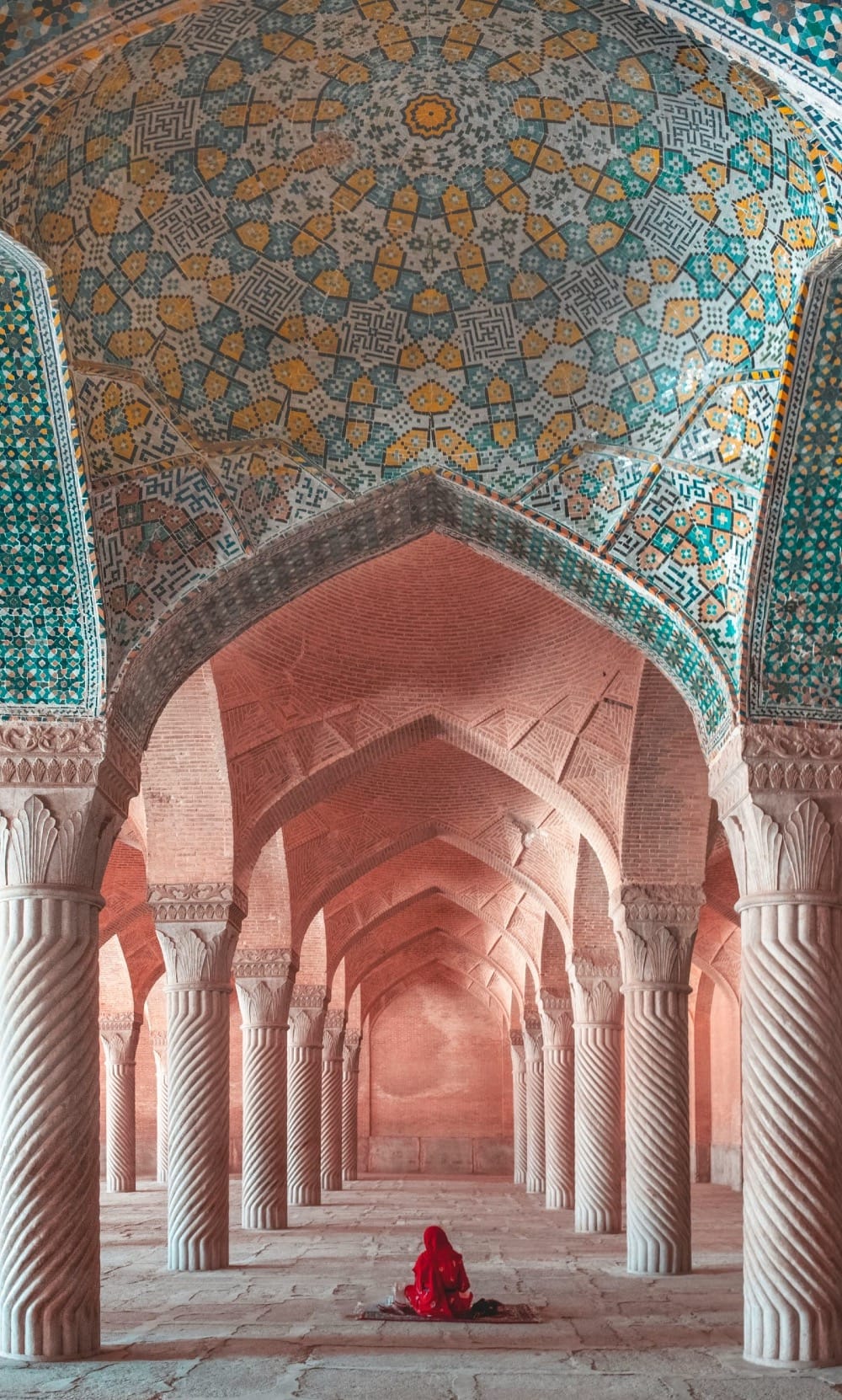
Tile panel in the Wazir Khan Mosque, Lahore, Pakistan.
If we ignore or deny the unknown as a higher level of Being, we limit ourselves to the apparently known as sufficient in and of itself, independent of anything beyond itself. For such a reduced view of the world and the self, the divisible and contingent neither manifest nor affirm the indivisible One. That means living with a fraud taken for a principle, supposing that everything in this world can be compared and measured and described in mathematical equations.[[9]] Even where we clearly see three — two measurable, comparable sides, left and right, and the Is, which is neither measurable nor comparable but without which there can be no duality in the first place — we ignore, deny, and either cannot or will not see that the Is is not the mere third of three. The Is is the absolute Third to every pair and all Its properties are reflected in existence and so in human language. Each language has levels of meaning that correspond to the levels of our ascent within consciousness. There is no movable boundary between the conscious level of consciousness and the level it is conscious of. Nor could there be.
Let us repeat that as persons-of/at/in-peace (muslim) we gather and focus existence within ourselves in relation to absolute Peace (al-Salam) by being-at-peace (islam). Our ability to cross the boundary between known and unknown and to connect with absolute Peace discloses to us that the horizons and the self are forms of the manifestation of God. People-of-peace look to the self for life and happiness within the realm of contingency. Death and unhappiness belong to contingency and travel always with us, but life and happiness in any absolute sense are in God and of Him. Each person-of-peace sees clearly the signs on the horizons and in the self as they praise God because they have nothing they did not receive from the absolutely Praised Who Is absolutely.The world and we are thus indebted to the absolutely Praised. We and it are owed praise only contingently. That is why our praise of the absolutely Praised is connection with Him and a returning of our debt to Him.
Turning to our own selves and to the world, we discover our debt, that we are praised, and our alienation. We comprehend contingency, from full consciousness of God's nearness to ultimate unconsciousness of it, with all of our being. No matter how we try to realize ourselves after the absolutely Praised, no matter how high we ascend within the self, glorifying and revealing the Praised within ourselves as our connection with the absolutely Praised, we always fall short of the higher potential within us. The absolutely Praised reveals Himself to us in that ever-present potential within contingent being to be higher and better than we are. The Praised is perfect, our shared connection to God, the essence of our humanity, our universal seal. He was sent into existence and to us, as the reason and the purpose of everything that exists. This is something we know directly, within ourselves, and so can bear witness to.
No matter how conscious and enlightened we may be, we still feel a need to transcend ourselves and become even more aware and enlightened. This links us consistently to that higher potential, the Praised, whom God sent as a mercy and a grace and as our maternal principle. As our higher possibility, the Praised is a continuous downward emanation of absolute Light into contingent manifestation. Only in and with him can we know ourselves in all our potential perfection, as our reason and purpose for being in the world. We do not enter the world or leave it of our own will. We are strangers here and sojourners, expected to become aware of ourselves and so come to know the Absolute as the homeland we are from and to which we shall return. The Praised is our guide, the perfect example of fully realized humanity, and our connection with God the Praised.
God is absolutely close to the world and to us, always and everywhere. He is Praised. This cannot be excised from any element or aspect of His creation. The Praised is the heart of His closeness to all that makes Him known, the perfect individual who affirms in and of himself that none are owed praise but the absolutely Praised. Neither he, the Praised, who was sent to remind us of and recall us to the absolutely Praised, nor the absolutely Praised can lose their purchase within our core humanity, as that is/we are the core of all that exists.
Chosen for and sent to us, the Praised mediates for us with God, the absolutely Praised, on that axis by which we ascend internally from multiplicity to the One and from contingency to the Absolute. We have always known that there is no god but God. This knowledge depends on nothing outside of us. We are contingent, prone to self-forgetfulness and alienation from the absolute Principle of contingency. We fall into alienation from what is known and imagine other gods than God. Equally we betray the other tenet, that Muhammad is God's apostle, even though we know it in and of ourselves, independently of anything passed on to us. We are reminded of both these indisputable truths, which we know in and of ourselves, by the signs on the horizons and in the self.
Neither act of witness depends on anything outside the self. They can be expressed in every language. Everything we feel, think, say, or do bears the seal of this knowledge lodged at the core of our being. Once we become conscious of this, we understand everything on the horizons and in the self in terms of it. There is no fissure or lack in creation or its contents.
Everything in existence can be separated off from the rest and from the whole. Duality is clearly not and cannot be its own beginning or principle. God is the Principle of all things, Himself depending on nothing, though everything contingent depends on Him. We know nothing as it really is. Confess this and it offers a reliable basis for deriving the rest. We know fully, in and of ourselves, independently of anything outside us, that none is praised but God, the Praised. The contingent announces Him and is indebted to Him in an economy of praise. Existence is linked to God, the Praised, through praise, as He reminds us in the Recitation:
“The seven heavens, and the earth, and whosoever is in them glorify Him. And there is no thing, save that it hymns His praise, though you do not understand their praise. Truly He is Clement, Forgiving.”[[10]]
That 'there is no god but God' and that 'the Praised is His apostle' are tenets independent of age, place, language, or tradition. We possess them always in the depths of our self and our being. The prophetic call to remember them, as already present in every self and inherent to existence, does not entail their rebirth ab ovo each time they are invoked.
Each of us can be fooled by our experience of being conscious into supposing consciousness an exclusively human property …(thereby) transforming ourselves from God’s worldly vicar into supposedly independent lord
Existence gathers in the individual. When the self brings awareness to being through knowledge of the names, it is complete manifestation of unconditioned God in His creation. His names are most beautiful. He reveals himself through them as Beautiful. He loves Himself in this revelation. The realized individual loves God as He is manifest in the beauty of the Praised whom He sent down to dwell within the self of each individual as our most beautiful potential. Our love of God is inseparable from our love of and adherence to the ever-present potential within us all to excel and reach higher. Ascending towards that potential, after the Praised, we free ourselves of the weaknesses that issue in sin. In the Recitation, God says to His prophet, the Praised, that he is to announce to all people: "If you love God, follow me, and God will love you and forgive you your sins. And God is Forgiving, Merciful."[[11]]
God loves the Praised, whom He sent down to be the fulcrum of our humanity and so of existence. The Praised loves God. Everything in existence discloses God, as absolutely Praised, to the Praised—divine Self-disclosure. This is why, to the person of faith, the Praised is a mercy unto the worlds and the most beautiful example, more precious than any condition of the self, because as Apostle he is the potential ever-present in us to be better and to attain a higher destiny on the path of self-realization and of return to God. On this path of ascent, the known is contingent, inseparable from the unknown. The known is useless unless it brings about a straightening up and ascent within the self.
We have intrinsic knowledge that there is no god but God and that the Praised is His apostle. We know nothing more reliably. But only when we make our own selves bear witness to it, out of our own will, so that our witness connects us with absolutely knowing and witnessing God, do we open up to self-liberation and self-realization as recipients and observers of what exists. All the worlds, in all their difference, and all people, in all their irreplicable originality, then stand in a matrix of unity, as a community through which the One reveals Himself. What determines and defines the person-of-peace is witness to no god but God and to the Praised as His apostle. This is the heart of unity and of responsibility for what has been received.
The signs on the horizons and within the self can appear independent of the absolute Signifier and absolute Signified, reducing the Truth they announce to contingence. Such existence would be self-contained, subsisting independently of any observer. But that cannot be the case. We are the reason and purpose of existence, but God is the absolute reason and the absolute purpose. There can be no contingency without the Absolute. To deny this, we must first exclude ourselves from observation, as we attempt to construct a deterministic image of a world of laws with no absolute Legislator. This reduces existence to the comparable and measurable. The frontier between the known and the unknown cannot be crossed. Faith, the connection of the faithful to Faithful God, is excluded from the territory of the known.
But we do not accept any such confinement within the limits of the known. We are constantly trying to overcome those limits. As knowing subjects, we are involved in constant processes of change, especially regarding what we regard as known. Our connection with the external horizons and the self receives new impressions through the senses of hearing, sight, smell, taste, and touch. Names woven into webs of meaning embrace everything within reach of our senses. That web of language, meaning, and symbol incorporates everything within the boundaries of the known. The knower cannot magically eliminate the boundary between known and unknown. Each name caught up in these shifting webs of meaning is thereby linked to the unknown and so to the absolute Is. But these connections do not mean the known and the unknown are commensurate.
Knowing that there is no god but God and aware of two attributes, His being absolute Peace and absolutely Praised, we can discover our own highest self-potential, our perfectibility as human beings, a perfectibility manifest in the first of the people of peace, the Praised, who was sent down to be the most beautiful example and is therefore more precious to us than any condition of our own selves. This is the essence of the potential deposited as a treasure within the self, which we know independently of historical, geographical, or cultural context, as part of the evernow, the presence of the fully Real.
God, in His mercy, has sent His heralds to remind us, through their speech and presence, of what is already within us, of being-at-peace and of being praised, realized in the person of the first of the people of peace, the maternal prophet, the Praised. That we can be conscious of existence as a whole, the horizons and our inner world, and see in them the self-presentation of the One is due to our being on the axis between most beautiful uprightness and rectitude, the reason and purpose for which we and all things were created, and the lowest depth, towards which we descend when we reject what we know in and of ourselves. That most beautiful uprightness is the person of the Praised, our most sublime potential. It cannot be extinguished by any of the diverse states or conditions of the self. Through the Holy Spirit/the Spirit of Truth, God has sent down to the heart of His apostle, the Praised, seal and maternal principle of all His heralds, the essence of humanity, His Word, through which He made the nature of the Praised, our most beautiful example and a mercy to the worlds, perfected humanity, the telos and end of all existence.
The Word thus sent down is God's speech in human language and in everything on the horizons and within the self. It is His reminder to us of our reason and purpose. When it first appeared, it was, like any other word, in a specific language, but it was sent down to all people and so can be translated into all languages. In it, God says: "And among His signs are the creation of the heavens and the earth and the variety of your tongues and hues."[[12]] This variety of languages, which divides us into linguistic communities, does not in itself present an obstacle to our being reminded of the reason and purpose for which we are in the world. Each of us stands before God's Face, created in the same authenticity and capable of the same full self-actualization in what we have and are. Given God's absolute justice, no a priori advantage is offered to any select group based purely on linguistic, racial, or geographic difference or of the age into which they were born.
So, all languages and all ways of using them are equally open to the person-of-peace (muslim), in the universal meaning of that term. As individuals, we may not understand them all, but they all already contain everything, all the signs on the horizons and in the self. Conscious of this, we rise up towards most beautiful uprightness, the reason and purpose for which we have been created. In the Recitation, God announced: “Every people has its Messenger; then, when their Messenger comes, justly the issue is decided between them, and they are not wronged.”[[13]] The plurality of languages puts no one at a disadvantage in pursuing the reason and purpose for which we were created. The Recitation makes this clear: “We have sent no Messenger save with the tongue of his people, that he might make all clear unto them.”[[14]]
These citations show that God has sent as many heralds as linguistic communities. God told them one and the same essential Truth in different forms, which they received and passed on. In the Recitation God says: “And We sent never a Messenger before thee except that We revealed to him, saying, ‘There is no god but I, so serve Me.’”[[15]] In this verse, ‘before’ may mean both before and after. As a prophet, the Praised is the capstone of existence, first in intention and last in execution. The other heralds swore their oath to him as their paladin, and he affirmed them as having been announced and sent out into the world.
It may seem that we do not always know the linguistic community we belong to. Those sent as heralds to the thousands of such communities often originally came from other peoples and spoke in other languages. But all languages can convey the messages God uses to remind us of and recall us to the reason and purpose for which we were created. No one is a stranger in his or her own tongue. When we become alienated from our own language, the self is darkened. Our true homeland lies in language, as God addresses us by His speech in it. None of us is ever deprived of the merciful and just potential to rise higher, to be better, and to attain a more beautiful selfhood. But we can mistake ourselves for lords of our own being and of what has been entrusted to us and placed within the reach of our will and our power. This egoistic misprision alienates us from the Real and distracts us from what is known, from what we know in and through and at the core of, our transcendent self.
We did not create even a single particle of our being. Or speech. We may deludedly suppose our destinies to be entirely within our own power and authority—our selves sovereign. Though the absolutely Is speaks through everything on the horizons and the self, we nonetheless consistently forget, ignore, and deny that reality. But the heralds are those amongst us to whom the absolute Is has allocated the task of making clear, in speech and in language, the necessary presence and ineradicable authority of the One. Their examples in our heritage disclose the presence of God in consciousness, thought, and speech and in all they express. It bears repeating that God made us and everything we can feel, think, or do. He sent the Praised as His prophet, a mercy to the worlds, and so a mercy in all tongues.
God is absolutely conscious and everything He has created, great and small, reflects this. All the signs on the horizons are conscious in their relations with God, as absolute Signifier and absolute Signified, and so of themselves as participants in His creation. Each of us can be fooled by our experience of being conscious into supposing consciousness an exclusively human property. Alienated from existence, which is itself conscious and has its claims on us, we turn our violence against the horizons, transforming ourselves from God’s worldly vicar into supposedly independent lord, in an illusion of power and strength. All we have done is oppress the world, the beings in it, and our own selves and so debase ourselves to our lowest rather than our highest potential.
Every manifestation of the individual heart is dual. Its essence is Oneness or Unity, which is God and of God. This is also the case with Peace.
Humanity has a single essence. As Inceptor, God’s sublime plan was to introduce us into Being as its purpose.[[16]] The prophets draw our attention to that ontological reality, which is the marrow of humanity, its maternal and sealing nature, and they realize it themselves in and through their oath to God. That oath is mentioned in the Recitation, the discourse God sent down to His prophet, the Praised, that he might bear witness to it and pass it on to all:
And when God made the covenant of the prophets: “By that which I have given you of a Book and Wisdom, should a messenger then come to you confirming that which is with you, you shall surely believe in him and you shall help him.” He said: “Do you agree and take on My burden on these conditions?” They said: “We agree.” He said: “Bear witness, for I am with you among those who bear witness.”[[17]]
God thus offered a covenant or contractual relationship to the prophets and to each of us. This is why we have free will. Otherwise, a contract or agreement would be meaningless. We can forget, ignore, or deny this contractual relationship, but know it innately, having been brought into Being through the love of God as Initiator. God comprehends everything by knowing. He has full knowledge of all things and judges our attitude towards the stake of that original contract. This is what trust or faith mean as the form of our relationship as faithful subjects with the Faithful. Without trust, neither the offer nor the acceptance of a contractual relationship makes sense.
The apostle is the one self-identical essence of humanity. Each individual treasures their knowledge of that essence. As does every language. Each of us knows it and bears witness to it in the irreproducibility of our individual being. Manifest to us within history, in a given language, region, or way of life, that essence gathers within itself the archetypal force of exemplarity as criterion for judging our relationship to God and so to His creation. But contingent existence is not commensurate with the absolutely Steadfast.
Existence extends across ungraspable expanses of space, time, mass, and energy. It and humanity, which contains and focuses it, are at peace in and serve God, absolute Lord and Peace. God's absolute Lordship is expressed and affirmed by this service. That God is absolute Peace is expressed and affirmed by being-at-peace. This is how contingency relates to the Absolute. The contingent is not self-sufficient. It is nothing without the Absolute. All creation has is from Him, everything owed to Him. God says in the Recitation: “Unto God belongs whatsoever is in the heavens and whatsoever is on the earth, and unto God are all matters returned.”[[18]]
That all human hearts are as one between the two fingers of the all-Merciful[[19]] and that everything comes from Him and returns to Him show that the contingent cannot be extricated from the Absolute, duality from the One. Thanks to its dependence on the One, contingency, as a whole and in each thing, no matter how great or small, is dual and fully entangled. This entanglement involves every particle being “aware” of all others. Each particle reveals its dependence on the observer and on the time and place of observation. As such, each particle confirms the interrelationship of all things on the horizons and in the observing self, our awareness, and the absolutely Conscious and Aware.
We have received all we have from the One. Our awareness of this means that existence is aware of its beginning and end in time and space. These are signs of the absolute Beginning and the absolute End, which cannot be distinguished or comprehended or encompassed by anything conditional. In the Recitation, God says of this interrelationship with the One: “Glory be to Him, Who created all the pairs of what the earth produces, and of themselves, and what they know not.”[[20]]
Everything creation has received from God recalls Him but is not to be equated with Him. Compared to God, everything is nothing. Compared to creation, God is God. He says in the Recitation: “There is none in the heavens and on the earth, but that it comes unto the Merciful as a servant.”[[21]] Given the contingency of free will, our striving and what we do clearly has no impact on God's chosen approach.
Whether we wish it or not, contingency comes to consciousness in and through free will as manifestation of the absolutely Conscious. Everything in existence and existence as a whole make manifest and confirm absolute Peace and are in turn focused and affirmed within us and our awareness. In the Recitation, God says: “Do they seek other than God’s debt, while whosoever is in the heavens and on the earth is in Peace with Him, willingly or unwillingly, and unto Him they will be returned?”[[22]]
God addresses us all individually in every language. The heart, the essence of humanity properly understood, is the presence of the One both in and out of time, in and out of space. It is in us together and severally, “one between the two fingers of the all-Merciful”. As creaturely, it corresponds to duality under the absolute rule of the One. As uncreated, it is the same as Him, the One. This claim may seem questionable. Every manifestation of the individual heart is dual. Its essence is Oneness or Unity, which is God and of God. This is also the case with Peace.
The one heart of all human beings between the two fingers of the all-Merciful, the One, is a clear reminder of the dual aspect of creation and its full and absolute dependence on the Creator. He cannot be divided but what has been created can. Even the most minute particle of the self-showing of the One within space-time and mass-energy, of the teeming flux on the external horizons and in each and every self, and of the constant processes of coming into and going out of existence can be further divided. Imagine or measure it as we will, every particle or quantum is connected, in its particle-wave duality, with every other particle, throughout existence. Consciousness within an observer is thus connected with all others, a sign of the absolute Is without Which there is no existence at all. This entanglement of contingent manifestation in duality is the One, the Third to every pair but never the third of three.
Judgement is the showing or demonstration of truth. Only in and through judgement is full justification possible. Each time we judge, we do so out of knowledge, as what connects us as knowing subjects with what we know. The only knowledge that can possibly be absolute is that there is no god but God and that the Praised is His apostle, though even here the knowing and witnessing subject remains contingent and so only contingently knowing and witnessing. Only God, Who comprehends all with His knowing, can judge entirely justly. And He shall do so:
"And, now you have come unto Us alone, just as We created you the first time, and you have left behind that which We had bestowed upon you. We see not with you your intercessors – those whom you claimed were partners. Now the bond between you has been severed, and that which you once claimed has forsaken you."[[23]]
Creation is a treasure deposited within us. In the Recitation, God says: “And He taught Adam the names, all of them.”[[24]] Those names are God's. They express the inexhaustible attributes of His oneness through their difference. All the obstacles in our path of ascent from one level of consciousness to another are removed in our consciousness or awareness of God, as the Possessor of the most beautiful names. The higher the level of consciousness, the clearer the names and their integration into fields of meaning. There is not and cannot be a level of being at which God’s names are not present. They are God’s and what connects the contingent with Him.
Create a free Sacred Web Members account
Gain access to this post, limited free articles, and a members' newsletter.