
The sorrows of today’s humanity are not fundamentally based on the many disasters that face us, or even on the understanding that most of these disasters are of our own making, that so many of them are actually the dark result of our highest ideals, now finally displaying their unintended consequences. No. The sorrows of humanity are based on the fact that we have collectively lost ourselves, lost faith in ourselves. We are disgusted with ourselves, actively despise ourselves—and feelings like this have led so many of us to actually seek out what is most despicable, what is most disgusting, as if we could hide from degradation in degradation itself, hide from shame in shame. This diagnosis does not apply of course to the totality of the human race, and there is certainly a great counter-current to this collective degeneration of the Human Form, a renewal of humanity’s highest spiritual aspirations that keeps pouring in from some invisible Source even in this darkest of times—a Source upon whose true Name, however, we cannot seem to agree. And yet it is undeniably there. But if we name it wrongly, then even this great outpouring of Spirit may be lost to us because we lack a conceptual vessel clear and stable enough to contain it.
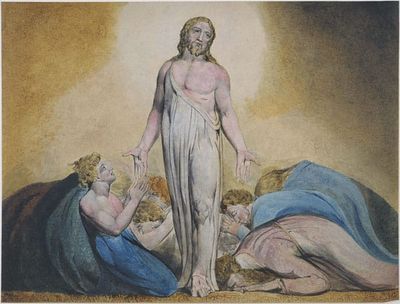
The name of this vessel is Humanity, what William Blake called “the Human Form Divine,” the human face of God that lives in Eternity and yet is always pouring itself into time and change and becoming. As Blake said in his “Auguries of Innocence”:
God appears and God is light
To those poor souls who dwell in night
But does a Human Form display
To those who dwell in realms of day.
But can we still accept this concept in times like these? In times when “humanity”, to so many of us, is at best a quaint nostalgic memory, and at worst an oppressive set of limitations and boundaries and that we long to escape? Because the idea of transcendent Truth appearing in a human form is becoming alien to us, just as we are becoming alien to ourselves. We imagine the animal spirits of the shamans, the great plant powers like Ayahuasca, the UFO Aliens themselves as the plausible and proper channels for the arrival of the higher truths, if not those “techno-elves” that Terrence McKenna and many others have seen on DMT, which I take to be symbolic images of the human nervous system itself when alienated from the realized divinity of the human soul, seeing that the brain without the soul must appear more and more in the guise of an exquisitely sophisticated machine. This is what opens the door to transhumanism and the literal worship of artificial intelligence, which represent the final deconstruction of, and requiem for, the human race. “And this is as it should be” say the proponents of mass soul-suicide; “no more will we be ‘human, all-too-human,’ but something greater, and freer, and colder, something more powerful and more terrifying. No longer will the order of existence terrify us—now we will terrify it, and bend it to our will”. And this might actually be, to some, an attractive result—except for the nagging question, “Who, exactly, will be this triumphant ‘we’? Certainly not the humans, the ones we have always recognized ourselves as being; we the humans are precisely the ones who will not triumph; we will be ground under foot, negated, pulverized—obsolescent—irrelevant—forgotten.
In the face of this massive threat, I believe that it is necessary to speak for Humanity again—especially since Humanity is what we are, with no possibility of our ever being anything else. But—where to begin?
knowledge without love, just like power with nothing human to achieve or protect through use of that power, is nothing less than Hell
Ibn al-‘Arabi, the “greatest Sufi shaykh,” taught that “human knowledge is higher than Jinnish knowledge.” The truths of God that come to us through human channels, channels such as saints and prophets and avatars, can reach and alchemize our essential and integral humanity—but the truths that come from non-human sources, through channelers and spirit mediums and alien abductions, even though these too may speak of God, can only come to us if we agree to become dehumanized in the process so as to meet them half-way; this is what the “human-alien hybridization project”, for example, is all about. The higher transcendental truths will come to us, even through channels like these, because we can’t exist without them—but they will come at the expense of our full humanity. In order to know what the Jinn know we will be required to become uncanny, elven, half-jinnified ourselves—to allow ourselves to be turned into what are traditionally called “changelings.” Knowledge we will gain, certainly, and along with knowledge, power. What we will lose in the process, however, is love—and knowledge without love, just like power with nothing human to achieve or protect through use of that power, is nothing less than Hell, a heartless technological Hell that will ultimately make us wish that we had never been born. The greatest booby-prize of all! We had thought of love as weak—or, at best, as a kind of recreational reality, like a summer vacation in a quaint mountain village from which we might nostalgically survey the rich panorama of the human past, before returning to our post on the front lines in the great war for the future, the battle to eliminate the last vestiges of the Human Form in the name of Something Greater!
if war is the prime metaphor for the human struggle in these times, then I must openly declare that I have joined the ranks of the opposing forces, the side of the defenders of the Human Form
But if war is the prime metaphor for the human struggle in these times, then I must openly declare that I have joined the ranks of the opposing forces, the side of the defenders of the Human Form. But where are these forces to be found? Who are their leaders? Where are their headquarters? How can their recruiters to be contacted? Where do we sign up?
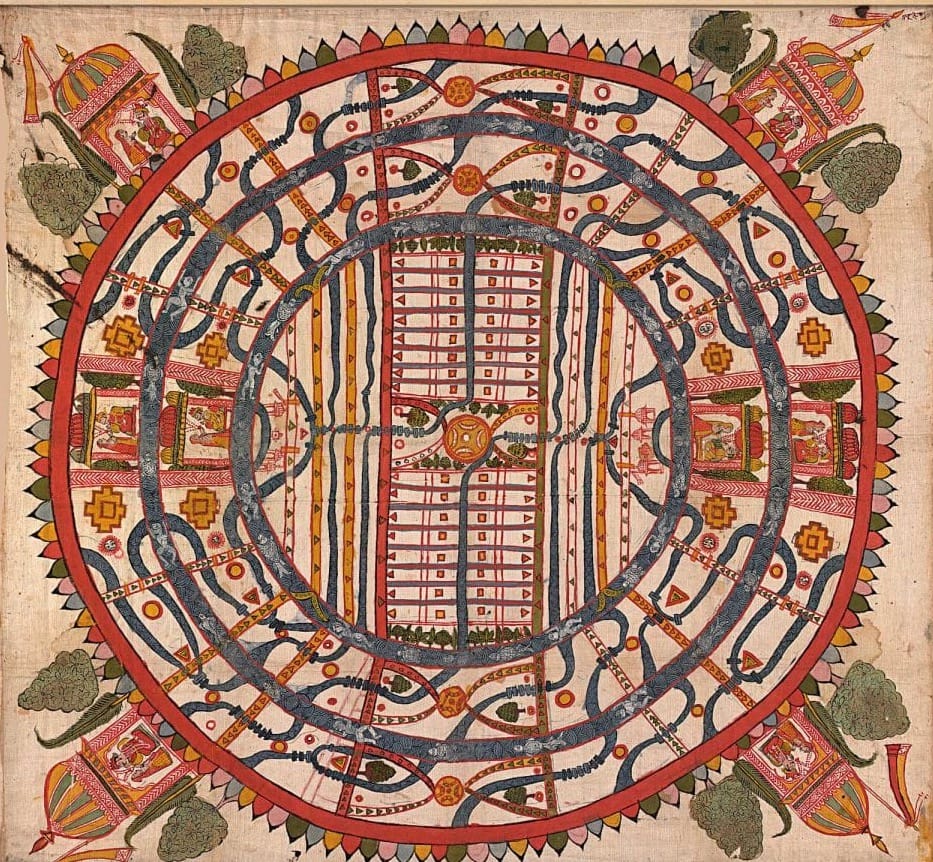
The preservers and guarantors of the integrity of the Human Form are the great revealed religions, and the Primordial Tradition from which the material for them was inherited on the horizontal axis of time, just as their forms descended, along the vertical axis, from the Word, the creative act of God in Eternity. Hinduism speaks of the figure of Manu, or of some particular Manu, as the principle of a given manvantara or cycle-of-manifestation, as if time itself were the “long body” of a Primordial Man, the working out of his/her possibilities in sequential order rather than synthetic form; Manu appears to be the ultimate origin of the English word “man,” which is also related to the Sanskrit manas, “mind”. The Buddhists speak of “the human state hard-to-attain”, the only form of sangsaric existence (according to some accounts) from which Perfect Total Enlightenment can be gained.
Islam declares that it is humanity alone, not the heavens, the earth and the hills, who possesses the Amana, the Trust, thus making us Allah’s khalifa or vicegerent, His delegated “eye” through which He surveys and orders terrestrial existence [cf. Q. 33:72].
And in the Christian universe, the Second Person of the Blessed Trinity, the Logos, incarnates not as a tree or a star or an animal or a robot, but as a man, which is why Jesus Christ called himself “the Son of Man.”
Even in those traditions where shamanism remains dominant, such as that of the plains Indians, though the animal powers are placed at the four cardinal points of the medicine wheel, it is Humanity who occupies the Center. The spirits of the animal species assume a quasi-angelic status in the Native American universe, but while in the unseen world they are the powers of the Great Spirit, in this earthly world they are the powers of Man.
Likewise in the world of “mythology”, which is largely made up of the remnants of various archaic religious conceptions, as well as of certain esoteric interpretations of the major divine Revelations, the concept of the Primordial Man also appears, usually paired with the traditional notion of humanity as “the microcosm of the macrocosm,” the universe in miniature appearing in synthetic form, just as the vast universe we see around us is Humanity in dispersed and multidimensional form.
In Norse mythology the giant Ymir is butchered to create all the forms of nature; his blood becomes the rivers, his bones the mountains, etc. A similar function is performed in Zoroastrianism by Gayomard, the first man, while in the symbolic system of William Blake the epitome of cosmic manifestation is symbolized by the Giant Albion; as he says in his poem Jerusalem, “Man anciently contain’d in his mighty limbs all things in Heaven & Earth….But now the Starry Heavens are fled from the mighty limbs of Albion”. This was Blake’s rendition of the Kabbalistic doctrine of the Adam Kadmon, who is the synthesis of all the sefirot or manifested divine hypostases that constitute the Tree of Life.
In the archaic Greek tradition as well, the Primordial Man appears as Orpheus, whose function is to mediate between the celestial or Apollonian powers above and the chthonic or Dionysian powers below—just as, according to the Aristotelian hylomorphic theory, forma and materia are united and synthesized as the “substantial forms” of real existing things.
And this correspondence between microcosm and macrocosm, between humanity and the universe, appears in modern cosmological theory as well as the Anthropic Principle, which holds that the universe is meticulously designed and fine-tuned so as to let life, and ultimately human life, emerge—the one kind of life that could conceive of the universe as an ordered cosmos and so generate an Anthropic Principle in the first place. Nor can anyone deny that the totality of the measurements we have made of the universe around us, as well as the entirety of the concepts we have generated to organize and make sense of the resultant data, are inevitably conditioned by the fact that the one performing the measurements and generating the theories is, precisely, Humanity. Thus, as Blake expressed it in so many places—especially at the end of his great unfinished epic, The Four Zoas—the Trees, the Rocks, the Hills and the Oceans, the Animals, the Sun and the Stars are all human forms in essence—and, for us, they can never be anything else, because they are seen and formed by the Divine Imagination operating through Eye of Man.
And the strange thing is, we all used to know this without ever being taught it. We knew instinctively, “naturally,” that we were human beings, bearers of the Image of God, the Imago Dei, and consequently that we possessed a fundamental human dignity as our “inalienable right.” We knew this by the very fact that we were it, though our various religious traditions fulfilled the vital function of reminding us of this intrinsic and obvious fact and preventing us from forgetting it.
We have given worms and flies the human voice, and so filled our bodies with worms and flies.
But now that these traditions are in their decadence, we actually have forgotten it—or at least enough of us have forgotten it, those most severely affected by scientism, atheism, and materialism, for human society to now be in the process of reforming itself along non-human lines; as the Holy Qur‘an puts it, [they] forgot Allah, and so Allah caused them to forget themselves [Q. 59:19]. We call this “transhumanism,” but what it actually is subhumanism; as I expressed it in a poem I wrote as many as 50 years ago, “We have given worms and flies the human voice, and so filled our bodies with worms and flies.” And all the sophisticated metaphysical, theological, esoteric and mythological lore and understanding in the world can never restore to us what we have lost through the kind of alienation from our own true essence that has made us forget what a human being is, even though we actually are human beings and can never be anything else. Nothing short of a radical apocalypse, a great Purification Day (speaking in Native American terms), could restore to us, on a collective basis, this abandoned self-knowledge. The ghosts, the spirits, the cryptids, the UFO Aliens that we are now collectively turning to in order to fill the void left by “the death of God” can never do this for us, precisely because each of these represents a specific departure from the human form along one or another vector of extremity or caricature or degeneration or loss—the Sasquatch toward the subhuman orders of nature, the ghosts toward the separation of spirit from flesh, the Aliens toward the transhuman deconstruction of humanity, since they are nothing less than the spirits of alienation, the very archetypes and emissaries of the great transhumanist self-betrayal.
Yet in the heart of every great Divine revelation, as in the depths of the human heart, the Primordial Humanity that the Muslims call the fitrah still remains, intact and inviolate, just as it was originally conceived, and is eternally conceived, in all its primeval perfection, in the Mind of God. If we have faith in this, if we know this existentially, whether or not we can make conceptually explicit to ourselves exactly how we know it, then we can remember God. And if we remember God, He will cause us to remember ourselves. In the great war between the Human Form and all the infernal, subhuman forces that menace it, those powers of terror and seduction and forgetfulness and despair, this is the primary weapon, the central strategy and the front line of battle. And as for the battle-cry: “STAY HUMAN!” might well suffice. It is short, it is succinct, and it hits the nail on the head.


