
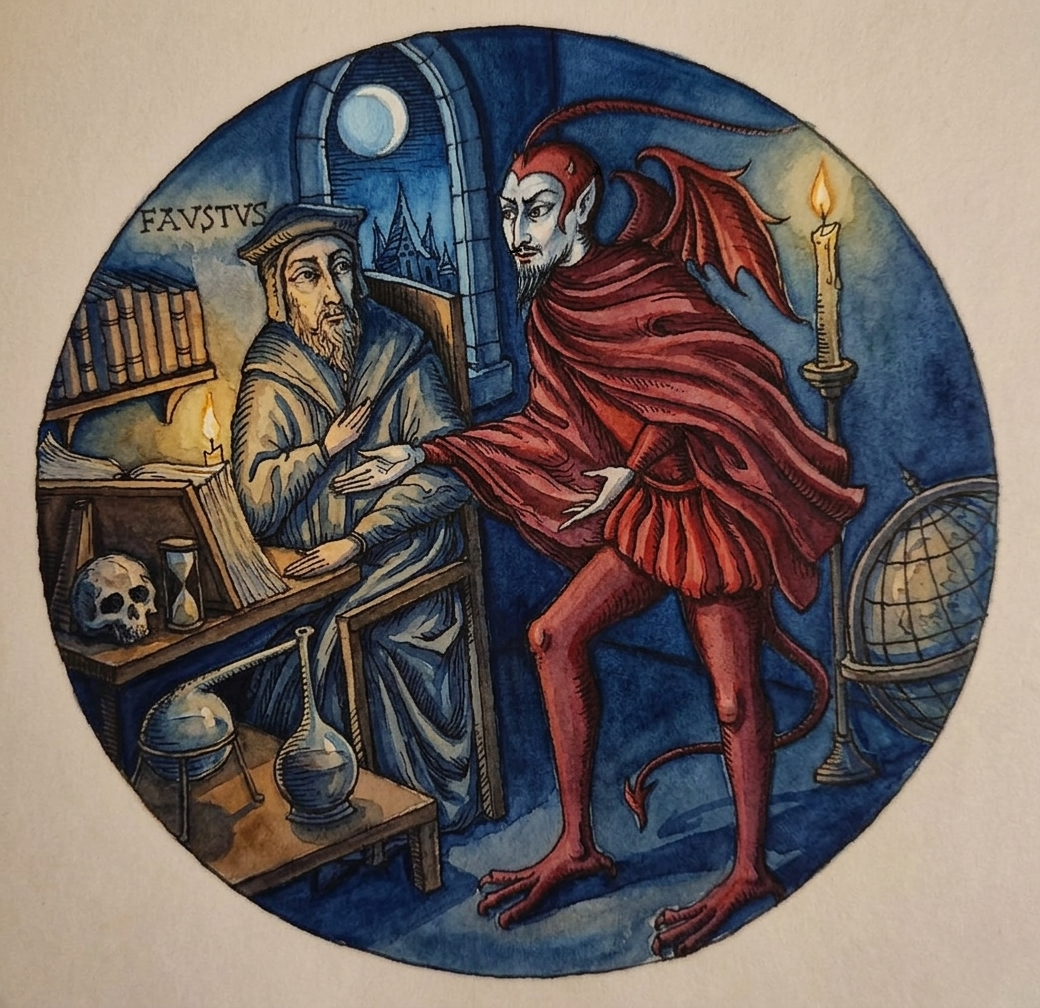
"We note in passing a curious and scarcely known fact: the legend of Faust, which dates from approximately the same period [16th century] constituted the ritual of the Printers initiation."
— (René Guénon)
"By printing in the infernal method, by corrosives, which in Hell are salutary and medicinal, melting apparent surfaces away, and displaying the infinite which was hid."
— (William Blake)
Introduction
The transition of book production from the scriptoria of monasteries to the secular domain of the printing presses must have inevitably signalled to the traditional mind a kind of desacralization of an ancient spiritual craft whilst the printers themselves for centuries afterward retained certain symbolism from the monastic world of the Middle Ages (even today in Britain the representative for the fellow workers in a print workshop is traditionally titled 'Father of the Chapel').
From the historical viewpoint the period of Western modernity has been widely regarded as being ushered in by Gutenberg's printing press. But from its inception, the printing press was viewed with a distinct ambivalence on account of its almost 'magical' ability to produce identical books faster than any scribe, contrasting markedly with what Frithjof Schuon has characterized as 'traditional slowness' in the artisanal world, in this case the cumulative, patient discipline of manuscript production and illumination.
In effect, all such material technologies imply a 'pact with the devil', a transaction with 'titanic', 'elemental' or 'daemonic' forces.
The rupture with the sacred world of medieval scriptoria, whose arts had provided an authentic support for spiritual realization and their replacement by the rapidity of production obtained via the new 'profane' or desacralized technology of printing may explain the 'infernal' themes associated with the craft. In effect, all such material technologies imply a 'pact with the devil', a transaction with 'titanic', 'elemental' or 'daemonic' forces. The new powers and marvellously increased quantitative efficiencies bestowed by technology are invariably paid for by the atrophying, obscuration and loss of those skills, values and abilities associated with a qualitatively superior plane. The material advantages granted by these 'familiar spirits' bound to man's service come at the cost of a diminishment on a higher plane, a loss or impoverishment of the soul, and so forth. The advent of AI and digital media in the technological 'progress' of our own day now elicit similar feelings of disquiet in many.
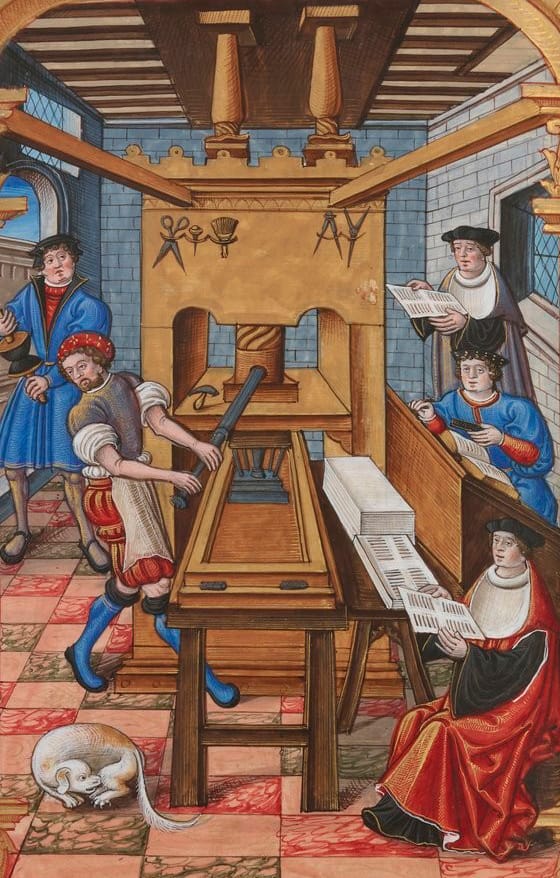
This ambivalence crystallized around the prominent printer and financier Johann Fust (c. 1400–1466), whose surname became conflated and identified with the legendary scholar Dr. Johann Georg Faust famous for having sold his soul to the devil (a narrative influenced by the hagiography of the 6th century St Theophilus of Adana who similarly made an infernal pact from which he was finally released by the grace of the Virgin Mary). In 1507, Johannes Trithemius wrote a letter giving a contemporary account of the wandering magician, reputed to be a mountebank and heretic, named “Georgius Sabellicus, who was styling himself 'Faustus Junior'” and who boasted of being magus maximus and fons necromanticorum. Johann Georg Neumann’s Disquisitio historica de Fausto praestigiatore (1683) noted that “some had begun to identify the legendary Faust with 'a printer of Mainz called Johann Fust'.” Similarly, André Chevillier’s L’Origine de l’Imprimerie de Paris (1694) told how Fust was accused of sorcery in Paris for selling printed Bibles, because “the authorities, unable to believe so many identical books could be made without magic, accused Fust of sorcery.”
German Printing Guild Traditions
Terminology and Rituals
The “dark arts” of printing were reflected in the guilds’ own vocabulary and initiation. The youngest apprentice was called the “printer’s devil” because he was covered in black ink and tended the “hellbox” (the container for broken type, which was eventually melted in a furnace). The craft itself was called the “Black Art” (Schwarze Kunst).
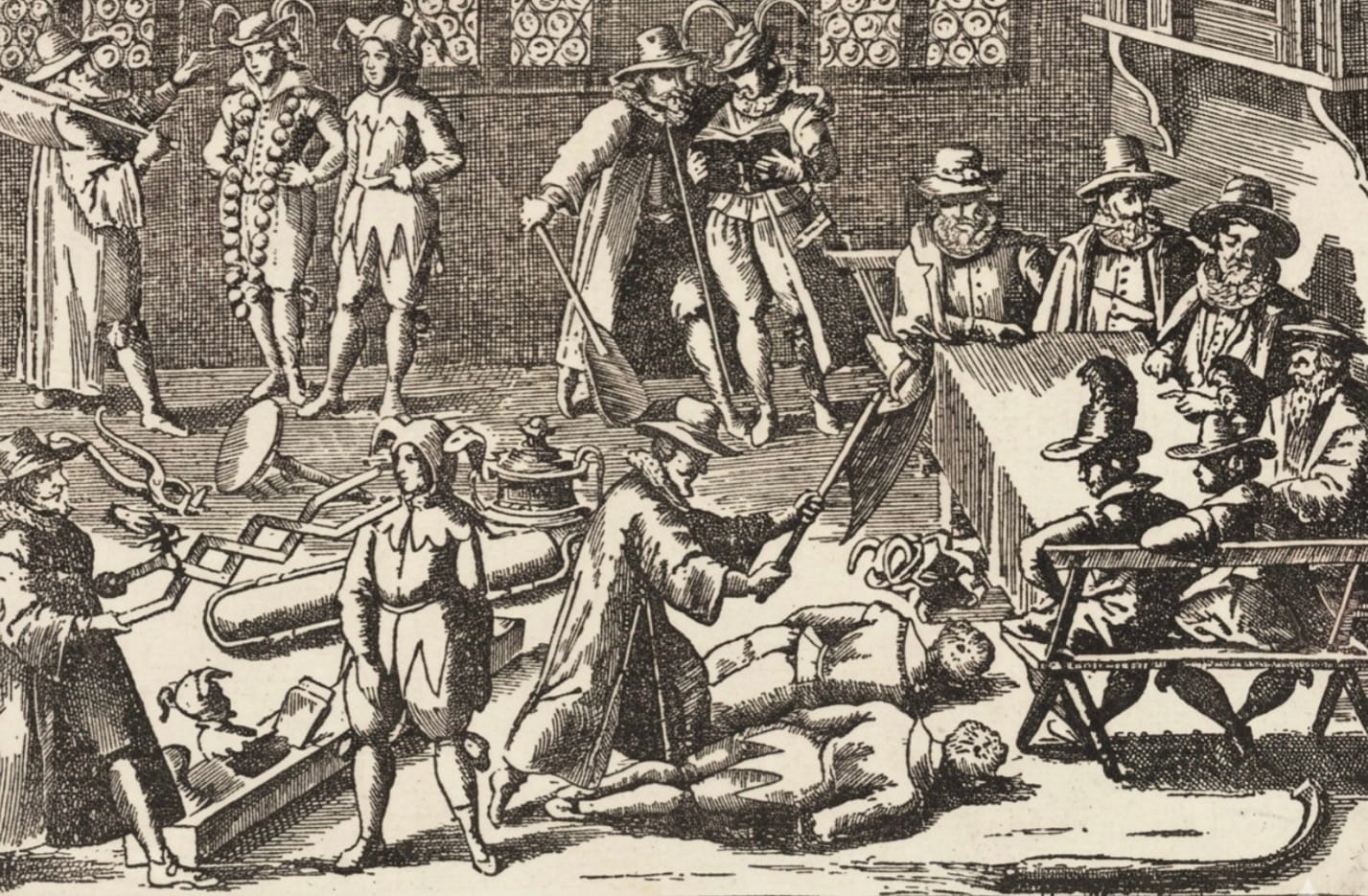
This was the most elaborate German printing guild initiation, a carnivalesque morality play that transformed an apprentice into a journeyman. The most famous version was the 'mirthful play', Depositio Cornuti Typographici, written by Johann Rist in 1654 which remained “in general use throughout Germany for nearly two centuries” (William Blades, An Account of the German Morality-Play, Entitled Depositio Cornuti Typographici, 1885).
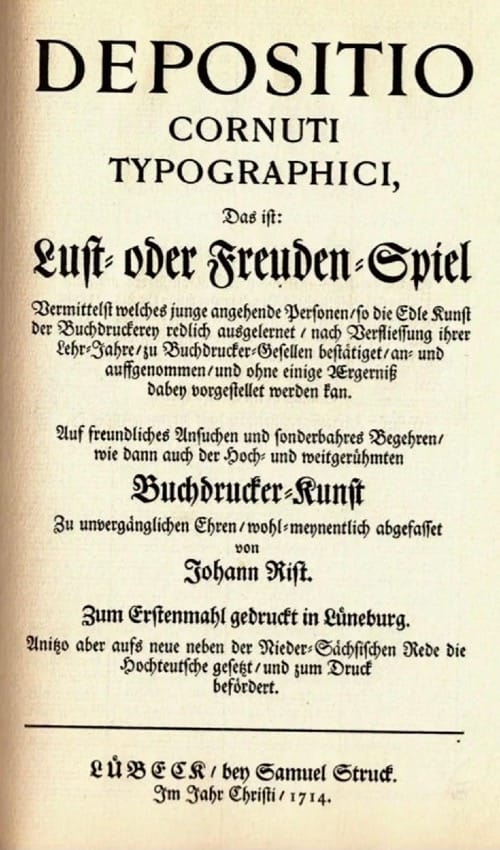
Rist’s script gives instructions for the musical opening of this drama: “Here let the Trumpets, the Trombones, the Clavicides, the Drums, Cymbals and other instruments play vigorously some lively music” (Blades translation).
The “Cornute”
The apprentice was called “a 'Cornute' — an amphibious animal, neither apprentice nor workman, but a horned beast full of all kinds of wickedness, from which he could be freed only by the saving ceremony of the Depositio”. This semi-bestial and horned figure typifies the profane state of the candidate, immersed in ignorance, delusion and the contaminations of the lower passions. He must be purified of the Saturnian 'lead dust' of the fallen state to be worthy of the art and mystery of printing. Through a boisterous ceremonial this horned beast is ritually humiliated, 'laid down' and symbolically divested of his horns – an initiatory 'death' and symbolic dismemberment preceding regeneration.
…this horned beast is ritually humiliated, 'laid down' and symbolically divested of his horns – an initiatory 'death' and symbolic dismemberment preceding regeneration.
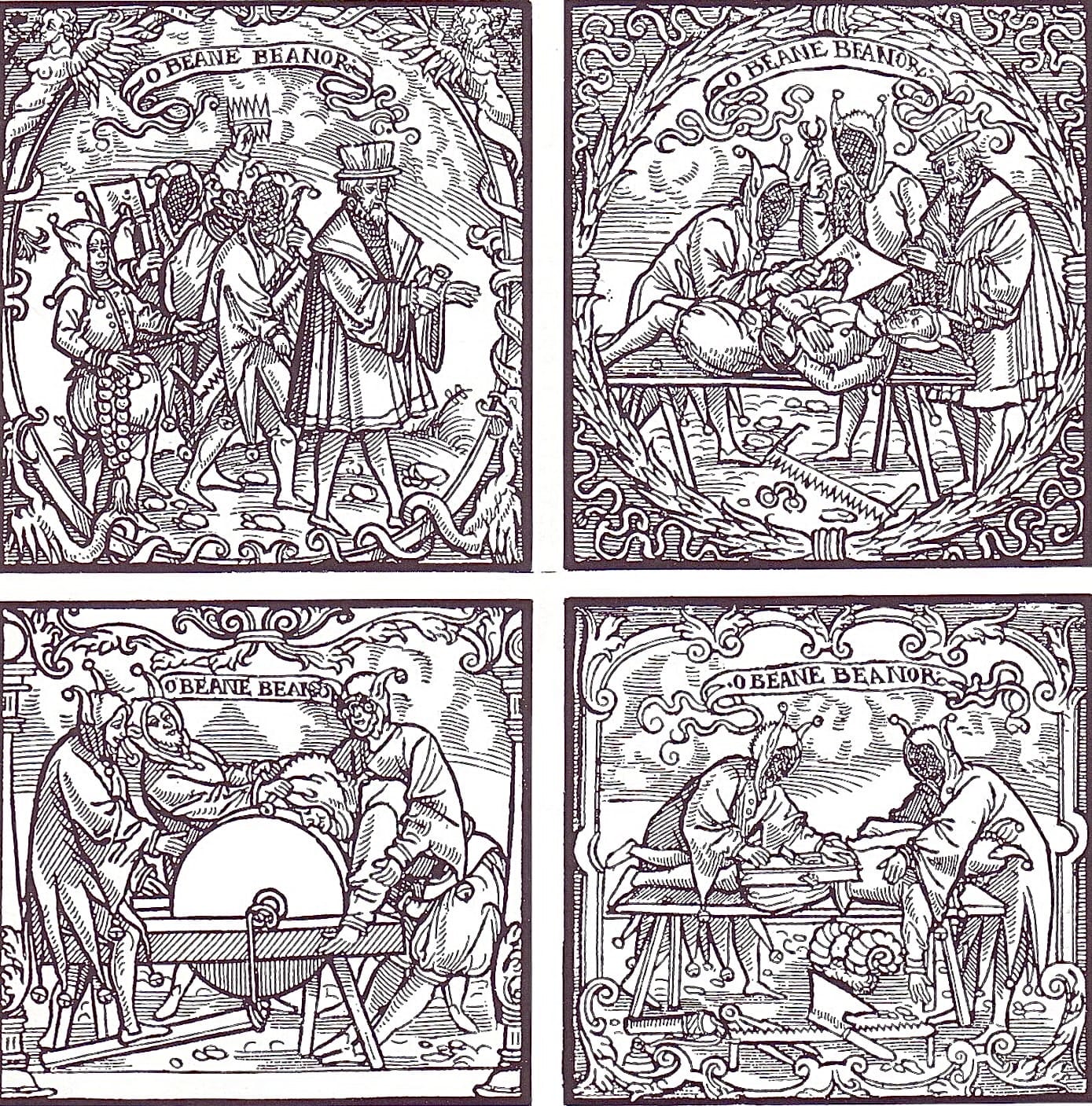
Symbolic tools, the compass, square, axe and plane are brought into play as the Depositor says:
'First take the axe and hew him square,
Each corner, bump and angle pare,
Then plane him well till all is straight,
Nor for his cries one jot abate,
Then with my compass in good sooth,
I soon will see if all be smooth.'
(c.f. Blades, pp38)
This parallels the stonemason's initiatory symbolism of the transition from the 'rough stone' to the 'polished stone' as a metaphor for the perfecting of the candidate.
The Depositor’s servant was named Urian (a devilish figure), who dragged the Cornute in and tormented him. When shown a piece of writing, the Cornute “declares he cannot read, not having received any education” (Blades). “The 'Postulate' or apprentice was sprinkled with water, and so cleansed from his original state of brutal ignorance, and admitted by the 'Pfaffe' or parson into the privileges and responsibilities attaching to every member of the Printers' community” (Blades).
The Gautschen: The Printer’s Baptism
While the Depositio was a theatrical morality play, the Gautschen (also known as the Gautsch) was a more direct, physical baptismal ritual that served as the practical initiation into the printing trade. It remains one of the oldest continuously observed craft traditions, with roots in the 15th and 16th centuries.
This baptismal dousing symbolically washed away the apprentice’s “sins” – ignorance, clumsiness, and the metaphorical filth of the initiate.
The term Gautschen originally meant “to press the water out of paper” – a reference to the wooden vat used in papermaking. This connection to pressing out water likely inspired the ritual’s core action. The central act of the Gautschen was a forced, full-immersion dunking in a tub of water (the same type of vat used for making paper by hand). In some versions, the apprentice was seated on a wet sponge, leading to the alternate name Schwammsitzen (“sponge-sitting”). This baptismal dousing symbolically washed away the apprentice’s “sins” – ignorance, clumsiness, and the metaphorical filth of the initiate.
After the dousing, the newly initiated journeyman was presented with a Gautschbrief (a “baptismal certificate”). These decorative, often hand-illuminated documents served as proof of the initiation and full membership in the “Black Guild” (Schwarze Zunft). The Gautschbrief was a respected credential, recognized throughout German-speaking printing . The ritual was followed by a festive celebration known as the Gautschfeier. Traditional lore held that the apprentice would receive “water from below” (the sponge), “water from above” (the dunking), and finally “water from within” (the celebratory drink). The toast that followed was an essential part of the ceremony, sealing the new journeyman’s place in the craft community.
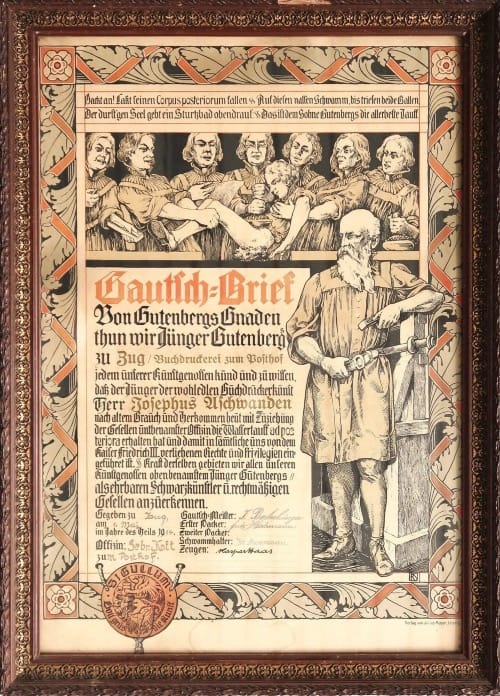
In Mainz, Gutenberg’s hometown, the Gautschen is still performed as a major public event during the Johannisnacht festival (St. John’s Eve), where apprentices are symbolically washed free of “lead dust.”
Together, the Depositio and the Gautschen formed a two-stage initiation: first a burlesque theatrical “laying down of the horned beast,” then a physical baptism that marked the apprentice’s rebirth as a journeyman of the guild. Insofar as traditional craft or artisanal initiations pertain to the cosmological domain of the Lesser Mysteries it is clear that we have here a late example in an attenuated and vestigial state.
William Blake’s 'Printing House in Hell'
Blake's late 18th century London teemed with engravers and printers shops including that of James Basire - at the age of 14 in August 1772, Blake was apprenticed to James Basire, an established and highly respected fine-art engraver established at Lincolns Inn Fields where from 1772 to 1779 he gained a thorough training in the engravers craft.
William Blake, as a professional engraver and printer, doubtless steeped in the traditions of the trade, paradoxically revalorizes and transmutes this 'infernal' symbolism of printing via his dynamic artistic-esoteric sensibility to metaphorically image the fiery sources of creative vision and its transmission into the world. In The Marriage of Heaven and Hell, Blake depicts the “mighty Devil... folded in black clouds, hovering on the sides of the rock, with corroding fires he wrote”. The “corroding fires” refer to Blake’s own relief-etching process (acid bath engraving).
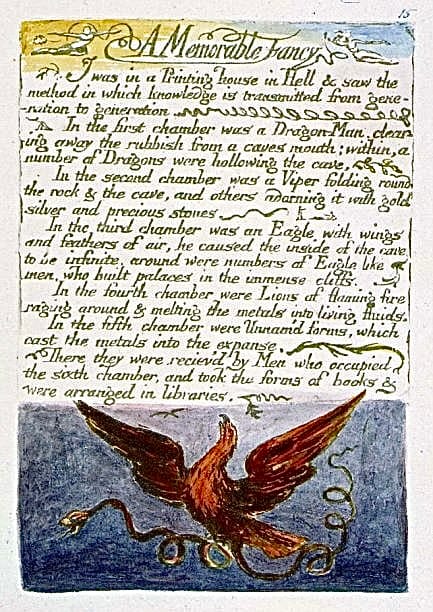
Blake’s “Memorable Fancy” in The Marriage of Heaven and Hell describes a subterranean workshop where dragons, vipers, and eagles perform tasks that mirror real printing processes. Here Blake presents a kind of alchemical manifesto of artistic creativity.
Chamber 1: The Dragon-Man
A Dragon-Man clears away the rubbish from a cave's mouth, while a number of Dragons hollow out the cave.
The cave represents the human mind imprisoned within the physical skull, locked away by the limitations of sensory perception. Before any spiritual awakening can happen, the obscuring and obstructing "rubbish" of materialistic dogma, profane mentality and dualistic conditioning must be cleared away to 'cleanse the doors of perception'.
Chamber 2: The Viper
A Viper infolds the rock and the cave, and others ornament it with gold, silver, and precious stones.
By encoiling the rock, it beautifies and illuminates the material world. It symbolizes the refinement of our senses and imagination — transmuting the "base metal" of ordinary material existence into the "gold and silver" of heightened visionary perception.
Chamber 3: The Eagle
An Eagle with wings and feathers of air renders the inside of the cave infinite. Around it, numerous Eagle-like men build palaces in the immense cliffs.
The Eagle represents the soaring intellect of spiritual genius and imagination. Once the senses are awakened (Chamber 2), the mind is no longer confined by the physical walls of the cave, transcending the limits of the finite. The Eagle expands the human consciousness, making the inner world "infinite." The palaces built in the cliffs are the enduring edifices of art, myth, and vision.
Chamber 4: The Lions of Flaming Fire
Lions of flaming fire rage around and melt the metals into living fluids.
The Lions represent divine wrath, passion, and energy breaking down rigid structures. In the context of a printing press, this is the melting of metal type, but esoterically, it is the melting of rigidly reified dogmas and fixed dualistic concepts. The dense "metals" of material and profane existence are transformed into "living fluids".
Chamber 5: The Unnamed Forms
"Unnam'd forms" cast the metals into the expanse.
These forms are "unnamed" because they represent the pure archetypes of creation that exist beyond human language. They take the fluid energy from the previous chamber and project it out into the universe.
Chamber 6: The Books
There, they are received by Men who take the forms of books and arrange them in libraries.
The final stage is the manifestation and transmission of vision into the outer world. However, Blake says Men take the forms of books. Many teachers have enunciated the concept of the Perfect Man as the living book in which all the Beautiful Names of God are inscribed in the uncreated substance of the Divine Intellect. To Blake, a true book is a living emanation of the human soul. By reading and contemplating these illuminated works, other human beings are inwardly kindled by this flaming creative energy, and the cycle of spiritual liberation begins anew in the reader's soul.
Blake called his technique “infernal" because like the Vitriol of the alchemists the artist employs fiery acids to burn away the concealing obscurations of apparent surfaces and reveal the infinite vision of the Eternal World. Burning vitriols now become 'salutary'; in an almost tantric vein the virulent and consuming 'venom' or 'poison' transforms into a healing Medicine or nectar. This is the destructive corrosive called Ignis Gehennae or 'Tartarean Fire' in classical Alchemy. As Eirenaeus Philalethes in chapter 11 of An Open Entrance to the Closed Palace of the King (1667) describes it: 'an infernal fire, yet a fire of a most heavenly virtue, which penetrates to the very center of the metals, purges them of their corruptible superfluities' to reveal the Philosophers Stone, the imperishable Gold of the Wise.
Blake affirms: 'This World of Imagination is Infinite & Eternal, whereas the world of Generation or Vegetation is Finite & Temporal.... All Things are comprehended in their Eternal Forms in the divine body of the Saviour, the True Vine of Eternity, The Human Imagination'. (A Vision of the Last Judgement, 1810).
Citations
Johann Georg Neumann, Disquisitio historica de Fausto praestigiatore (1683).
André Chevillier, L’Origine de l’Imprimerie de Paris (1694).
Historia von D. Johann Fausten (1587).
William Blades, An Account of the German Morality-Play, Entitled Depositio Cornuti Typographici (1885), containing Johann Rist’s 1654 play in English translation.
William Blake, The Marriage of Heaven and Hell (c. 1790); and A Vision of the Last Judgement (1810).
Eirenaeus Philalethes, An Open Entrance to the Closed Palace of the King (1667)


