
Tradition has nothing to do with any “ages”, whether “dark”,
“primaeval”, or otherwise. Tradition represents doctrines
about first principles, which do not change.
- Ananda K. Coomaraswamy, Correspondence, 1946
... there is nothing and can be nothing truly Traditional that does not contain some element of a super-human order. This indeed is the essential point, containing as it were the very definition of Tradition and all that appertains to it.
- René Guénon, The Reign of Quantity
There rose a tree. O pure transcendency!
O Orpheus singing! O tall tree in the ear!
And all was silent. Yet even in the silence
new beginning, beckoning, change went on.
- Rainer Maria Rilke, Sonnets to Orpheus (Translated by M. D. Herter Norton)
The terms “traditional” and “modern” suggest a distinction between old and new, the fixed and the changing, the hallowed way of the past and the progressive way of the future. However, when these two terms are used by Traditionalists they are used in a very particular and different sense, and this difference can be confusing.
The Traditionalist, Seyyed Hossein Nasr has explained that “Modernity” is “that which is cut off from the Transcendent, from the immutable principles which in reality govern all things and which are made known to man through revelation in its most universal sense.” By contrast, “Tradition” designates those immutable principles—expressed as the sophia perennis or primordial wisdom—that are rooted in the Transcendent. According to this definition, therefore, Modernity cannot be limited to the contemporary, nor Tradition to the conventional or customary. Rather, in this special usage, the term (we prefer “Modernism” to “Modernity”), represents an ethos characterized by a loss of the sense of the Sacred.
“Tradition,” in this special terminology, is meta-historical: its only relation to the history resides in, firstly, its origination in time as a particular revealed religious tradition descended from an eternal Source, and secondly, its deployment thereafter as a doctrine of Truth and a related methodology or Way which preserves the means of the soul’s salvation. A religious tradition therefore includes its foundational scripture and forms of worship, which are thereafter transmitted through the protective medium of its particular tradition.
Tradition is the fixity of the river amid the river’s flowing.
But this historical aspect of a particular tradition cannot in a sense be any more than indicative of the Truth revealed, which transcends yet is communicated through the medium of its revelation. The relation between Tradition as such and Revelation as such transcends history. Revelation “in its most universal sense” is not a merely historical event: it unfolds in divinis and manifests as a reflection in the sublunary realm of the created cosmos as the sempiternal presence of the Sacred, the ever-renewing theophany, which is the imprint of the Absolute in creation and in the Heart of the soul. The authenticity of a particular tradition does not therefore derive from one’s ability to retrace its historical origin in time, but from its ability to reflect the Sacred within the sanctum of the Heart. Through the supra-rational Intellect, the Heart can discern Truth. Primordial wisdom is thus the resonance of the spiritual Substance of the Transcendent pervading the whole of creation, whose reverberation sounds within the pure Heart.
Gnosis, then, is not merely a form of “intellectual taxidermy,” but a way of inhabiting the living creature itself by letting the soul repose in her Spiritual Center, the Heart. To know in this sense is to be centred in the sacred core of one’s Being, to be at peace in the midst of change. While in common parlance, the terms “traditional” and “modern” suggest two differing attitudes towards the negotiation of change, the former resisting it, the latter embracing it, “Tradition” transcends change. It is the fixity of the river amid the river’s flowing.
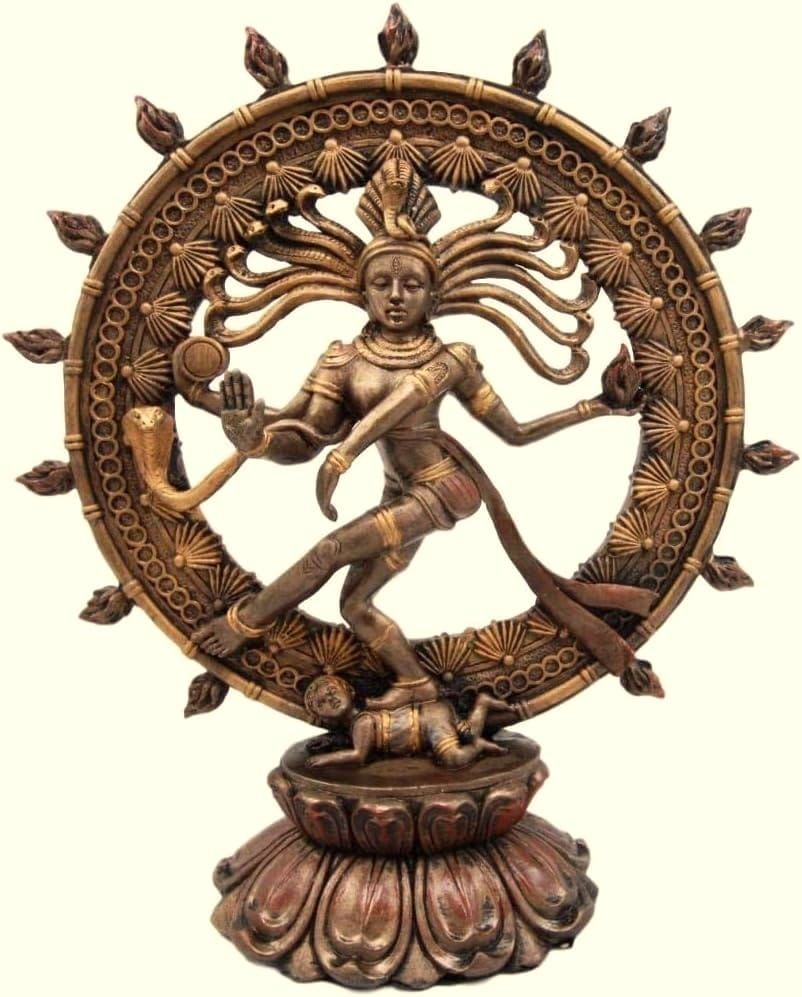
The Shiva Nataraja expresses … inner stillness and outer motion, Being and Becoming melded in the moment of creative living.
The classic Hindu image of Shiva Nataraja embodies the ideas of both stillness (the aspect of the soul reposing in her transcendent Center as Being) and movement (the aspect of the soul engaging creatively in the dance of life, as Becoming). “Tradition” is a combination of both these elements. It is at once the static Equilibrium of being grounded in the transcendent Absolute, and the dynamic interplay of Freedom within the All-Possibility of the immanent Infinite. Man is both a slave of change (subject to the processes of time) and its master (equipped to transcend it, spiritually). The quest for salvation is, at one level, a quest for peace, for freedom from change, but at another, it is a quest for creative engagement and freshness, for freedom from petrification. The Shiva Nataraja expresses both elements: inner stillness and outer motion, Being and Becoming melded in the moment of creative living.
Human beings innately know what is True, Good and Beautiful—and they incline to these sublime qualities by conscience, love and a desire for harmony.
In its ordinary usage, the term “traditional” can have a pejorative implication of excessive rigidity and formalism, while the term “modern” can mean that which is unprincipled or excessively individualistic. In both these senses, the terms are opposed to the ethos of “Tradition” as such, which recognizes the mutual interdependence of the ordering and creative principles of reality—of Necessity and Freedom. When creativity ceases to conform to the hierarchies inherent in a spiritually ordered universe, volition manifests as Promethean desire, with an impulse to transgress the natural bounds of Freedom regulated by the ordering principle of Necessity. “Tradition” recognizes that Necessity (the intellectual discernment that creative expression has an ordering principle) and Freedom (the conformance of creative expression to that ordering principle) are normatively tethered, and therefore that intellectual discernment is a Norm with moral implications. This ethos is inherent in the sacred structure of reality. The Norm is the principial criterion of objectivity by which Truth can be apprehended beyond relativism, and is the dynamic criterion for engagement with change so that one’s actions conform to Goodness. The soul therefore possesses a normative nature, which is the basis of human dignity. Human beings innately know what is True, Good and Beautiful—and they incline to these sublime qualities through conscience, love and a desire for harmony.
“Modernism” is transgressive ethos in that it has lost sight of the transcendent qualities represented by the soul’s Primordial Nature and innate Norm. It therefore lacks both the perspicacity of spiritual vision and the softness of “the love that melts hearts.” Instead, the decentered soul will tend to intellectual “opacity” and moral “hardness.” When reality is no longer perceived as metaphysically “transparent to transcendence,” human beings will tend to act soullessly, unconscionably and callously, without dignity. Veiled from the integrating luminosity of creation, there is nothing in the soul to “melt” it, to conform it to its spiritual Center. Only when the soul is spiritually enlivened by the grace and light of love can she recover her true and serene creative Freedom, her normative orientation. Without this, the soul becomes egoic, a tawdry counterfeit of the Spirit, enslaved by passions and lusts, and seeks ephemeral gratifications which can never suffice because the wayward soul’s appetites are drawn away by the next seduction in an unending downward spiral of insatiability.
It is in this sense that “Tradition” and “Modernism” are placed in opposition. The traditionalist is not necessarily opposed to the “modern” as conventionally understood, only to “Modernity” as the converse of “Tradition” in the particular sense defined above—as the ethos of Modernism. A Traditionalist may be modern in appearance, through dress, language, and the use of modern amenities or technologies, and yet will, unlike the Modernist, strive to conform to the transcendent Spirit which is the sacred substance of reality and the principial criterion of objectivity.
That said, not all that appears traditional necessarily accords with “Tradition.” So, for instance, though some may don traditional garb or employ traditional language, they may nonetheless act in ways that violate the Sacred or disrespect dignity. As Shakespeare reminds us, “the devil can cite Scripture for his purpose” and can conceal falsehood in ”a goodly outside” (Antonio in The Merchant of Venice). Religious fundamentalists, for instance, though they use religion to support their views and conduct, can act in ways that are the very antithesis of Tradition. “By their fruits shall ye know them,” not through appearance.
Tradition calls us to be true to ourselves in order to be good to all.
Words and labels can often conceal Truth by abstracting reality and isolating meaning, disconnecting it from the Spirit. At their best, words serve as symbols of the Spirit, reflecting archetypal meanings latent within us. “Tradition” and “Modernity” are ultimately aspects of ourselves: “Duo sunt in homine,” taught St. Aquinas, a teaching that resounds throughout Traditionalist discourse, reminding us that there is, in the end, an element in each soul that must be overcome for the greater good and for the good of oneself—which are normatively One. It is this spiritual ground or Center that the soul seeks.
Tradition calls us to be true to ourselves in order to be good to all. To be true to oneself means reposing in the Heart. The Shiva Nataraja, a symbol of “Sanatana Dharma” or the Primordial Tradition, reminds us that we must seek Equilibrium by searching for our Center in the midst of flux. It teaches us to see all of creation as bound by a single Spirit to which our soul’s striving and desires must conform in order to be at peace. By perceiving the outer world inwardly, with compassion, we can be better equipped to participate in the creative dance of life with love, and so to subsume change within our Being. It is only when we integrate Truth, Goodness and Beauty within ourselves that we can express it in our daily lives. Tradition teaches us that our transcendent Substance is Spirit-Love-Felicity (in Sanskrit, satchitananda). It is by finding our true Center in our Substance that we can hope to merit the grace of dissolving into the Sanctum of the Everlasting.