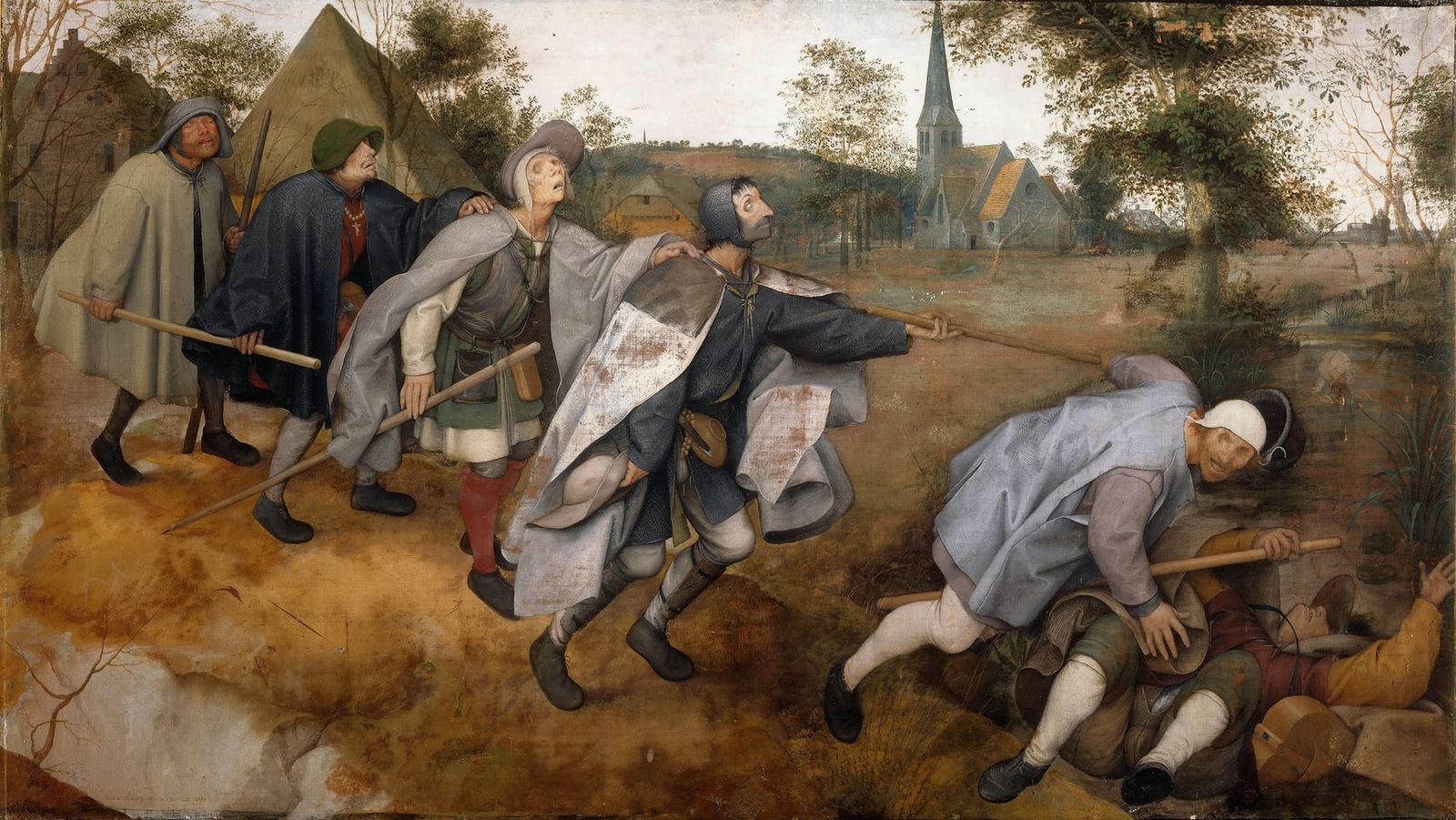
The greatest problem facing those who believe in the possibility of truth and who set out to seek it seriously, is the absence—or supposed absence—of any criteria by which to be certain that what we find is the real thing. With several major religions and between 5 to 20,000 cults all offering us various and often exclusive options, how are we to choose, or more precisely, to discern? Caught as we are in the toils of maya—or as a Catholic would put it, with our intellects wounded and our wills weakened by the Fall of Adam—how can we, by ourselves and without external help, ever be sure that we are avoiding delusion? We can of course embrace the sceptics' position and give up the struggle. But as an old gloss of Plato says, “scepticism is easy, unbelief is for the mob.” But for those who are not yet intellectually dead, the question still remains: by what authority do we live and die? Are there authentic well-springs of truth, or is truth simply a matter of our own personal gut feelings, our psychological experiences, and what works for us?
The first problem to be faced is whether truth is an objective or a subjective entity. Is there such a thing as objective truth—truth which has always been and always will be the same—unchanging and constant—hence a truth which is absolute? Now, either words have meaning or they don't. If truth is only a matter of personal taste, if one is convinced that all reality is relative, there is hardly any point in continuing either discussion or search. One is caught in the vicious circle of proclaiming that the only truth is that there is no truth.
In the last analysis we have only three possible sources for authenticity. We have the Ancient Teachings which are—or so I assume—embodied in the great religious traditions of the world.[[1]] We have our own gut feelings or psychological experience as to what is true. And we have some mixture of these two extremes. Either we accept objective criteria, or we accept subjective criteria, or we create a mixture that for some reason or another we find personally satisfactory. The latter is also, needless to say subjective.
It is only when we accept the possibility of objective truth that we can look to the Ancient Teachings as a possible authentic source. Unfortunately, we live in a very superstitious age. The so-called “age of enlightenment”—a phrase which certainly appeals to man's egoity—is more appropriately described by the Ancient Teachings as the Kali Yuga, the age of darkness, or in Catholic terminology, “the latter days.”
This brings us to two of the most powerful superstitions which we accept—indeed they could almost be called the ‘dogmas’ of modernity—namely evolution and progress. Most of us are convinced that mankind has evolved over the centuries, and continues to evolve with each generation. Do we not consider our ancestors as somewhat primitive, backward and superstitious? The very word ‘superstitious’ makes us think of a medieval European peasant fingering her beads before some miraculous shrine of the Madonna, or of a Hindu Brahman refusing untouchables access to the temple precincts. The last person we would think of as superstitious is a Harvard professor or a prominent scientist.
The problem with being superstitious is that it tends to blind us to the truth. If we are convinced something false is true, we are hardly likely to seek beyond its confines for a source of authenticity. If we are to look to Ancient Teachings as embodied in the great religious traditions of the world as a possible source of authentic and objective truth, the first thing we must do is abandon our modern superstitious belief in progress and evolution. As we shall see, there are a host of other superstitious beliefs that may also have to be abandoned. Among these are included our modern view of the nature of man, our false egalitarian concepts, our socialist and utopian ideals, our familial attitudes, our moral or rather our unmoral codes, our belief in science and our attitude towards religion.
I well remember how my college friends—and later, how some of my professional colleagues—looked upon my being Catholic. I was accused of no longer thinking for myself. Now the idea that it is a good thing to think for oneself is another modern superstition. To put the matter into clearer focus, I would ask you to imagine a classroom of mathematical students telling the teacher that they disagreed with his answers because they were doing mathematics ‘for themselves’. No, thinking for oneself is not a healthy thing to do. What we must do is learn, not to think for ourselves, but to think correctly. It is a function of the Ancient Teachings to help us do just that, but it takes both work and discipline. We do of course have the freedom to think for ourselves—we can think any way we want. But we do not have a right to do so, for error never has rights. Like murder: we are free to murder anyone we want, but we certainly do not have a right to do so.
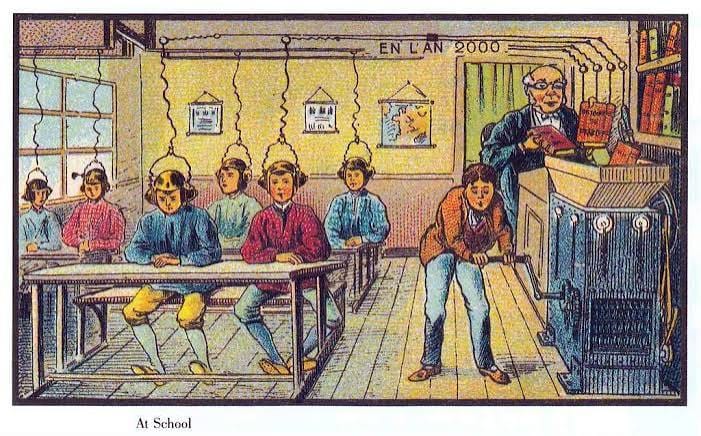
We no longer accuse religious adherent of failing to think for themselves. The current allegation is that they have allowed themselves to be brainwashed. Brainwashing implies that one's thoughts and attitudes can be influenced, if not controlled, by external forces. Both religions and cults—to say nothing of political systems—are accused of using various techniques to bring this about. Have those individuals who adhere to the Ancient Teachings as embodied in the great religious traditions in their integrity allowed themselves to be brainwashed? Before answering this question, allow me to point out that we are all to some degree brainwashed. Every day our minds are bombarded by the news media, by television which the average American watches for over 60 hours a week, by popular novels and by those with whom we are in daily contact. There is no doubt in my mind but that most if not all of these entities embrace an anti-religious, liberal-humanistic, socialist and more or less sceptical-atheist viewpoint. Moreover, the stresses of modern life are such that, in what little free time we have left, most of us expose ourselves to the media in a completely passive and non-critical manner. We in essence let the newscaster and politicians and writers of Book-of-the-month Club novels tell us how to think, and pride ourselves that we are thinking for ourselves. If we do not see this as brainwashing, it is because these sources pander to our egos and we find the offered pablum both acceptable and pleasant. On the other hand, a mother who teaches her ancestral faith to her children and the Brahman who insists on ritual purity and caste restrictions are also guilty of brainwashing. But here many find the process highly objectionable.
As my father [Ananda K. Coomaraswamy] once said. . . it is almost impossible for someone to graduate from college without a severe degree of intellectual impairment.
Let us for a moment consider our own educational backgrounds. What formation did we bring with us from our homes? Most parents today have been so effectively brainwashed by the liberal and agnostic ethos of our times, that they no longer have, and hence cannot convey, any value system or set of fixed beliefs, to their offspring—unless of course you consider material success a belief system. And so it is that most children leave the home with a sort of tabula rasa—or worse, a belief in the world of the television screen. According to published statistics, every Saturday 16 ½ million children spend an hour and a half watching Graystone or the Mutant Ninja Turtles. Sociologists call television the “third parent.” Unfortunately, it is often the only parent.
And so, it is with considerable relief that children are sent off to school. Here formal brainwashing is initiated. The process starts in kindergarten where boys are made to play with dolls and girls with swords—this in order, to use the jargon of modern psychology, “to teach them to avoid stereotypes.” Through a variety of techniques such as 'values clarification' they are taught to reject their parents' values—assuming they were inculcated with some—under the guise of developing their own, usually those of the teacher or those being promoted by various governmental agencies. This process is called “desatilization.” Throughout the next ten years they are taught to be good little evolutionists, socialists, and how to use the gift of sex without responsibility. And then they go to college, which is the sine qua non for entrance into a modicum of economic success. Once again, they pay a steep price—the price being paid is more than fees for tuition—it is the subjecting of our minds to yet another process of indoctrination. As my father[[2]] once said—and this is in the forties—it is almost impossible for someone to graduate from college without a severe degree of intellectual impairment.
And so to the question: are religious adherents brainwashed? I think the answer to this question must be phrased in terms of ‘thinking correctly’ and of embracing ‘correct values’. If the Ancient Teachings are an authentic source of truth, and if we make them our own, then we are like the student of mathematics who learns to calculate correctly. Such a student is not brainwashed, because he knows how to do his sums correctly. The truth, our submission to the truth and our making it ‘our own’, is in the last analysis our only protection against both brainwashing and self-delusion.
Man does not live in a vacuum. Everyone—even the convinced atheist—has what we can call a “belief system,” that is to say, a series of convictions that determine how he lives his life. Now every belief system can be characterized by three things: by its ‘creed’ or what is believed, by its ‘cult’ or manner of worship, and by the ‘code’ or rules for behaviour which it practices or advocates.
Let us consider the belief system—the creed, cult and code of the average college graduate. What does he believe? I think it fair to say that he is convinced that there is no such thing as absolute truth—that all truth is subjective, and hence relative. Hence it is that, in common parlance, he no longer says “I know,” but only “I feel” something to be true. He believes that evolution is a law of nature applicable to all realms of experience. Everything evolves, not only man, but knowledge, society, and even God! I remember my six year old son coming home one afternoon from school and announcing with pride that he no longer believed in God! I asked him what he believed in then and he answered “E.... oh, how do you say that word?” Fortunately I was able to convince him otherwise. But evolution is inculcated in our children's minds from the cradle. Have you ever looked at a nature show on television? The pictures are marvellous but the message is driven home repeatedly. Everything from the tiger's stripes to the giraffe's neck evolved. Every child knows who Darwin is. How many have heard of Gautama the Buddha or John the Baptist?
Evolution is of course quite absurd from both the scientific and philosophical viewpoint. From the scientific viewpoint: not only is there absolutely no proof in favour of evolution; all the evidence is against it. Geology, biology, genetics and all other scientific disciplines speak to the fixity of species and to the impossibility of transformism. No intermediary forms between species have been found. There is much talk of “missing links.” The problem with missing links is that they are missing! To believe in evolution is to believe that the greater can come out of the less; it is to believe that energy can be created in sui generis, it is to believe that things happen by ‘chance’ in the sense that chance is a random possibility. Probability theory tells us that the chance of one evolutionary step occurring is so remote as to be impossible. Yet evolutionists tell us many such steps have occurred. The most amazing thing about evolution is that scientists who admit all this continue to believe in evolution—they are truly men of deep but blind faith. It is not bushman, but rather modern man who believes in the blind forces of nature and who should be labelled an animist!
Philosophically, evolution is also absurd. If it were true, it would be as impossible for man to step outside the evolutionary stream in order to examine the process that ‘developed’ him as it would be for a computer to examine the creator. As the Oxford philosopher, Sir Karl Popper, points out: “If Darwinism is right, then any theory is held because of a certain physical structure in the holder—perhaps of his brain. Accordingly we are deceiving ourselves and are physically so determined as to deceive ourselves whenever we believe that there are such things as arguments or reasons for anything. Purely physical conditions, including our physical environment, make us say or accept whatever we say or accept.”
Implicit in evolutionary theory is the denial of free will. As Huxley says, “the fundamental proposition of evolution” is that “the whole world, living and not living, is the result of the mutual interaction, according to definite laws, of the forces possessed by the molecules of which the primitive nebulosity of the universe was composed.” After all, how can ‘something’—notice, I did not say ‘someone’, which is the product of rigid laws, laws which control its future development and which has no freedom to step outside the evolutionary process—how can this ‘something’ act independently of these laws? How can this thing have a free will for which it is responsible? Evolutionist Jonas Salk admits as much. He openly admits that his polio vaccine works against the evolutionary process of natural selection. The only way he can explain his drive to develop this vaccine is that he was genetically programmed to do so. Here one comes upon another conundrum, and one interestingly enough shared by socialists for whom evolution takes the form of historical determinism. If man's life is determined by evolution or by history, how can he be ‘free’? Yet both evolutionists and historical determinists proclaim man is free to help the process on its way towards perfection and an earthly utopia. Socialists go even further. They punish man for his failure to do so, and in the name of their socialist ideation have killed millions more than all the wars of the last three centuries.
No scientist every came up with the idea that God worked through evolution. Theologians did so. And why? Because they wanted to appear to be up to date and ‘scientific’.
To think this way, as the psychiatrist Karl Stern has said, “is crazy” in the sense that decompensated schizophrenics are crazy. I have called evolution a superstition—indeed, it is the grand-daddy of all modern superstitions. Allow me to give you a definition of “superstition” taken from an older edition of Webster's New International Dictionary:
"An irrational abject state of mind... proceeding from ignorance, unreasoning fear of the unknown or mysterious morbid scrupulosity, a belief in magic or chance, or the like, misdirected or unenlighted religion or interpretation of nature... a fixed irrational idea, a notion maintained in spite of evidence to the contrary."
Who are some of the more dominant ‘gurus’ of the modern world, and what do they believe? Freud, Adler, Fromm, Maslow, Rogers and Jung—are or were, all of them, evolutionists and consequently atheists. They tell us that what is called ‘intelligence’ consists of ‘reason’, the ability to deal with abstractions, the capacity to learn and the ability to handle new situations. Now reason apart—and enormous amounts of energy are extended in an attempt to prove that animals reason—all these abilities are to be found in lower forms of life. Hence it is not surprising to find Darwin telling us that “animals have an intellect of different proportions,” and that “man's intellectual faculties have been mainly and gradually perfected through natural selection...” Similarly, we are told that man's motivations and beliefs have their origin in his ‘subconscious’, a term for which there are innumerable definitions and which is best defined as a kind of “cess-pool of evolutionary memory.” Again, we are told that man's ultimate motives are a search for security, pleasure or what they call ‘self activation’ through the meeting of ‘meta-needs’. Truth is what is true for the individual; beauty is what gives pleasure; love the fulfilling of ‘biological urges’. At the cost of denying both logic and experience, all that is qualitative in man is declared to be genetically determined—that is, determined by evolution—and hence is reduced to the measurable and thus to matter. Everything falls under this aegis. Rousseau held that savage man progressed to “civilized” man. Huxley gave this progression his scientific blessing. “Nature's great procession is from the formless to the formed—from the inorganic to the organic—from blind force to conscious intellect and will.” If one can accept these premises it is easy to be persuaded that man is but a higher form of matter and that Superman is on the way. Those who think otherwise are dismissed as ‘dreamers’—as if matter could dream—who for all their efforts produce nothing materially beneficial.
Let one thing be quite clear. One cannot logically believe in evolution and also believe in God. Every scientist and every theologian worthy of his hire will admit to this. You will hear much talk about theistic or mitigated evolution—the idea that God works through evolution. If such were the case, then God would be very upset with any one who interfered with natural selection. How dare we treat the sick child or feed the poor and hungry? These are but nature's way of weeding out the weak. How dare we stop wars when they are so highly successful in controlling the population explosion? Let's face it. It would be stupid to pray to a God whose only answer to prayer would have to be “let natural selection or the ‘punctured equilibrium’ solve your problem.” No scientist every came up with the idea that God worked through evolution. Theologians did so. And why? Because they wanted to appear to be up to date and ‘scientific’.
Now, I have spent a long time on the credal issue of evolution because we will never look to the Ancient Teachings as a source of authentic truth unless we abandon our superstitious belief in evolution and progress. By definition, no evolutionary process can provide us with authenticity—and surely this is reasonable. After all, an evolutionary process is a changing process and anything that is spiritually authentic cannot change.
No wonder the Ancient Teachings are unanimous in declaring that all creation is the result of God's activity and not of evolution. The Church insists on a creatio ex nihilo, and the Vedas teach that “being is engendered from non-being.” And they are even more clear in specifying that man, society and above all truth, are not subject to any evolutionary process.
Let us return to our college graduate who sees himself—in so far as he troubles to look at himself at all—as made in the image of an amoeba. Having dealt with his fundamental credal premises, what can we say of his manner of worship? For modern man no ‘cult’—no form of worship—is possible unless it be the worship of materialism or of that lesser “self” which we refer to when we call someone selfish. What besides the evolutionary process or man, which is its highest product, is there to worship? As Karl Marx said: “Humanism is the denial of God and the total affirmation of man.” This then is the foundation of modern humanism.
Finally, we come to ‘code’. Here the rule of thumb is expediency. Everything is allowed providing it doesn't hurt the other—but in point of fact, self interest usually takes precedence. Consider adultery—and certainly adultery is not a rare phenomenon in our society. When we sleep with our neighbour's wife we loudly proclaim that such activities between consenting adults hurt no one. But what of the offended party? Or again, we claim that abortion hurts no one—and rapidly proclaim that the fetus is no one.
This then is the ‘uncreed’, the ‘uncult’ and the ‘uncode’ of modern man. We can summarize it as progressive, evolutionist, anthropocentric or man-centered and void of metaphysical principles. What is of interest is that so many major religious bodies have adopted this weltanschauung or world view. At the risk of offending certain Catholics, let me say that these are precisely the principles which Vatican II embraces and which form the foundation on which the post-Conciliar Church rests. The Ancient Teachings—what the Hindus call Sanatana Dharma, what St. Augustine called “Wisdom uncreate, the same now as it ever was and ever will be,” are unanimous in being diametrically opposed to such attitudes. They are not progressive, but rather static, because while sin may change its style, it can never alter its nature. Indeed, they are anti-progressive, because they hold that man has fallen from his former high estate. Born to a Golden Age, a Garden of Eden, men living in the Kali Yuga or “latter days” are degenerate. Again, the great traditions are unanimous in declaring that all creation is the result of God's direct action—ex nihilo, as the Catholics put it; “being engendered from non-being,” as the Vedas put it; and they are unanimous in proclaiming that man is created, not in the image of an amoeba, but in the image of God. All are theocentric rather than anthropocentric. All teach that man qua man can never be a sure source of truth, that man's dignity does not lie in his self-validating abilities, but rather from his adherence to God's truth. Finally, all claim and can demonstrate that they are based on solid metaphysical principles—which is to say, a consistent doctrine dealing, not only with conditioned and quantitative experience, but also with universal possibility. The two extremes are like oil and water. They cannot be mixed. To accept the one is to reject the other. In which fundamental set of ideas are we to find truth and authenticity?

Turning to the Ancient Teachings, we find that the most striking thing that all the religions have in common is their claim—right or wrong—to be based on a Revelation—what the Hindus call Sruti. At some time God—an Avatar—or a Messenger appeared on earth and gave man a specific ‘creed’, ‘cult’ and ‘code’—or to use oriental terminology, a doctrine and a method. Moreover, they all hold this Revelation to be fixed, complete and unalterable. The Vedas are fixed once and for all. New insights into the teachings of the Buddha may occur, but the Buddha is not providing his followers with a continuous revelation—one that evolves and progresses with the course of time. Mohammed is called the “seal of the Prophets,” by which is understood that he has provided the last and final revelation in the Abrahamic line. Muslims do not hold that the Archangel Gabriel is still revealing passages in the Quran. The Torah can be interpreted, but Moses is not currently sending us any messages. In passing it should be noted that none of the great founders of religions claimed to be discovering or revealing new truths. Jesus spoke of fulfilling, not changing the law and proclaimed that he taught, not his own, but his Father's doctrine. The Buddha said that he himself only “followed the ancient path,” and added that “whoever pretends that I preach a doctrine wrought by my own reasoning and argumentation shall be cast out.” Mohammed claims to be returning to the religion of Abraham. And does not Krishna tell us in the Bhagavad Gita that he comes down to earth when dharma grows cold?
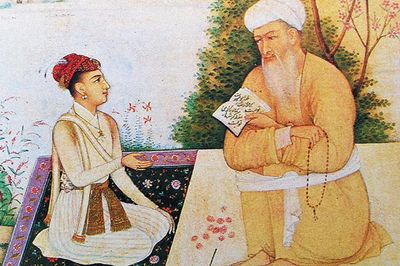
Religions have another criterion in common. Their revelations are often somewhat elliptical—or appear to be such to our darkened and Kali Yuga intellects. Hence it is that religions provide official interpreters—be they saints or sages. The Hindus have what is called smriti as well as the writings of such individuals as Sankaracharya—to say nothing of the Kanchi Guru who is his living descendant. The Muslims have the commentaries on the Quran such as those of Ibn Arabi and al-Ghazali. The Jews have the Haftoras as well as their Rebbes—those authorized to give current interpretations. The Christians have Church Fathers, Doctors, and what is called the ‘Teaching Magisterium’. And what characterizes authenticity in all these living sources is that their teachings in no way depart from that of their predecessors and, ultimately, in no way depart from the original Revelation.
Yet another aspect of fixed Revelation is ‘cult’. Forms of worship in a religion are never man-made. They are determined by God or His representative. Consider the agnihotra or vedic fire sacrifice. Do you think this was made up by some old men in the forest—what today would be called a consilium of theologians—wishing to dupe the poor peasants out of their hard-earned money, or to placate the lightning? And the same is true of the prayers used by the Muslims and of the true and ancient Catholic Mass.
Similarly with regard to ‘code’. It is Christ Himself who determined that divorce was forbidden to his followers though permitted to the Jews. The practice of Mohammed and his judicial decisions along with the Quran provide the basis for Muslim law. The laws of Man were not put together by a conference of businessmen, lawyers and politicians.
Gurus and spiritual directors are not judged on the basis of their charismatic personalities, but on the degree to which they conform to the truth of the religion in question, on the degree that they themselves are perfect conduits or vehicles for the truth.
The very word ‘religion’ means that which ‘binds’, that which ties us to the Origin and Center. That is why an intact religion is always traditional, for tradition means to hand on or hand down. And what is handed down other than the original revelation? Thus all religions speak of ‘orthodoxy’ and ‘heresy’—oh, how we moderns hate those words! ‘Orthodoxy’ is defined as pure faith and sound belief—that which is in conformity with the original revelation. Heresy is a departure from this as a result of picking and choosing what we will or will not believe. Heresy, as the Buddhists say, is like “a worm in the heart of a lion.”
Another important fact is that there are no secret doctrines in religions. There are teachings which are not readily available, or which are phrased in obscure fashions so as to avoid ‘casting pearls before swine’, but they are not secret as such. All the sacred texts of Hindus have been published—you might have to learn Sanskrit, but they are not hidden. Of course one has need of certain things to access these sources: one has to have certain intellectual and moral qualifications; one needs guidance and hence a guru; and one needs initiation which is a ritual act that ties one to the Avatar or founder of the religion and ultimately to God. Now if this offends our egalitarian prejudices, allow me to ask you if you would allow a person who had not trained under a skilled teacher to perform surgery on you. I rather doubt it. Certainly, there are anatomical texts and descriptions of operations published in the medical literature, but one still needs certain qualifications, guidance and training to access them. Why should religion be different?
It should be abundantly clear by now that religions provide us with objective criteria. Gurus and spiritual directors are not judged on the basis of their charismatic personalities, but on the degree to which they conform to the truth of the religion in question, on the degree that they themselves are perfect conduits or vehicles for the truth. Every ritual act on the part of the Catholic priest is in persona Christi. We confess, not to Father Bob, but to Christ. It is Christ who in the person of the priest effects the consecration in Mass.
Religions not only provide us with objective criteria, but even more, they all share a view of man which is vastly different from that of the modern psychologist. The premises that reason uses can be derived from four possible sources: measurable phenomena (science), feelings, Intellection or Revelation. These sources are both internal and external, both superior and inferior—Intellection and Revelation being of a higher order than reason. Judgment or discernment is part of Intellection and hence can look at a reasoned conclusion to determine whether or not it is true. However, our Intellects are darkened because of the Fall, and hence we stand in need of Revelation.
Man is capable of using his Intellect to determine what is objectively real and of discriminating between this and what is illusory.
Modern psychologists tell us that reason is the highest product of the evolutionary process. Now, clearly, truth does not depend on reason. We do not say something is true because it is logical, but rather that it is logical because it is true. This presupposes a still higher faculty of judging or, to use the term of St. Thomas Aquinas, “discernment.” Modern philosophers attempt to get around this problem by speaking of “rational principles,” but forget that principles can never be derived from discursive logic. Reason cannot prove its own validity, for principles must be grasped intuitively and suprarationally. As Aristotle said, “one does not demonstrate principles, but one perceives directly the truth thereof...” To make use of scholastic terminology, it is the pure Intellect which is the habitus principiorum, while reason is only the habitus conclusionum. Man then possesses reason and with it language, only because, unlike animals, he has access in principle to suprarational vision. It is this suprarational vision, Intellection or insight that gives man, not only discernment, but certitude: certitude in his own existence as a being, confidence in the functional capacity of reason, the ability to discriminate between what is real and what is unreal, what is true and what is false. Intellection is a kind of ‘seeing’, a seeing with the ‘Third Eye’, and not a conclusion, and it is this that opens to man the possibility of metaphysical certitude.
It should be clear that Intellection has nothing to do with mental agility. This is well evidence by what psychiatrists call ‘idiot savants’—people who can function like a computer, but who are incapable of thinking, much less Intellection. But if all men are endowed with an Intellect, why is it that all men do not see clearly? The various religions answer this differently. Christianity and the Semitic religions see the Intellect as ‘clouded’ and the will as ‘weakened’ by the Fall. This does not mean that man is deprived of them, but only that they don't work as well as they should. Hinduism explains the same situation by what is called maya and portrays sin in terms of ignorance. This is precisely why Revelation is required. Adam, or man living in the Golden Age, required no Revelation as his Intellect was clear and he “walked and talked with God.” We, however, especially as we approach the end of the Kali Yuga, are desperately in need of a guidance, which is precisely why there is Revelation.
If the religions provide man with objective criteria, they also hold that man is capable of objectivity. Man is capable of using his Intellect to determine what is objectively real and of discriminating between this and what is illusory. This requires on his part a certain act of the will. Man must choose to accept these objective criteria or reject them, and must suffer the consequences which flow from this choice. With freedom comes responsibility. This ability to exercise the Intellect and the will are qualities man shares with God and hence man is said to be made in the “image of God.” By exercising them correctly, we participate in the divine life. Modern man, seeing himself as made in the “image of an amoeba,” does not believe it is possible to know Truth, or God who is the essence of Truth, much less desire Him. Hence he does not believe he is responsible to anything other than his fellow amoebas. And this brings us to another principle that all religions have in common: man is responsible and hence when he dies he will be rewarded or punished in accord with how he uses both his Intellect and his free will. This principle is inculcated in a variety of ways. The Semitic religions speak of hell and heaven. Hinduism speaks of transmigration of the soul, of the need to be born again myriads of times in myriads of worlds prior to being once again given that central opportunity which is man's to achieve—moksha or liberation. Buddhism describes this as the “round of existence.”
All religions relate back to the Center or Origin, a Golden Age when the Founder “walked upon the earth,” a sort of Ram Raj, and hence see the present era as one of a falling away or degeneracy.
Again, all the religions are agreed that in man there is a hierarchy in which what is higher must rule over what is lower, in which ultimately the Atman must rule over the ego and the various passions. As the Bhagavad Gita teaches, it is Krishna who must control and drive the chariot lest the passionate horses, being left unbridled, should run amuck. Putting this in other terms, all the religions advocate a spiritual life whose goal is the sanctification of the individual. All this speaks to the fact that the religions inculcate a strict moral code, not as an end in itself, but as predispositive towards the true and proper ends of man.
Now clearly the religions are agreed on the need of prayer to sanctify our lives. Not only individual prayer whose purpose is to obtain particular favours and to purify the soul, but also prayers that express man's gratitude, resignation, regret, resolution and praise. Man always has grounds for gratitude. Resignation is the acceptance in advance of the non-fulfilment of some request. Regret or contrition: the asking of pardon, and the desire to remedy some transgression. Praise signifies not only that we relate every value to its ultimate Source, but also that we see every trial in terms of its necessity and usefulness.
Another mode of prayer is meditation where the contact between man and God becomes one between Intelligence and Truth. Where prayer is subjective and volitive, meditation is objective and intellectual—in the language of the Vedanta it is called vichara or ‘investigation’ leading to viveka or the discrimination between what is Real and what is unreal. But the individual who follows a path of meditation does so within the cultural milieu of a given tradition which provides him with canonical prayers and presumes all the attitudes that volitive prayer implies as a sort of substratum, japa yoga or the Invocation of the Divine Name, embracing all these attitudes.
All religions relate back to the Center or Origin, a Golden Age when the Founder “walked upon the earth,” a sort of Ram Raj, and hence see the present era as one of a falling away or degeneracy. Now in view of this, it is not surprising that none of the religions are utopian. One must however make distinctions, for all the religions envision man's life on earth as one to be patterned after a divine model—this precisely in order that our sojourn or exile here below can be one which directs us and leads us to a life above. Here we come to another important point: modern man and the ‘cultic ethos’—if I can utilize such a phrase—dream of creating a perfect society on earth, a society that is, as T.S. Eliot says, “so perfect that no one will ever need to be good.” Modern man has, so to speak, re-oriented himself and, instead of looking ‘above’, he looks ‘ahead’. The religions know that an earthly utopia is an absurd dream. Even in the Garden of Eden a snake existed—or, as Scripture tells us, “God alone is good.” The fundamental error of those imbued with the utopian imperative is their mechanistic belief that if one changes the nature of society it will change the nature of man. But every man is a kingdom unto himself and must make the choice of whether or not he wishes to conform to that image in which he is created. Yet all this does not mean that man should not, in conformity with his nature and with simple good sense, attempt to overcome the evils he encounters in the course of life—this requires no injunctions, either divine or human. Putting it simply, one does not have to be a sage to know enough to come in out of the rain. But to attempt to establish a certain state of well-being with God in view is one thing, and to seek to institute a perfect state of happiness on earth apart from God is quite another. In any event, the latter aim is foredoomed to failure precisely because the lasting elimination of our miseries is dependent not on ourselves, but on our conforming to the Divine Equilibrium and upon our establishing the Kingdom of God within our own souls. As long as men have not realized a sanctifying ‘inwardness’, the abolition of earthly trials is impossible, for, as the Buddha taught, we can never eliminate sorrow, sickness, old age and death. It is not only impossible, it is not even desirable, because the sinner—exteriorized man—has need of suffering in order to expiate his faults and tear himself away from sin; in order to escape that very ‘outwardness’ from which sin derives. From the spiritual point of view, which alone takes account of the true cause of our calamities, a society ‘perfect’ in the worldly sense, a society with the maximum of comfort and so-called ‘justice’, would, if the final ends of man were frustrated, be one of the most evil societies conceivable. Those who dream of liberating man from his age old frustrations are in fact the ones who are imposing on him the most radical and irreparable of all frustrations. The Civitas Dei and worldly Progress as envisaged by modern man can never merge.
If we accept objective truth and use our innate ability to discern between what is real and what is unreal, we are forced to turn to the Ancient Teachings as incorporated in the great religious traditions. There simply is no other objective source.
What kinds of social order do the religions advocate? Basically, one patterned after the Gods—Thy Kingdom come—Ram Raj jaya. Such is not capitalism and certainly not socialism. On the contrary, all the traditions envision one which modern economists would describe as ‘distributism’ or what I like to call ‘sufficientism’—that is, the widest possible distribution of private property providing people with enough to live in dignity such as is appropriate to their station in life. Without private property there can be no freedom. Usury, which is at the heart of modern economics, is forbidden by every religious tradition. It also envisions a non-industrial society, one in which “the artist is not some special kind of man, but each person is a special kind of artist.” People in such societies were organized into guilds which functioned not only to protect their members, but also to insist on a high standard of production. The term “masterpiece” was thus applied to the work that an apprentice produced at the end of his period of training and which, when so judged by the guild, gave him the license to open his own shop.
Now, religions are further agreed on several other matters. All are agreed in considering the family as the basic structure of society. Catholics envision it as a mini-Church where the Father has as his exemplar God. As Arjuna says in the Gita, “in the destruction of a family, the immemorial family traditions perish; in the perishing of traditions, lawlessness overcomes the whole family... the abode of the men whose family customs are extinguished is everlastingly in hell.” This is one of the reasons the various traditions surround the sexual act with so many taboos or restrictions. This is not the only reason, because fundamentally, the sexual act is seen as a sacred act, one performed in the imitation of the Gods. All the Ancient Teachings insist upon a strict morality—not as an end in itself, but as predispositive to the proper ends of man. Just as he has the ‘freedom’ to think for himself, so also, he has the freedom to act for himself. But he has no ‘right’ to misbehave, and when he does, he loses his dignity. Man is only dignified when he conforms to the Divine Image. Lacking this he behaves like an animal.
Religions display another feature. They are exclusive. They all claim to provide mankind with everything that is needed to save his soul and know his true nature. However much they may appreciate or admit that other religions have elements of truth, they clearly are anti-syncretic. None of them advocates the creation of a single world religion. And there is good reason for this. Inevitably anyone who attempts to syncretize religions abandons objectivity and indulges his personal feelings and becomes his own judge of truth. If we are to let syncretism have free play, we will all end up drinking wine like Christians and having four wives like Muslims. There is no divine or heavenly mandate for such an approach. Along with this anti-syncretic attitude is another of equal importance. One is required to accept the totality of any given religion. One cannot be half a Muslim—one cannot accept the Hadiths of the Prophet Mohammed and reject the Quran. Similarly, Catholicism teaches that to reject one dot of revealed truth is to reject the whole body of Revelation. One cannot pick and choose.
One last question: are there Ancient Teachings available to us outside the great religions? The answer is both “yes” and “no.” “Yes” in the sense that one might turn, for example, to the ancient Egyptian religion. But “no” in the sense that one would not have access to the totality of that religion, and “no” because every religion demands ritual participation as a pre-requisite for participation in the Truth.
And so we are brought back to our original thesis: Ancient Teachings or Modern Superstitions—the Search for Authenticity. We have demonstrated that the revelations provide us with objective criteria and that man is capable of objectivity. We have basically three alternatives open to us. Either there is an absolute objective truth outside ourselves, or a relativistic subjective truth drawn from within us, or some mixture of the two. If we accept objective truth and use our innate ability to discern between what is real and what is unreal, we are forced to turn to the Ancient Teachings as incorporated in the great religious traditions. There simply is no other objective source. If we declare ourselves to be the source of what is true for us, or pick and choose between this and the former alternative, to accepting only those Ancient Teachings which we like, we are placed in the position of a physician who treats himself or a lawyer who is his own advocate. However, since we are dealing neither with our physical health nor our money, but rather with our soul, we are in essence declaring that we will be our own spiritual guides. There is an ancient oriental saying that “he who takes himself as his spiritual guide, takes Satan as his guru.” The latter alternative is, as Catholic apologists were prone to say, a situation in which “every man becomes his own Pope.”
A final caveat: when we look to the Ancient Teachings, we must be absolutely sure that it is the Ancient Teachings we access. Thus with regard to Hinduism, translations by academics trained in the sceptical and positivistic views of the modern West, and unfamiliar with Christian theology, can hardly be expected to produce metaphysically accurate works that can be trusted. The comment also applies to many Hindu translators who derive their training from the same Western sources. The same applies to Catholicism and every other religion. One can no more find true Hindu doctrine in the writings of Krishnamurti and Aurobindo than one can find true Catholic doctrine in the writings of Hans Kung and Karl Rahner.
Now, from the point of view of the Ancient Teachings man is placed in this world so that he can know (jnana), love (bhakta) and serve (karma) God and thereby save his soul (moksha). The unfolding of human potential can only follow two alternate courses. Either man conforms to the image in which he is created, and as the early Church Fathers said, ‘divinizes’ himself—and this is what the Ancient Teachings and methods help him to do—or he makes himself the source of both doctrine and method, remains attached to his prideful ego and self-validating psychological experience, and condemns himself to a perpetual migration through interminable samsaric hells. Our human potential can be summed up in two simple alternatives, ‘sanctity’ or ‘damnation’, moksha or the interminable round of existence. Heaven or Hell. In the last analysis, nothing else matters.
Satyam aevam jayati—Veritas vincit omnia.
[[1]]: The author would like to make it clear that it is not his intent to advocate any kind of syncretism in religion.
[[2]]: Ananda K. Coomaraswamy