
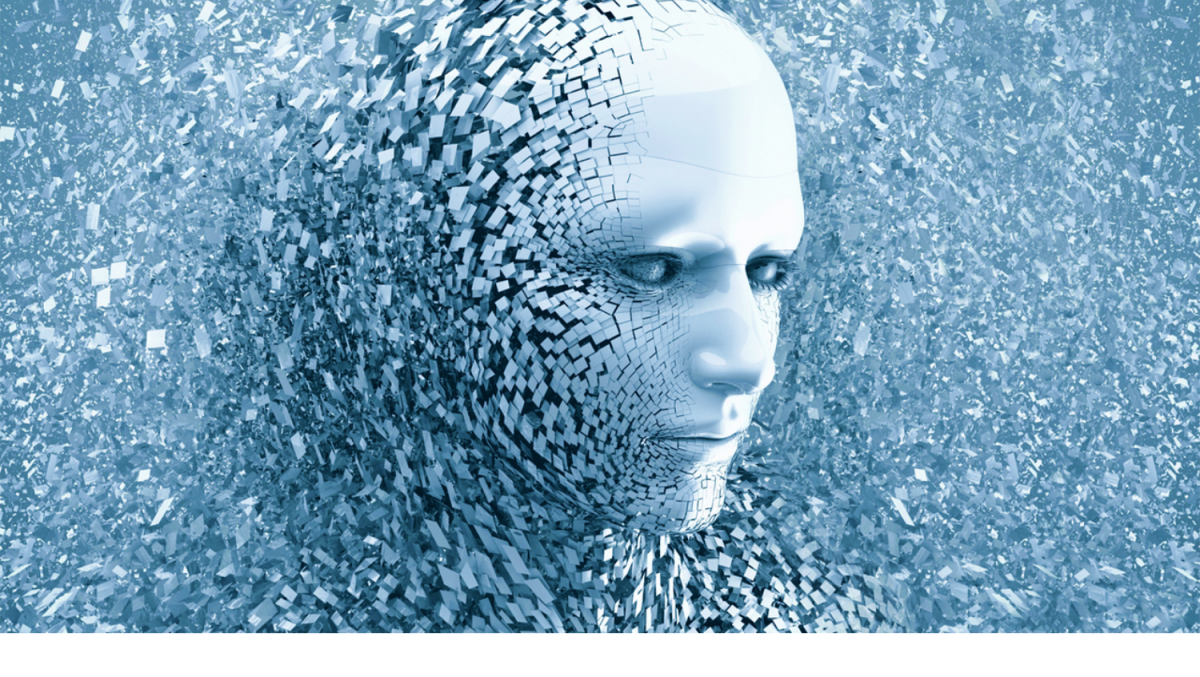
“Servant of the machine, the man must become a machine himself.”
— René Guénon (The Reign of Quantity and the Signs of the Times)
“Since each person is a ‘portion of God’ by the logos of virtue in him…, whoever abandons his own beginning and is irrationally swept along toward non-being is rightly said to have ‘slipped down from above.’… It means that someone who had the ability to direct the steps of his soul unswervingly toward God voluntarily exchanged what is better, his true being, for what is worse, non-being.”
— St Maximus the Confessor (Ambiguum 7)
I haven’t been watching many series lately. First, for the most obvious reason: with two small children, a mere film of less than two hours has to be split into episodes of about 30 minutes each, which means it takes three or four days to finish; logically, it takes about a month to watch a single season of any not-so-short series. Second—and more importantly—because I share a diagnosis that seems to me increasingly commonplace: series tend to drag on tediously for long seasons. Films and miniseries have pleased me more—even if they take three to fifteen days, more or less, to be finished here.
That said, taking advantage of a few calmer days at the beginning of the year, I decided to watch Pluribus, perhaps the most discussed series currently. The central reason: I liked the synopsis. I like science fiction in general, but I felt especially drawn to the story of Pluribus because it seemed to begin precisely where Childhood’s End—Arthur C. Clarke’s book that may be my favorite work of fiction—finished. By the conclusion of Childhood’s End, humanity loses any remnant of individuality, submerging into a kind of cosmic consciousness—and this is conveyed by the most blatant image possible: people lose their faces.
Pluribus begins precisely at this point. The trajectory that leads humanity in Pluribus to lose any remnant of individuality is different from that of Childhood’s End, of course. In Pluribus, everything is far more direct: an alien virus, or something akin to it, strikes humanity, and virtually the entire population is infected, fusing into a kind of collective mind—with the exception of a few remnants, otherwise there would be no story.

As always, there are theories about the series. Some say it is a great metaphor denouncing sects and religious groups that lose their individuality. Fine—that kind of series leaves room for plenty of valid interpretations. But to me it is quite clear that the series is about something far more obvious: the fusion of the human being with an intelligence that is alien to him and purportedly superior.
Notice that it matters very little where this intelligence comes from—whether from some distant point in the cosmos, as the series suggests, or whether it is an intelligence that is born and develops right here, on this earth that gives everything, even silicon. On the symbolic plane, the relationship between the human being and an extraterrestrial is very close to the relationship between the human being and a robot animated by artificial intelligence: in both cases, it is a relationship between us and something immensely alien to us and, at the same time, endowed with certain capacities that are notoriously superior to ours.
Both themes—extraterrestrials and AI—have long populated our imagination. In recent years, they have increasingly populated the news and everyday life. No, there is no confirmation of ETs among us, or even somewhere out there, but the subject has increasingly been treated with seriousness, to the point that the worn-out term “UFO” is no longer used, having been replaced by the new “UAP.” Let us be sensible, however: when we dive a little deeper into ufological studies, we see that someone like Jacques Vallée, for example—the man who inspired Close Encounters of the Third Kind, Spielberg’s film much praised by those interested in these themes—has for decades questioned the more widespread narrative that extraterrestrials would come from some far-off point in the universe. For Vallée, there are indeed “aliens” among us, but if we truly want to understand their origin we must look in another direction. Charles Upton has written extensively on the spiritual, rather than material, origin of ufological phenomena, and there is no better reference for those interested in the subject.
Pluribus is about transhumanism: the fusion of the human being with an intelligence that is alien to him and purportedly superior, resulting in the human being becoming something other than properly human.
But let me return to the focus of the present article. What matters to me here is to say that we can very well set aside the vision presented in Pluribus of an intelligence that comes from outside, taking it as a merely poetic or metaphoric image, and replace it with another, much more concrete one: an intelligence born right here, made of silicon, batteries, sensors, algorithms, and a dash of witchcraft.
Pluribus is about a highly advanced form of human–machine fusion.
Pluribus is about transhumanism: the fusion of the human being with an intelligence that is alien to him and purportedly superior, resulting in the human being becoming something other than properly human.
Pluribus is therefore a pretext for me to arrive at the subject I really want to address here: transhumanism.

Transhumanism is a theme that has been gaining notoriety in recent years. The main reason seems to be the advent of truly prodigious artificial intelligences. In 2022, when I first encountered the earliest versions of ChatGPT, I was utterly astonished. I do not recall any other occasion on which I witnessed a technological advance that, until then, had seemed entirely impossible to me.
The context surrounding the emergence of artificial intelligences such as ChatGPT is the same context of pandemic isolation and of technological promises of every sort—none of which, at this point, strike me as impossible. Most notably, we see advances in efforts aimed at inserting devices into our brains, which initially promise to restore lost bodily functions—but since the essence of the matter is the human–machine interface, a scenario in which these same devices will serve to connect human beings directly to those artificial intelligences whose capacities are growing at an exponential pace no longer seems distant.
I mentioned earlier that Pluribus reminded me of Childhood’s End, by Arthur C. Clarke. Clarke also wrote a far more famous work, however: 2001: A Space Odyssey, which gained enormous notoriety when adapted for the cinema by Stanley Kubrick. The underlying belief of 2001 is simple to describe: the human being evolved from primates, yet a further evolutionary leap would still be reserved for him, somehow intertwined with the technological advances that enable space exploration. Man is destined, Kubrick and Clarke suggest, for a final evolutionary leap that will raise him above ordinary humanity—something, it must be said, also quite close to Pluribus, although there the mysterious monoliths are replaced by no less mysterious viruses.
It is not difficult to see that, in all these cases, there is an evolutionary vision of human history. We came from primates and, through mysterious evolutionary processes, became beings capable of building rockets, developing artificial intelligences, and writing science fiction. Yet this is not all: the future holds a further step, in which we will finally abandon our genuinely human traits and become something more, beyond the merely human—superhuman, if we adopt Nietzsche’s terminology, whose Zarathustra is referenced by Kubrick in the cinematic version of 2001.
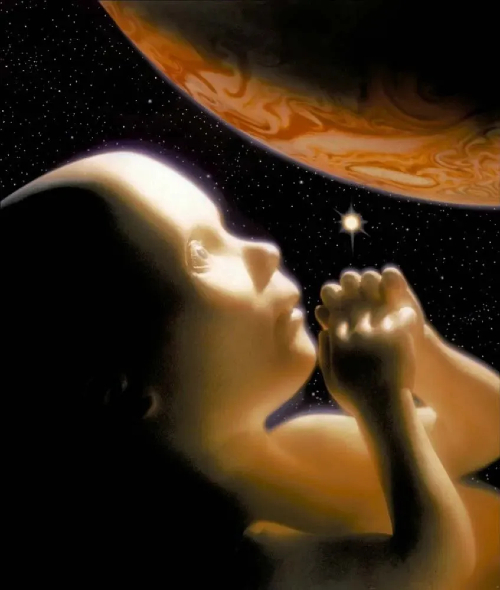
From a traditional point of view, however, to believe in evolutionism—as portrayed in 2001 or Pluribus—is to disbelieve in the archetypal quality of the human being.
From a traditional point of view, however, to believe in evolutionism—as portrayed in 2001 or Pluribus—is to disbelieve in the archetypal quality of the human being. It is to believe that the human being does not manifest from an image conceived by God in the plane of eternity. It is to believe that God, if He exists at all, is responsible only for the initial impulse of this mysterious universe, which thereafter follows its own evolutionary laws. And finally, it is to believe that if evolution governs the cosmos, there is nothing truly wrong with seeking to overcome our own human limitations, becoming something else—indeed, becoming whatever we wish.
M. Ali Lakhani states that man is not Homo Deus, as transhumanists would have it, but is Imago Dei, a “bridge between Earth and Heaven” whose destiny is not to become a mechanistically built Übermensch, but “to transcend his material limitations through rebirth into the spiritual Source that manifested him—to die to contingency in order to be reborn into Eternal Life.”[[1]] Transhumanism, as the same author says in another article, “rests on the fallacy of materialism. It reduces man to matter and humanity to its mechanisms, thereby rejecting their true spiritual foundations.”[[2]]

Still from a traditional point of view, the very use of the term “artificial intelligence” to refer to the prodigious technological advances we have been witnessing with such fascination is highly questionable.
After all, the development of algorithms, however extraordinary it may be, is fundamentally the development of the material sphere of existence—the realm of quantity, as René Guénon would say. It is curious that Guénon, in his astonishing book The Reign of Quantity and the Signs of the Times, stated that the plunge into quantity characteristic of our age is a plunge into the digit, or the number, insofar as the digit is what, at this level of existence, comes closest to matter in its deepest existential and philosophical sense:
“Saint Thomas Aquinas, when he says that numerus stat ex parte materiae, seems rather to suggest that number constitutes the substantial basis of this world, and therefore that it is number that must properly be looked on as pure quantity.”[[3]]
ChatGPT, Grok, Claude, Gemini, and their peers are fundamentally made of algorithms and are therefore entrenched in the pole of matter or quantity. Intelligence, on the other hand, is traditionally linked to the pole of form (in the philosophical sense of the term), to quality, to spiritual intuition, to genuine creativity, to humility, or to dignity. In the words of Lakhani:
"An indicator of the divide between the traditional and transhuman can be seen in their different understandings of ‘intelligence’. The transhuman focus is on statistical or rational intelligence (what the Future of Life Institute’s Open Letter on AI terms ‘statistical and economic notions of rationality’) or other quantifiable data (like IQ measurements) while the traditional focus is on spiritual intelligence (the ‘eye of the Heart’, which can read the ‘signs’ of the sacred) or its qualitative aspects (such as the human capacity for wonder or the symbolist spirit of its Intellect).[[4]]
Any fusion of man and machine will therefore never be a fusion between man and a truly superior intelligence; it will rather be a fusion between man and the lower limits of matter. “By denying those spiritual foundations,” Lakhani also writes, “transhumanism dehumanizes man, devaluing his true stature, substance, heritage and purpose, and deprives him of the humility of his creaturehood, the dignity of his spiritual status, and his capacity for the grace of transcendence.”[[5]] Hence the fundamental accuracy of the image, in Arthur C. Clarke’s Childhood’s End, of people without faces. The plunge into quantity is, without any doubt, an immersion in that which most distances us from our true humanity—a baptism in reverse, one might say.

How, then, might we escape the destiny that now reveals itself to us?
If it is true that the human being carries within himself, in his heart—the seat of the Nous, the spirit—a genuinely profound longing for self-transcendence, it is equally unquestionable that humanity, in its present condition, undermines, in countless ways, the very possibilities of human self-transcendence toward God. As a result, that deep longing, now incapable of reaching its supernatural destiny, finds itself confined to the earthly realm. Fusion with the machine is then taken as a substitute for the mysterious fusion with the Absolute, with the extraordinary difference that a fusion with the Absolute would never imply the loss of our faces.
It is not my task, in this brief article, to explain how we arrived at the current situation. But I can, by mentioning an especially emblematic name, refer to Ludwig Feuerbach, a philosopher who would exercise decisive influence, for example, on Karl Marx. Feuerbach, as we know, claimed that God is merely a projection of the beauty that the human being carries within himself but hides from himself. Feuerbach inverts biblical logic: whereas in the sacred texts God creates man in His image, for Feuerbach it is precisely the opposite, since it is man who creates, in his most beautiful and hidden image, an invented God. Feuerbach thus articulates a line of thought that expresses a historical reality: humanity has immanentized transcendence. In the words of Phillip Sherrard:
“By the end of the eighteenth century the change in outlook between mediaeval times and modern times was virtually consummated: for all practical purposes this world was by now regarded as the only reality, the be all and end all, the one place where, as Wordsworth put it, man can find his happiness if he is ever to find it.”[[6]]
Marx, a follower of Feuerbach, dreamed of purely material paradises, entirely alien from God. But he was certainly not alone. Technological dreams in general—the technoutopias we increasingly witness—reflect precisely the same immanentized yearning to make this Earth the site of man’s definitive fulfillment. The noetic impulse toward transcendence, inscribed by God in the heart of man, when severed from grace and no longer perceiving a real possibility of flowing toward the Absolute, turns in upon the things of the world, fabricating ersatz versions—whether ideological or technological—of the paradise it has abandoned. Fusion with the machine—whose supposed intelligence appears to him infinitely superior—is, in my view, the inevitable outcome of a very long process in which the human being, having lost sight of transcendence, also loses himself. It is the final icon of a humanity that seeks deification through the quantifiable, offering itself in an inverted sacrifice, from which there is no redemption, only annihilation—as Sotillos writes, “the merging of humanity with the machine is but an attempt to contrive an ersatz salvation through technological means.”[[7]] This is the infernal picture that narratives like Pluribus portray not as a warning, but as an almost logical destiny.

I want to put forward here a hypothesis: what if transhumanism were the ultimate goal of every revolutionary agenda?
I want to put forward here a hypothesis that, as such, can very well be tested and questioned. Here it is: what if transhumanism were the ultimate goal of every revolutionary agenda in known human history, or at least of the last two thousand years?
I know this is quite a hypothesis. To admit it means, first, to acknowledge that there may have existed, since very ancient times, intelligences of another order—angelic or, more precisely, demonic in the classical theological sense—that, from behind the scenes, have decisively influenced human beings in a particular direction. This influence would not operate through crude coercion, but through a continuous and extremely patient action, unconcerned with immediate results, for which two or three centuries amount to little more than a brief interval. Always oriented toward distant ends, such an influence would gradually pave the way toward a transhuman horizon from epochs in which scientific advancement itself was still capable only of the most rudimentary achievements.
Such intelligences do not generate a new telos of their own; rather, they parasitically redirect the natural impulse of the human heart, whose proper and original end is the Absolute. They would have two parallel missions, both indispensable to their ultimate purpose: (i) first, a mission at the level of consciousness, consisting in substantially altering humanity’s vision of itself, gradually implanting in it the desire to overcome the limitations of its own nature, but in a way frontal and contrary to religious traditions; and (ii) second, a mission at the material level, consisting in, at the proper time—when consciousness was already prepared—accelerating technological progress.
In this hypothesis, we would be dealing with intelligences with extensive knowledge of human trajectories and possibilities—knowledge inherited from times that completely escape our reach, evidently. In addition, they must be consummate connoisseurs of the human soul, understanding nuances, movements, tendencies, sources of pleasure and trauma, because only thus could they, over centuries and centuries, subtly but decisively influence the course of history.

Here I undertake an exercise in the manner of C. S. Lewis in his Screwtape Letters: I try to place myself on “the other side” and imagine what would be the steps of this immense epic battle—the strategies and achievements deemed necessary by such intelligences to reach their transhuman end. And I arrive at the following conclusions:
(i) First, it was necessary to dilapidate true mysticism, the path that leads to close contact between man and God. As long as there were a considerable number of holy, enlightened, deified men—I use the terms here interchangeably, merely to develop the argument—there would be witnesses of the truth endowed with excessive strength for any enterprise along another path to have lasting success. The sanctification or deification of the human being is, as I will argue later, the supreme antidote to transhumanism: when humanity has full conviction that it can indeed overcome itself, rise infinitely above what it believes itself to be, and come to live in a body glorified by the living presence of God, no transhuman seduction will be effective.
To end sanity, it was necessary to end sanctity.
Imagine the laughter of a St. Maximus, a St. Gregory of Nyssa, or a St. Teresa of Ávila—to limit myself to just three names and only to the Christian tradition—when faced with a pseudo-transhuman intelligence inviting them to fusion in the strange molds of Pluribus or Childhood’s End. “Are you completely mad?” they would reply. “We know another form of union, and nothing, absolutely nothing, can pretend to surpass it!”
But to recognize madness, one must be sane. And those intelligences knew this well from the beginning. To end sanity, it was necessary to end sanctity.
And so the attacks came: against mysticism, against monasticism, against contemplation.
(ii) Second, it was necessary to turn vices into virtues and virtues into vices. Of course: virtues are expressions, however limited, of being, and those intelligences need a humanity plunged into the abyss of non-being to complete their plans. Only an inwardly dead humanity would voluntarily agree to transform itself into something else, purportedly superior to humanity as it is in its nature and essence.
A very difficult task. One does not make lust and greed, for example, into virtues overnight. But by now, a quarter of the 21st century having passed, we know that there has been enormous success here.
(iii) Third, it was necessary to turn humanity’s eyes toward the earth. This is, in truth, a corollary of the first step: with mysticism weakened, it is a logical consequence that eyes turn toward the earth. With the noetic or spiritual dimension of the human being forgotten, what evidently comes to rule is what lies immediately below it: reason. If the spirit was conceived to be the center of the human being, this step consisted, initially, in making humanity believe that the center was reason—in its capacity to measure, judge, systematize, and so on.
Reason, as Phillip Sherrard says, first ignores, then denies, and finally closes itself to the source of knowledge which is above it.
Of course, at first everything still seemed fine. Reason, in its early period of predominance, still trusted in higher things, regarded as unshakable presuppositions. But those intelligences are immensely patient. They rejoice in small victories, because they know the course of things and know what consequences will naturally follow. Human reason, reigning by itself, contaminates the heart with its ruminations, and soon those higher things are despised, forgotten, fought. Reason, as Phillip Sherrard says, first ignores, then denies, and finally closes itself to the source of knowledge which is above it.[[8]]
The paradise promised by religions is replaced by merely earthly promises, at some future point. I will not dwell here on the immanentization of the Eschaton (as Eric Voegelin would say), or on the various ideologies that promise, in very different ways, an earthly paradise built solely by human brains and hands: it suffices to think of the failed ideologies of the 20th century or, at this moment, of the technological dreams that animate Silicon Valley or its Chinese counterpart, Zhongguancun. Feuerbach lives in California and Beijing.
(iv) Fourth, it was necessary to foster in man the conviction that he can become infinitely more than he is—a transformation, of course, to be sought not by the retrograde religious paths, but by the apogee of technique, by the force of science and human reason, breaking all limits. In a word: liberalism, in the philosophical sense of the term.
it is possible that a time will come when the Antichrist will precisely use this artifice: he will arrive at the desired dominion claiming precisely to combat the Antichrist!
The Antichrist, as the technology enthusiast Peter Thiel has said, will be a Luddite, a destroyer of machines, someone viscerally averse to technological advance that, according to him, will free man from the shackles of being what he is. Today these may still sound like comical words, somewhat ridiculous. But if those intelligences are successful in their intent, it is possible that a time will come when the Antichrist will precisely use this artifice: he will arrive at the desired dominion claiming precisely to combat the Antichrist!
(v) Fifth, there comes the need to tear apart, in each human being, the notion that he may have something unique and special. The path here seems complex to me, subdivided into stages. The first: to make man forget that he carries within himself a proper imago Dei, a personal vocation, a logos that is uniquely his. The second: to make him believe that he is indeed very special, but not because of genuinely his own characteristics and gifts, but for accessory reasons: wealth, fame, power, and so on. The third: to feed the idea that the human being is a tabula rasa, having nothing genuinely his own, since everything is a sociocultural construct: if there is no truth about anything in existence, there is also no truth about the human being. The fourth: to question the hierarchical value of humanity itself in relation to other creatures and, in a second moment, in relation to machines. It was indeed the outstanding realization of modern science: the conclusion that there is ultimately no difference between man and machine.
Sherrard wrote:
"The world-picture, with man in it, is flattened and neutralized, stripped of all sacred or spiritual qualities, of all hierarchical differentiation, and spread out before the human observer like a blank chart on which nothing can be registered except what is capable of being measured. For Newton, the celestial spheres are a machine; for Descartes, animals are machines; for Hobbes, society is a machine; for La Mettrie, the human body is a machine; eventually for Pavlov and his successors human behavior is like that of a machine. Everything, including the mind of man, is aligned on the model of a machine constructed out of dissections, analyses, and calculations. And a worldview founded on the model of a machine brings after it a mechanistic world.[[9]]
Done: the fundamental belief is established that man has nothing genuinely valuable, and not even genuinely his own, yet can, if he so desires, mechanically transform himself into something completely other.
It is surely possible to think of other steps in this enormous epic battle against humanity; I believe, however, that these suffice to present the argument.
We can thus look retrospectively at human history—or, if we wish to restrict the analysis, only at the history of Christian civilization—through this lens. Faced with each fundamental event analyzed, the following question can be asked: could this fundamental event have been driven, from behind the scenes, by intelligences whose aim was to lead humanity to a fully transhuman or posthuman scenario?
Has the history we know been, all along, a great battle between those who adhered—even unconsciously, of course—to the transhumanist agenda and those who resisted it? Has the history we know, and which continues to unfold, been a great battle between those who accepted the pain and glory of being human and those who rejected their own humanity—thus also rejecting God Himself?

Pluribus, in my view, bases its argument on a profoundly false dichotomy.
In the series, we see, on the one hand, a humanity fused with a cosmic intelligence, its members losing absolutely their humanity; on the other, we follow above all the story of a rebel: the American Carol Sturka, brilliantly played by Rhea Seehorn, who proves to be a very egocentric, individualistic, and sarcastic character. It is suggested, then, that the fusion of the self with something greater necessarily means giving up one’s condition as a person, whereas resisting fusion means clinging fiercely to one’s egocentered self, with its myriad defects and illusions.
In one of the best analyses I have seen of the series, a cultural commentator highlights this dichotomy, concluding that there is no way out: all we can do is to choose between remaining attached to our egotism or giving up our personhood in order to merge into a kind of superior collective being. But there is a serious blind spot there. As presumably the vast majority of people in our time, he ignores that, as the series presents it, there really could be no way out. That is because it is a false dichotomy. And it is a pity that the falsity of the dichotomy—easily perceptible to any average Christian of a few centuries ago—is today solemnly ignored even by quite cultured people in our society of Christian roots.
The dichotomy is false because—as the reader must already have concluded—only in a false world does fusion mean self-annihilation and the maintenance of one’s own self mean egocentric resistance. Christianity has been absolutely clear on this point since its beginnings: we are indeed called to union with God; we are indeed called to be members of one body—and none of this means annihilation of who we are, but rather the fullest preservation of our true, sanctified nature. Christianity is founded on the mystery of unity in diversity, and the mystery of unity in diversity also goes by the name of love.

Theosis is the answer to Pluribus and to transhumanism and to that old and oft-repeated question about the meaning of human life.
Theosis, or deification, is a term that synthesizes the ultimate goal of Christian life for many Church Fathers—and although it is a word that has been lost in the West, it remains widely used in Eastern Christianity. It is a beautiful term, because it means precisely the deification of the human being, his full union with God. In this union, all the most beautiful human dreams, including the dream of being eternal and of eternal blessedness, are fulfilled. And in this union, our singular, utterly personal traits are not only preserved, but truly elevated to their splendor. In Theosis, there is union without loss and there is personhood—indeed, an innumerable multiplicity of genuine, authentic, unique, integral, holy persons—without egocentrism. As St. Maximus the confessor wrote:
"Having been united wholly to the Logos, within the limits allowed by their own natural powers, to the extent that this is possible for them, [the deified] are imbued with the qualities of God, so that, like the clearest of mirrors, they become visible as reflections of the irreducible form of the divine Logos... possessing the fullness of his divine characteristics, without any loss of the original attributes that define human beings by nature; for all things simply yield to what is better, as air — which in itself is not luminous — is completely mingled with light.[[10]]
Theosis is the answer to Pluribus. Not only that. Theosis is the answer to
transhumanism. Theosis is the answer to the question of questions, that old and oft-repeated question about the meaning of human life. And Theosis is the answer to the meaning of history.
For just as we can analyze history from the fundamental question posed above—did this or that event contribute in some measure to the transhuman agenda, or was it driven by it?—so too can we analyze it from another question, diametrically opposed to the first: did this or that event contribute to the Theosis of humanity?
“He who does not gather scatters,” we read in the Gospels. He who does not serve Theosis serves the transhuman agenda. These are—and here I deepen my hypothesis—the two ultimate set before each of us: Theosis or transhumanism.
Will we be gods (John 10:34) or will we be like gods (Genesis 3:5)? "The promise of technological supremacy is for humanity to become divine: 'Ye shall be as gods' (Genesis 3:5),” as Sotillos writes. “In doing so, we are given the knowledge of 'good and evil' (Genesis 3:5) at the touch of our fingertips, or in the palms of our hands."[[11]]
Will we be fully human or will we be something else—transhuman: men who, seduced by vain promises, accepted renouncing their own humanity? It is the battle between being human and not being human, in the end—and not by chance the fundamental philosophical question never ceased to be the one that gained perpetual fame in Shakespeare: to be or not to be?
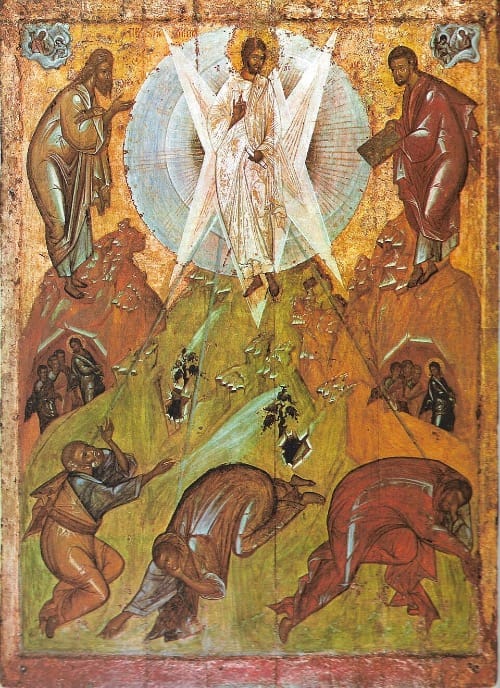
History unfolds in slow stages.
For centuries—millennia, in fact—we could not see the future. Now, however, the final horizon is beginning to reveal its contours, however roughly. Indeed, we live in the 2020s. And that, according to Paul Kingsnorth—one of the most prolific authors of our times when it comes to fighting the machine—means that we are a very idiosyncratic type of people:
"You are a citizen of the 2020s. Device in hand, earbuds in, you wander the lanes of a strange world. You can make a trip to the shops without talking to another human being, but you cannot walk through a city without being filmed. You cannot walk on a beach without being filmed, for there are satellites now, so many satellites. You are never far from a screen, you cannot afford to be, and why would you want to? The screen gives. The screen has abolished time, distance, boredom, longing. Is anything you see on it real? But then, what is ‘reality’? Who decides? Do you find this notion oppressive, restricting? Then redefine it. Make anything real. Make everything new. Make yourself what you want to be.[[12]]
The scenario is already scary enough. History, nonetheless, unfolds in slow stages, and perhaps between this moment—when yet nothing but the first contours of our ultimate destinies are revealed—and the truly final moment there may still pass decades or centuries. There may still pass decades or centuries until, like a final fork when there is almost no road left, our ultimate choice is made undeniably clear to everyone.
But assent or rejection of the truly human takes place, in its own way, at each stage of the journey. In Pluribus, or in the very final moment, through voluntary acceptance of fusion with a cosmic intelligence that strips us of humanity. Today, in an ordinary home of our times, assent or rejection may be measured by our willingness—or lack of willingness—to live genuine relationships with real people, as unmediated by machines as possible.
And in all times, rejection or assent has always taken place through the personal willingness to live a life that truly aims to be at once human and divine, through the cultivation of virtues and through commitment to prayer: praxis and theoria, in the true—and not yet entirely lost—sense of these terms.
To be or not to be?—this has never ceased to be the question. And so it will remain, as long as there are human beings from whom an answer is still expected, in their own most personal way.
[[1]]: LAKHANI, M. Ali. “Darwinism: A Critique”. Sacred Web 46, p. 119. Available at : https://www.sacredweb.com/science/darwinism-a-critique/
[[2]]: LAKHANI, M. Ali. “Editorial: The Transhumanist Fallacy”. Sacred Web 43
[[3]]: GUÉNON, René. The Reign of Quantity and the Signs of the Times, transl. Lord Northbourne (Hillsdale NY, Sophia Perennis), p. 20
[[4]]: LAKHANI, M. Ali. “Editorial: The Transhumanist Fallacy”. Sacred Web 43
[[5]]: LAKHANI, M. Ali. “Editorial: The Transhumanist Fallacy”. Sacred Web 43
[[6]]: SHERRARD, Phillip. “Modern Science and the Dehumanization of Man”. Studies in Comparative Religion, Vol. 10, No. 2, p. 6
[[7]]: SOTILLOS, Samuel B. “Meaning Amidst Chaos: Navigating the Post-Human Era”. Sacred Web 53. Available at : https://www.sacredweb.com/volume-53/meaning-amidst-chaos-navigating-the-post-human-era/
[[8]]: SHERRARD, Phillip. “Modern Science and the Dehumanization of Man”. Studies in Comparative Religion, Vol. 10, No. 2, p. 13
[[9]]: SHERRARD, Phillip. “Modern Science and the Dehumanization of Man”. Studies in Comparative Religion, Vol. 10, No. 2, p. 6
[[10]]: Quoted by Miguel Escobar Torres. See TORRES, Miguel Escobar, La Persona en Máximo el Confessor (PHD Thesis, Universidad de Sevilla, 2018), p. 229. See also St Maximus, the Confessor. “Ambiguum 10”. In: On difficulties in the church fathers. The ‘Ambigua’ (Ed. Constas, N., Dumbarton Oaks, Cambridge and Harvard University Press, 2014), p. 213
[[11]]: SOTILLOS, Samuel B. “Meaning Amidst Chaos: Navigating the Post-Human Era”. Sacred Web 53. Available at : https://www.sacredweb.com/volume-53/meaning-amidst-chaos-navigating-the-post-human-era/
[[12]]: KINGSNORTH, Paul. Against the Machine: on the unmaking of humanity (New York, Thesis, 2025), p. 298


