
Introduction
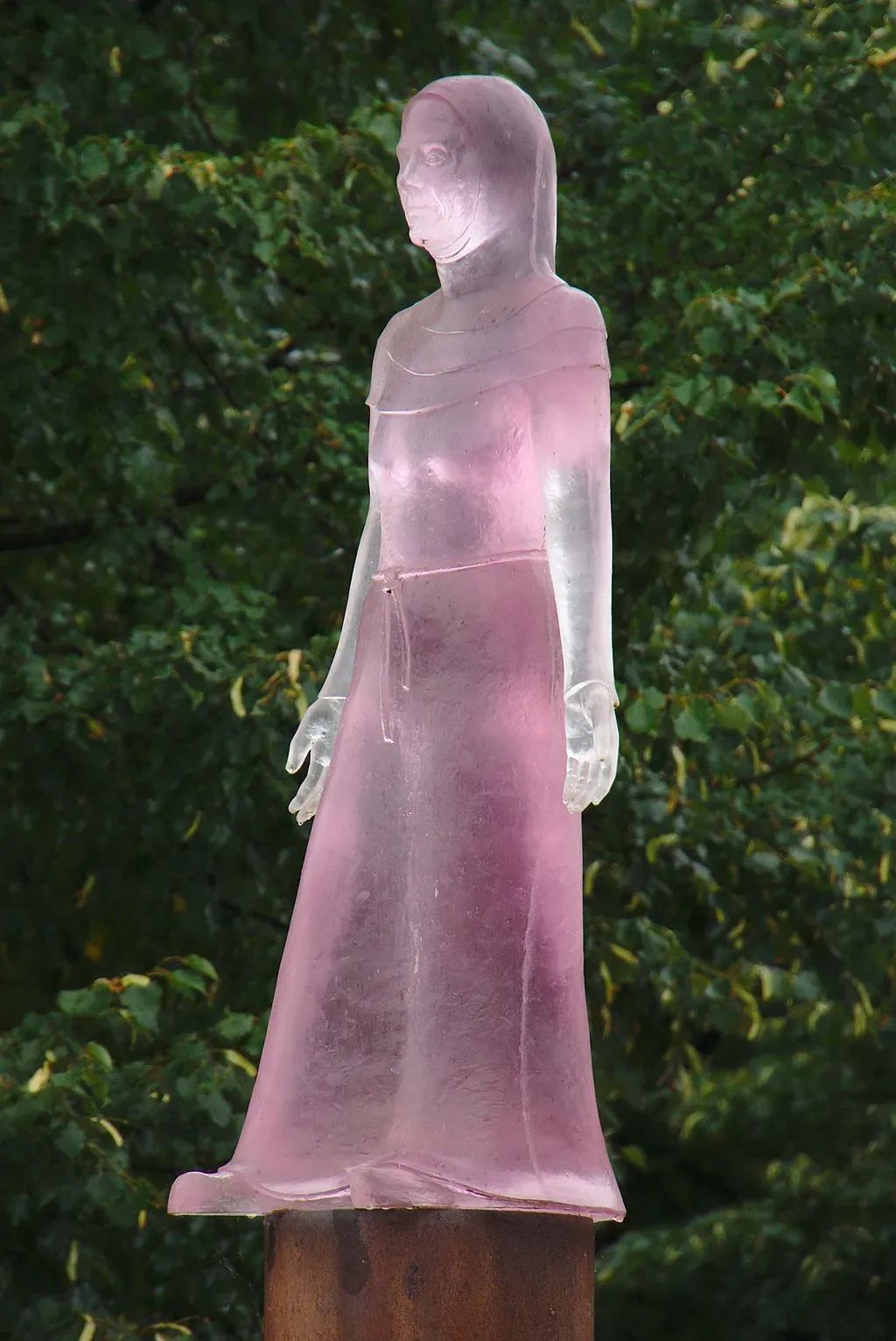
Who was Mechthild of Magdeburg? Who was the author of Flowing Light of the Godhead? What do we know about her? The short answer is: we know little. Old – especially Germanistic – research has some statements about her, but these were and still are not, historically corroborated. Examples include: Magdeburg as her domicile, Mechthild as beguine, her date of birth and death, a certain 'Balduin' mentioned in the text as her real brother.
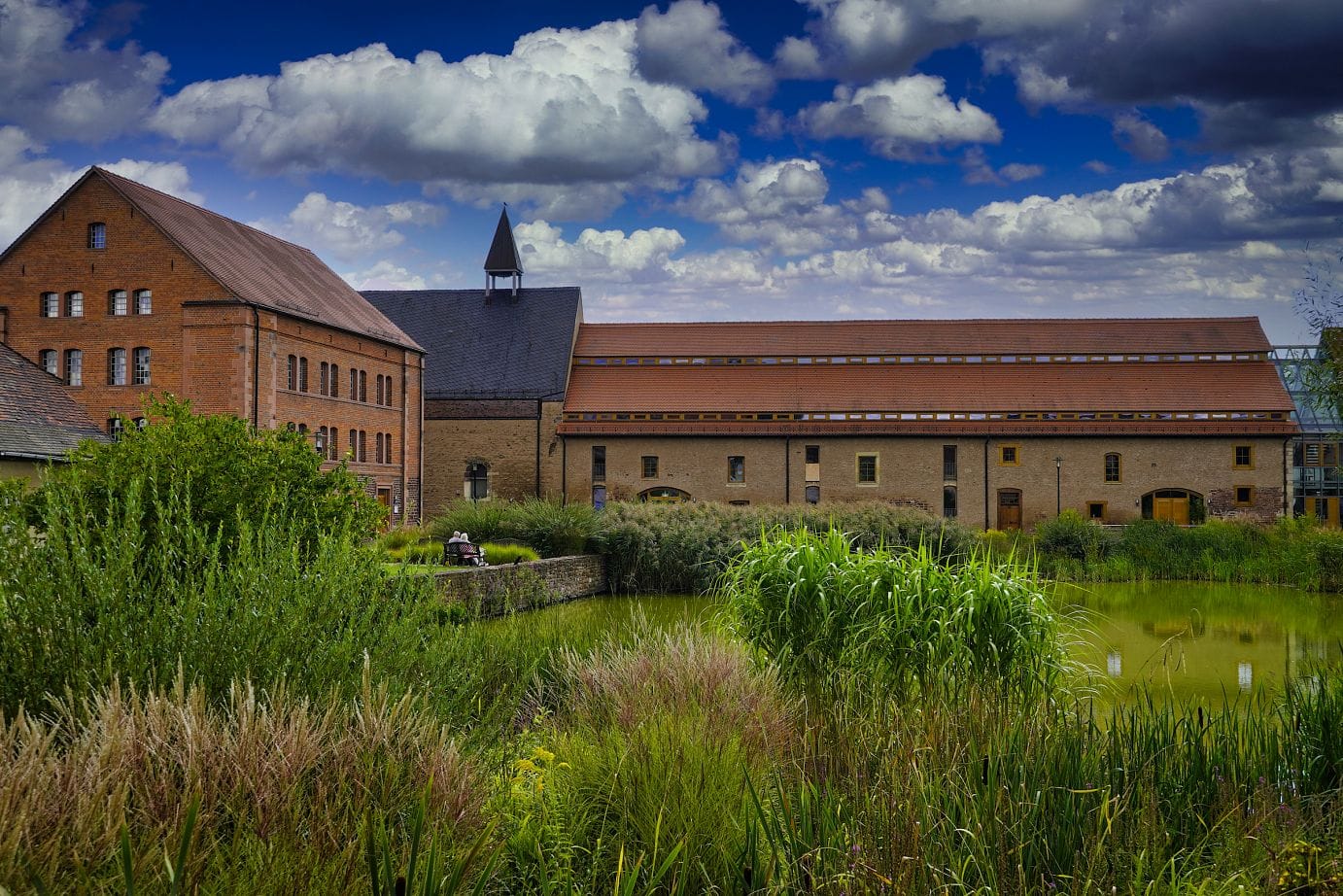
What can be said about her? There was in great probability a 'Mechthild' who was the author of Flowing Light. She lived in the 13th century: 1207/1208 is often cited as her year of birth, and 1282 or 1294 as her year of death. More definite dates are not available. It can be said with some certainty that in 1270, as an old woman, she moved to the Helfta cloister near Eisleben (Sachsen-Anhalt in Germany).
Based on the profound knowledge displayed in Flowing Light, Mechthild’s family of origin was most probably noble and wealthy. Without doubt, however, is her appreciation for the Dominican Order, which is often specifically mentioned.
What is Mechthild’s sole work? A book to which God Himself gave the title: A Flowing Light of the Godhead:
“Oh, Lord and God, who made this book?”
“I made it, in My powerlessness to hold Myself back from My Gift.”
“Oh, Lord, what should this book be called, so that it expresses only Your Glory?”
“It should be called: A Flowing Light of My Godhead, for all those hearts which live without falsehood.”
(FL, Prologue: author’s translation)
The book was regarded by her to be under the direct protection of God, legitimized and defended by Him, such that God Himself claims that the words and the sound of the words represent His Trinity:
“.…Thus revealed God Himself immediately to my sorrowful soul and held this book in His Right Hand and said: “My dear, do not sadden yourself too much, no one can burn the Truth. Whoever wants to take it from My Hand, must be stronger than I. The book is triune and describes Me Alone. This Pergament which encloses it, describes My pure lustrous, just Humanity, which suffered death through You. The words describe My Glorious Deity, which, from my Divine Mouth, flows hour by hour into your soul. The sound of the words describes My Living Spirit, and the unadulterated truth manifests itself from within….”
(FL, II, 26: author’s translation)
The Flowing Light is the only written text that has been ascribed to Mechthild of Magdeburg. If she wrote other works, these were either destroyed, penned anonymously, or transmitted under other names. The date of the book’s origin is given as between 1250 and the time of her death. It was apparently written in middle-German or middle-low German in the region of Magdeburg, Halle, or Helfta. The original text no longer exists; the oldest fragment of Flowing Light in German was found in Moscow in 2008; that copy of the text is close to the original but dated end of the 13th century. The only translation of the complete manuscript of the text is apparently an Upper-German translation from the mid-14th century, which was discovered and edited anew in the 19th century in the Einsiedeln cloister in Switzerland.
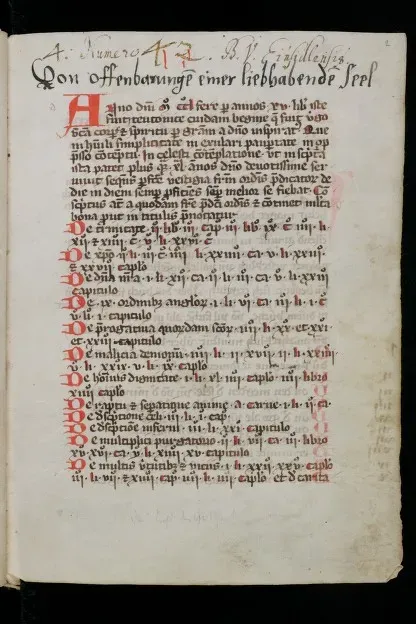
With that discovery began a phase of scientific and scholarly interest with the text, which intensified after the publication of the 1990 and 1993 critical edition by Hans Neumann and Gisela Vollmann-Profe. Different scientific disciplines have dealt with this work: German mediaeval studies, religious studies, and theology. In 1995, Margot Schmidt produced a second reworked translation of Flowing Light in new high-German; the edition in 2010 by Gisela Vollmann-Profe translated into new-high German simplified once more the text’s accessibility; and in 1997, Frank Tobin published an English translation titled The Flowing Light of the Godhead.
The Flowing Light is structured in seven books, the Latin version has only the first six. It is difficult to assign to it a literary genre; though its autobiographic character, comparable to a diary, is often emphasized, this, however, should not preoccupy us – far more important is the high literary quality of the text. Mechthild wrote her book in rhymed prose with lyrical segments; she varied in individual and unforced forms the spiritual, courtly and vernacular poetry. Stylistic devices she used are, for example, metaphors, comparisons, allegories, hymns and paradoxical statements, by which Mechthild expresses what is essential for her. The character of personal dialogue in Flowing Light is significant, conveying a sense of the insoluble bond between God and man. The dialogue – with oneself, with God, and with others – is thus the necessary logical form of Mechthild’s writings.
I await you in the orchard of love and pluck for you flowers of sweet communion
The immediacy of the emotional/erotic experiences described in the text, often disconcerting for researchers, is not only an expression of the tremendous intensity of the experience of love, but also expression of the knowledge that God, through Himself, is everywhere and in everything.
“…. Now I say to you where, then, I am: I am through Myself in all places and in all things, as I always was without beginning; and I await you in the orchard of love and pluck for you flowers of sweet communion and prepare for you a layer of pleasurable grass of sacred knowledge; and the radiant sun of My eternal Godhead illuminates you with the secret wonder of My Fullness/My Desire/My Joy,…”
(FL, II, 25: author’s translation)
The speech of Flowing Light is imagery, for which Mechthild uses all the resources available to her, whether of high literary, philosophical or theological rank, or adopts colloquial expressions such as songs, poems, proverbs and puzzles. The images are characterized through all manner of linguistic forms, whether nouns, verbs – especially intransitive and present-perfect continuous verbs, and adjectives – and she made her own abstract forms with the addition of suffixes like “-ity” and “-ness”. Her texts were made to resonate with sound, melody and rhythm, with the support of speech. Mechthild endeavoured to convey God’s courtly language, which was not ordinarily heard in the “kitchen”, the world of man. (I,2)
God as an Unending Sphere
Subsequent to these introductory comments, we can now proceed to address the question: what is God? – associated with the query: where is God?
The following quote from Flowing Light addresses this:
“….Where was God before He created something? He was in Himself, and for Him were all Things present and visible, as these are at present. In what shape was our Lord and God formed? Exactly like a Sphere, and all things were enclosed/included/embraced/encompassed in Him, without lock and without door. The bottom part of the Sphere is a fathomless base beneath all abysses; the topmost part of the Sphere is a height above which is nothing; the circumference of the Sphere is an incomprehensible circle. God had not yet become Creator. But as He was creating all Things, was the Sphere opened? No, it is still complete, and it will/should/must certainly always remain complete. When God became Creator, all creatures became visible to themselves: man, to love God, to enjoy and to recognize and to obey Him; the birds and animals, to maintain their nature; the dead creatures to remain in their being-there….”
(FL, VI, 31: author’s translation)
God is formed like an Unending Sphere and He is Flowing Light: the connection of these two perceptions in the image of an unending flowing perfect Sphere of Light conveys an overwhelming impression of the incomprehensibility of God. Although difficult to envision, Mechthild’s image is simultaneously comprehensible and yet completely open to every association of every person. If we examine the exact formulation, it becomes clear that in two passages in the text lies a more crucial difference: the portrayal of the gestalt of the Sphere is no self-statement by God but a profound description of Mechthild’s gnosis: God was formed like a sphere.
God did not give Himself the gestalt of a sphere! So who then did? It was the movement of He Himself in flowing light, it was the actualization of He Himself as the materie of light and it was the becoming-revealed of His creation for He Himself and His creatures, who always were, and who, in the everlasting creation through the effect of the fragmentation of the pure materie of light, in coincidental mixing of the materie of light, showed itself: there arose the earth-light, the air-light, the water-light, and the fire-light – the basic components of all life (based on the teaching of the four elements). In a few words, Mechthild portrays in this short description of the gestalt of the sphere a version of a narrative of creation which names God as Creator and integrates creation as a coinciding event arising through the effect of the movement of God to and within Himself.
Your sweet hunt tires Me so, so that I desire to cool Myself in your pure soul into which I am tied in.
In Flowing Light, the sphere is described simultaneously as being without dimension as well as being spatially and temporally constituted. These descriptions are conveyed in the text through Mechthild’s usage of different tenses, so that past and present are interwoven and, as it were, voided. This paradoxical connection is fundamental to the relationship between God and man. Both need space and time as well as spacelessness and timelessness: God, to live man as counterpart/as duality; man, to perceive God in dimensionlessness.
God is forced into the human soul, the soul hunts for God: God speaks to the soul:
“….Your sweet hunt tires Me so, so that I desire to cool Myself in your pure soul into which I am tied in. The sighs of the quaking of your wounded heart have expelled from you My Justice. This is appropriate for you and for Me: I cannot Be without you. However far apart we are divided, we simply cannot be separated...’”
(FL, II, 25: author’s translation)
This description unites the interweaving of the Unending as Cause of Movement and the Finites as the Effect of this Movement. With that, the Sphere closes the Unity, the Oneness and the Plurality of the effects into Itself. Also, the Trinity of the sphere creates comprehensible spaces for man. These three spaces bring simultaneously the external arrangement of the habitable geographic space (subterranean areas of water, on earth and in heaven) and the internal arrangement of man’s spiritual constitution in three areas: close to earth, encompassing heaven and earth, and Heaven.
In Chapter II, 19 of Flowing Light, these three regions are designated as the three Heavens. The devil has free access to the first two heavens, if man makes this possible for him. If man finds himself in the third heaven, he is close to God. The devil is barred.
The trinity refers to the established three hierarchies of angels in Mechthild’s time (for example, in Pseudo-Dionysius the Areopagite). It should again be emphasized that the horizontal trinity of the sphere does not mean demarcated spaces and times, rather that these also always work flowing into one another – and are simultaneously without dimension.
The expression ”flowing light of the Godhead” is mentioned only once in the prologue of the book. It thus belongs to the group of words which Mechthild of Magdeburg uses only once in her text. These are one of the many hapax legomena, which form, as it were, the many stanchions of the philosophical background of the text. The sphere, too, is mentioned, though many times, only in this chapter VI, 31. But the sphere works through the entire text; the book is the image, the language, the sound of God, while God Himself legitimizes this textual flowing-from-Him. God is formed as Sphere, hence this book, too, is to be seen as sphere.
The entire text of Flowing Light is written systematically from the perspective of non-duality, encompassing the One in Two, Two in One. The Flowing Light incorporates the doctrine of God emanating from the Unending, and cosmological perceptions, natural philosophical ideas and ethics, having the human perspective as basis.
mankind can see God’s Light/Beauty only when it goes in search of it.
The flowing light shows itself in humankind, the souls, like God, being themselves light (II,9: God to Bride/Soul: “… you are a light of the world”; II,10: The Bride/Soul to God: “ … You are the Light in all Lights”). The flow is evident in the light of five prophets, who illustrate Mechthild’s book (III, 20), the Light of God spreads Itself all over through four rays of light (II, 3), words can be light (III,2: Solomon’s words; III, 20: the words of the psalms; the flowing light with its words), love is light (II, 19; V,28), the Holy Spirit is Light (III,1; III, 4). The light brings clarity (II,7), the light brings and is, Gnosis (II,19; IV, 12), the light itself is reason (I,46), is the capacity to discriminate/judge (I,46), light is generosity/goodness, attention/watchfulness (I,46), it is Truth (II,3). But also the devil is light (II, 19). With the acquisition of the incomprehensible all-inclusive light, the soul can recognize how God is All in All (II,19).
Through the image of light, God comes closer to mankind; the images which the light produces vizualize/realize the Presence of God in the life of each. Light shows mankind the external beauty of creation, and it summons mankind to seek this beauty, brought forth by light, also within. But different from the external exposed beauty, mankind can see God’s Light/Beauty only when it goes in search of it. This means that mankind must detach itself from the consciousness of its duality towards God (created through the fall of man: this was the necessary act for man’s freedom, which was granted to him by God) and gain the knowledge of union with God. Only then does mankind see in itself the beauty, the endlessness, the light, of all life.
Mankind must place their lives in a univocal perspective to be able to experience God as Light in themselves. The path to this perspective is, however, a laborious one (I, 46): characteristics such as self-knowledge, truthfulness, moral integrity, clarity of thought, reason, wisdom, inner strength, courage; but also love, humility, disdain for material things and personal traits, which arise from egoism and greed, desire for union with God, a conscience aligned with love, joy on this path, and, not least, peace with the inadequacy of human endeavours and simultaneously with the success of effort.
You should love the Nothing, you should flee from the Something, … you live thus in the true desert.
The Flowing Light is in its totality an involvement with this path in a univocal perspective. Its beauty is described in encounters with God, which recall the Song of Songs of Solomon in the Old Testament:
The soul to God: “…Lord, You are my Lover/Beloved, my Desire, my Flowing Fount, my Sun, and I am Your mirror.”
(FL, I, 4, translation by Vollmann-Profe)
The light here is represented in the image of the sun. But not only is God described in this image, the soul also radiates with the unfolded Light of God within it, as does the sun.
God to the soul: “…you shine like the sun.”
(FL, I, 16: author’s translation)
These are overwhelming images and yet Mechthild of Magdeburg formulates in a short verse:
“You should love the Nothing, you should flee from the Something, … you live thus in the true desert.”
(FL, I, 35: author’s translation)
This also means that the images which describe light are ‘nothing’, signify ‘nothing’. Each image passes away and leaves behind only emptiness. But what does this mean for the existence of Light? It does not allow itself to be grasped in its flowing, it does not allow itself to be discerned in its being-still: the Light simply passes away. The emptiness and the Light penetrate each other – endlessly:
“….The emptiness is still unmixed and untouched, no one is in it, and it is clear/lustrous in itself and glowing/playful in rapture, to honour God….”
(FL, III, 1: author’s translation)
Mechthild challenges her readers to seek the Nothing that the Everything is – only after having experienced the endless persisting silent movement and its realization in daily life, does the seeking and craving person reach the univocal perspective. Thus is Mechthild obligated to the negative theology of Pseudo-Dionysius, the Areopagite.
If God is formed as a Sphere, what is the form that people have? Logically, they are too spherical. But which part is spherical? Apparently not the physical appearance. To the question of human anthropology, Mechthild developed a complex answer, hidden deep in the text of Flowing Light. Her answer explains the logical relationship between the Perfection of the Form of God as Sphere and the human sphere: human beings can experience themselves as spherical after completing the path to union with God.
That which is certain as logical knowledge already prior to the completion of the Path [for God created the Soul in His Own Image (I,41)] is then also tangible as sense, as image, or as conviction.
The process of the Self-Knowledge of God is presented in Flowing Light as an occurrence of the perpetual around and in-itself-circling reflection of God and Soul:
The Soul is Mirror for God to reflect the world:
“The Soul is … a mirror of the world …”
(FL, II, 16: author’s translation, also I, 4)
Mechthild writes that God has a “Mirror of the Godhead” (III, 1), He is and/or has an “eternal Mirror” (III, 11), there is the “Mirror of the Holy Trinity” (VI, 41) and the “Mirror of Eternity” (VII, 1). Thus, the mirror integrates itself with the image of the unending sphere as means to enlightenment. Especially impressive is how the soul addresses God:
“ … You are my Spiegelberg, a feast for my eyes, …”
(FL, I, 20: translation: Vollmann-Profe).
The word “Spiegelberg“ belongs to the hapax legomena in Flowing Light. Above and beyond that, other than in Flowing Light, the word “Spiegelberg” used as a noun in middle-high-German literature is documented only in the sermons of Mechthild’s contemporary Berthold of Regensburg.
Sinfulness is frozen light, which also belongs to the sphere! Hell is not a place external to the sphere: the sphere contains everything.
The human soul is kept safe in the unending flowing light of endlessness (of God). It has no beginning and no end. But this description does not refer to a modern “feel-good” faith, which promises each one to be lifted to a divine paradise. Mechthild writes in the 13th century of the Christian era: the existence of hell, and of purgatory, were at that time hardly dismissed, but certainly interpreted differently.
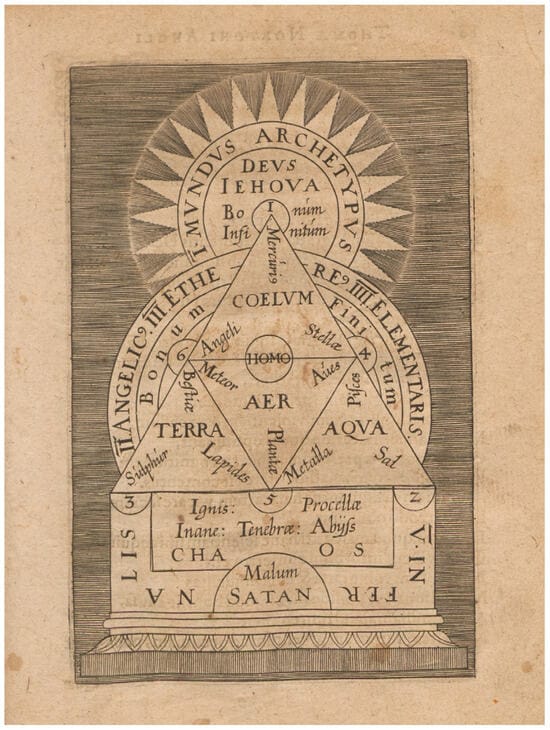
Mechthild did not exclude negative human characteristics, the existence of hell, the existence of the devil. For her, these belonged to divine and human reality, just as man, with his behaviour can be present in both purgatory and in Heaven. However: for her, hell was a space created by each for themselves out of their negative traits, desires, misdemeanors, sins, crimes. Already on earth, each lives in such a hell and leaves that domain not even after death. Sinfulness is frozen light, which also belongs to the sphere! Hell is not a place external to the sphere: the sphere contains everything.
According to Mechthild, humans consist of light, but of a weaker materie of light, which becomes stronger in the recalled remembrance of unity with God. Here, the weakness of the human materie of light means to be imprisoned in duality, to be subjected to becoming and the passing away of a being with free will but still subject to the limitation of one’s own will and that of others. An example are the needs of the body, its birth, and its death. In the words of the soul to the body at the end of the last chapter in Flowing Light:
“… O my most beloved prison, in which I am shackled, I thank you for all where you obeyed me; even when you oft afflicted me, you were still a support. …”
(FL, VII, 65: translation: Vollmann-Profe)
Despite all the weaknesses of the materie of light, it is the basis of creation, the cause of being-there, the bedrock of the individuality which makes seeking possible. The search for the sphere of light is the search for completion and the search for the flawless beauty of all life. Mechthild of Magdeburg saw it and experienced it. She wanted to open the path to it for all.
Bibliography
German References
Mechthild von Magdeburg "Das fließende Licht der Gottheit", hrsg. v. Hans Neumann, Band I: Text, besorgt von Gisela Vollmann-Profe, München und Zürich 1990.
Mechthild von Magdeburg "Das fließende Licht der Gottheit", hrsg. v. Hans Neumann, Band II: Untersuchungen, ergänzt und zum Druck eingerichtet von Gisela Vollmann-Profe, München und Zürich 1993.
Mechthild von Magdeburg, Das fließende Licht der Gottheit, zweisprachige Ausgabe, aus dem Mittelhochdeutschen übersetzt und herausgegeben von Gisela Vollmann-Profe, Verlag der Weltreligionen im Insel Verlag Berlin 2010.
[English]
Mechthild of Magdeburg The Flowing Light of Godhead pub. Hans Neumann, Vol. I: text, provided by Gisela Vollmann-Profe, Munich and Zurich 1990.
Mechthild of Magdeburg The Flowing Light of Godhead, pub. Hans Neumann, Vol. II: Investigations, expanded and prepared for printing by Gisela Vollmann-Profe, Munich and Zurich 1993.
Mechthild of Magdeburg The Flowing Light of Godhead, bilingual edition, translated from middle-high-German by Gisela Vollmann-Profe, publisher World Religions, publishing house Insel Berlin 2010.
Andrea Nowak-Enshaie studied History of Religion, Iranian Studies, and Sociology at the University of Göttingen (Germany). She earned her PhD (Dr. Phil.) in Studies of Religion from the University of Vienna (Austria) with a dissertation on The Flowing Light of the Godhead of Mechthild von Magdeburg. She taught courses on garden design. Her main interests are medieval Christian philosophy and mysticism. She published (with Rüdiger Lohlker): Das islamische Paradies als Zeichen: Zwischen Märtyrerkult und Garten, in Wiener Zeitschrift für die Kunde des Morgenlandes 99 (2009), pp.199-225 (‘The Islamic Paradise as a Signifier: Martyrs and Gardens’) and Persische Gärten – Orte der Imagination, in Gartenpraxis 08 (2009), pp.44-49 (Persian Gardens – Places of Imagination).


.jpeg)