
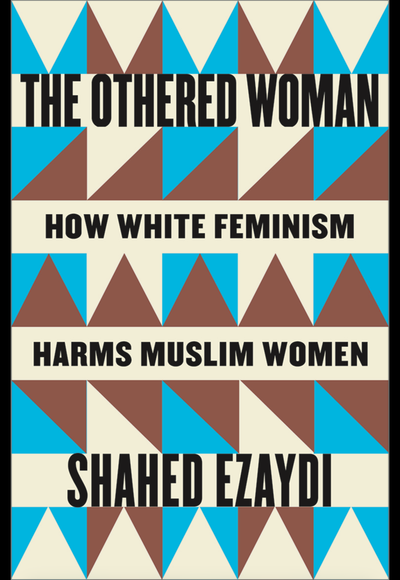
How White Feminism Harms Muslim Women
Whose lives “matter” and whose do not? When do stereotypes and propaganda obfuscate both our rich diversity and our common humanity? Whose plight is worthy of mention only when it can be exploited for ideological ends and geopolitical advantage?
In The Othered Woman, Shahed Ezaydi raises such vital questions regarding the distortion, erasure and omission of human beings, the corrosive subjection—not only of women but also of men—to caricature and calumny. Whole communities of marginalised women are excluded, imprisoned in “the prism of white feminism” that views Islam as inherently violent (10), a paradigm that is “exported and imposed” (5).
On March 4 of this year, Peter Beinart lamented on a Piers Morgan broadcast that if the U.S. and Israel had not attacked Iran, the schoolgirls killed at the Shajarah Tayyiba elementary school in Minab “would be alive.” An immediate retort came from Matt Schlapp, chairman of the American Conservative Union: “They’d be alive in a burqa… in a barbaric, unequal society… with no ability to make career choices.” On another recent episode, host Piers Morgan himself ludicrously claimed that women in Iran “have to cover their faces.”[[1]]
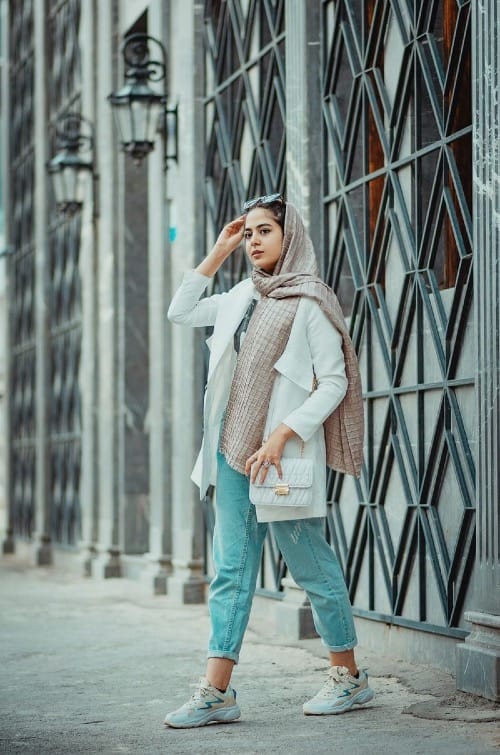
I thought at once of my women friends in Iran—where the burqa is not worn—a concert violinist, an architect, diverse musicians steeped in both European and Persian traditions—whether devoted to the qānūn and santur, or the piano and the harp, who often appear without hijab; and their companions who speak two or three languages—teachers, actresses, mothers; of others I admired without having known them, like the poet Parnia Abbasi, murdered along with her family last June 13th, shortly before her twenty-fourth birthday, in the unprovoked Israeli strike that killed 1,100 people.[[2]]
[[2]]: https://writersmosaic.org.uk/close-up/remembering-parnia-abbasi/
By Schlapp’s cavalier reckoning, the illegal war of aggression against Iran was blameless, and the humanity of both the dead and living girls and women could be effaced, their fate dismissed: for their “barbaric” society allegedly denied them careers.[[3]]
[[3]]: Be it noted that Schlapp has faced multiple sexual harassment charges involving other men. See Anna Rascouët-Paz, “Breaking down allegations CPAC head Matt Schlapp sexually assaulted another man.” Snopes, Feb. 14, 2025.https://www.snopes.com/news/2025/02/14/matt-schlapp-sexual-assault/
Her central theme is how dominant Western narratives depicting Muslims are constructed around a pole of violence that simultaneously distorts and effaces: women and girls are perpetual victims; men and boys are invariably perpetrators or terrorists.
One of numerous strengths in Ezaydi’s book is that alongside her focus on Muslim women, she examines the corrosive representation of both sexes. Her central theme is how dominant Western narratives depicting Muslims are constructed around a pole of violence that simultaneously distorts and effaces: women and girls are perpetual victims; men and boys are invariably perpetrators or terrorists. The former need to be rescued by “white” (i.e., “normative”) feminism; the latter tamed—or eliminated—by imperial conquest.
Since the book was published three weeks into the unprovoked war of aggression against Iran, it could not address the Minab atrocity. Yet Ezaydi’s themes are paralleled in the bombing and reporting of the Shajareh Tayyebeh Elementary School. For Western media has simultaneously exploited and erased the victims of Minab by reiterating the initial inaccurate reports of “168 schoolgirls”, omitting the diversity of both the report by local officials and the later casualty summary by the general prosecutor in Minab, Ebrahim Taheri on April 9.[[4]]
[[4]]: “Makan Nasiri, the only child still missing from the school bombed in Iran.” Al Jazeera, 23 April, 2026.https://www.aljazeera.com/news/2026/4/23/makan-nasiri-the-only-missing-child-from-the-school-bombed-in-irans-minab
The actual number of victims was 156, comprising 120 students and 36 adults: 47 girls, 73 boys, 26 (or 27?) school employees, “including teachers and technical staff, plus 9 parents / relatives who had arrived at the site prior to the second strike.” An initially unidentified “missing person” in the account by local officials (totaling 155) accounts for the slight discrepancy: perhaps “the lady responsible for the school’s cleaning and basic organisational tasks who was not counted at first as a school employee.”[[5]]
[[5]]: Quoting Kaveh Rostamkhani, who personally confirmed to me (on 5/3/26) the number of 156 casualties asserted by Taheri, and speculates that the initially uncounted 156th victim was the woman he suggests herein. See his detailed report: Kaveh Rostamkhani, “A reason to detest the West!” Veridio, April 16, 2026. https://veridio.substack.com/p/a-reason-to-detest-the-west
Media reports of the Minab victims have erased both the larger number of boys than girls, as well as all the adults, 26 of whom were women.[[6]]
[[6]]: The “faceless” teachers are memorialised here: https://www.instagram.com/p/DYCxrtmqgyO/
But these souls did not conform to the dominant narrative that Ezaydi identifies: “that Muslim women can only experience oppression at the hands of Islam (ignoring other structural harms); that this oppression can be boiled down to the wearing of the veil; and that Muslim men enact an exceptionalised form of misogyny and gendered violence.” (2)
The target of her project: … a “mainstream”political feminism that, as Alison Phipps wrote, dehumanizes and views as enemies all marginalized people who “thwart our will to power”
These themes unfold under Ezaydi’s characterization of “White Feminism”. One might argue with her use of a divisive racial term that assumes all white women enjoy equal privilege, thus risking a variant of the very problem of monolithic misrepresentations and misbeliefs she is at pains to critique throughout. The target of her actual project might be more accurately deemed “Bourgeois feminism”, as this term centres the mentality she proceeds to expose: an individualistic disregard or denial of the systemic injustices integral to the capitalist, secular and (Neo-) liberal order. For although the type of feminism she examines and reprehends is an ideology which “focuses exclusively on white middle-class women and prioritises issues that primarily affect them”, often favouring the voices of wealthy, famous celebrities, her discussion includes figures like Priti Patel, who as Home Secretary promised a continuation of Theresa May’s policy to “create a really hostile environment for illegal migrants” (128). This more precise conception emerges as Ezaydi’s book progresses: a feminism that is weaponized to promote and launder ethno-nationalist agendas, to “protect their own positions in society whilst furthering hateful and violent modes of thinking” (126), a “mainstream”political feminism that, as Alison Phipps wrote, dehumanizes and views as enemies all marginalized people who “thwart our will to power” (122).[[7]]
[[7]]: Alison Phipps. Me, Not You: The Trouble with Mainstream Feminism (Manchester UP, 2020). https://phipps.space/wp-content/uploads/2020/05/me-not-you-sample.pdf
“White” is thus not so much a racial category as a structural space, the arena of power constructed of rigid misconceptions that assign inferiority and deny dignity to the “Other”, be that exclusion cast in terms of colour, origin, religion, custom or gender. Black and brown faces may well pledge their service to the “white saviour complex” (16) that masks the egoic human impulse to superiority, exploitation and domination in the guise of “liberation” and “enlightenment”—often at the expense of sanctions, invasions and wars.
Ezaydi, born in Britain of Libyan heritage, naturally focuses on the situation in Britain, although her ample lens scrutinizes parallel conditions in the US and Europe, structuring the book by examining how “white feminist” ideology (Ch. 1) exacerbates the misrepresentation and homogenization of Muslims in the popular ethos, locating four major areas of often unexamined bigotry (Chs. 2-5).
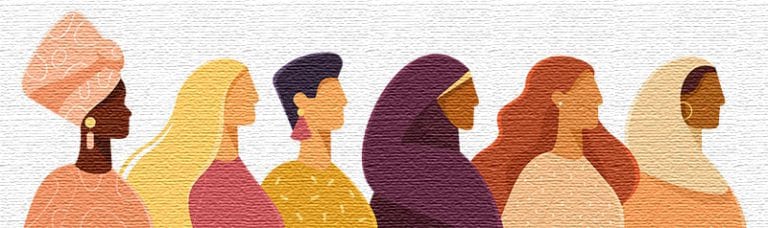
Chapter 2 foregrounds the notion that “for Muslim women, the single and only oppressive force in their lives is their faith” (24) blinds dominant feminism to the “multiple layers of structural disadvantage in society” (31). As Nafisa Bakkar observes, Muslim migrants in particular face economic hardship, prejudicial policies and violence, all of which are commonly blamed on their faith, rather than “the UK’s foreign interventions in countries such as Afghanistan, Iraq, Syria and Libya” (34). Meanwhile, for Black Muslims the distress is redoubled. For not only do they face the procrustean norm of “white European beauty standards”, but in spite of the fact that Islam prohibits discrimination and racism, “that doesn’t mean that Muslims don’t discriminate or harm others”, resulting in a majority of the Black population feeling they are not even welcome in their mosques or university Islamic societies (26-8).
Bigotry has turned the hijab not into a symbol but a stigma—a dismal sister to the Scarlet Letter.
Ezaygi’s insights are particularly keen in her discussion (Ch. 3) of how, in popular culture, the hijab instantly classifies a woman as Other, while its absence connotes assimilation (39-40). The simplistic equation of freedom as women wearing less is enhanced with the false correlative that Muslim women choosing the veil aligns with anti-feminism. Bigotry has turned the hijab not into a symbol but a stigma—a dismal sister to the Scarlet Letter—thus rendering Muslim women “both invisible and hyper-visible… simultaneously scrutinized and ignored” (44). A 2021 EU law “allows employers to ban women from wearing the hijab in the workplace” (55-6;93-4).[[8]]
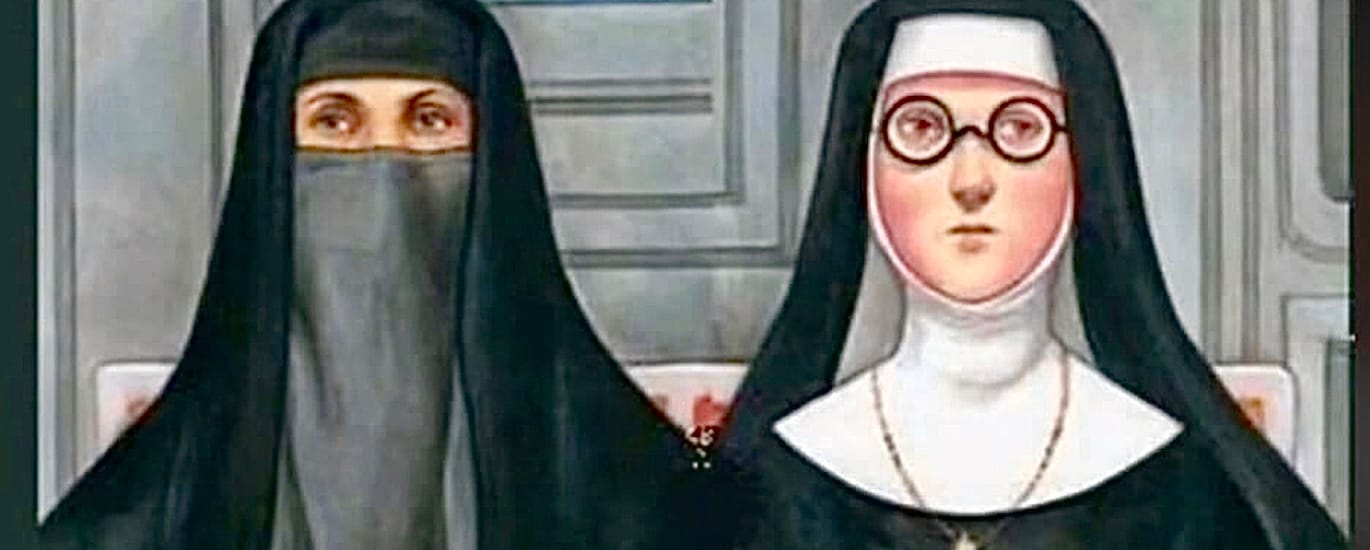
[[8]]: The EU Court of Justice (CJEU) ruling that “religious dress could harm a business’ ability to operate rests on the flawed logic that a client’s objections to employees wearing religious dress can legitimately trump employees’ rights.”
Hillary Margolis, “European Union Court OKs Bans on Religious Dress at Work.” Human Rights Watch, July 19, 2021. https://www.hrw.org/news/2021/07/19/european-union-court-oks-bans-religious-dress-work
Muslim women are at times even blamed for assaults perpetrated against them, with violence deemed an unfortunate consequence of “their perceived unwillingness to assimilate into Western society” (56). They may be victims of their faith or their husbands, but are themselves assumed at fault for any assaults they might suffer on “our” shores. And radical feminist groups such as Femen, which promotes the idea that Muslim women have no rights, ultimately serve, as Sofia Ahmed lamented, “not to emancipate us but instead reinforce Western imperialism and generate consent for the ongoing wars against Muslim countries” (43).[[9]]
[[9]]: Sofia Ahmed, “Muslimah Pride: We Reject Femens’ Islamophobic and Neo-Colonialist Crusade to Save Us.” Huffpost, Sept. 4,2013. https://www.huffingtonpost.co.uk/sofia-ahmed/muslim-women-against-femen_b_3044015.html
Although Ezaydi enumerates many objective social and political details, she includes a more insidious yet cruel form of personal violence (long familiar to Latinos in the US who dare to speak Spanish in public) recalling when, speaking Arabic during a phone conversation with her mother, a perfect stranger approached to remind her that she was in the UK, and scolding: “We don’t want any of your funny language in this country” (58).
Such bigotry is amply reinforced in popular media. Ezaydi notes three dominant stereotypes identified by Jack Shaheen in his seminal book Reel Bad Arabs (2001): the “oppressed wife”, the “oversexualised harem maiden” and the “female terrorist” (37).[[10]]
[[10]]: Shaheen’s documentary Reel Bad Arabs: How Hollywood Vilifies a People (2006) is an excellent summary and illustration of the book, providing many clips directly from films that reveal Hollywood’s long history of vilification - https://www.youtube.com/watch?v=TPxak6lFd-I
The six-part series The Bodyguard (2018) initially oscillates between two of these clichés: the character Nadia Ali is initially presented as a foiled terrorist, then an oppressed wife, finally “unveiling” her as a villainous mastermind. Whilst feigning to challenge stereotypes, the series embraces them and ads another: perfidy. Nadia’s intelligence and strong character are siphoned into ruthless cunning in service to violence (39). In Elite, another girl named Nadia is both timid and alienated until, at her school’s demand, she removes her hijab, which not only liberates her, but opens the possibility of romance. The show seems oblivious of the irony it inadvertently depicts: her “oppressive” parents and religion is only dispelled by yielding to the “liberating” authority of benign Western norms (40).
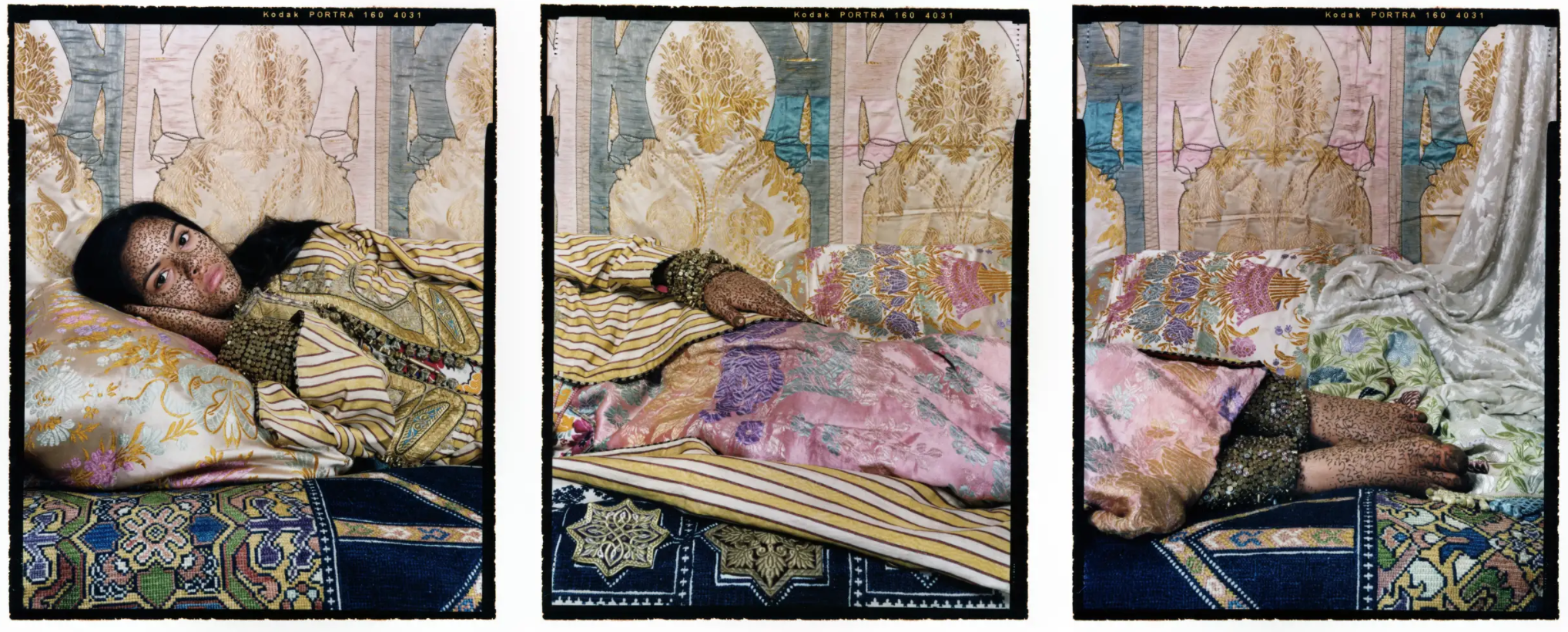
The third stereotype indulges in Orientalist fantasies of the Muslim woman as either sexually repressed or ravenous: forbidden fruit “fetishised and objectified by the male gaze”, indeed “consumed” or even conquered (65-6), a domestic parallel to the military “liberation” of a territory by subduing and seizing it. One cannot fail to note the many degrading videos posted by IDF soldiers as they rifle through the drawers of plundered Palestinian houses, mocking the expelled women’s underwear or even donning it to perform lewd dances and gestures—a ritual of degradation in absentia.
Xenophobic exaggerations of “honour killings” are misrepresented as a “norm” in Islamic culture, contrasted with the supposed “aberration” of femicide in the West
The abasement of Muslim women intertwines with the demonization of Muslim men, whose popular depiction Ezaydi mocks as their purported “unique” misogyny (Ch. 4), comprising of the notorious calumny of the Muslim male as not only “inherently violent, aggressive, misogynistic, hyper-sexual and dangerous” (78) but determined to “destroy the ‘Western way of life’” (84). News media plays a key role, promoting fearful fantasies of the “great replacement theory” and “Muslim grooming gangs” that play into a timeworn formula: “Men of colour are automatically seen as a threat” to a “white women’s ‘purity’ and ‘innocence’” (82). Ezaydi might well have mentioned how this inveterate canard of using imperiled female virtue to justify racism was sealed by D.W. Griffiths’ Birth of a Nation (1915): abolish slavery, and white women will live in terror—as embodied in Flora, who leaps to her death to escape the lustful advances of Gus—played not by a real black man, but a white actor in blackface makeup.[[11]]
[[11]]: See Jack Zwerneman. “The Birth of a Nation: D.W. Griffith's Great and Terrible Epic.” Cana Academy, Aug. 5, 2025. https://www.canaacademy.org/blog/the-birth-of-a-nation-dw-griffiths-great-and-terrible-epic
Xenophobic exaggerations of “honour killings” are misrepresented as a “norm” in Islamic culture, contrasted with the supposed “aberration” of femicide in the West—despite the fact that femicide in the US has been called “the silent epidemic” (96-100).[[12]]
[[12]]: In 2019, 474 women were killed in Turkey, while 2,991 were murdered in the US. “Even accounting for the fact that the US is four times larger in population than Turkey, the proportion of femicides here remains distinctly larger.” Rose Hackman, “Femicides in the US: the silent epidemic few dare to name.” The Guardian, 26 Sept., 2021. https://www.theguardian.com/us-news/2021/sep/26/femicide-us-silent-epidemic
Repudiating such travesties, Ezaydi offers not only her lifelong experience of witnessing marriages “rooted in love, respect and friendship” (91), but provides several crucial ahadith and passages from the Surah An-Nisa, and stresses that, in contrast to the West, Islam has long granted women as well as men the right of divorce (101-2).
The chasm between the monochromatic clichés and the rich reality can be promptly grasped by contrasting Julia Hartley-Brewer’s hostile interrogation of Palestinian PM Mustafa Barghouti (“Maybe you’re not used to women talking!”) with International Lawyer Lara Elborno’s nuanced homage, “The Palestinian Man The Media Doesn’t Want You To Know Exists.”[[13]]
Naomi Wolf: “Fascism with a feminist face.”
[[13]]: “Julia Hartley-Brewer sparks controversy with conduct towards Mustafa Barghouti during interview.” [1:29] Middle East Eye, Jan. 5. 2024. https://www.youtube.com/watch?v=3g6_Bcd45Q0; Lara Elborno, “The Palestinian Man The Media Doesn’t Want You To Know Exists.” [5:46] Double Down News, Dec 19, 2024. https://www.youtube.com/watch?v=dI1QL3ZQvtU
Yet fear, ignorance and malice lie at the heart of far-right propaganda in both the UK and Europe (Chs. 5-7), stoking hysteria about Islamic ‘extremists’ infiltrating Birmingham schools, in the Trojan Horse hoax (2014), while women who wear the hijab are viewed by groups like the English Defense League and Britain First as the portent of a dreaded “‘invasion’ of sharia law” (108-13). In Europe, leaders like Italy’s Giorgia Meloni have often invoked women’s rights to demonise immigrant men and spread fear of the “Islamisation of Europe”; Marine Le Pen has attached women’s rights to xenophobia; numerous platforms promote the idea that immigration threatens women’s freedom in Europe, characterizing Islam as “quintessentially misogynistic”; in Germany, Alice Weidel’s Alternative für Deutschland (AfD) Party has proposed banning the Adhān (call to prayer), and one feminist group even claims that sexual violence in the West is imported from “archaic societies.” Such leaders belie the illusion that “war, hierarchy and xenophobia belonged to the patriarchy and that… women’s leadership would create a more inclusive society… [yet] that is simply not the case” (117-24). Rather they embody a feminism weaponized to promote and launder ethno-nationalist agendas, to “protect their own positions in society whilst furthering hateful and violent modes of thinking” (126), embodying what Naomi Wolf has called “Fascism with a feminist face.”[[14]]
[[14]]: Naomi Wolf, “Fascism with a Feminist Face.” Project Syndicate, 31 March 2014. https://www.project-syndicate.org/commentary/naomi-wolf-examines-the-rise-of-women-to-leadership-positions-in-major-far-right-european-political-parties
In Britain, the common lens of white feminism and Neoliberal economics, renders the subtext clear: the purported peril betokened by the hijab is at odds with “British values”, and since Muslim mothers, as “reproducers of the Other”, endanger Britishness, the sole path to be granted dignity is to align one’s cultural aspirations and values in service to the plutocratic order. Thus social media accounts aimed at young Muslim women bear slogans such as “I want to be a CEO” (142-5).
Ezaydi excels in unveiling the chronic rhetorical hypocrisy and semantic sophistry of conquest in the guise of secular liberation.
Islamophobia has become “woven into the fabric of European political life”, permeating elections in Germany, Switzerland, Belgium, Sweden and Hungary, with rank discrimination cast in the rhetoric of “counter-terrorism” (151-3). According to reports, UK and France have led the way in “normalising” the injustice.”[[15]]
[[15]]: 2022 Report - https://islamophobiareport.com/en/index.php/2022/10/18/anti-muslim-racism-institutionalised-in-europe-report-warns/
The most recent 2024 Report - https://islamophobiareport.com/islamophobiareport-2024.pdf
All reports from 2015-24 - https://islamophobiareport.com/en/index.php/all-reports/
“Anti-Muslim racism institutionalised in Europe, report warns.” https://islamophobiareport.com/en/index.php/2022/10/18/anti-muslim-racism-institutionalised-in-europe-report-warns/
Ezaydi excels in unveiling the chronic rhetorical hypocrisy and semantic sophistry of conquest in the guise of secular liberation. In France, laïcité—secularism—virtually functions as a state religion, and its dogma of “public service neutrality” has resulted in laws banning “conspicuous” religious symbols (2003) and cementing an invasive “religious separatism” (2021). Freedom of expression, however, has been conflated with “freedom to express Islamophobia”; French bans on sports teams range from prohibiting fasting during Ramadan to women wearing hijabs in both football games and at the 2024 Olympics, which violates the Olympic Charter (159-62). Such a climate reflects an extension of the French colonial milieu, exemplified by Algeria, where French citizenship was granted only if one rejected Islam, whose eradication formed the basis of colonial rule (164-5).[[16]]
[[16]]: To become a citizen, “the Algerian first had to abandon his personal status of «Muslim». This meant renouncing… Muslim law.” Mouhamadou Ndiaye, “Building Islam as a race in French colonial law”, Völkerrechtsblog, 16 February 2018. https://voelkerrechtsblog.org/building-islam-as-a-race-in-french-colonial-law/
In recent decades, as political scientist Françoise Vergès observes, French feminists have focused solely on the veil, whilst excluding the voices of French Muslim women: in exchange for political power, feminism became “an ideological and political weapon” at the service of the state; the mere sight of women in Strasbourg wearing hijabs prompted one feminist to declare the Alsatian capital was “not the city of women’s rights.” (167-8). And while even celebrities expressed fervent support for the Zan, Zendegi, Azadi movement in the wake of Mahsa Amini’s death, “chose to speak up for Iranian women but not for marginalised women in their own country…” (169-70).[[17]]
[[17]]: Discussion of Vergès’ book, A Decolonial Feminism (2021) - https://womenscenter.georgetown.edu/education/a-decolonial-feminism-book-talk-with-francois-verges/
The strands of Ezaydi’s argument culminate in her discussion of “white” feminism’s complicity in global conflicts (Ch. 8), detailing “wars… justified under the guise of feminism.” (173) from the invasion of Afghanistan (2001) to Iraq, depiction of protests in Iran, and the genocide in Palestine. Although US First Lady Laura Bush affirmed that Afghan women, thanks to the invasion, were no longer subjected to the Taliban’s “severe repression and brutality against women”, and PM Tony Blair’s wife Cherie Blair lauded the UK’s mission to “lift the veil”, Afghan women were excluded from the peace process talks of 2018. As Ezaydi infers, “the oppression of women is only a concern for nations like the US when they are looking for palatable reasoning for foreign intervention” (176-7).
In the case of Iran, reality has often been reduced to a stark, shallow dichotomy: photos of women in miniskirts vs. hijabs, pre-1979 vs. “the regime”, a degrading caricature of a female populace that, despite restrictions, is one of the most highly-educated in the world.[[18]]
Nowhere is this myopia more clearly exposed than in the genocide of the Palestinian people.
[[18]]: See, e.g., Winn, Meredith Katherine, “Women in Higher Education in Iran: How the Islamic Revolution Contributed to an Increase in Female Enrollment. Global Tides: 10, Article 10 (2016). https://digitalcommons.pepperdine.edu/globaltides/vol10/iss1/10
Such stark juxtapositions (“bikinis vs. burqas”) serve a hegemonic end: presenting the middle class urban elite as the mythic norm, suggests that they could be “‘just like us’ if Islam didn’t exist” (191). The narcissism is palpable, and blatantly on display in a recent news broadcast showing a male athlete executed by Iran: “He looks like us!” declared the newscaster with amazement: “You can identify with him.” The fatal lack of empathy and moral imagination that permeate nearly all our dominant narratives is found in the corollary: If they don’t look and act like us, how can we—and why should we identify with him or her?
Nowhere is this myopia more clearly exposed than in the genocide of the Palestinian people, “met by silence from most feminists in the West…”, with most feminist organizations determined to sustain “their position of power and privilege...” (193-7) during the last two and a half years, even as 38,000 Palestinian women—an average of 47 every day—were killed.[[19]]
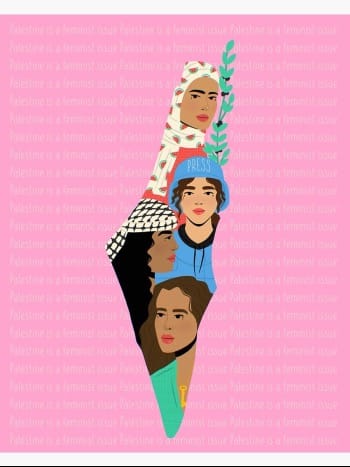
[[19]]: “Where is the humanity, when more than 38,000 women and girls in Gaza have been killed?” Sofia Calltorp, UN Women Chief of Humanitarian Action, Press Release, 17 April 2026. https://www.unwomen.org/en/news-stories/press-briefing/2026/04/where-is-the-humanity-when-more-than-38000-women-and-girls-in-gaza-have-been-killed
Ezaydi’s final chapter (Ch. 9) presents a vibrant counterpoint to the monochromatic feminism that, in alliance with the Neoliberal order, aims at the indurate homogenization of womanhood: a specious unity bereft of diversity, an instrumentalism devoid of imagination, which benefits only “a minority of already privileged and powerful women” (221), obfuscating the reality of Muslim women as “complex and varied… we occupy a range of roles, ideas and behaviours that don’t fit into this harmful box that white feminism has put us in” (200), enumerating brief glimpses of inspiring Muslim women over the centuries, from the Prophet’s wife Khadijah and the surgeon Rufaida Al-Aslamia, to Doria Shafik (who studied philosophy at the Sorbonne and founded the Daughters of the Nile Union in 1948) and Zarah Sultana, one of the youngest parliamentarians in Britain (201-15).[[20]]
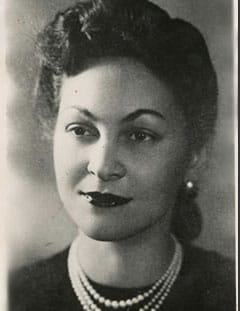
[[20]]: “Zarah Sultana speaks emotionally about Islamophobic abuse received as a Muslim MP.” Sept. 2021 [5:50] https://www.youtube.com/watch?v=8wv0Dwq2Lc0
The Appendix features interviews with a variety of Muslim women struggling to chart a path between tradition and modernity, notably Nafisa Bakkar, who concisely rejects the confines of a feminist ethics “shrouded within ego”, aspiring instead to an ethos that is “God-centred and faith-centred”; a vision of womanhood that is neither focused on nor defined by the “male gaze.”
Rather, she declares,“the gaze that I’m living in is the gaze of God...” (233-4).
Traditionalists seeking a deep metaphysical vision of gender relations will turn to Sachiko Murata’s magisterial Tao of Islam, which meticulously examines the complementarity of male and female in relation to the divine attributes of Jalāl and Jamāl (Majesty and Beauty); whilst a delicate, often poetic memoir coupled with a critique of simplistic “New Orientalist” distortions regarding men and women can be found in Fatemeh Keshavar’s Jasmine and Stars: Reading More than Lolita in Tehran.[[21]]
[[21]]: Sachiko Murata, The Tao of Islam (Albany: SUNY, 1992).
Fatemeh Keshavarz, Jasmine and Stars: Reading More than Lolita in Tehran (Chapel Hill: U of North Carolina P, 2007).
Given its predominantly political focus, Shahed Ezaydi’s work is a valuable compendium, deftly problematising the contemporary perils faced not only by Muslim women and men, but indeed by all people confronted with pervasive ideologies of Othering that sever us from the Sacred and efface the interlacing plenitude of women and men, exalting mastery over mystery, power over plenitude, and conquest over compassion.[[22]]
[[22]]: Interview with Shahed Ezaydi– "How White Feminism Harms Muslim Women" [1:07:00] https://www.youtube.com/watch?v=XkrnfS1CcSA


