
Introduction
How is man to reach knowledge of God?
By thought, for “Thought is passing from the false to the true.”
(Shabistari, Gulshan-i Raz)
Shabistari composed the Gulshan-i Raz[[1]]or The Rose Garden of Mystery in rhyming couplets in response to a series of philosophical and mystical questions sent to him by a fellow Sufi master, Amir Husayn Harawi of Herat in 1317 (717 A.H.). The questions posed were on themes related to Sufi metaphysics such as thought, soul and its evolution, knowledge, the hierarchical levels of Being, the spiritual journey (sayr), and so forth.[[2]] The first question addressed to Shabistari was on the nature of “thought” (tafakkur); hence, we start with thought, for “thinking” is the primary means to acquire knowledge of God. There are two ways to acquire knowledge, by reason or “divine unveiling” (kashf),[[3]] or, to employ Rumi’s idiom, external plumbing-knowledge or internal fountainhead-knowledge, respectively.[[4]] While the former is merely rational inquiry using the rules of logic discursively, the latter, “divine unveiling” or the uncovering of metaphysical truths, is through mystical experience. Shabistari’s notion of “thinking” or tafakkur is that of “kashf, ‘unveiling,’ that is, an immediate intuitive grasp of Reality, as opposed to istidlal, the process of reasoning by which one tries to arrive, on the basis of something known, at something unknown.”[[5]] And, in the words of Lakhani, “Knowledge is therefore to be understood as ontological, rooted in being, and not merely logical, and it possesses a sacred dimension.”[[6]] Hence, Shabistari rejects ratiocination as this form of tafakkur is not only time-consuming but is also indirect and subject to doubt and error,[[7]] making it an unreliable method of obtaining Truth.
To move “from the false to the true,” we need first to know what is “the false and the true,” to recognize the illusionary nature of the world which presents itself outwardly and apparently as the real world. To Shabistari, a follower of Ibn ‘Arabi as well as those of the Islamic intellectual tradition, this is straightforward; as reason and sense cannot dismiss the apparent reality of this phenomenal world, one needs to look for reality deeper, within the soul. Only when “consciousness arises in the soul of its own nothingness”[[8]] can one recognize that which is true. This is the real world, the noumenal world—reality as it is, which underlies the phenomenal world. For mystics like Shabistari, thought or tafakkur is the “visionary” journey of unveiling that the mystical wayfarer has to undertake from this phenomenal world of multiplicity and individual determinations of Being—the “false” (bāṭil) or Unreal towards the “true” or the Real (al-Ḥaqq). This is the journey of realization within the heart, not from the things of this world, the surfaces, for they are nothing but veils that separate one from God. This inner dimension is reality as ḥaqīqah[[9]]—that which encompasses all, the world of existence in its totality. This Islamic vision of reality and truth is a metaphysical survey of the visible (shahādah) as well as the invisible/unseen (ghayb) worlds of existence, encompassing both al-dunyā and al-ākhirah, and life as a whole, not, in Al-Attas’s words,
“…one that is formed gradually through a historical and developmental process of philosophical speculation and scientific discovery, which must of necessity be left vague and open-ended for future change and alteration in line with paradigms that change in correspondence with changing circumstances. It is not a worldview that undergoes a dialectical process of transformation repeated through the ages, from thesis to antithesis then synthesis, with elements of each of these stages in the process being assimilated into the other, such as a worldview based upon a system of thought that was originally god-centered, then gradually became god-world centered, and is now world-centered and perhaps shifting again to form a new thesis in the dialectical process. Such a worldview changes in line with ideological ages characterized by a predominance of the influence of particular and opposing systems of thought advocating different interpretations of worldview and value systems like that which have occurred and will continue to occur in the history of the cultural, religious and intellectual tradition of the West.”[[10]]
Al-Attas terms this all-encompassing worldview as ruʿyyāt al-islam li al-wujūd,[[11]] distinguishing it from the narrower Western scientific conception of the world that is restricted only to the world of sense and sensible experience or the world of created things. Put differently, this physical world is also a part of reality, just as is the other—the metaphysical dimension that lies beyond the physical. The two are neither disconnected from one another, nor are they situated on the same level. They are part of a single hierarchy that connects them in a “vertical” manner, with the higher metaphysical, unseen realm comprehending and encompassing the lower manifest realm; hence, the relation between these two realms is not of the order of two things on the horizontal plane, rather, it is a transcendental one.[[12]] And God as Wujūd[[13]] is the Source, for He is the First (Al-Awwal) and the Last (Al-Akhir), the Outward (Az-Zahir) and the Inward (Al-Batin), and the Knower of all things (Al-Alim).[[14]] All that exists in seeming separation from Him are only His modes of Being. This vision of reality has remained the same though its articulation in terms of the language and the way of its presentation, may differ over time. Shabistari’s (and also al-Attas’) reality is direct and distinct, and he makes it clear that there is only One Real Being, and the rest are merely Not-Being. Hence, it is important for one’s thought regarding reality to be correct.
when science reduces the universe to precise mathematical categories, the perception of wholeness disappears, for the consequence of having reduced the world of its qualitative inwardness is that what remains is only the quantitative sum of its atomic parts.
But, for most of us who are currently living in this phenomenal world of appearances and sensory experiences that are shaped by our senses and minds, Shabistari’s reality is not the reality we recognize. In our material world of appearances, the notion of unseen realities that societies once beheld as real regardless of their religion or culture, is seen as an anomaly due to the systematic erosion of such ways of seeing from the very soul of man. Hence, people find it difficult to comprehend realities that exist beyond the framework of this world, and how this world and other unseen realms are related to one another. In other words, when science reduces the universe to precise mathematical categories,[[15]] the perception of wholeness disappears, for the consequence of having reduced the world of its qualitative inwardness is that what remains is only the quantitative sum of its atomic parts. Thereby, being also disappears from the world (epistemologically), making man and life atomized into seemingly polarized discrete compartments. Such a science, it is fair to say, is based exclusively on horizontal causation that operates only “in time”, through temporal processes that flatten and reduce the world into material aspects recognized by the limited epistemology of the scientific method, stripping it of its vertical dimensions and thereby of its integral connection with other realms of existence. However, inasmuch as horizontal causation operates in time, it cannot affect time itself. That is why Smith says,
“The natural or “natured” world presupposes a creative or “form-bestowing” agency not simply in the sense of a first cause that brings the universe into existence, but as a transcendent principle of causality that is operative here and now.”[[16]]
The “form-bestowing” agency is the Vertical Causality, that does not act from the past, but instantaneously and sempiternally from a transcendent, higher level of reality to the lower. It is what “collapses” the quantum wave function into a definite, macroscopic object. In terms of an integral ontology, Vertical Causality (literally “the causality of wholeness”) is what constitutes the primary causation, the cause of the horizontal modes, and as such has power to override them.[[17]]
In our postmodern world, reality is now reductively multiple and relative for it is no longer contingent on a transcendent God, but on man’s conjecture. “God” has become an object of study, no longer the Ineffable, Transcendent Being beyond the grasp of man, the purpose of life. The distinguishing characteristic of its theorizing is the rejection of traditional philosophy and metaphysics; hence, the emphasis on all sorts of diversity of human experience and multiplicity of perspectives, making it difficult to understand the ground of reality. The term “postmodernism,” though a contested and “particularly unstable concept,”[[18]] is often seen as a consequence of modernism that transformed not only the material conditions of European society but also the traditional religious beliefs of the 16th-18th century. Despite these criticisms in its usage, it has gained traction for the newer generation. The contemporary mindset has been colored by these multiple factors, and versions of reality that keep evolving with time. The noumenal world, hidden from our outer knowledge, remains an enigma, accorded credence only as a philosophical construct or a religious myth.
there is the concern that Islam and its religious knowledge may be templated or modelled after Western secular knowledge
Hence, we write this article for two main reasons. First, reality as conceived and accepted in the West is also insidiously affecting Muslims’ understanding of their reality, initially via colonization and now coloniality, perniciously flooding Muslim countries masquerading as the face of Islam and using the language of religion.[[19]] As such influences upon our awareness and consciousness determine our reality, these flawed Western narratives and ideologies need to be understood for there is the concern that Islam and its religious knowledge may be templated or modelled after Western secular knowledge. We describe how the conceptualization of reality in the West evolved as a direct consequence of the 16-18th century developments in modern science, outlining the many contesting versions of reality that have sought to fill the vacuum once God and Scripture have been removed. More importantly, however, the modern understanding of “man” is no longer based on the Scripture, but is an anthropocentric product of the Enlightenment and modern science—a contrived physical reality following the laws of nature, no longer the Pontifex or bridge between the divine and the material worlds as in the hierarchical philosophical concept of the Great Chain of Being,[[20]] stretching from God down to the lowliest form of life.
Second, we consider how reality is understood by Shabistari, a representative of the Islamic intellectual tradition,[[21]] which is rooted in the Quran and the Hadith. We believe that it is necessary to go back to our traditional religious roots to grapple with modernistic errors, for the tradition describes the nature of reality and the condition of the human self—man, that special creation of God who is created with the natural ability and purpose to worship Him, hence our telos is transcendent.[[22]] Chittick calls this the recovery of our true human nature. But this nature cannot be grasped with the tools at the disposal of the modern sciences and academic disciplines, rather it has to be via a process of self-discovery within the context of an overarching anthropocosmic vision.[[23]] Put differently, it is to discern the nature of one’s own self in the global context of reality, for reality is coherent, ordered and whole.[[24]] It is Al-Ḥaqq (the Truth and the Real), the only reality, which is our true thought. This reality is, as we noted earlier, not what we experience in this realm of things, this phenomenal world. Furthermore, God is not a thing, for the Arabic word for thing is shayʾ, meaning that which is willed into existence or emerges from non-existence into existence. Reality in the Islamic tradition transcends things. This world of things is only a shadow of that higher reality which brings them into existence. In short, we aim to decipher reality.
To do so, we start from our worldview, using the Quranic verse, 41:53[[25]] as the frame to understand reality. God’s signs include those on the horizon (al-afaq, the cosmos) and within men’s own selves (anfusihim), in which are brought together all the realities of the cosmos, and in understanding these two, man comes to know Him, making it clear that He is the Truth (al-Ḥaqq), the ultimate Reality who witnesses all. This verse summarizes the realities for Muslims: God (al-Ḥaqq), cosmos and man. In other words, the relationships among these three realities constitute the nature of our existence.
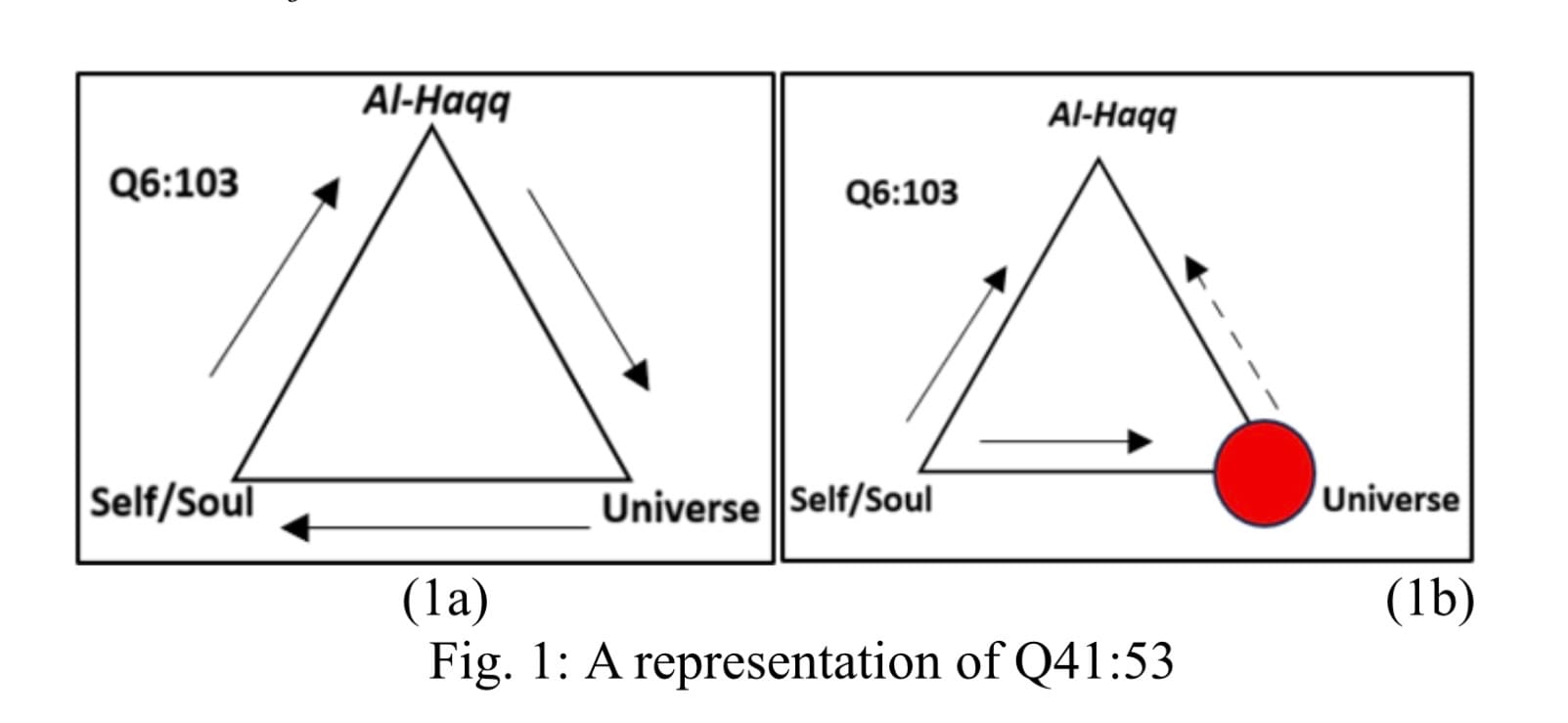
Fig. 1 is a simple illustration of the relationships among these three realities. At the top of the triangle is al-Ḥaqq, God as the Absolute Being completely transcending all limitations, where “No vision can encompass Him, but He encompasses all vision. For He is the Most Subtle, All-Aware” (Q6:103). At the base of the triangle comes the cosmos, then man, [[26]] both creations of al-Ḥaqq, each a mirror unto the other, with the cosmos displaying an infinite array of His Names individually (differentiated) while these are collected together in man as a totality (undifferentiated). To pass from the “false to the true” is to journey from the multiplicity of the phenomenal world—the universe to the self, and from here, to return to God, with no mediation whatsoever (Fig. 1a). However, due to the pervasive influence of modern science, the inverse is now the case—the self is moving into the universe, into multiplicity, and is getting further away from al-Ḥaqq (Fig. 1b). For without a transcendent God, there is no need for a soul, so all is reduced to this bit of the triangle (the circle in Fig. 1b)—the bare-matter of the physical universe, no more whole, depth or verticality.[[27]] But this contrived self of the universe cannot know God (the broken arrow in Fig. 1b). The once coherent, ordered, and harmonious reality with several dimensions/realms of being has been truncated into a flatland. The figure also shows that man is always in tension between al-Ḥaqq and al-afaq, between the One Wujud and His diverse manifestations.
The Western Unfolding of Reality and Man
During the 16th-18th century, Europe witnessed profound changes. The Renaissance provided education to the masses, introducing new values (of individualism, skepticism, secularism, and humanism) which made possible the Reformation, and the Scientific Revolution, culminating in the Enlightenment. With the power of the Church diminished, the scientific community could question the structure of nature and reality in ways other than that defined by the Church to explain the world and man. Reality,[[28]] once rooted in Scripture and mythos,[[29]] was soon replaced by logos, based solely on reason and logic. Communities which once were traditional became modern with technological advances that were propelled by new discoveries of modern science, replacing a once sentient world. A new vision of reality was formed, where the world became natural and was looked upon as a mechanical clock with man as a cog in it.
With the removal of a transcendent God, man becomes the measure of all things; so, truth becomes relative, based on individual human perception, not objective, absolute, or divine truth. This is the new reality, and, without the absolute, this reality will keep shifting in line with ideological ages characterized by different systems of thought and values.[[30]] In other words, man creates his own reality based on the changing socio-historical paradigms of the time. In this sense, religion and Tradition[[31]] are no longer seen as providing the immutable principles or primordial wisdom which in truth govern all things, and which are made known to man through revelation in its most universal sense. In other words, the new reality or existence is completely independent of the Sacred, with man taking over the place of the Creator. Hence, the immaterial “soul,” that which once connects man to God also disappears, to be replaced by the material self.[[32]]
In place of metanarratives, there are multiple narratives and realities, and myriad universal standards of judgment, values or legitimations that run counter to accepted norms and conventional wisdom. This is anarchic, and understandably confusing to many of the younger generation.
Postmodernity further argues that changes in technology, space, and consumption have created conditions for a new mode of experience of self and others. Many of the thinkers rejected the idea that theories and concepts represent a pre-existing reality or that there is only one true account of how things really are. In other words, philosophical postmodernism is seen as a “crisis” in representation, and is accompanied by the abandonment of belief in a universal subject of reason and value, as well as a rejection of a particular schema of progress inherited from the Enlightenment.[[33]] Postmodernism, it is therefore claimed, “eschews metanarrative, those sweeping interpretations that totalize human experience in some monolithic way … anything that reflects the past or present ‘hegemony’ of dead white males.”[[34]] In place of metanarratives, there are multiple narratives and realities, and myriad universal standards of judgment, values or legitimations that run counter to accepted norms and conventional wisdom. This is anarchic, and understandably confusing to many of the younger generation.
Despite these numerous present-day realities, however, the Cartesian legacy or modernistic epistemology that looks at the world through the lens of modern philosophy still lurks beneath the surface, as unstated and underexamined assumptions for these realities. The problem is the relation between the subject and the object. In this distinction, where the subject is a thinking thing that is not extended, and the object is an extended thing which does not think, first, only the subject knows the object, and second, the object is “out there” as the reality of the external world or in a space “out there” which the subject tries to know. Here, the ideal inner world of the subject is separated from the outer world of the object. Put differently, the subject is divorced from the world for the world is put “out there” as separate from the subject; i.e., the subject “subtracts” himself out of the world. The subject becomes the center, and has priority over all other beings. But this leaves him in a conundrum for though he is ruler of nature, based on this vision of science he is nothing but a mechanical cog in a giant mindless machine. He is stripped of responsibility for his acts, and becomes an isolated automaton struggling for survival in a meaningless universe. This legacy has divided man from his world, locked him within his inner self, and removed his soul from his body. Many have now questioned and rejected this subject-object distinction or Cartesian dualism.[[35]] In other words, as God’s representative, man is central to the universe. He is both the knower and the known, the participating observer; so, as premodern thinkers understood, there is no such thing as subject-object dichotomy.[[36]] There is always interaction between the knower and the known, and as such, man cannot be “subtracted out” of the universe.[[37]] He is part and parcel of the universe, for if he is subtracted or singled out of the universe, then physics can never understand anything because it is man who gives meaning to the universe. All are entangled, for all things are dependent on the One Wujūd.
So, how is man to be understood? In doing away with a transcendent God, verticality is also removed and all is reduced to this material world—the physical world of science and matter.[[38]] Without a vertical causation, only horizontal causation remains, for in the absence of wholeness, being too disappears, epistemologically.[[39]] Hence, many contrived versions of “man” or “self” are possible, depending on the ingenuity of its inventors, whose nature is solely material. Put differently, in doing away with God, man not only cuts off his bond or relation with Him doing away with higher levels of reality, but also his intrinsic connection with the cosmos as order or harmony. That is why Nietzsche could famously claim, “God is dead and we have killed him (i.e., our idea of God).” And, if God is dead, “where does the potentia absoluta go?” It goes to man himself—which is given full expression in Sartre’s existentialism,[[40]] where an individual in his freedom has a godlike mastery over good and evil, morphing into an “all-creating, all-defining self: that I can decide on the basis of my absolute freedom the nature of reality; don’t tell me what to do, and don’t tell me who I am… It is the transplanting of the potentia absoluta of God now into the potentia absoluta of the self.”[[41]] This is the “radicalization of the self,” and the identity politics of wokeism is one of its expressions. Indeed, “self” has a long and chequered history in psychology, and while it has been held in high regard at some point, at other times it has been relegated to the domain of the unobservable and scientifically unthinkable, hence reduced to an illusion. Currently, in psychology, self is considered as the totality of the individual, which exists only within this material domain with nothing higher than the mental or psyche. It is still important in certain areas of psychology, such as in psychoanalysis, personality theories, and self psychology.
Another development on the many realities of the “self” is the notion of “signs.” John Deely[[42]] takes this notion of “signs” as central to the emerging postmodern consciousness. In this history of philosophy, he traces the development of the notion of “signs,” and of the general philosophical problems and themes which give that notion a context through four ages. Using this notion of signs, he sees the human being as an extension of the brute animal, albeit a more intelligent one, and this “human animal”[[43]] is capable of not only using signs (like any other animals) but to “know that there are signs.” Hence, he defines the human being as “the semiotic animal.” In other words, during these ages, the definition of man changes. From a metaphysical beginning that views man as a recipient of being from the One Being, to one who is both human and divine, then to a thinking or rational subject, he has now become a mere sign lacking meaning, existing only as a human animal. To quote Deely,
“The “higher” animal, brute or human, comes from the womb with no identity other than its biological one as a substance of a given species. Immediately it begins to interact with its surroundings, and new relations impossible within the womb develop between the animal individual and its surroundings. These relations “shape” its development, presupposing of course (and no doubt) whatever dispositions and talents the animal has from its “nature” as not only a member of this or that species, but as an individual with distinctive inclinations, talents, and gifts.”[[44]]
In other words, this human animal’s identity is based only on its biology and interactions with its surroundings, very different from the Islamic tradition that sees identity being created in the womb itself, with each being different from the other.
in removing the Divine, verticality is removed, and only horizontal causality remains
A most recent version of reality is that posited by Joseph LeDoux[[45]] who postulates a new framework of man, founded on four realms of existence—bodily, neural, cognitive, and conscious, all within the world of matter. The conscious realm that allows man to have inner experiences of, and thoughts of, the world is not understood as a higher dimension of reality, but as an epiphenomenon of the brain. The result is a man that is defined as an “ensemble of being,” not a self—for in doing away with a transcendent God, man’s reality cannot extend beyond this world of bare-matter. This move is aptly described by Graziano—from God to soul to mind to brain.[[46]] In other words, in removing the Divine, verticality is removed, and only horizontal causality remains. From here, there is a progressive descent into simulation, what Baudrillard termed as the “precession of simulacra.”[[47]] Thus, in the absence of wholeness, being too is absent because there are no more wholes! Man then, has to be constructed from parts of matter in the physical world, gradually descending into a state of hyperreality, where he can no longer distinguish reality from a simulation of it.[[48]] This condition is described by Feuerbach who defines his era (the mid-nineteenth century) as one that,
“…prefers the sign to the thing signified, the copy to the original, fancy to reality, the appearance to the essence, this change, inasmuch as it does away with illusion, is an absolute annihilation, or at least a reckless profanation; for in these days illusion only is sacred, truth profane.”[[49]]
Hence, the wisdom tradition that sees this world as a shadow of that higher world becomes a thing of the past. In this postmodern age, there will always be new editions of the concept of “man” or what the philosopher Kemmerling[[50]] speaks of as a “bewildering conceptual plenitude of person,” living, using the phrase “the end of transcendence” in a state described as “one dimensional.”[[51]]
This classical view of reality, however, has been challenged by proponents of quantum mechanics at the beginning of the 20th century who argued that the observer or “man” cannot be removed or subtracted out from the description of physical phenomena. Because the measuring instruments (which are macroscopic and obey classical laws) are required to measure quantum-level events, the observer and the instruments are fundamentally inseparable from the phenomenon itself.[[52]] Hence, “man” has to be brought back into the world. But problem is that this is merely “man” within the limited conception of science—a reduced man, a contrived man, diminished by the epistemological erasure of his immaterial aspect and of God and Scripture. This is the current reality of modern man, a physical reality where his consciousness has also been moved into the res extensa. This is why many quantum physicists feel that there is much more to the physical universe than meets the eye. For example, Wolfgang Pauli questions the strictly materialistic view of science by suggesting a “psychophysical” approach, arguing that physical reality cannot be fully understood without considering the role of the observer and the mental world. His view of reality includes both physical and psychic phenomena which are “…understood as complementary expressions of an abstract, non-describable reality. Reality itself is considered transcendent (incomprehensible, unattainable to rational theories).”[[53]] Because quantum mechanics only describes our knowledge of the atomic world (reality), it does not actually reach the atomic world itself;[[54]] hence, it follows that the consciousness of the observer must be included in the analysis.[[55]]
In sum, because modern science removed from its epistemology the metaphysical dimensions represented by God and Scripture, all canonical knowledge is currently reduced into this truncated universe. While quantum mechanics may provide an inkling into a “veiled reality,” “hidden reality,” “recasting reality” or “choosing reality,”[[56]] and so forth, each of these conjectured realities are still trapped within this impoverished perception of the physical universe (the circle in Fig. 1b). Hence, from the Western perspective, their musings on deciphering of reality are only the unfolding of the physical universe over the constrictions of time.
Deciphering Reality
There are three elements that need to be taken into consideration in deciphering reality: reality itself, the man or the decipherer, and the faculty or the modus operandi needed to decipher reality. We first consider the term “cipher,” and why the need to decipher reality before looking at these three aspects. The second part of our article’s title, From Point Comes a Line, and From Line Again a Circle is a phrase taken from Shabistari that succinctly describes this reality that starts with the One Reality, from nonexistence to existence and back to nonexistence, to complete the circle of the cosmic procession and its return. In this tradition, it is the immaterial or spiritual world (al-Ghayb, the hidden dimension of reality) that animates this material world (al-Shahada, the dimension one can witness), whereby this world is only a shadow of that other world. Indeed, the very foundation of Islam is “…a belief in the Ghayb[[57]]” with God as the Source of the Unseen reality, and all else flows from this reality. His is the only Truth and Real, and “He is the Knower of the Unseen and the Visible” (Q59:22), both the spiritual/immaterial world and the material world. Everything that is material emerged from the immaterial, just as every action is preceded by an idea or a thought.[[58]]
Hence, deciphering reality here means knowing God. To know God, however, man has to know himself first, which is contingent on knowing the true “I”—the “no-thing” in the face of the absolute and transcendent Reality. Only as a “no-thing” can he come to know God.
Cipher and Deciphering Reality
As al-ḥayawān al-nāṭiq, man is the living being that speaks,[[59]] who is able to communicate and decipher to find answers about the world and his own self. Through the medium of language, theories are created to interpret the world. It is for this reason that physics, taken as the basis for all the other sciences, aims to decipher reality—to come up with a Theory of Everything[[60]] in order to describe the natural world. Physics, however, deals only with the physical universe—consisting of physical objects and physical laws that require intermediary or measurement apparatus as these objects and laws are not directly observable or capable of being outwardly experienced. The world that we live in—the corporeal world, on the other hand, is based on the direct experience of our senses; hence, it is an experienced, experiential, sensuous world. Put differently, the physical universe is only a shadow of our real living world, for it has no sensory qualities, only quantities.[[61]] It uses the language of mathematics that is precise, value-free and culturally independent, as opposed to our ordinary language that is full of nuances and ambiguities. As a lexicon of symbols, it is a special language that needs the experimenter or observer to function as interpreter. As such, physics can only offer physical theories, not a theory of man for it cannot go beyond the symbols. Here, man enters the picture only by interpreting the theory, by deciphering reality.[[62]] Physics’ “reality”, however, is only a physical reality, although there are those who acknowledge that there is a transcendent realm “beyond” what is perceptible to the senses—one that lies outside the physical universe and the corporeal world. This is our al-Ghayb, the concealed/hidden realm from which all things originate. Within the tradition represented by Shabistari, to decipher reality is to know al-Ḥaqq, but this knowing is contingent on man first knowing himself, perceiving his in-between nature[[63]] that connects the invisible and the visible, giving him the means to thereby decipher that reality. This pontifical dimension of self is the nafs,[[64]] from the Arabic root n-f-s, which is also the root for the word nafas or “breath,” that connects the absence with presence or nonexistence with existence. The nafs is also a barzakh[[65]]—an “isthmus,” barrier, or intermediate realm that both separates and brings together two things. It is paradoxical because it is “neither this nor that” but also “both this and that.” Like a mirror image, it is real (you see it) but unreal (it has no physical mass) for it is the realm of the Khayāl (more equivalent to image than imagination, hence a similitude or Mithāl).[[66]] In this sense, the Islamic tradition always assumes a triplicity of worlds—all interconnected, as opposed to the separation of mind and body in Cartesian dualism that is the basis of modern science.
To decipher reality, we need to introduce the origin of the word “cipher” and its cognates like “nothing,” “sifr,” “sefr,” “empty,” “void,” “zero,” and the likes. These terms represent the concept of nonexistence or absence. “Zero” is a numerical representation of nothing, while “void” often refers to a spatial emptiness or a state of nothingness. “Sefr” and “sifr” are linguistic roots of the word “zero,” coming from Persian and Arabic, respectively, and reflecting the historical understanding of nothingness as a state of “empty” or “vacant.” By adding the prefix de-[[67]] to “cipher,” the term “de-cipher” would indicate “something,” “presence,” “everything/complete,” or in mathematical context, “infinity.” In other words, “de-cipher” connotes something that is hidden or secret and has “zero meaning” unless one has the key to unlock that secret.

In the Arabic numerical system, the symbol for zero is a dot or point [.], and to understand or interpret this dot or point, it has to be deciphered for there is a secret behind the symbol. For the dot or point in Arabic is nuqṭa;[[68]] it plays a profound role not only in writing, but is also a metaphysical symbol—one that forms the basic unit for aesthetic proportion in Islamic calligraphy as well as in philosophical thought and mystical meaning.[[69]] In the former, in Islamic calligraphy, the nuqṭa serves as the basic unit of measurement, where letters are constructed in proportional relationships to the dot, following fixed rules governing height and width, to establish balance and symmetry, mirroring the belief that beauty in form is a reflection of Divine Beauty.[[70]] Here, the dot serves as the unseen standard by which the calligrapher establishes visible harmony. In the latter, as a metaphysical symbol, the nuqṭa represents the Point of Origin from which all existence and meaning unfold.[[71]] Here, the nuqṭa as a metaphysical origin serves as a cipher for the hidden reality from which all multiplicity arises. Indeed, man begins his journey in this physical world as a nuqṭa as detected by the ultrasound scan dot, from that initial drop or nutfah[[72]] of his parents, thereby developing from potentiality to actuality.
In mystical thought, only God can attest His Unity, for only He “has the right to say ‘I.’” Creation, on the other hand, requires the existence of duality.
Put differently, the nuqṭa can be seen as a primal point symbolizing the moment of disclosure, from the One Ineffable Being to the multiplicity of existents; i.e., from divine silence into human understanding, nonexistence to existence, 0 to 1. Though visually minute, the nuqṭa is pregnant with meanings—a singular point that holds within it the possibility of infinite expressions, or the metaphysical All-Potentiality of the Absolute.[[73]] As such, the nuqṭa has to be deciphered. This is what we mean by the first part of our article’s title, “Deciphering Reality,” for what we see as symbols in the forms of phenomena on their own are merely representations. Behind all phenomena there is a hidden Reality, one that has verticality and infinite transcendence, going back to the Source, which brings us into the language of unsaying.[[74]] This is the dilemma of transcendence in mystical religions where the transcendent is beyond names, and is Ineffable. But, to say that the transcendent is beyond names, it has to be given a name, “the Transcendent,” so that we can affirm that it is beyond names. Because one is always caught in a linguistic regress in attempting to state the aporia of transcendence, Sells introduces the mystical language of unsaying, a discourse that includes both apophasis (un-saying or speaking-away) and kataphasis (affirmation, saying, speaking-with).[[75]] It is in the tension between the two—apophasis and kataphasis, that the discourse becomes meaningful. For example, in the Islamic tradition, God is One, but One is not a real number.[[76]] One is only the symbol of the primordial One, the divine without a second, comprising of relation, wholeness, and unity, and rests in itself but stands behind all created existence.[[77]] Here, the problem of attesting to God’s absolute unity and Oneness creates difficulties for the gnostic/mystics, for the very act of declaring the profession of God’s Unity presupposes the existence of a speaking subject. In mystical thought, only God can attest His Unity, for only He “has the right to say ‘I.’”[[78]] Creation, on the other hand, requires the existence of duality.
To Muslims, the Word of God, the Quran can never be fully comprehended for it has multiple meanings, depending on the state of the person. How could it be otherwise coming from the unfathomable Divine Being? God the Speaker is the Many-Named One,[[79]] and His Names are numerous; revelation then will always be fraught with mystery, however clear its words may appear to be. Hence, the need to decipher. But, how to decipher His Many Names? One way to do so is to give Him a name.[[80]] In the Quran, He has already given Himself the Name “Allah”[[81]] (Q20:14), so His “personal” name is known. This name then can act as a sacred cipher to help man to know Him, for He has to be “nameable” to be known and obeyed.[[82]] In other words, for man to meaningfully engage with God, He has to be conceptualized in some way, even if it is an abstract one. Without a name, God would remain an abstract, indefinable entity, making meaningful address and worship impossible for man. To act as cipher, the name “Allah” has to be sounded, for the Quran was revealed as a recitation—the “oral-aural quran,” and we as His creations can only hear and utter His Speech. So, to feel His Presence, His Name “Allah”[[83]] has to be chanted, and that incantation serves as a reminder or dhikr for man who is forgetful. That chanting and sounding of His Name—the yes and no that form its roots, AL (or EL) referring to the sacred Something and LA (or LO) referring to the sacred Nothing, the ultimate Yes and No, existence and nonexistence, affirmation and negation—point to a reality that ultimately just is.[[84]] This is the mystical side of religion that tends to hide the Divine Name, for to name something is to possess it, to define and limit it. In mystical experience, the beloved’s true nature is beyond human comprehension and articulation. Therefore, to hide the beloved’s name is to acknowledge the divine mystery and the inadequacy of human language to capture the absolute nature of God, and a testament to the profound, ineffable nature of divine love. While His Beautiful Names and Attributes point to Him, they do not reveal His Essence.
“Allah”—the sacred cipher, is also known as God’s Greatest Name (al-ism al-a’zam). Both cosmos and man are created upon this Divine image (Q41:53), displayed in their full splendor within the cosmos in a differentiated manner, while in man these names are brought together as a unified whole.[[85]] In the former, the names/signs are shown upon the horizon while in the latter, they are hidden. In other words, to decipher, these names must be made manifest for all to see, and these realities are brought together within the human being.[[86]]
The Man—the Decipherer
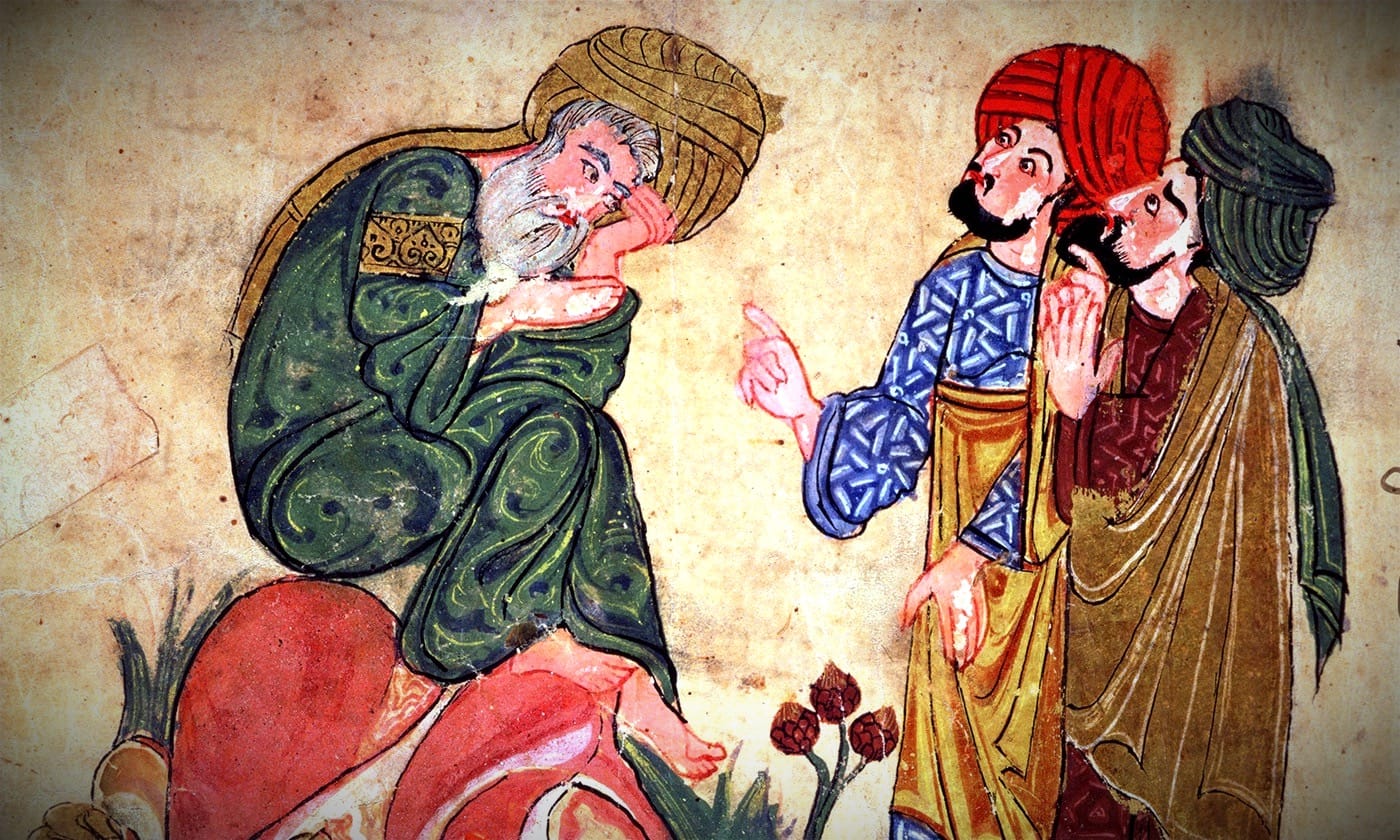
So, who is the “man,” the one deciphering? Is he a Darwinian man, a product of modern Western science based on a mechanical materialistic explanation of life, a contrivance at the disposal of his masters? Or is he a Cartesian psycho-physical subject, res cogitans, separated from res extensa and the world itself? Or one founded on a traditional view with reference to a transcendental God, a bridge between heaven and earth, who knows that he is bound to Him in some mysterious manner? If it is the Darwinian man, then there is no metaphysical explanation for the origin of life or consciousness, and no scriptural understanding of creation. “Man” here, is just a cog in the machine, not a complex, nuanced sentient being. Similarly in the Cartesian man, the schism between the internal, subjective mind and the external physical body has numerous implications, for example, the disenchantment of man within the physical world, the loss of man’s stewardship of the natural world and his consequential exploitation of nature, the materialistic anomaly of consciousness, and the alienation of the psychologically locked-in man, trapped within his own subjectivity.
This is the deciphered sifr in the Islamic tradition—the nafs whose nature is barzakhi, standing between nutfah and nuqṭa, nonexistence and existence, ‘0’ and ‘1’, always conscious that his existence is contingent on the One existence.
By contrast, in the Islamic tradition,[[87]] “man” is Adam, the first man created by God. Adam is God’s special creation, a genus by himself, created with a purpose (Q2:30), and suffused with His Names and Attributes (Q2:31); thus, elevating and making him conscious of his relationship with his Creator.[[88]] While the creation of Adam is metaphysical, his constituents are both from this lower world (clay/dust) and the higher world (Spirit). As for his offsprings (or Adamic-man), their creation is also in the higher world, but conception is in the wombs (rahim[[89]]) of their mothers. The Quran (Q23:12-14) depicts the creation of Adam’s offspring as a new creation, khalqan ākhara. According to al-Attas, this man is “a third entity constituted out of the two”—these being body and spirit, a merging of the essential characters of the two into a new one, a singular being,[[90]] with intellect (aql), thinking (fikr) and articulation (nutq).[[91]] In other words, Adamic-man, the khalqan ākhara known as insān, is a barzakh—in-between the darkness of clay and the luminosity of the Spirit, for it has a dual-nature.[[92]] This is the reality of the new creation, whose essence is the nafs[[93]] that lies in-between the body and Spirit. That is why human experience is always soulish (nafsānī); i.e., simultaneously bodily and spiritual because man’s true nature is in-between, wavering between the two. Like Adam, he is always tied to God and in him are all the Names and Attributes of God. Just as what unites all the prophets in their teachings is the core message of tawḥīd—the Oneness of God, what unites the offspring of Adam is the knowledge that his existence is contingent on the Source of all existence. In this spiritual lineage starting with God as the Source and with Adam as the first man and the first prophet to the successive prophets right to the last, Prophet Muhammad (pbuh), Adamic-man follows the guidance of the Prophet’s tradition, for the Prophet is the first Muslim.[[94]] Nursi calls this lineage the “line of prophethood” and contrasts it to the “line of philosophy.”[[95]] This is the deciphered sifr in the Islamic tradition—the nafs whose nature is barzakhi, standing between nutfah and nuqṭa, nonexistence and existence, 0 and 1, always conscious that his existence is contingent on the One existence.
By doing away with the transcendent, modern science no longer deals with the cosmos as a whole (with man playing a central role within). Verticality is removed and all is reduced to this material world of science and matter. Hence, there is no more higher realms of reality, and only horizontal causation remains. The modern man then, is seen to be purely material, so his understanding also remains at this limited temporal mode of knowing, which is more fossilized, opaque and literal compared to higher modes of knowing that tend to be more flexible, translucent and multivalent. So, in deciphering reality, in the absence of ontological hierarchy, he will decipher from his subjectivist vantage point, using the incredible amount of data/quantity, objective according to modern science’s limited epistemology, which lacks the basis to incorporate any quality whatsoever; modern science abstracts only from matter, not from spirit, because its worldview denies to man the soul that connects him to something higher than himself. As such, it is not difficult to see modern man living a version of “Life, Inc.,”[[96]] moving in line with what de Garis called an “artilect,”[[97]] especially in this age of AI and hyperreality. In this sense, he subsumes his self into the universe, becoming more solidified in matter, subsisting as a flatlander, unaware of any higher dimension beyond.[[98]] This is his reality.
The moment man is reified, he becomes a construct—matter, neuronal, without a soul or spirituality, nothing special.
The lives of the two—the modernistically contrived secular man who lives as Life Inc., and the Adamic-man, who approaches life holistically, as hayat, could not be more qualitatively unalike. Considered in terms of relationships, the difference can be likened to that between Gesellschaft and Gemeinschaft—German words meaning society and community,[[99]] respectively.
In sum, the key in deciphering reality is the self, the “who” of man. If the self is reduced to mere matter, then there is no hierarchy of being, so his reality is correspondingly based only on the physical universe and matter. In contrast, if man sees himself as a shadow of the Real, then there is hierarchy implied, and so his reality is founded on the Real, who, being transcendent, is always beyond his grasp.[[100]] The moment man is reified, he becomes a construct—matter, neuronal, without a soul or spirituality, nothing special.[[101]]
The Faculty of Deciphering
There are two ways of knowing; ‘aqlī and naqlī, or “intellectual” and “transmitted.”[[102]] Most knowledge is of the latter kind. The former cannot be learned by transmission, it has to be actualized by the self—‘aql, its own awareness and intelligence.[[103]] To know God, man has to turn to the former because the latter is limited by sense and reason and cannot transcend phenomena. Hence, it needs the illumination of inner light, the inspiration or divine vision, the heart-knowledge that is drawn directly from God which adapts perpetually to the ever-replenishing theophany, reflecting His never-repeating Self-disclosures.[[104]] This is the cardial knowledge of the Intellect, the only faculty by which man can perceive God.[[105]]
The “heart” referred to here is not the physical heart but that “subtle tenuous substance of an ethereal spiritual sort (laṭīfa rabbāniyya rūḥāniyya) which is connected with the physical heart…the real essence of man…that perceives and knows and experiences…”[[106]] In other words, man has a faculty that is superior to reason—the “heart” (qalb), a place and instrument of knowledge in which God reveals Himself (Q26:192-194). “Did We not appoint for him two eyes?” (Q90:8). Ibn ‘Arabi is here referring to the heart, the seat of our consciousness and selfhood that he understands as having “two eyes.” One “eye” of the heart is ‘aql’, the Intellect which understands through the divine light, and sees innately that “there is no light but God.” It is the faculty that discerns ḥaqq from bātil and comes to understand with certainty that God is tanzīh, incomparable with all of creation, transcendent, and is One in every respect. The second eye is imagination (khayāl), the innate capacity to see that “He is with you wherever you are (Q57:4),” the faculty that needs to be developed to understand tashbih—the complement of tanzīh—the assertion that we are somehow similar to God because Absolute Reality entails not only transcendence but immanence, without derogating from Oneness.[[107]]
Though transmitted or rational knowledge may be limited, it has a purpose—it acts as a pointer to a deeper or higher form of knowing—the knowledge of the heart. That is why Souad Hakim says that Ibn ‘Arabi "makes no separation between the heart and the intellect… [For] if the Sufi does not state his knowledge in intelligible form then the intellect will not accept it, and no-one will pay any attention to what he says… He will be unable to state his knowledge in intelligible form insofar as he has not brought his knowledge across from the heart to the intellect, or else receives an understanding developed in the image of reasoned theory, as did Ibn ‘Arabi… The heart is drunkenness (sukr), the intellect is lucidity (sahw) [and]… the ‘knowing’ Sufi, although he has tasted all states of knowledge, does not omit to return to the sensory in order to give a line of conduct to disciples."[[108]]
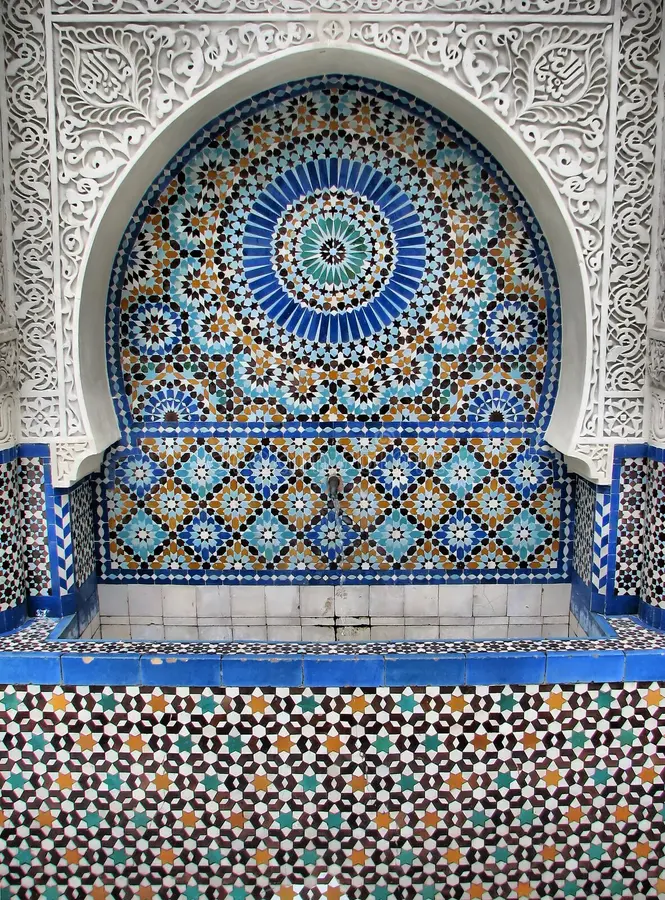
In this higher form of knowing, there is no longer any distinction between the knower and the known. Here, the knower, the knowing and the known are intrinsically one.[[109]] The knowing heart sees unity and wholeness. That is why Mencius says, “The way of learning is nothing other than to seek for the lost heart.”[[110]] For the heart is “spiritual clarity” or luminous, unitary intelligence, and the reality that lies behind all appearances.[[111]] But, this higher knowledge cannot be attained by reason and effort, only through faith and grace. In other words, to be truly human, the inner self has to be cultivated, so that the coarse physical functions of the material senses are gradually transmuted into the subtle organs of light through the seeker’s conscious neediness.[[112]]
The heart, the seat of awareness and consciousness, is the locus of the intellectual faculty to decipher reality—al-Ḥaqq. As mentioned by the Hadith Qudsi, “Neither My Heavens nor My Earth contain Me, but the heart of My believing servant contains Me,” for the heart is the point of contact between the divine and the human, where complete “imagining” and knowing take place. When this is fully realized, not only is man in his final state of entelechy—al-insān al-kāmil (the Perfect Man)—the barzakh as the “third thing”[[113]] that both separates and unites al-Ḥaqq and 𝑎𝑙-𝑘ℎ𝑎𝑙𝑞, but also the whole purpose of creation is fulfilled.[[114]] He has moved from potentiality to actuality, from nutfah to nuqṭa, to be what he is meant to be.
Conclusion
For mystics like Shabistari, this world is an illusion, not the real world. Similarly, the saying, “People are asleep; when they die, they awaken,”[[115]] implies that people are currently distracted by the illusions, desires, and fleeting nature of worldly life. Only upon death is the veil of ignorance removed, revealing the ultimate reality. Hence, the need to understand reality and to decipher, to move from the state of the “sleeper” who clings to this fleeting material world, to the state of awakened spiritual reality, brought through faith and the gift of Divine Grace.
To summarize, to decipher is to know the decipherer. “God created Adam in His Image”[[116]] for Adam is the First Man, the Spirit of Being. And, in virtue of his having been created in God’s Image, He made him His representative on earth.[[117]] In other words, the decipherer has to be a conscious being from the “line of prophethood,” not one from the “line of philosophy,” imbued with the Breath of the All Merciful (Nafas ar-Rahman), His Names and Attributes. This decipherer, the man, is the “third thing,” whose nature is barzakhi, lying between the Real and nonexistence. As such he is able to apprehend both the intelligible and sensible worlds for he lies in the intermediate world, the khayāl of Ibn ‘Arabi that Corbin[[118]] refers to as “creative imagination,” for this Imagination is active—the place of theophanic visions, the scene in which visionary events and symbolic histories appear in their true reality.
In the Gulshan, Shabistari uses the imagery of the Point, Line, and Circle to show the Unity of Being and the illusory nature of the phenomenal world, i.e., the ontological process of creation from the One to the many, the many being a reflection of the One.
The journey of existence then starts from the Divine (that first Point, metaphysical), descends into this temporal, sensible world (the arc of descent), and eventually returns to its origin (the arc of ascent).
The Point, Nuqṭa, represents the Divine Essence, the indivisible, Absolute Unity that is the source of all existence, that transcends all dimensions and multiplicity. As the “point” begins to move (or descend[[119]]), it creates a “line” (khatt),[[120]] representing the first stage of existence. It is, in other words, the path or “arc” created when the Divine Essence begins to manifest Its Attributes into the world. When this line/path completes its movement and returns to its starting point, a “circle” (dāʾira) is formed, indicating the totality of creation—the visible world, which appears separate from God but is actually an illusion created by the rapid, continuous motion of divine manifestation. The journey of existence then starts from the Divine (that first Point, metaphysical), descends into this temporal, sensible world (the arc of descent), and eventually returns to its origin (the arc of ascent).[[121]] The goal is to recognize this illusion and travel backward along the circumference—the world of multiplicity, through the line—knowledge/spirit, to return to the Point—the original Unity. Hence, From Point Comes a Line, and From Line Again a Circle, completing the cycle (see Fig. 2). This figure is none other than Fig. 1 seen from the top.
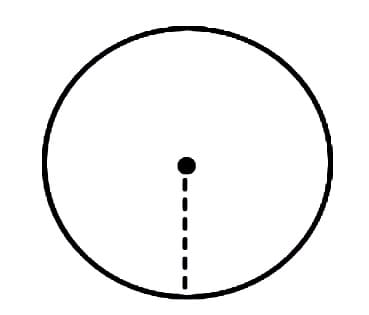
In other words, Shabistari, the decipherer, the man, is key in understanding his Point—Line—Circle representation. When Sayyidina ‘Ali ibn ‘Abi Talib said, “I am the dot beneath the ba (ب),” he is referring to himself, the “I” of ‘Ali, the one who utters and interprets, rather than the dot/nuqṭa, for the dot under the ba (ب) is already determined, hence the dot is just an ink marking.[[122]] But ‘Ali, as the utterer, is real, the wasaṭ[[123]] and the supreme barzakh between the divine reality (al-Ḥaqq) and the created cosmos. As the wasaṭ, he occupies a unique position of holding everything together, the bridge that ensures that the divine essence is manifested and active within creation. Hence, he acts as the mirror of Divine Reality. In this sense, ‘Ali is the inkpot that manifests the letters. Similarly in the case of Shabistari, he himself is the Attesting-Witness, the one who sees the world through the Divine Reality. Fig. 2 is that representation of the manifestation of the movement of the descent and ascent of man from the metaphysical Point into this world and back.
[[1]]: Sa’d Ud Din Mahmud Shabistari, The Secret Rose Garden, trans. and intro. by Florence Lederer (London: John Murray, 1920), p. 22. There are several renditions of the book, the latest being translated with commentary by Seyyed Hossein Nasr (Maḥmūd Shabistarī, Gulshan-i Rāz: The Rose Garden of Divine Mysteries [New York: SUNY Press, 2025]). Though not much is known about his life, Shabistari (ca 1288 to ca 1320-1340) was a Persian Sufi mystic and poet. From Lewisohn, we know that he was born in Shabistar near Tabriz, and he lived during the aftermath of the Mongol invasions (1219–1258). He spent most of his life in Tabriz, hence, he was deeply affected by the tumultuous socio-political landscape of the Il-Khanid Mongol period. It was a time of strife marked by intense theological controversy, including conflicts between Islam and Christianity, as well as sectarianism but it was also a center for Persian literary culture and Sufi thought, and he was deeply influenced by teachings of Ibn ‘Arabi. His masterpiece is the Gulshan-i Raz, with Muhammad Lahiji (d. 912/1507) a prominent 15th-century Persian Sufi master, poet, and philosopher providing the most celebrated and comprehensive commentary on the Gulsan in Mafātīḥ al-iʿjāz fī sharḥ Gulshan-i Rāz (Keys to the Inimitability/Wonder in Commentary on the Rose Garden of Mystery) written around 1473. Shabistari’s other works are Saʿadat-nama (The Book of Felicity), a didactic poem highlighting his later theological shifts, and Haqq al-Yaqin (The Truth of Certainty), his only known prose work focusing on theosophical certainty. Lewisohn portrays Shabistari’s work, particularly his masterpiece Gulshan-i Raz (The Rose Garden of Mystery) as a reaction to the religious and political crises of his time, and in his book “Beyond Faith and Infidelity” offers a metaphysical resolution to the challenges of his time. See Leonard Lewisohn, Beyond Faith and Infidelity: The Sufi Poetry and Teaching of Mahmud Shabistari (Richmond, Surrey: Curzon Press, 1995)
[[2]]: Leonard Lewisohn, Beyond Faith and Infidelity, p. 14
[[3]]: R. Rahbari Ghazani and A. Topaloğlu, “Mystical Contemplation or Rational Reflection? The Double Meaning of Tafakkur in Shabistari’s Rose Garden of Mystery,” Islam and the Contemporary World, 1:1, (2023), pp. 9-30. Lewisohn says these two types of thinking have been differentiated by Lahiji, where the first is thinking that pertains “to the head,” i.e., ratiocination or logical reasoning; and second, thinking as a reflection “of the heart,” an unveiling (kashf) that consists of the dual processes of “severance (from selfhood) and union (with God).” While both are valid in their own spheres of reference, unveiling is superior to ratiocination (Lewisohn, Beyond Faith and Infidelity, pp. 227-228)
[[4]]: Rumi too distinguishes between formal erudition (ʿilm) and mystical insight (maʿrifa), in which the latter is prioritized over the former. Here, in the poem, “Two kinds of Intelligence,” Rumi uses the language of metaphors common in Islamic mysticism—such as flowing water and tablets—to contrast empirical learning with spiritual awakening. The first intelligence is tied to education, competition, and social status, described through static images of storage and ranking, whereas the second is presented as an internal spring, unchanging and generative, aligned with spiritual intuition. The shift from “collecting” to “overflowing” emphasizes agency; that knowledge is not consumed but issued from the self. See The Essential Rumi, transl. by Coleman Barks with John Moyne, A. J. Arberry, and Reynold Nicholson (New Jersey: Castlebooks), p.178
[[5]]: Quote is from Toshihiko Izutsu, cited in Leonard Lewisohn, Beyond Faith and Infidelity, p. 228
[[6]]: Quote is from M. Ali Lakhani, ‘“Who will Rule, God or Man?” - Politics and the Sacred,’ Sacred Web. Available at https://www.sacredweb.com/volume-35/who-will-rule-god-or-man-politics-and-the-sacred/ This is the Platonic epistemology of anamnesis or the “Theory of Recollection,” the idea that learning is not the acquisition of new information, but rather the process of remembering knowledge that the soul already possesses. Plato argued that the human soul is immortal and existed in a “realm of Forms” before being born into a physical body. While in that realm, the soul had direct contact with perfect truths which it forgets when born
[[7]]: This is because correct ratiocination involves several stages, and mistakes can be made at any of these stages. The stages are outlined in Lewisohn (Beyond Faith and Infidelity, p. 230). Hence, due to this human fallibility, one cannot attain true knowledge of the Real and achieve certainty
[[8]]: Sa’d Ud Din Mahmud Shabistari, The Secret Rose Garden, p. 22
[[9]]: Haqīqah, from the Arabic root ḥaqq refers to “truth and reality.” Al-Ḥaqq is one of the ninety-nine names of God, so already embedded in the Arabic language is something that lies beyond this visible phenomenal world. See Syed Muhammad Naquib al-Attas, Prolegomena to the Metaphysics of Islam: An Exposition of the Fundamental Elements of the Worldview of Islam (KL: UTM, 2014), pp. 1-2
[[10]]: Syed Muhammad Naquib al-Attas, “Islamic Philosophy: An Introduction,” Journal of Islamic Philosophy, 1: 1 (2005), p. 12
[[11]]: Syed Muhammad Naquib al-Attas, “Islamic Philosophy: An Introduction,” Journal of Islamic Philosophy, 1: 1 (2005), p. 12
[[12]]: Hamid Parsania, “Unseen and Visible,” Islam & Science, 4:1 (2006), pp. 10-11
[[13]]: Wujūd is both being and finding. As knowing is ontological, only Being—the Absolute Reality, the only Existence, can truly know. All else are only His manifestations. Finding is epistemological, and relates to the self-knowledge of the finder, the human experience of “finding” or perceiving God. One who finds Him “finds” Him through spiritual unveiling (kashf) and direct “tasting” (dhawq) within their own heart and the cosmos. For the “People of Unveiling and Finding,” to exist is to be “found” by God, and to truly find God is to realize that one's own existence is borrowed from Him
[[14]]: Q 57:3
[[15]]: Physics has been taken to be the foundational science upon which all other sciences are based. It deals with the physical universe—of physical objects and physical laws, not the corporeal world that we live in. Using the language of mathematics, it is precise, objective and empirical. Wolfgang Smith defines it as a science based on the reduction of wholes to the sum of their “atomic” parts, the consequence of the Enlightenment. Put differently, it does not deal with the cosmos as a whole for in following Descartes bifurcation, the objectively real world consists exclusively of res extensa (bare-matter). All others that cannot be reduced to mere quantity is consigned to res cogitans (things of the mind). because we have been taught that this mathematical “physical” universe is the only real one, when in reality it is an abstraction of the “corporeal” reality we actually inhabit, we have what is term as the “elusiveness” of quanta, for quanta do not exist as “things” in the same way macroscopic objects do. Drawing on Aristotelian-Thomistic philosophy, he identifies quanta as potentiae (potencies), not "actualized" entities. Hence, quanta remain elusive, existing in a state of superposition, until they interact with a corporeal instrument. In this moment of "measurement," they are "instantiated" into our world through vertical causality. See Wolfgang Smith, The Quantum Enigma: Finding the Hidden Key (Sophia Perennis, 1995), Physics and Vertical Causation: The End of Quantum Reality (Angelico Press, 2019), and “Vertical Causation and Wholeness,” available at https://philos-sophia.org/vertical-causation-wholeness/
[[16]]: Wolfgang Smith, The Quantum Enigma, p. 109
[[17]]: Wolfgang Smith, The Vertical Ascent: From Particles to the Tripartite Cosmos and Beyond (Philos-Sophia Initiative Foundation, 2021), Chapter 9
[[18]]: Hans Bertens, The Idea of the Postmodern: A History (London: Routledge, 1995), p. 12
[[19]]: Joseph E. B. Lumbard, “Decolonizing Quranic Studies,” Religion, 13: 176 (2022), https://doi.org/10.3390/rel13020176; See also Joseph E. B. Lumbard, “Islam and the Challenge of Epistemic Sovereignty,” Religions, 15: 406 (2024), https://doi.org/10.3390/rel15040406. Though direct imperial colonialism has ended in many of the Muslim countries, coloniality is embedded in the structures of the society, remaining alive “in books, in the criteria for academic performance, in cultural patterns, in common sense, in the self-image of peoples, in aspirations of self, and so many other aspects of our modern experience. In a way, as modern subjects we breathe coloniality all the time and every day” (p. 6). In Iran, for example, this fascination with and dependence upon the West to the detriment of traditional, historical, and cultural ties to Islam and the Islamic has been termed as Gharbzadegi (rendered into English as Weststruckness, Westoxication or Occidentosis)—made famous by the intellectual Jalal al-e Ahmad. It is an indiscriminate borrowing from and imitation of the West, joining the twin dangers of cultural imperialism and political domination. Katouzian and Moazami, in their paper, traced the history of the concept from the late 19th century through to the Constitutional Revolution and the Pahlavi period, up to the Iranian Revolution of 1979 by analysing the sociopolitical ideas of Sheikh Fazlollah Nuri, Seyyed Hasan Taqizadeh, Ahmad Kasravi, Fakhreddin Shadman, Ahmad Fardid, Jalal Al-e Ahmad, and Ali Shariati. See Homa Katouzian and Morad Moazami, “Weststruckness: Its Trials, and Its Tribulations,” Iran Namag, 7: 1 (2024), pp. 192-215
[[20]]: The concept of the Great Chain of Being originated with the Greeks, and Arthur O. Lovejoy traced the history of this idea from Plato through the 18th century in his book, The Great Chain of Being: A Study of the History of an Idea (Harvard University Press, 1936). The Chain organizes all life and existence in a hierarchy of complexity and perfection, with God at the pinnacle and simple inorganic matter at the bottom. This ordered system is seen as a fixed, God-given hierarchy, placing humans above other animals and plants, and reflecting a belief in different degrees of “life and movement.” Each position in the chain is determined in such a way according to its utility to man, for man is special, being both human and spirit. And, he has to constantly struggle between the demands of these two sides, for is can go either way. See Mark L. Brake, “The Great Chain of Being,” in Revolution in Science: How Galileo and Darwin Changed Our World (New York: Palgrave Macmillan, 2009), pp. 89-98. E.M.W. Tillyard, in The Elizabethan World Picture (1943), applied Lovejoy’s ideas to literature, arguing that this rigid hierarchy was central to Shakespeare and his contemporaries. He showed how it governed the “macrocosm” (the universe), the “body politic” (social order/divine right of kings), and the “microcosm” (human psychology, where reason should rule passion). Both Lovejoy and Tillyard argue that a rupture in this chain would disrupt the natural order, leading to chaos
[[21]]: The proponents of this tradition go beyond asking about the “how” of things to the “why,” to discern the deeper reasons for the Islamic worldview. In other words, to go beyond the legalistic approach of the Shariah to the roots of Islamic thought, to the nature of reality itself. Murata call this the “sapiential tradition,” see Sachiko Murata, The Tao of Islam: A Sourcebook on Gender Relationship in Islamic Thought (Lahore, Pakistan: Suhail Academy, 2001), pp. 2-3. This is a living legacy, and participation in this legacy demands passing beyond illusory life and joining with real life. See William Chittick, “Ibn al-‘Arabi: The Doorway to an Intellectual Tradition,” Journal of the Muhyiddin Ibn ‘Arabi Society. Available at https://ibnarabisociety.org/doorway-to-an-intellectual-tradition-william-chittick/
[[22]]: Adam is the first human being and the father of mankind. He was a new creation (Q2:30), not one that is considered “as belonging to the anthropological classification of Homo” (see Syed Muhammad Naquib Al-Attas, On Justice and the Nature of Man: A Commentary on Sūrah Al-Nisā’ (4):58 and Sūrah Al-Mu’minūn (23):12-14 [Kuala Lumpur: IBFIM, 2015], p. 33
[[23]]: William C. Chittick, “The Recovery of Human Nature.” Paper presented at the 2008 Metanexus Conference, “Subject, Self, and Soul: Transdisciplinary Approaches to Personhood,” Madrid, July 13-17, 2008, later published in Transdisciplinarity in Science and Religion, 4 (2008), pp. 281-293
[[24]]: This is the meaning of “tawhid”—the universal truth that God is one, where reality is coherent, integrated, and whole. Ibid., p. 285
[[25]]: Translates, “We will show them Our Signs in the universe, and in their ownselves, until it becomes manifest to them that this (the Quran) is the truth. Is it not sufficient in regard to your Lord that He is a Witness over all things?” That is why Ibn ‘Arabi says concerning this verse, “When we come to understand these two affairs together, we come to know Him and it becomes clear to us that ‘He is the Truth.’” For Ibn ‘Arabi, the key to our knowledge of the external world is that it is an indicator of something within our own selves
[[26]]: Note that the creation of the cosmos precedes that of man
[[27]]: Even the discipline of psychology (from the Greek psyche—soul or mind and logos—study) that started as a “science of the soul” has transitioned from “soul” to “self,” representing a fundamental shift from a metaphysical, spiritual foundation to an empirical, subjective science. When psychology moved from philosophy to be a science in the late 19th century, it applies the methodology of the physical sciences to the study of man, hence the term “self” began to replace “soul” to remove any “metaphysical baggage” as “soul” often implies an unchanging, immortal essence that is non-empirical and unmeasurable, whereas “self” focuses on subjectivity—the individual’s unique experience and self-awareness, that makes it more palatable to the discipline. Indeed, Fullerton in his presidential address before the American Psychological Association (December 30, 1896) states that “psychology as natural science should resolutely confine itself to mental phenomena, and eschew all such metaphysical entitles as ‘substrata,’ ‘unit-beings,’ or ‘transcendental selves.’” In other words, the knower/self is a fundamental aspect of mental life, not necessarily a soul; the soul remains a metaphysical concept beyond the scope of scientific psychology. His is a “psychology without a soul” (G. S. Fullerton, “The ‘Knower’ in Psychology,” Psychological Review, 4: 1, 1897). Samuel Bendeck Sotillos’ recent article on “The Deification of the Psyche” further shows that Jung’s understanding of the self is also truncated only at the level of the psyche, and many times he conflates it with spirit. But that spirit is nothing other than the psychic in man, not the transcendent Spirit of Tradition; hence, the deification of the psyche. See Samuel Bendeck Sotillos, The Deification of the Psyche: Carl Jung and the Spiritual Crisis of the Modern World, available at https://www.sacredweb.com/volume-51/the-deification-of-the-psyche-carl-jung-and-the-spiritual-crisis-of-the-modern-world/ At present, psychology is defined as the scientific study of mind and behavior (see the American Psychological Association and the British Psychological Society), a process, aptly reflected in the title of Michael Graziano’s book, God Soul Mind Brain: A Neuroscientist’s Reflections on the Spirit World (MA: Leapfrog Books, 2010)—the total disappearance of God and soul from current mainstream psychology to matter
[[28]]: In the linguistic relativity theory of language lies the idea that language is not just a means of communication, for within a language itself, is embedded a worldview. Hence, when people speak, they articulate their worldview. The English word “reality,” from late Latin “realis” means “relating to things.” So, within the English language itself, there is inherent in the word “reality” connotations of materialism. This view of language is consistent with Heidegger’s in which he says that language is the “house of being,” and “in its home, man dwells. Those who think and those who create with words are the guardians of this home” (Martin Heidegger: Basic Writings, David Farrell Krell, Ed., [Harpercollins Publishers, 1992], p. 217). In other words, Heidegger sees language not merely as a linguistic construct of spoken and written signs, but an “ontological” construct that claims the being of its residents as they speak its tongue. Over the course of his association with Eastern texts and thinkers, Heidegger’s metaphors for language change from the “house of Being” to “Saying” and to “flower of the mouth,” showing the cross-cultural dimension of his thought (See Wei Zhang, Heidegger, Rorty, and the Eastern Thinkers: A Hermeneutics of Cross-Cultural Understanding (New York: SUNY Press, 2006). But, of course, his notion of language as “ontological” is different from the Muslim understanding because Heidegger rejects Sein or Being as a “God” or a supreme cause behind presence. To him, Being is a phenomenological event occurring in time, not a metaphysical Principle—the uncreated, non-manifested divine order. His approach is phenomenological, analyzing human experience to reach the meaning of Being, via language. That is why he sees language as the very articulation of life, “…the guardianship to which presence and absence are each entrusted and thereby the ‘house’ in which beings can find their way into their essence without Being having to be changed into the rigid permanence of mere presence.” (Otto Pöggeler, Martin Heidegger’s Path of Thinking, transl. Daniel Magurshak and Sigmund Barber [Atlantic NJ: Humanities Press International Inc. (1989)], p. 226. In other words, though he recognized that language may be “ontological” as attested to the words he used in his theorizing, he did not accept metaphysics in line with his predecessors in the “philosophy of life” (see Wilhelm Dilthey, the most celebrated of this “life philosophy,” available at https://plato.stanford.edu/entries/dilthey/). Hence, we will always be limited by our language, for as Wittgenstein says, “The limits of my language mean the limits of my world,” where language is our frame for thought, the very structure that shapes our experience of reality
[[29]]: The distinction between the two was first made by Karen Armstrong in A History of God: The 4,000-Year Quest of Judaism, Christianity and Islam (The Random House Publishing Group, 1993; see also her paper, Mythos and Logos: Faith in the Modern World, Sacred Web, available at https://www.sacredweb.com/volume-4/mythos-and-logos-faith-in-the-modern-world/). Mythos and logos are two ways of thinking used by people of the past that are both essential and complementary to arrive at truth, with each having its special area of competence. The former is primary, pointing to what is timeless and constant in our human existence and is concerned with meaning—going back to our origin and culture, while the latter is our rational, pragmatic and scientific thought that enabled us to function in the world. These two are equivalent to our self-aware (right-hemisphere) based on the deeper meaning of things and the rational (left-hemisphere) thoughts based on sensory evidence (see Iain McGilchrist, The Master and His Emissary: The Divided Brain and the Making of the Western World (New Haven: Yale University Press, 2009)
[[30]]: Al-Attas, in his Prolegomena to the Metaphysics of Islam, details four related terms in understanding the Western worldview which he deems as contrary to the Islamic vision of reality. First is secularization—a historical, “almost certainly irreversible” process that he sees as a cultural de-sacralization, characterized by the disenchantment of nature, desacralization of politics, and deconsecration of values. Secularization “frees” man from religious control, turning his attention away from the metaphysical toward the “now” and the “worldly” (saeculum). Second is secularism—a totalizing ideology, a “closed worldview” resulting from the process of secularization that seeks to replace religious worldview with a purely rationalistic and materialistic one, eventually destroying the foundations of religion. Third is modernity and modernism; while modernity is the constantly changing condition of Western culture and consciousness (because it has no metaphysical anchor), modernism is the accompanying intellectual and cultural movement that replaces revelation with human reason. Finally, the logical conclusions of this trajectory—postmodernity and postmodernism. Postmodernity is the age where the “artificial coherence” of modernism breaks down with continued secularization, leading to a fragmented world where no single truth is recognized as absolute, whereas postmodernism is an ideology characterized by historical relativism and skepticism. Al-Attas sees postmodernism as the final stage of secularization, where even the “rational” standards of modernism are discarded, leading to a complete “metaphysical confusion.” In short, al-Attas argues that in relation to reality, secularization is the historical process that removes the “sacred” from the world resulting in the ideology of secularism that actively opposes and replaces religion, and finding expression in modernism by replacing revelation with human reason, culminating in the relativism and loss of truth in postmodernism. Al-Attas argues that while the West views these shifts as “evolutionary progress,” from an Islamic perspective, they represent a “loss of adab” (right action/proper order) and a crisis of knowledge. See also his book, Islam and Secularism (Kuala Lumpur: ISTAC, 1993)
[[31]]: Tradition, as understood here, focuses on “the religious, metaphysical, and esoteric traditions of the world, in light of the one truth from which they proceed and to which they provide formally distinct but essentially equivalent paths of return” (see Charles Upton, “What is a “Traditionalist”? Some clarifications,” Sacred Web: A Journal of Tradition and Modernity, 17 [2006], p. 4). See also M. Ali Lakhani, Editorial: Is Tradition ‘Against the Modern World,’?” Sacred Web: A Journal of Tradition and Modernity, available at http://sacredweb.org/online_articles/sw47_editorial.pdf. See also the previous footnote of al-Attas on his critiques of secularization, modernism and postmodernism that run counter to religion and Tradition. Rene Guenon’s Reign of Quantity and the Signs of the Times (Sophia Perennis, 2001) describes a similar metaphysical attacks of Western civilization, in which he sees the modern world’s obsession with materialism, mechanization, and measurement as a disastrous move from the qualitative, spiritual, and traditional values
[[32]]: Raymond Martin and John Barresi, The Rise and Fall of Soul and Self: An Intellectual History of Personal Identity (Columbia University Press, 2006). However, this is not to deny the innate religious need of man for he is created to know, worship, and reflect the Divine; i.e., his natural state is as homo religiosus for his existence is anchored in God. But, in this world he gets distracted due to a myriad of factors that include modernizing influences, modernistic errors, and so forth, making him vulnerable to forgetfulness
[[33]]: Paul Patton, “Postmodernism: Philosophical Aspects.” In Neil J. Smelser and Paul B. Baltes (Eds.), International Encyclopedia of the Social and Behavioral Sciences (2nd ed), 18 (2001), pp. 684-689. http://dx.doi.org/10.1016/B978-0-08-097086-8.63062-3
[[34]]: Terry Cook, “Fashionable nonsense or professional rebirth: Postmodernism and the practice of archives.” Archivaria, 51, (2001), p. 15
[[35]]: Findings in quantum physics as well as the phenomenology of Heidegger reject this distinction of Subject-Object. Heidegger brings Subject and Object together by the concept of “Dasein,” Being-in-the-world, to show that no subject is distinct from the external world of things. “Being-in,” is the most essential and existential characteristics of Dasein, and it signifies also “dwelling,” “being familiar with,” and “being present to.” See Martin Heiddeger, Being and Time, trans. by John Macquarrie and Edward Robinson (Oxford, UK: Blackwell, 1962)
[[36]]: See Karen Barad, Meeting the Universe Halfway: Quantum Physics and the Entanglement of Matter and Meaning (Duke University Press, 2007), p. 31. Here, Barad offers her understanding of Bohr’s philosophical-physics. She argues that he neither subscribed to a Kantian noumena-phenomena distinction nor did he accept the possibility that scientists can gain access to the “things-in-themselves;” i.e., there is always interaction between the objects of investigation and what he calls “the agencies of observation.” In other words, the world cannot exist independently of human beings, which is aptly seen in the title of her book—the entanglement of matter and meaning
[[37]]: Ibid, p. 31
[[38]]: Verticality refers to an inward dimension, to something beyond man himself; that is, to metaphysics or first principles. In this understanding, there are other higher orders of reality besides the natural world that man currently lives in. It is the higher that governs the lower natural world so without this governance from the higher world, man becomes his own god (see Seyyed Hossein Nasr, An Introduction to Islamic Cosmological Doctrines [Thames & Hudson, 1978])
[[39]]: Wolfgang Smith, The Quantum Enigma, and Physics and Vertical Causation
[[40]]: In Sartre’s existentialism, “existence precedes essence,” means that humans are not born with a pre-defined purpose or nature. They first exist, then define themselves through their actions, freedom, and choices. As a staunch atheist, he concludes that humans are “condemned to be free” to define themselves. In contrast, take Mulla Sadra (c. 1571–1636), in his philosophy called Transcendent Theosophy (al-hikmat al-muta‘āliyah) also says that existence precedes essence. But his system is deeply rooted in theology. He views God as Pure Existence, all others are “gradations” of this single reality of existence, with humans occupying a flexible rank in a divine hierarchy. For Sadra, the “primacy of existence” (aṣālat al-wujūd) means that in the external world, only existence is real. Essence (quiddity) is merely a mental abstraction or a shadow that the mind uses to categorize the limitations of a particular act of being. Hence, his is a theistic, mystical ontology while Sartre’s philosophy is an anthropocentric project focusing on the radical agency of the individual in an empty universe. Hence, though both use the phrase “existence precedes essence,” they apply it to entirely different philosophical problems—Sadra to the fundamental nature of reality and Sartre to human freedom. Again, this is the limitation of language, where the words used are the same, but their meanings are different
[[41]]: Robert Barron, “The Philosophical Roots of Wokeism,” Religion & Liberty, 34 (1), Available at https://www.acton.org/religion-liberty/volume-34-number-1/philosophical-roots-wokeism. In it, the author argues that wokeism is not an ephemeral ideology that suddenly happened, but that it originates from the postmodern intellectual movement in the mid-20th century. Hence, an understanding of some of these thinkers, like Jacques Derrida, and Michel Foucault, is necessary
[[42]]: These four ages starting from the ancient Greeks to the present are: (i) Ancient Philosophy: The discovery of “reality,” (ii) The Latin Age: Philosophy of being, (iii) The Modern Period: The way of ideas, (iv) Postmodern Times: The way of signs. See John N. Deely, Four Ages of Understanding: The First Postmodern Survey of Philosophy from Ancient Times to the Twenty-First Century (University of Toronto Press, 2001), pp. 736-737
[[43]]: To quote from Deely, “The human animal is like all other animals in living in an actual objective world or Umwelt; but the human animal is unlike all other animals (at least on this planet) in that its actual objective world admits of an indefinite number of alternative possibilities, some of which can be actualized in turn. Thus human society is not only, like every society of animals, hierarchical; this hierarchy is civil as well, in that it can be embodied in different patterns of government agreed to by members of a given society, and it can be changed by further agreements, sometimes imposed by conflict” (pp. 8-9). Because of the uniqueness of the human Umwelt compared to the Umwelts of other animals, Edmund Husserl has named it Lebenswelt or the “lifeworld”
[[44]]: John Deely, “Toward a Postmodern Recovery of ‘Person,’” Espíritu LXI, nº 143 (2012), p. 159
[[45]]: Joseph E. LeDoux, The Four Realms of Existence: A New Theory of Being Human (Harvard University Press, 2023)
[[46]]: Michael S. A. Graziano, God Soul Mind Brain: A Neuroscientist’s Reflections on the Spirit World (MA: Leapfrog Books, 2010). To him, God and soul (or rather its modern proxy, consciousness) are things of the past, and both are nothing but illusions. Hence, it is all bare-matter
[[47]]: This is the idea that our culture has become increasingly synthetic and artificial, losing contact with what was once known to be real. The worst-case scenario is simulacra, an imitation of an original and in the postmodern world, these simulacra are copies of copies (of copies of copies, etc.) of originals that sometimes bear no resemblance to the actual original. Baudrillard identified four stages in this descent of an image: reflection of reality, masking of reality, absence of reality, and no relation to a reality becoming its own pure simulacrum. Jean Baudrillard, Simulacra and Simulation, trans. by Sheila Faria Glaser (The University of Michigan Press, 2010), p. 6. See also James Walters, Baudrillard and Theology (T&T Clark International, 2012), pp. 26-40
[[48]]: Jessica Schad Manuel, “Hyperreality: Tracing the Evolution with Jean Baudrillard.” Available at https://bookoblivion.com/2019/02/26/
[[49]]: Ludwig Feuerbach, The Essence of Christianity, trans. G. Elliot (New York: Prometheus Books, 1989), p. xix
[[50]]: Andreas Kemmerling, “Why Is Personhood Conceptually Difficult?” In Michael Welker (Ed.), The Depth of the Human Person: A Multidisciplinary Approach (UK: Wm. B. Eerdmans Publishing Co., 2014), pp. 15-44
[[51]]: The phrase is from Herbert Marcuse, One-Dimensional Man: Studies in the Ideology of Advanced Industrial Society (London: Routledge Classics, 1992). See also Edward J. O’Boyle who argues that the modern man is a contrivance, with his nature explained by the functions that he serves. He uses the example, homo economicus, constructed by orthodox economists to represent a passive economic agent who is entirely predictable—one that functions so as to maximize net personal advantage. It “…is a convenience, an assumption that does not reflect reality, a modern scientific tool of the type accepted across the sciences and adopted because it simplifies economic analysis.” As a contrived concept, it is entirely devoid of creativity, originality, imagination, intuition, and so forth. It is incapable of experiencing any emotion—neither sorrow nor joy, hatred or love, empathy nor indifference. As a fabrication of enlightened thinking, it is only a “something,” whose nature would be dictated by its maker/inventor. In other words, this “man” is essentially material, as opposed to Scriptural or traditional man who believes in the transcendent and whose nature goes beyond the material. (“Homo Economicus: Part Human, Part Machine.” Pieniądze i Więź, nr 1(86), 2020, 7-21
[[52]]: Niels Bohr, the main proponent of quantum philosophy, says that “on the scene of existence we are ourselves actors as well as spectators.” This phrase succinctly captures a key point of quantum theory; that human observers are no longer passive witnesses to a flow of physical events that they cannot influence. They are essential players in the action: their “free” choices can influence the flow of physical events. Niels Bohr, Essays, 1958-1962, On Atomic Physics and Human Knowledge (US, 1958) p. 81
[[53]]: Kalervo V. Laurikainen, The Message of the Atoms: Essays on Wolfgang Pauli and the Unspeakable (Springer, 1997), p. 53. According to Pauli, the psyche of the observer is inseparably mixed with the description of the observed object because he plans the experimental arrangement and interprets the results of the experiment, and this of course influences the way the results have to be described
[[54]]: Bernard d’Espagnat in Veiled Reality: An Analysis of Present-day Quantum Mechanical Concepts (Basic Book, 1995) also made a similar point—that science describes a reality “as it appears to us” (the empirical reality). He proposed that beyond this appearance must exist a “veiled reality” (or “independent reality”) that is holistic, non-material, and transcends space and time, which science can only approach indirectly
[[55]]: Ibid., Pauli considered observation as an “interaction” between the consciousness of the observer and the observed object. p. 57
[[56]]: These are all titles of books aiming to answer the question of “what is reality”
[[57]]: al-Fatihah, the opening surah of the Quran is seen to be a synthesis of its message and the most important. Known as Umm al-Kitab (Mother of the Book), it is the foundation of the Quran, containing its entire meaning—the nature of God, the relationship between God and human beings, and the main states of the human conditions. The rest of the Quran explicates the nature of this opening surah, and it starts with the ghayb (Q2:3), following the mysterious letters and God’s guarantee that this is His book that will guide the reverent. The Arabic “al-ghayb” is usually translated as “the unseen” in English. But this word has vast connotations and include the six pillars of faith (beliefs in Allah, angels, books, messengers, the Last Day and the Divine Decree). It also includes knowledge of the past, present, and future foretold by God and His Messenger (pbuh), like news on the creation of the heavens and earth, botanical and zoological life, past nations, Paradise and Hell, etc. See Muhammad Taqi-ud-Din AI-Hilali and Muhammad Muhsin Khan, The Noble Quran: English Translation of the Meanings and Commentary (Madinah, K.S.A: King Fahd Complex for the Printing of the Holy Quran). Ibn ‘Arabi defines the ghayb as “that of you which God has concealed from you, though not from Himself, and thus it indicates Him,” in Ibn ‘Arabi, The Seven Days of the Heart: Prayers for the Nights and Days of the Week, trans. Pablo Beneito and Stephen Hirtenstein (Oxford: Anqa Publishing, 2008), p. 6
[[58]]: Indeed, newer writings in philosophy, for example by Nicholas Maxwell distinguishes between the objective phenomenal world and the subjective experiential world. This is the fundamental philosophical problem, what he terms as the human world-physical universe problem; “How is it possible for there to be life of value in the physical universe?” (Human World and Physical Universe: Consciousness, Free Will, and Evolution [Rowman & Littlefield, 2001])
[[59]]: Speech issues from nuṭq—the root of language inbuilt in the cognitive faculty of the soul, called al-nafs al-nāṭiqah, given by God to man. It is this power of speech that enable the souls of the children of Adam to respond at Alast, the Day of the Primordial Covenant (Q7: 172). This is what differentiates man from animals, the existence of the soul that binds him to God for the soul possesses the cognitive power to identify its Lord and Creator, itself and others life itself, to articulate and discriminate, to formulate and communicate symbols. See Syed Muhammad Naquib al-Attas On Justice and the Nature of Man: A Commentary on Surah Al-Nisa (4):58 and Surah Al-Muʾminun (23):12-14 (KL: IBFIM, 2015), p. 31
[[60]]: Tegmark and Wheeler, proposes a “Theory of Everything,” (TOE), a unified law of nature, a single all-encompassing law that underlies the different manifestations in physics. This is the Holy Grail of physics—to find a TOE, one that unifies gravity with quantum mechanics, the macro and the micro. According to the authors, if such a theory exists, then it should be able to describe the properties of the world and its inhabitants. Max Tegmark and John Archibald Wheeler, “100 Years of the Quantum,” Available from https://arxiv.org/pdf/quant-ph/0101077, p. 8
[[61]]: This is the era of the Enlightenment (16th-17th century), where Descartes in following Galileo, emphasized quantity over quality in his quest to be scientific and objective, and in doing so, privileged human reason as the means in directing man to the “truth.” In his cogito ergo sum, mind was radically separated from body, and discursive reasoning became the way to validate one’s existence. Hence, sense perception was seen to be subjective and unreliable
[[62]]: This is aptly described by Heinz Pagels in his book, The Cosmic Code: Quantum Physics as the Language of Nature (New York: Dover Publication, 2012) in which he argues that the universe operates on fundamental laws, his so-called “cosmic code” that scientists have to decipher to uncover the rules and laws that underlie the universe, by means of the scientific method. To him, nature is also a form of revelation, just as scripture, for both may transform one’s understanding of the nature of reality
[[63]]: This is the “imaginative” or “imaginal” faculty which has the power to mediate between the senses and reason by representing perceptual objects without their presence, within the world of imagination, recognized in the Islamic tradition as an independent world of its own that continuously informs/acts on the visible world of phenomena. See Hooman Koliji, In-between: Architectural Drawing and Imaginative Knowledge in Islamic and Western Traditions (Routledge: 2015), pp. xxiv-xxv
[[64]]: In early Arabic literature, nafs was used to refer to the “self,” “soul,” “psyche,” or “person.” The term is also a cognate with the Hebrew word nephesh, meaning “soul” or “life.” The nafs is seen as the spiritual essence of a person which was breathed by God into the foetus in the womb of the mother. In that inbreathing of the Breath of the Merciful (wa nafakhtu fīhi min Rūḥī) the nafs is created and given His Names. The nafs is totally in-between in nature, lying between the body and the spirit, the Yes and the No, existence and nonexistence, always in flux, so it can go both ways. The concept of nafs is central to Islamic theology, for it refers to the individual’s inner self that influences behavior and desires
[[65]]: In the metaphysical system of Ibn ‘Arabi, the barzakh, the space between breaths represents the critical moment of absolute receptivity and emptiness. It is the point where the soul is neither fully in the world nor fully in the Divine, but in a state of “poverty” (faqr) that allows for the next new revelation. In other words, it symbolizes the instantaneous state of “non-existence” between one creative act and the next—the renewal of creation at each instant (tajdid al-khalq), where the inward breath represents the return of all things to their divine source (annihilation or fana'), and the outward breath denotes the manifestation of the world and the self-disclosure of God’s names. The space between breaths then is the silent, empty moment of “now,” where the heart is unburdened by the past and open to the continuous and fresh creation of God. Only the Perfect Man is able to walk between the two breaths, connecting with the Divine without abandoning the world. See William C. Chittick, Imaginal Worlds: Ibn ‘Arabi and the Problem of Religious Diversity (State University of New York Press, 1994); Sara Sviri, “Seeing with Three Eyes. Ibn al-‘Arabi’s barzakh and the Contemporary World Situation,” Synthesis Philosophica, 31:2 (2017), pp. 385-393
[[66]]: To Ibn ‘Arabi, this intermediate ontological realm is real, a “meeting place” where spirits are corporealized (given form) and bodies are spiritualised (rendered subtle), allowing for visions, dreams, and the manifestation of divine attributes. Like an image brings together two sides and unites them as one; it is both the same as and different from the two. See William C. Chittick, Imaginal Worlds
[[67]]: In the English language, 'de-' acts primarily as a prefix to convey the following ideas; reversal or negation, separation or removal, and descent or reduction, depending on contexts
[[68]]: This is the small diacritical dot used in Arabic script that holds a central place in the Islamic intellectual and spiritual traditions. The nuqṭa not merely acts as a functional part of writing, but as a metaphysical symbol, a foundational unit of aesthetic proportion, and a deep reservoir of philosophical meaning
[[69]]: Mohammad Obaidullah, Intellectual Significance of the Dot (Nuqṭa), available at https://netversity.io/intellectual-significance-of-the-dot-nuqta/?srsltid=AfmBOornFpgbfUUgD_h1lB6FLhafMulOWf9A2SXT59qTDEPozvl1885A
[[70]]: The principles of Islamic calligraphy were first laid down by Ibn Muqla in his theory of proportion script based on three sets of measurements (the dot, alif and circle), and is used by calligraphers up to this day. The tip of the pen (qalam) produces a rhomboid dot (nuqṭa) and the sizes of all the letters of a script are determined by the width of the nuqṭah. The first letter of script alif is then drawn based on a set number of rhomboid dots contingent on the type of script being used. Once the letter alif is formed, an invisible circle is drawn around the letter (the height of the alif is the diameter of the circle), serving the basis from which all letters of a script may be calculated. Calligraphy soon became a sacred art because the written word was seen to be the visible bridge to the unseen world of spirit
[[71]]: This is based on the metaphysics of Ibn ‘Arabi—of the descend of Being from Oneness to multiplicity
[[72]]: The drop of the male sexual discharge mixed with the female secretion
[[73]]: See Reza Shah-Kazemi (Ed.), The Essential Martin Lings (World Wisdom, 2023), the chapter on “The Symbolism of the Letters of the Alphabet.” In the text, point and ink are used interchangeably as symbols in the sense that writing is nothing other than a series of points of ink, citing Nabulusi that all the letters are engulfed in the Point. In short, all is ink. But the Point is essentially different from the letters; the latter being the qualities of the former
[[74]]: Michael Sells, Mystical Languages of Unsaying (Chicago: University of Chicago Press, 1994). Our everyday language cannot engage with the ineffable Transcendent without there being contradictions—paradoxes, aporias, and coincidences. These contradictions, though are not illogical. To the apophatic writer, the logical rule of non-contradiction functions for object entities. When the subject of discourse is a non-object and a no-thing, it is not irrational that such a logic be superseded. Everyday language falls short of meaningfully deciphering such mystical texts
[[75]]: Ibid., pp. 1-3
[[76]]: In Islamic mathematics, following Ibn ‘Arabi, one is not considered a number, for “…nothing comes to be from ‘one.’ The first of the numbers is two, and nothing whatsoever comes to be from two unless there is a third thing that couples them and relates one of them to the other…This is the property of the name the Singular [al-fard], since three is the first singular [i.e., the first odd number]. From this name becomes manifest every possible entity that becomes manifest. No possible thing becomes manifest from the One. it becomes manifest only from a plurality [jam‘], and the smallest plurality is three, which is the singular” (Sachiko Murata, The Tao of Islam, p. 151)
[[77]]: Annemarie Schimmel, The Mystery of Numbers (Oxford University Press, 1993), p. 42
[[78]]: Annemarie Schimmel, Deciphering the Signs of God: A Phenomenological Approach to Islam (State University of New York Press, 1994), pp. 76-77. In the declaration of faith, la ilaha ill-Allah, the question is, can a person say it without associating something with the One? In other words, mystics believed that only after the seeker’s complete annihilation in the divine, God Himself speaks through His mouth the profession of His own unity. In The Mystery of Numbers (New York: Oxford university Press, 1993, p. 42), Schimmel further adds that for those who are able to understand/decipher the signs of God, it should be obvious as to why the Quran starts with the letter b or Arabic “ba” (ب) in the formula Bismillahi… (In the Name of God). The numerical value of b as 2 points to the duality inherent in everything created, while the first letter of the alphabet, alif with a numerical value 1, is the cipher for the One and Unique God. M. Ali Lakhani, in his recent paper, “Sura Al-Fatiha, The Heart of the Qur’an: Reflections on the Opening Chapter of the Qur’anic Recitation” (available at https://www.sacredweb.com/volume-53/sura-al-fatiha-the-heart-of-the-quran/) discusses many similar points that are made here, such as the Divine Names, prayer, the meaning of the term “Allah,” dhikr Allah, and the dot beneath the “ba” (ب)
[[79]]: 'God the Speaker: The Many-Named One' is the title of the article by Tim Winter, in George Archer, Maria M. Dakake, and Daniel A. Madigan (Eds.), The Routledge Companion to the Quran (Oxon: Routledge, 2022). He is One, but His Names and Attributes are many. In the Quran, when expressing His characteristic of Grandeur (e.g., Loftiness, Magnificence, etc.), the (plural) pronoun is used. And when expressing the fact that He is One, the singular pronoun is used
[[80]]: Annemarie Schimmel, Deciphering the Signs of God, p.119. Unlike the word God, “Allah” has no plural, masculine or feminine form, and is never used for any other object or being (Q19:65). It is a substantive name, neither attributive nor descriptive. It has no parallel or equivalent in any other languages
[[81]]: The name “Allah” contains all the Divine Names. In the Islamic tradition, all beings reflect certain Divine Names and Attributes, but man is the only being in the world who in his full reality is the mirror that can reflect all the Divine Names. This is why one of the names of the Prophet, as the Universal Man is ‘Abd Allah
[[82]]: Ibid., p. 119
[[83]]: In Arabic, “Allah” is written as “الله”, a word consisting of the first letter ا (alif), second letter ل (lām), third letter ل (lām), and the final letter ه (Hā). The alif, the first letter of the Name is also the first letter of the alphabet, written as is a straight vertical line, symbolizing the descent of the One or Divine Word from the world of utter Transcendence into the human world and human language, meeting in the point/dot under the second letter of the alphabet, the “ba” ( ب ), a curved horizontal line. That point or nuqṭa alludes to the Origin and Reality itself. See Seyyed Hossein Nasr, Caner K Dagli, Maria Massi Dakake, Joseph E.B. Lumbard, and Mohammed Rustom (Eds.), The Study Quran: A New Translation and Commentary (HarperOne, 2017), p. xxxiii. Note also that the alif, representing the One Reality, always remain alone, for it is One without a second, and hence, not joined to the letters that follow it. See also M. Ali Lakhani, “Sura Al-Fatiha, The Heart of the Qur’an” https://www.sacredweb.com/volume-53/sura-al-fatiha-the-heart-of-the-quran/
[[84]]: The final “ه” of “الله” affirms that there is yet a divine secret, something not heard or pronounced, the life behind all life, without name and form and beyond all our ideas of the divine. As stated by one Sufi author (cited by Neil Douglas-Klotz, in his book, The Sufi Book of Life: 99 Pathways of the Heart for the Modern Dervish [New York: Penguin Group, 2005], p. 5), “Allah” is really not “God”; i.e., Allah points to a being that is beyond humanly constructed images, ideals, and names. It (not the name) is the ground of Reality, the Only Being.” This is why in the usual list of God’s Most Beautiful Names, “Allah” is not one of the ninety-nine names. And, “to show that it is beyond numbering and yet includes all numbers, it is sometimes symbolically numbered zero, indicating both everything and nothing, being and non-being, infinity and each moment. Just as zero times any number equals zero, when any quality is “multiplied” by this Reality, only the Reality remains” (p. 5). See also M. Ali Lakhani, “Sura Al-Fatiha, The Heart of the Qur’an” https://www.sacredweb.com/volume-53/sura-al-fatiha-the-heart-of-the-quran/
[[85]]: The cosmos and man are reflections of each other: the cosmos is macrocosm and man is microcosm, with the same reality manifests in each
[[86]]: To Ibn ‘Arabi, in the context of the unity of being, this macrocosm-microcosm principle implies a complete correspondence between knowledge of the cosmos and knowledge of God, because there is nothing in existence but Him. Furthermore, both cosmos and man are made in the image of God; hence, in knowing the cosmos, man comes to know himself. So, there is no such thing as knowledge of “external” things; there is only knowledge of the self. In other words, “He who knows himself knows his Lord.” See Jane Clark, Fulfilling our Potential: Ibn ‘Arabi’s Understanding of Man in a Contemporary Context, available at https://ibnarabisociety.org/fulfilling-our-potential-jane-clark/
[[87]]: Note that Christianity too, before the Enlightenment believes in a transcendent God. For example, Thomas Aquinas argues that God is the primary substance (pure actuality, “Ipsum esse subsistens”), while all other beings derive their existence from, and are dependent upon, God’s essence. In other words, others are “shadows” of this divine substance. In this hierarchy of being, God is the necessary, uncaused being, and all other contingent beings exist only because of their relation to the Divine. After the Enlightenment, however, Aquinas’ transcendent God is replaced with that of Spinoza’s god of nature. In other words, the absolute and transcendent God is now naturalized, and man is no longer seen as a reflection of the Divine
[[88]]: One of the interpretations given by Ibn ‘Arabi in the creation of Adam is that “God created Adam according to the form of the Name Allah,” which he refers to as the ism jāmi’, the Name which totalizes all the other Divine Names. In his original form man carries within him all the Divine Names of which he is, potentially, the most perfect receptacle. That is why, of all creatures, man is the only one capable of ‘containing’ God because he was created according to the Form of [God]. It is due to this honor of being a guardian of His Names that man is chosen to act on His behalf as khalīfa, though most often he forgets his dependence the One who appoints him as such. See Claude Addas, “The Paradox of the Duty of Perfection in the Doctrine of Ibn ‘Arabi,” Translated from the French by Cecilia Twinch. Journal of the Muhyiddin Ibn ‘Arabi Society, Vol. XV, 1994
[[89]]: The Arabic raḥim, the maternal seat of life, is God’s Mercy for in this condition, He creates an abode of life-giving compassion (rahma) where the child (initially a nutfah becomes a nuqta) is sustained, cared for and developed under His Care, and it is in the rahim-womb that the nafs makes its appearance (wa nafakhtu fīhi min Rūḥī). In other words, this total “darkness of unknowing” is to produce in the womb a sense of total unity of Time/Space, of wholeness, for each child is created complete and born in tawḥīd—a singular being, al-insan al-mufrad, in a state of oneness
[[90]]: Syed Muhammad Naquib Al-Attas, On Justice and the Nature of Man, who says, “Man is man, he is his very self, whose existence is indicated when he says “I,” and whose identity is the articulate soul, the soul and the reality of man that defines him.” (p. 36)
[[91]]: Asfahani, p. 19. Indeed, these qualities of intellect (aql), thinking (fikr) and articulation (nutq), are what differentiate him from all other creatures of this earth
[[92]]: One aspect pertaining to spiritual, rational soul—al-nafs al-nātiqah, and the other the physical vital soul—al-nafs al-hayawāniyyah. Hence, man is both insān and bashar. See Syed Muhammad Naquib al-Attas, Islam: The Covenants Fulfilled, p. 10
[[93]]: This is what distinguishes man from the rest of creation—the gift of the nafs—that consciousness which enables him to break through the world of forms and enter the spiritual beyond. This liminality is also known by names such as bayniyya, khayāl, mundus imaginalis, the hidden third, indeterminacy, borderlands, and so forth, denoting the in-between nature of the nafs—man’s true nature. For Al-Ghazali, this is the heart or qalb, due to its remarkable quality of always being in a state of fluctuation, enabling it to continuously see the self-disclosures of God is such that it is always in a constant state of vacillation (taqallub). See Noraini M. Noor and Aziuddin Ahmad, “The Notion of Man from the Islamic Intellectual Tradition and Modern Science,” Sacred Web: A Journal of Tradition and Modernity, 49, pp. 43-46. This is also the reason why traditional religions see man as a ternary, constituting of the Spirit (ruh), psyche (nafs) and body (jism), with the nafs acting as a bridge that connects the two different realms. Often, psyche and body are categorized together as the “lower/outer self” for two reasons: (i) the body in itself has no directive force, needing some higher power or faculty like the psyche to direct it; and (ii) both psyche and body lack permanence for they are always in a constant state of becoming, and hence, never stable (Coomaraswamy, 2002)
[[94]]: In his book, Islam: The Covenants Fulfilled, Syed Muhammad Naquib al-Attas (Kuala Lumpur: Taʾdib International, 2023) argues that Prophet Muhammad (pbuh) brought the final, universal religion that completed the chain of prophecy, incorporating and finalizing earlier revelations. While previous prophets brought Islam, Muhammad (pbuh) is the first to establish the completed, formal, and universal religion of Islam as revealed in the Quran, emphasizing the difference between milla (a system of beliefs, rituals, and practices that forms the socio-historical-culture of earlier prophets and communities) and din (a religion or way of life as revealed and perfected by Allah, emphasizing its divine origin, not a cultural evolution. It implies a comprehensive, structured, and binding submission to God. (See Q39:12, “And I am commanded (this) in order that I may be the first of those who submit themselves to Allah (in Islam) as Muslims”)
[[95]]: Colin Turner and Hasan Horkuc, Said Nursi, pp. 62-67; Colin Turner, The Qur’an Revealed, pp. 185-190
[[96]]: “Life, Inc.” is a book by Douglas Rushkoff that argues how corporatism and its values have overtaken community and civic responsibilities, leading to a world where everything is commodified and community has dissolved into consumer group. In other words, it is the “corporatization” of life itself
[[97]]: Hugo de Garis, “What if AI Succeeds? The Rise of the Twenty-First Century Artilect,” AI Magazine, 10: 2 (1989). In the age of machines and AI, de Garis poses two important questions that needs to be addressed with the rise of AI: What is life? What is intelligence?
[[98]]: The three-dimensional world as well as the self have now been conditioned to live as flatlander in two-dimension, much like the allegory of Plato’s cave. In John D. Barrow’s The World Within the World (New University Press, 1988), he mentions that though in reality the Universe is four-dimensional, it appears three-dimensional because the fourth-dimension is too minute to be perceptible to us. In other words, the higher dimension remains curled-up to an infinitesimal extent (pp. 190-193). See also Ruth E. Kastner, Understanding Our Unseen Reality (Imperial College Press, 2015)
[[99]]: The terms were coined by the German sociologist Ferdinand Tönnies to differentiate between the rural, peasant societies that were being replaced across Europe by modern, industrial ones. Gemeinschaft is characterized by a strong sense of common identity, shared norms, and close personal relationships, while Gesellschaft is characterized by impersonal relations, formal organization, and the absence of common, binding norms. See Ashley Crossman, “Overview of Gemeinschaft and Gesellschaft in Sociology,” available at https://thoughtco.com/gemeinschaft-3026337
[[100]]: But He can be recognized via His signs in the universe. In other words, the universe is nothing but a display of His Most Beautiful Names and Attributes, manifested individually. In man, however, these Names are brought together/abridged, non-differentiated (mujmal)
[[101]]: See Baruch Spinoza, Stanford Encyclopedia of Philosophy. Available at https://plato.stanford.edu/entries/spinoza/
[[102]]: This is similar to the distinction between Rumi’s “internal fountainhead-knowledge and external plumbing-knowledge” on the first page of the Introduction. See Footnote 4
[[103]]: These two kinds of knowing correspond also to the medieval distinction between intellectus and ratio, or mystical and rationalist disciplines of knowledge, respectively, with the former cultivated by the Sufis and the latter by the theologians. See William C. Chittick, “The Recovery of Human Nature,” pp. 281-282
[[104]]: Nasr and Ogunnaike also differentiate between these two types of knowing. They pointed out that Ibn ‘Arabi, in his famous poem (“My heart has become receptive to any form…”), capitalizes on the word qābil (receptive) that is also derived from the same root letters as qalb (ق ب ل) to emphasize the dynamic receptivity of the heart to theophanies. See Seyyed Hossein Nasr and Oludamini Ogunnaike, “The Heart (qalb),” St Andrews Encyclopaedia of Theology, 2024, available at https://www.saet.ac.uk/Islam/Heart
[[105]]: Gulshan I Raz: The Mystic Rose Garden of Sa’d Ud Din Mahmud Shabistari, trans. Edward Henry Whinfield (London: Trubner & Co., 1880), pp. ix-x
[[106]]: The term “heart” (qalb) for al-Ghazālī has two meanings. The first means the piece of flesh in the body of man or animal, living or dead. The second means that “subtle tenuous substance of an ethereal spiritual sort (laṭīfa rabbāniyya rūḥāniyya) which is connected with the physical heart…the real essence of man…that perceives and knows and experiences…” (p. 6. See Al-Ghazali, The Marvels of the Heart [Ihya Ulum Al-Din/The Revival of the Religious Sciences, Book 21], trans. from the Arabic with an Introduction and Notes by Walter James Skellie with a Foreword by T.J. Winter. al-Ghazālī uses the term qalb (heart) to depict the soul for the heart is never constant, it is always in a state of flux, taqallub, constantly “turning” or “being turned” according to the way God makes Himself known, i.e., the heart or qalb changes in response to the Divine revelation (tajalli)
[[107]]: William Chittick, “Ibn al-‘Arabi: The Doorway to an Intellectual Tradition”
[[108]]: Jane Clark, “Fulfilling our Potential: Ibn ‘Arabi’s Understanding of Man in a Contemporary Context,” Journal of the Muhyiddin Ibn ‘Arabi Society. Available at https://ibnarabisociety.org/fulfilling-our-potential-jane-clark/
[[109]]: What William Chittick (“The Recovery of Human Nature”) calls the “the unification of the intellecter, the intellected, and the intelligence” (p. 282)
[[110]]: Cited in Mohammed Rustom, Atif Khalil and Kazuyo Murata (Eds), In Search of the Lost Heart – William C. Chittick (SUNY Press, 2012), p. 313. Mencius further says that the lost heart is nothing other than the true human nature. Hence, learning to find the lost heart is to learn to be human because man is not born human, he has to actively pursue a way and be human—ren or man’s heart (p. 315). This is our fitra, our primordial nature
[[111]]: Ibid., p. 315
[[112]]: Sara Sviri, The Taste of Hidden Things, p. 190
[[113]]: According to Salman Bashier, Ibn ‘Arabi uses the barzakh to describe a limit-situation that is dynamic and creative in allowing opposites to be reconciled without merging. Hence, he named it as “the third thing” (al-shayʾ al-thālith) that exists between the Absolute and nonexistence. It is represented by the Perfect Man (al-insān al-kāmil), the bridge through which the Unknowable Essence becomes accessible to human perception. In other words, the barzakh is “neither existent nor nonexistent, yet it is both.” It is the space where God’s paradoxical nature, both transcendent and immanent, is manifest in the Perfect Man who unites divine and cosmic realities. See Salman H. Bashier, Ibn al-‘Arabi’s Barzakh: The Concept of the Limit and the Relationship between God and the World (Albany: State University of New York Press, 2004), and Salman H. Bashier, Philosophy of the Limit: Ibn ‘Arabi’s Barzakh Concept and the Meaning of Infinity. The University of Utah: PhD Dissertation, 2000
[[114]]: Jane Clark, “Fulfilling our Potential”
[[115]]: The saying is attributed to Ali ibn Abi Talib
[[116]]: Hadith Sahih al-Bukhari 6227 and Sahih Muslim 2841
[[117]]: According to Martin Lings, the First Man is created based a priori on God’s Image of man’s spiritual prototype; i.e., the Universal Man. That First Man is represented by Adam in this world. See The Essential Martin Lings, pp. 20-21
[[118]]: Ibid., p. 4
[[119]]: The is the Vertical Causality of Wolfgang Smith—that instantaneously “form-bestowing” agency from a transcendent, higher reality to the lower, that collapses the quantum wave-function (see Footnote 17). This is like the Muslim understanding of God’s saying Be! (Kun!) when He wants a thing to appear in creation
[[120]]: The line is not a separate entity but the result of the “rapid motion” of the single point. Just as a spinning point of light appears to be a line, the multiplicity of the world is an illusion caused by the swift manifestation of Divine Light
[[121]]: In Martin Ling’s 'Symbolism of the Letters of the Alphabet,' the ink is as nutfah, unknowable and undefinable, and as it overflows, it becomes the point/dot from which emerges the letter Alif, and from the Alif all the other letters are manifested. See The Essential Martin Lings, pp. 22-23
[[122]]: See Haydar Amuli, in Toshihiko Izutsu, “The Basic Structure of Metaphysical Thinking in Islam,” Mehdi Mohaghegh and Hermann Landolt (Eds.), Collected Papers on Islamic Philosophy and Mysticism (McGill University: Montreal Institute of Islamic Studies, Tehran Branch, 1971), who says, “Letters written with ink do not really exist qua letters. For the letters are but various forms to which meanings have been assigned through convention. What really and concretely exists is nothing but ink. The ‘existence’ of the letters is in truth no other than the ‘existence’ of the ink which is the sole, unique reality that unfolds itself in many forms of self-modification. One has to cultivate, first of all, the eye to see the self-same reality of ink in all letters and then to see the letters as so many intrinsic modifications of the ink” (p. 66). In other words, letters have no independent existence and are merely loci of manifestation for the ink, so also the physical world is but a locus of manifestation for the divine names, attributes, and acts
[[123]]: As wasaṭ, man is the “middle” that joins the Divine and the created, the intersection between the “Necessary Being” and the “contingent being.” And, the specific site of this “middleness” is the human heart that is constantly “turning/in flux” (taqallub from the Arabic word qalb that means “to turn over,” “to invert,” or “to flip upside down” to receive different divine manifestations, making it the most flexible and central point of existence


