
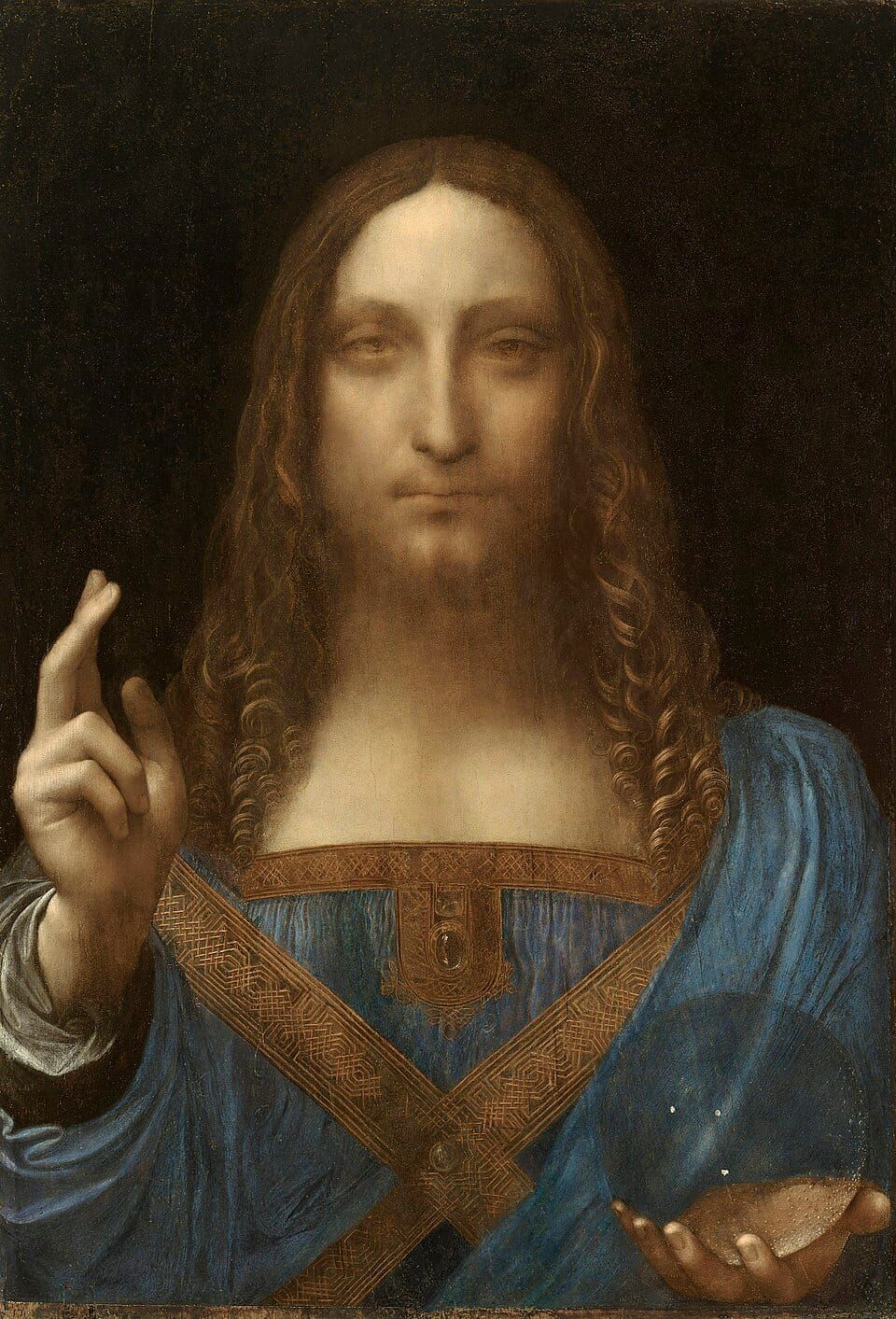
20 And, behold, a woman, which was diseased with an issue of blood twelve years, came behind him, and touched the hem of his garment:
21 For she said within herself, If I may but touch his garment, I shall be whole.
22 But Jesus turned him about, and when he saw her, he said, Daughter, be of good comfort; thy faith hath made thee whole. And the woman was made whole from that hour.
Matthew 9 (KJV)
Introduction: Healing and Wholeness
Given our topic of healing in relation to wholeness and holiness, let us begin with the observation that in the Gospels, Jesus explicitly connects healing with ‘being made whole’ by one’s faith. It is reported by the Evangelists that Jesus used a particular phrase to make this connection: ‘Thy faith hath made thee whole’.
In the passage quoted in the epigraph, he says those words to the woman with the bleeding disorder whom he has miraculously healed, and both Mark (5:34) and Luke (8:48) confirm this in their recounting of the miracle.
Mark tells us that Jesus also used the same expression in the healing of the blind beggar Bartimaeus: "And Jesus said unto him, Go thy way; thy faith hath made thee whole. And immediately he received his sight, and followed Jesus in the way.” (Mark 10:52), and Luke tells us that he used the phrase when speaking to the grateful Samaritan leper, one of the ten lepers he had healed, and the only one who had returned to thank him: "Arise, go thy way: thy faith hath made thee whole." (Luke 17:19).
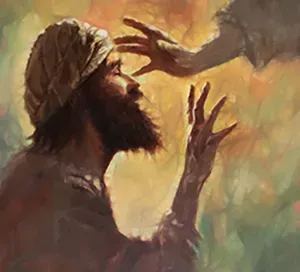
In each case, Jesus’ words highlight the connection between healing and wholeness. So, let us begin by asking: What does it mean to be made whole by one’s faith, and what does this have to do with healing?
The phrase ‘Thy faith hath made thee whole’, spoken by Jesus in Aramaic to the healed woman, is 'haymanut-akh hayath-akh'. ‘Faith’, ‘hayman’, is from the proto-Semitic root H-M-N (from which the words ‘amen’ and Arabic ‘iman’ are derived). The Aramaic term employed in the Gospels for being ‘made whole’, ‘haya’, is from the root H-Y-Y (which is also the root for the Hebrew word חיים, ‘chaim’, or ‘life’), meaning 'to be given life' or 'to be born', and also means ‘to be saved’ or ‘to be healed’. In Aramaic, Jesus is named ‘Yeshua', and is given the title 'Mkhyana' ('Saviour' or 'Life-Giver'), both from the root 'haya’. In Arabic, the appellation, Al-Hayy (الْحَيُّ), meaning ‘The Ever-Living’, is one of the Beautiful Names of Allah الأَسْمَاءُ اللهِ الْحُسْنَى (Al-Asmāʾu llāhi l-Ḥusnā).
In the Greek Bible, the phrase ‘Thy Faith hath made thee whole’ is rendered as follows: ‘he pistis sou sesoken se’. The key term used is ‘sozo’ (σῴζω), a verb meaning to save or preserve, to heal, or to make whole. It is the root verb of ‘sesoken’ (the perfect form of the verb) and derives from the ancient Greek term ‘sos’ denoting safety, as in a place of sanctuary or a haven of peace. ‘Sos’ is the root of ‘soter’ (Saviour) and ‘soteria’ (Salvation). The term ‘sozo’ (or Aramaic ‘haya’) and its variants appear over 100 times in the New Testament. As a verb, ‘sozo’ (sometimes rendered as ‘being born again’) encompasses the entire arc of Jesus’ teaching, from physical and holistic healing to spiritual restoration and eternal salvation.
One can see this more spiritual sense of healing as eternal salvation in another passage: Matthew 16:25. Jesus uses the term sozo here in a different way than to denote physical healing. He uses it to signify spiritual healing, and in doing so he refers to the paradox of salvation, namely, that one must give up one’s life in an outward sense in order to gain it inwardly. He states:
25 For whosoever will save his life shall lose it: and whosoever will lose his life for my sake shall find it.
‘Sozo’ here (or Aramaic 'naḥḥē') denotes the verb ‘to save’, a more common Biblical usage than ‘to heal’. This more all-encompassing sense of salvation or spiritual restoration, as the passage just cited denotes, requires one to become as Nothing in one’s creaturely selfhood (kenosis, in the sense we will describe later) in order to be made Whole in God. This is a central theme not only in the mission of Jesus, but also in the teachings of the Dominican preacher, Meister Eckhart (1260-1328).
In this presentation, we will examine the connection between healing, wholeness and holiness, terms used in the title. As we shall see, Eckhart taught that healing was to be obtained by finding repose, through detachment, in the spiritual sanctuary or core of oneself, the very source of life, a place that Eckhart referred to as the soul’s Citadel (Bürglein), figuratively known as the ‘Heart’ (‘core’ is the cognate of Fr. coeur).
It is helpful to recall that the terms ‘whole’, ‘heal’, and ‘holy’ are cognates, whose meaning is captured in the phrase ‘to be hale and hearty’. ‘Hale’ is etymologically related to the Germanic term ‘heilig’, denoting ‘holy’ or ‘sacred’. To be ‘hale’ is not only to be robust and healthy (its conventional meaning) but, more profoundly, to be centered in the core of one’s being, the Heart. The term ‘hearty’ in this expression therefore means to be ‘of good Heart’, at rest in God.
In the Heart, it is the kenotically self-emptied soul, the Inner Man alone who acts, expressing the Divine Will, connecting all creatures through the enlivening Divine Substance of His love and His goodness. The usurping self of the Outer Man is purged and ‘denied’, reduced to the ‘poverty‘ of Nothingness to accommodate the plenitude of God – to be born again.
Healing is therefore about a pilgrimage to the Heart, to the place that T.S. Eliot (in Burnt Norton), and Thomas Merton after Eliot, referred to as the ‘still point’. It is a sacred space that Merton also referred to as ‘Eckhart’s Castle’, a place where the attachments of the world and the egoic self are transcended and sublimated, and where the soul reposes in the Ground of her Spirit, in the paradox of Nothingness which is also Wholeness. Let us begin by examining those terms.
Nothingness and Wholeness
The theme of exchanging human Nothingness for divine Wholeness – of losing one’s life temporarily to find it eternally in God – is central to Meister Eckhart’s teaching. He refers to it as ‘an equal exchange and barter’ by which one empties oneself of all that is not God in order to gain all that is God. By detaching from what is contingent and peripheral the soul comes to realize what is Absolute and Real. To restate this in terms of healing, the soul exchanges her debilitating restlessness for salubrious repose in God. This, as Eckhart tells us, is the only means of obtaining true peace.
In his Talks of Instruction (4: Of the Value of Resignation: What to Do Inwardly and Outwardly) he describes the bargain in these terms:
“It is really an equal exchange and barter: just as much as you go out of all things, just so much, neither more nor less, does God enter in with all that is His – if indeed you go right out of all that is yours. Start with that, and let it cost you all you can afford. And in that you will find true peace, and nowhere else.”
When Eckhart states that ‘just as much as you go out of all things, just so much, neither more nor less, does God enter in with all that is His’, he is expressing the formula of the spiritual law implied in Jesus’ teaching, cited earlier (in Matthew 16:25) about the exchange of the worldly for the spiritual, of the temporal for the eternal. But first, he reminds us, the soul must ‘go out of all things’ (that is, detach from contingent reality) in order to create the space for God’s grace and love to fill. Only in this way can the soul ‘find true peace’ (restorative healing and fulfillment in God, that is in the eternal life/ ‘haya’).
But what is this space that the soul occupies, free of all things? And what exactly is the soul? What is the ‘life’ to be exchanged in this barter? The soul is the ’in-between’ or liminal space within Man, where a choice is to be made: to turn to the animating Source which is humanity’s Ground or to turn away from it to the distracting world of things. Jesus uses the Greek term ‘psyche’ to designate this threshold (the Sufis refer to it as the ‘barzakh’ or isthmus). The terms used to denote the soul is ‘naphsha’ in Aramaic; the equivalents are ‘nephesh’ in Hebrew and ‘nafs’ in Arabic. The liminal nature of the soul within the microcosm implies that in one’s psychological (outer) death there is a spiritual (inner) gain to be derived by the soul orienting itself to her sustaining Ground and being thereby opened into a more authentic selfhood. The psychic self is the space where the spiritual struggle occurs, where the soul either submits to absorption within the higher order of spiritual reality (and thereby accepts the ‘bargain’) or else succumbs to the contingent world of things and of ephemeral surfaces (and so refuses salvation for worldly gain). To better understand the paradox of Wholeness and Nothingness – that one must become ‘nothing’ to be ‘made whole’ – we must begin with Eckhartian metaphysics and the cosmological principle of procession and return.

The philosopher Gottfried Wilhelm Leibniz (1646-1716) had famously posed the question, ‘Why is there something rather than nothing?’ Traditional metaphysics adopts a view of reality, which consists of levels of descending hierarchy proceeding from a Point of Origin, a transcendent and principial Center from which the entire cosmic sphere originates. This subtle Point of Origin is, metaphysically speaking, ‘Nothing’. It is beyond ‘things’ as such, though creation, which It originates and sustains, cannot exist except by participating in its Ground. Its mystery is expressed exquisitely in the first stanza of the Tao Te Ching. We quote it below in the translation by David Bentley Hart (published in 2026):
“That Way that abides forever is not a way that can be trodden,
that Name that abides forever is not a name that can be uttered:
when nameless, it is the pure origin of Heaven and Earth,
when named, it is the Mother of all the myriad things.
Abandon desire and its figments forever,
and you will be granted the vision of that wondrous mystery,
cling to desire and its figments forever,
and you will see only the surfaces of things.
Yet both the hidden and the manifest issue from a single source,
even if we speak as though they were wholly different.
All we can say of them is that they are an abyss of mystery,
and even then a mystery that constantly deepens—
this is the gateway through which one enters
into the wondrous mystery of all things.”
It is the Essence which is Beyond Being (hence, the Nothing which is the ‘pure origin’ and hidden ‘abyss of mystery’), yet it is also the very ground of transcendent Being (hence, ‘the Mother of all the myriad things’).
All that is originated from its Nothingness descends, along a vertical axis, into levels of being, while the pure Origin itself remains beyond being. Hence it is both hidden and manifest. What emerges horizontally and radially from this centric Source of Divine Reality is the created cosmos, solidifying planimetrically, peripherally and outwardly into ontologically and qualitatively lower degrees of manifestation in relation to the preceding level in a ‘Great Chain of Being.’
Eckhart distinguishes between two aspects of this Divine Reality: Godhead (Gottheit) and God (Gott), which he views as intrinsically One. In Sermon 96 (all references are to Walshe/McGinn), Eckhart states that God is not only Being but Essence:
He is a transcendent being, and a superessential nothingness.
As Essence or Godhead (Gottheit), the Divine Reality is a Naught, a Nothing, devoid of all things, forms and images. It is therefore Beyond Being, the Absolute Principle and Transcendent Ground (Grunt) of Reality, including of Being, and therefore intrinsically One with Being. This Nothingness is the ‘Nihil’ in the phrase ‘ex nihilo’, the Source from which all that is derives. It is pure, formless and ‘naked’, without qualities or accidents. The Godhead (‘superessential nothingness’) is the latent ground of Being (‘transcendent being’).
As Being, the Divine Reality is the Creator-God (Gott), the Logos or creative Word of Divine Infinitude and All-Possibility from whose archetypal font all creation comes to be. This is the Johannine ‘Word’/Logos – in John 1:1 – which was in the beginning ‘with God’ and ‘was God’. The Divine Being confers being on whatever is created by its animating power.
Eckhart explains the distinction between the Godhead/Essence and God/Being as follows (in Sermon 56):
Everything that is in the Godhead is one, and of that there is nothing to be said. God works, the Godhead does no work: there is nothing for it to do, there is no activity in it. It never peeped at any work. God and Godhead are distinguished by working and not-working.
Creation is the ‘work’, the creative reverberation from the Womb of Being. The Essence is the ‘still point’ which, while ‘not working’, is nevertheless intrinsically one with the Being which ‘works’, dynamically expressing the Divine Nature of goodness and love throughout the cosmos.
The outpouring of creation as an ever-renewing theophany therefore derives from the loving nature of God, which superabundantly wells up and flows out of His Being into the ever-replenishing theophany.
The generative impulse for this creation is love, which wells up from Divinity’s loving nature (1 John 4:8: ‘God is love’). This is a universal idea, expressed in other faith traditions. For instance, in the Judaic tradition creation was for and from goodness (‘tov’), and in Islam, the Hadith of the Hidden Treasure proclaims love (‘habb’ or ‘mahabbah’) as the generative impulse for creation. In the Hindu tradition, Brahman is Love, and the loving nature of Sat-Chit-Ananda (Truth, Consciousness and Bliss) infuses the cosmos which is created as a play/sport (‘lila’) from the generative impulse of loving desire (‘kama’). In Buddhist terminology, the impulse is compassion (‘karuna’) and in Taoist interpretations it is said to be the Primal Energy or Original Breath (‘Yuan Qi’) which is love. In monotheistic traditions, creation is the Divine Self-Disclosure of the Divine Substance of love in revelation. This is the underlying goodness of the cosmic theophany. Hence, the scripture in Genesis 1:31: ‘God saw all that he had made, and it was very good’.
The outpouring of creation as an ever-renewing theophany therefore derives from the loving nature of God, the qualitative criterion of Being, which superabundantly wells up and flows out of His Being as ever-replenishing theophany. Through this divine outpouring of loving being, the cosmos is spiritually illuminated and animated by God’s love, analogous to the way that the sun’s radiance lights and animates the world. Eckhart employs the terms ‘bullitio’ (for welling up ‘in divinis’) and ‘ebullitio’ (for boiling over into creation) to describe this generative impulse. In Sermon 33, he explains how the Essence lovingly pours out into Being and thence into all creatures:
The first outburst and the first effusion, God, runs out into is His fusion into His Son, who flows back into the Father. I said one day that the door was the Holy Ghost: there He is poured out in goodness into all creatures.
Divine Being (the Father) is the reflection of Divine Essence and Substance (Nature) of goodness and love. The Son is the reflection of the Divine Being, and His Nature is therefore goodness and love. The Holy Ghost is the efflorescence of that Nature, poured into all creatures. Eckhart elaborates on this in Sermon 14b:
God has reserved this to Himself that, in whatever reflects Him, there His nature and all that He is and can perform, is at once involuntarily reflected. …all His nature pours out into His image while yet remaining intact within itself; for the masters locate this image not in the Holy Ghost but rather in the middle Person; for the Son is the first issue of His nature, and therefore he is properly called an image of the Father, but the Holy Ghost is not this - he is simply an efflorescence of the Father and the Son, yet having one nature with them.
The entire cosmos proceeds from God’s Being, reflecting His loving Nature, and each level derives its being from the higher ontological level preceding it. God as Being creates and sustains the cosmos upon the transcendent ground of the Divine Essence. Of all God’s creatures, Man (the term, when capitalized, is not used here in a gendered sense, but to denote humanity or Anthropos) is a microcosmic reflection of the macrocosm, sharing its cosmic structure of Spirit-psyche-corpus; and is also a reflection of the metacosm (God) because the soul contains the Divine Substance (hence, Man is made in God’s image). This is the reason that Eckhart considers the soul to be ‘noble’; for, as he tells us in Sermon 14b, ‘the inmost and noblest part of the (divine) nature … is most truly patterned in the image of the soul.’
The uncreated ‘spark’ has the intelligence to ‘know’ its ground and substance, and is able to recognize it as one with the Divine Substance of love and goodness.
Just as God’s Essence is transcendent Nothingness, God’s Being is present in the soul as immanent Wholeness. Eckhart therefore preaches of ‘a light that is in the soul, which is uncreated and uncreatable’ (Sermon 60). He calls this the transcendent ‘spark in the soul’ (the ‘scintilla animae’), the ‘little spark’ (Vünkelîn) found in the Heart’s Citadel (Bürgelin). The uncreated ‘spark’ has the intelligence to ‘know’ its ground and substance, and is able to recognize it as one with the Divine Substance of love and goodness. This ‘knowing’ faculty is its innate Intellect, also described in various faith traditions as the ‘Eye of the Heart’ (‘Ayin Pnimut’ or ‘Ayin Tovah’ in Judaism; ‘Ayn al Qalb’ in Islam; with similar expressions relating to Buddhi/Bodhi/Xin or gnostic insight in the Hindu/Buddhist/Taoist traditions, respectively). This is the ‘Eye’ about which Eckhart famously states (in Sermon 57):
The eye with which I see God is the same eye with which God sees me: my eye and God's eye are one eye, one seeing, one knowing and one love.
The soul, whose true substance is love, is a bridge between God and existence, and, by detaching from worldliness (a process we will describe in more detail shortly), she embarks on a spiritual ascent of the ontological return to her Origin. This is the theology of theosis, summarized in the Athanasian dictum, ‘God became man so that man might become God.’ This is the significance of the mythology of the soul’s Return, retold in countless stories of archetypal homecoming, such as the Odyssey, the Ramayana, the return to the ‘Promised Land’, Dante’s spiritual ‘nostos’, and in even more recent mythical tales such JRR Tolkien’s The Return of the King.
The archetype of Return rests on a metaphysics of cosmic procession and return, where creation is understood in terms of a departure from a centric Source to a periphery, of the soul’s adventures beyond the sanctuary of her spiritual Center, where she enters into a ‘dark wood’ of forgetfulness. This is followed by metanoia and reorientation: the soul remembers her spiritual reality and, guided by the Spirit/Intellect/Love, journeys back to the interior Castle. This is the pilgrim’s Return to the Origin, to the spiritual Center that is both ‘Alpha and Omega’, one’s true home.
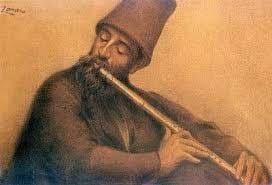
As in the celebrated opening from Jalaludin Rumi’s ‘Mathnavi’, where a reed (soul) has been separated from her reedbed (spiritual home) and, being awakened to her state of spiritual exile, she pines for her Return, the wanderer always pines for the homecoming, and the impetus (‘eros’) is always an innate spiritual memory of the Origin.
One can think of this in terms of the metaphysical paradox of radial continuity and peripheral discontinuity between God and Man: God is utterly transcendent, and yet immanent; He is both (in the language of Gerard Manley Hopkins) ‘the uncreated light’ (from ‘The Habit of Perfection’) and ‘the dearest freshness deep down things’ (from ‘God’s Grandeur’). He is incomparably sublime and yet intimately close. St. Bonaventure’s definition of God as a perfect sphere ‘whose center is everywhere and whose circumference is nowhere’ conveys the paradox of transcendence and immanence, the ‘beyond-ness’ and ‘within-ness’ of God, attributes which do not derogate from His intrinsic Oneness. The implication of Bonaventure’s definition is that Man centrically inhabits a Reality whose ground, while it is radially all-encompassing, cannot itself be encompassed by any finite horizon. It can only be penetrated by illumination, by being the light that it radially and centrically is.
As we have seen in Eckhart’s teaching, Man is made in the Divine image, innately present in the soul. The ‘memory’ of this Presence, while it may be temporarily obscured by the outer world, is nevertheless accessible and realizably Real. In Sermon 51, Eckhart expressly identifies the soul’s ground (Seelengrund) as ‘one with God’s ground.’ The term ‘soul’ can be a source of confusion (notoriously so in modern psychology) because it can mean both the transcendent ‘spark’ (clearly what Eckhart is referencing here, which he sometimes refers to as the Inner Man, or the uncreated part of Man) but it can sometimes denote the ‘psyche’ (or the Outer Man, the created self). It can mean the spiritual ‘Self’ or the psychic ‘self’. The soul, as noted earlier, is the liminal space of spiritual struggle, the threshold between the inner and the outer, the isthmus between the Divine and the human. Janus-faced, it is able to turn to the Light of the Real or away from it to the darkness of illusion — and it has the freedom and responsibility to make the choice. This liminality is referenced in the Scholastic maxim, ‘Duo sunt in homine’. As we will see later in our presentation, the soul only realizes her spiritual ground (which, as Eckhart tells is, is one with God’s ground) through detachment, a stripping away of all that is not God and a retrieval of the ontological memory of her true Origin through receptivity, enabling her to return from her exile to her true spiritual home. This recollection or awakened ‘self-awareness’ is one meaning of the Platonic ‘anamnesis’. In this essay we refer to the soul/psyche/anima as feminine because her role is to be receptive to the true ground of her being, to her governing or informing Spirit/Intellectus/Animus.
The sanctuary the soul seeks is therefore within her own depths. This is the paradox of seeking: one seeks what one is. The ‘self’ seeks the ‘Self’. Thus, the Tao Te Ching states (Stanza 47):
“Without stepping out through your door,
you can know all things under Heaven;
without peering out through your window,
you can see the Way of Heaven.
The further you travel, the less you truly know.”
Similarly, T.S. Eliot states ‘We shall not cease from exploration/ And the end of all our exploring/ Will be to arrive where we started/ And know the place for the first time.’ (Little Gidding) It is for this reason that all faith traditions echo the prescription of the Delphic Oracle: ‘Know thyself!’
The Return to the Origin is, in Eckhartian terms, a journey to the Ground and Source of the Real, where all is One. In Sermon 96, Eckhart explains:
[W]hen all images are detached from the soul and she sees nothing but the One alone, then the naked essence of the soul finds the naked, formless essence of divine unity, which is superessential being, passive, reposing in itself.
God enters the Heart only when we abandon our creatureliness. It is only when we embrace our Nothingness, wholesomely, that we are filled with God’s loving Wholeness.
We will address the topic of detachment in the next part of our presentation. For the present, we simply highlight that in this passage Eckhart provides us with the very image of healing: the soul at peace, reposing in her transcendent Center. The pure ground of repose referred to here is the Citadel, where “no image ever shone or power peeped” (Sermon 2). It is the sacred ground of the sanctified Mount (Exodus 19), preserved in her essential purity so as to make it worthy of the Divine Presence. It is the virginal womb of the soul, the purity in which the wisdom of goodness and love is born. This is the birth that happens unceasingly within the surrendered soul. In his Sermon 2, Eckhart therefore emphasizes that only the pure (or ‘wholesome’) soul can receive God’s light:
It is a property of this birth that it always comes with fresh light. ... No sinner can receive this light, nor is he worthy to, being full of sin and wickedness, which is called ‘darkness’. … for light and darkness cannot co-exist, or God and creatures; if God shall enter, the creatures must simultaneously go out.
God enters the Heart only when we abandon our creatureliness. It is only when, and to the extent that, we embrace our pure ground of Nothingness, wholesomely, that we are ready to be filled with God’s loving Wholeness. The creaturely soul, turned away from her Center by her egoic attachment to the images of the world must undergo, firstly, a ‘metanoia’ or reversion, reorienting to the symbolic Orient, the Source of the Sun, to receive the Divine Light, and secondly, a self-emptying detachment that enables the soul to be empty for God. This is accomplished by kenosis, through the soul’s dying to the egoic self of the Outer Man, and returning to her primordial ‘Nothingness’ of the Inner Man, into the womb-like ground of virginal purity where the divine birth unceasingly occurs. Hence the words from the scripture, quoted earlier: whosoever will lose his life for my sake shall find it.
Only by being stripped of all that is not Real can the soul be left with what is Real.
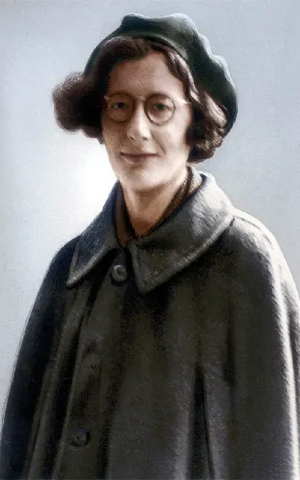
The French theologian and mystic, Simone Weil, who was greatly influenced by Eckhart’s teachings of the path of self-negation, coined the term ‘décréation’ to describe the soul’s voluntary self-emptying into the Nothingness that accommodates God. This is accomplished by the attentive receptivity of the soul to her ground of Nothingness, her utter dependence on God, and by a kenotic surrendering of her selfhood to that Nothingness in a way that radically unmakes the self, freeing her from her egoic attachments, and thereby a vessel for God’s love.
Here is a passage from her book Gravity and Grace (trans. Emma Crawford in 1963), where Weil uses language which resonates with Eckhart:
He emptied himself of his divinity. We should empty ourselves of the false divinity with which we were born.
Once we have understood we are nothing, the object of all our efforts is to become nothing. It is for this that we suffer with resignation, it is for this that we act, it is for this that we pray.
May God grant me to become nothing.
In so far as I become nothing, God loves himself through me.
We underline that, for both Eckhart and Weil, ‘Nothingness’ is not nihilistic. It is not the abstract and absurd meaninglessness of nihilism that one frequently encounters among certain existentialists or modernist philosophers; rather it is the very Heart of Reality, a lived Presence which can only be realized through a process of shedding, leading ultimately to the soul’s Transcendent Ground of connection and meaning. Hence the expression popularly attributed to Eckhart, ‘The soul does not grow by addition but by subtraction.’ Only by being stripped of all that is not Real can the soul be left with what is Real, the connecting ground of love. This is what Eckhart means by ‘holiness’, as we will see later.
The soul is made whole by accepting that she is Nothing outside God. This Nothingness, we underline, is not a meaningless abyss of nihility onto which the self projects its own self-will. Rather, it is the awakening to a metaphysically translucent inner Reality beyond the occluded vision of the outer world. To say ‘Nothing’ is, in semantic terms, an attempt to say the unsayable. It is an apophatic expression of the Ground which is Absolute, both transcendent and therefore beyond grasp and paradoxically immanent and therefore present and ‘at hand’ (Mark 1:15, among others). In Taoist language, Nothingness is the pure origin (Eckhartian Ground) of Heaven and Earth, which is the Mother (Creator) of all the myriad things (Stanza 1).
This superessential Ground, beyond even God or Being (as Eckhart reminds us), is not merely ‘no-thing’ but transcends the very concept of Nothingness, not because it is empty of reality but precisely because it is superessentially Real. It is, as the Tao Te Ching tells us, a Reality that is the source of wonder and mystery. As in Bonaventure’s definition of God, its Essence is both beyond fixity or reducibility, and Beyond Being, yet it is intrinsically one with Being, and is most realizably present in the soul’s own Center.
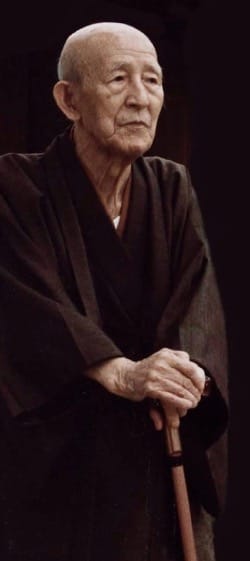
Buddhist philosophers of the Kyoto School [and other major Japanese thinkers, notably, Daisetz Teitaro Suzuki (1870-1966) and Toshihiko Izutsu (1914-1993)] have engaged extensively with the Eckhartian metaphysics of Nothingness, distinguishing it sharply from the nihilism found in Western philosophy. The Kyoto School’s founder, Kitaro Nishida (1870-1945), as well as its other prominent thinkers, such as Tanabe Hajime (1885-1962), Keiji Nishitani (1900-1990) and Shizuteru Ueda (1926-2019), have paid particular attention to Eckhart’s views on the Reality-affirming aspects of the Ground of Nothingness, drawing parallels between his ‘Gottheit’ and Buddhism’s ‘śūnyatā’ or ‘emptiness’. Nishitani viewed Eckhart as pointing to an Absolute Ground that was elusive to conceptualization, but capable of realization, that is, being realized through experience. In his magnum opus, Shukyo to wa nanika (Religion and Nothingness) (1961), Nishitani argued that Western nihilism could be overcome by shifting from the ‘field of nihility’ (or relative nothingness) to Absolute Nothingness (śūnyatā). He describes this as the field ‘wherein even that which is nothingness is negated (and) is not possible as a nothingness that is thought but only as a nothingness that is lived.’ Nishida’s writings therefore focus on this pure experiential realization of Reality.
‘Man can embody truth but he cannot know it.’ (W.B. Yeats)
The Kyoto School’s readings of Eckhartian Reality shift the ground of epistemology beyond conceptual knowing to the ontology of realized or ‘awakened’ Reality. The focus on Reality as a lived experience is the conclusion that the Irish poet laureate, W.B. Yeats reached about the knowability of Truth at the end of his own life. Just weeks before his death, he wrote to his friend Lady Elizabeth Pelham (on January 4, 1939) a letter that contains the following passage:
When I try to put all into a phrase I say, ‘Man can embody truth but he cannot know it.’ I must embody it in the completion of my life. The abstract is not life and everywhere draws out its contradictions. You can refute Hegel but not the Saint or the Song of Experience.
Yeats’ phrase that man ‘cannot know truth’ underlines the dilemma of how to express what one can only know by participating in it but can never adequately reduce to words or forms. Reality is, as the saying goes, the very water we swim in, beyond what appears to be. So, Eckhart tells us in Sermon 4:
there is no way man can know what God is. But one thing he does know: what God is not. And this a man of intellect will reject. … Only the essence will satisfy it, and this God withdraws from it step by step, in order to arouse its zeal and lure it on to seek and grasp the true, groundless good, so that it may be content with nothing but ever clamor for the highest good of all.
Eckhart insists that even the concept of God falls short of the realization of what God’s Reality or Truth is. In Sermon 11, he famously states:
The truth is such a noble thing that if God were able to turn away from truth, I would cling to truth and let God go; for God is truth, and all that is in time, and that God created, is not truth.
Truth is the very ground of Being, and so words like ‘God’ stand at a remove from its Reality. Hence, the axiom ‘Truth is Presence’, or the Taoist adage that ‘The Tao that can be named is not the eternal Tao’ (Tao, 1). In Islam, there is a distinction made between three levels of certainty (al-yaqin): the certainty of knowledge based on thought/concept (ilm al-yaqin), the certainty of what is experienced by outer sight or witnessing (‘ayn al-yaqin), and the truth of certainty (haqq al-yaqin) based on the Heart’s internalized experience of the Reality. Even to say that Realized Truth is Oneness in its absolute simplicity can be problematic because it introduces the relative concept of number. In Islam, the several of the sermons of 'Ali ibn 'Abi Talib in the Nahj ul-Balagha attest to the Absolute and Transcendent Oneness of Reality, notably Imam 'Ali's celebrated sermon 1 (Oneness is beyond number, attributes, modes or conditions). In Buddhist philosophy, Nishitani’s restorative double negation (which not only negates the ‘is-ness’ of Reality, but negates also the resulting relative abstraction or nihilism of doing so) is what one encounters in Eckhart’s view of Divine Oneness. In Sermon 97, Eckhart explains this:
What does One mean? One means that to which nothing is added. The soul receives the Godhead as it is purified in itself, with nothing added, with nothing thought. One is a negation of the negation. All creatures have a negation in themselves: one negates by not being the other. … But God negates the negation: He is one and negates all else, for outside of God nothing is.
Here, again, one encounters the paradox of the dualism of ‘outside’ and ‘inside’. For Eckhart, Reality is ultimately non-dual because it transcends all dualisms through negation, arriving at a Ground of non-dual Reality which affirms that which, while transcending all, encompasses all, similar to Advaitic Reality. The Absolute is the Infinite, the Perfect and the Good. The Nothingness of Reality is the basis for its Wholeness, which is essentially One. So, he tells us in Sermon 97,
All creatures are in God and are His very Godhead, which means plenitude.
It is this ‘plenitude’ or ‘wholeness’ which is the lived dimension of experiential Reality by which each soul lives participatively, radially embodying, as in Bonaventure’s Circle, the Reality of the transcendent Center. In this pleromic Nothingness there is Wholeness present [as in the Sufi formula that Nothingness (fana’) is Wholeness (baqa’)], so the soul is intrinsically and radically One with the Real. Here, the soul finds her rest in the Spirit, where she is ‘made whole.’ This is through the soul’s barter of the outer for the inner, the sacrificial bargain preached by both Jesus and Eckhart, and it begins by the soul’s self-emptying into ‘Nothingness’ – the topic we address next.
Holiness and Self-Emptying
In Sermon 26, Eckhart defines ‘holiness’ as ‘what is withdrawn from the world.’ By this, as will become apparent, he means detachment or integrated living, not a complete withdrawal from life. Detachment is the radical self-emptying into God of the Outer Man, so that the soul opens into her Center, to the Inner Man, to the Citadel of the Heart, and thereby comes to rest in the space where Nothingness and Wholeness, Essence and Being, faith and works, are integrated in love.
The self-emptying of the Outer Man is a return to the authentic Selfhood of the Inner Man. Eckhart states in Sermon 12, ‘Love at its purest and at its most detached is nothing but God.’ So, holiness is love; by denying the Outer Man, the soul can ‘gain all things in God.’ Only in selfless humility or Nothingness is the salvific Wholeness of love born. This is the Eckhartian bargain we referred to earlier, and the exchange that Jesus refers to in Matthew 16:25.
There are two closely-related German terms which Eckhart uses to explain what he means by detachment:
Abgeschiedenheit is the active step of making room for God – in Latin terminology, this is the ‘vacare Deo’; it is essentially the state of humility or spiritual poverty.
Gelassenheit is the passive state of submitting to God and reposing in God with equanimity; it is essentially the state of spiritual conformance or trust in God.
Both activity and receptivity are needed to achieve serenity: the intentional cleansing of the inner temple to accommodate the Spirit, and the trustful submission of the soul to the Spirit. Both are required to detach from the egoic selfhood (‘Eigenschaft’) and the willfulness (‘Eigenwille’) of the Outer Man and to replace it with God’s Will (‘Gotes Wille’), the conformed will of the Inner Man.
Self-emptying is a universal pathway to holiness and spiritual union. Thus, the Tao Te Ching states:
“Become utterly empty,
preserve a constant stillness.” (Stanza 16)
Detachment is a core virtue in many faith traditions. For example, in the Hindu tradition, detachment (vairagya) is the mastery over desires that is essential for spiritual liberation (moksha). Buddhism relates detachment to seeing the ‘self’ as an illusion, so it is seen through the lens of non-self (anatta) and the impermanence of all things (anicca). In Taoism, the emphasis is on realizing ‘Wu’ (Nothingness) through ’Wu Wei‘ (effortless action, similar to Eckhart’s acting ‘without a why’). In Islam, detachment (zuhd) is referred to in the following celebrated Hadith:
“Detach yourself from the world (zuhd fi ad-dunya) and Allah will love you. Detach yourself from what people possess and people will love you.”
Detachment is to reduce the soul to her primal ground of pristine purity, of the virginal womb where the birth of love can occur.
Detachment requires humility, a condition not only of lowliness but of returning to the spiritual ground. Rabbi Jonathan Sacks states, ‘Humility is the silence of the self in the presence of that which is greater than the self.’ All faith traditions insist on humility as essential for detachment. It is useful to recall here that the term ‘humility’ is etymologically related to humus, the ground, soil or earth, from which Man was created (the name ‘Adam’ is a cognate of adamah, the clay-dust and lowly ground from which he was made).
Eckhart reminds us in Sermon 34,
The more a man is sunk in the ground of true humility, the more he is sunk in the ground of divine being.
And in Sermon 40, he states,
Whoever would receive from above must be below in true humility.
In Sermon 51, Eckhart reminds us that ‘God's ground and the soul's ground are one ground’ and that ‘humility is a root in the ground of the Godhead’.
Similarly, the Tao Te Ching states,
“…one who is wise and holy places himself last,
behind all others,
and yet in this way advances beyond all others,
denying himself that his true self may be saved.” (Stanza 7)
Detachment/holiness is to reduce the soul to her primal ground of pristine purity, that of the virginal womb where the birth of love can occur. For only when we are self-emptied in humility are we worthy of receiving the grace of God based on the principle of ‘spiritual poverty’ enunciated by Jesus in the Sermon on the Mount, and based on the metaphysical adage recognized by Eckhart in Sermon 50 that ‘The highest flows into the lowest.’
Eckhart reminds us in Sermon 53:
Whenever a man humbles himself, God is unable to withhold His own goodness.
It is by our holy poverty that we become ‘the void made for the passage of God’ (from Frithjof Schuon’s ‘Stations of Wisdom’; John Murray 1961, revised, World Wisdom 2003). This is kenosis, being surrendered and submitted to the Spirit that created and sustains one.
To accomplish this spiritual station, one must deliberately detach from what Eckhart calls ‘this and that’, from the reified world and the deified self. One must consciously surrender one’s will to God and integrate it through active detachment, or Abgeschiedenheit. In the Sermon on Detachment, attributed to him, Eckhart states ‘the object of a detached heart is neither this nor that’. The things of the world that lure the soul are merely idols. By attaching ourselves to them, we contaminate the Temple of the soul, and are drawn away from God. It is therefore necessary to cleanse the doors of our perception (as Blake puts it) and thereby see things as metaphysically transparent to transcendence, so that they can be appreciated as theophanies – as icons (letting the light flow through), not as idols (opaque and reified objects). This requires one to look with inner vision, with the Eye of the Heart and not with eyes of the flesh. Only when the soul is free from egoic selfhood can she come to rest in her authentic Selfhood where, in Eckhart’s words ‘there is neither Conrad nor Henry’ (Sermon 78), but merely the common body of humanity bound as one in love. This state of intrinsic connection is the natural state of the Inner Man, where God alone acts. The poet William Blake refers to the participative reality of the Inner Man as the ‘Human Form Divine’ or the indwelling Spirit. In his poem ‘Jerusalem’, he expresses his vision of common humanity at follows:
As One Man all the Universal Family; and that One Man
We call Jesus the Christ; and he in us, and we in him
Live in perfect harmony in Eden the land of life.
(J34:19-21)
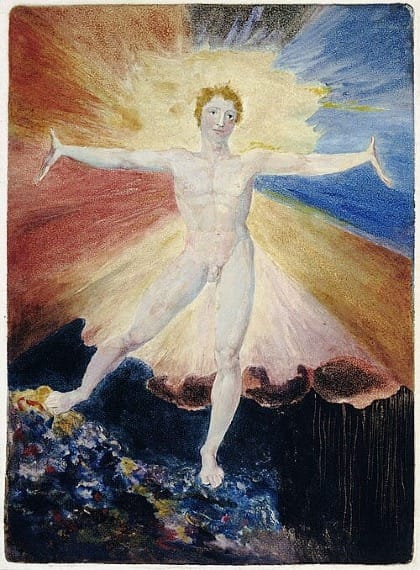
Holiness, then, is the gaze of the Inner Man looking at the peripheral self and persona of the Outer Man from the detached vantage of the Center, where all creatures are bound in love. That Center is the indwelling Christ of all-encompassing Oneness, a state that combines activity and stillness. Borrowing the description from W.B. Yeats’s poem, Byzantium, it is akin to being in a state of ‘death-in-life and life-in-death’. What has to die is the Outer Man so that the Inner Man (whom Blake calls ‘Albion’) can live in the Center that is the Primordial Wholeness and Eternal Vision preceding fragmentation and atomization by the centrifugal forces of creation. It is a state in which knowing and being, subject and object, are so fused that all is perceived through the Eye of the Heart/Imagination, ‘Eckhart’s Eye’, by which everything is seen (in Henry Corbin’s terminology) ‘imaginally’ as One. Or, in Blake’s language from ‘The Marriage of Heaven and Hell’, ‘If the doors of perception were cleansed, every thing would appear to Man as it is, Infinite’.
In practice, detachment means to curate within the soul an inner contemplative space (resting in Nothingness) and distance (viewing the peripheral world from the Center) to counter the soul's tendency to respond to life reactively.
True detachment is being centered in one’s Heart. The Sufis liken the state to ‘being in the world but not of it.’ Eckhart uses several images to explain this. In Sermon 4, he provides the analogy of the door and its hinge. He states,
Here is an analogy: a door swings open and shuts on its hinge. I would compare the outer woodwork of the door to the outer man, and the hinge to the inner man. When the door opens and shuts, the boards move back and forth, but the hinge stays in the same place and is never moved thereby.
This is similar to the analogy of the two birds in several of the Hindu Upanishads. Here is the relevant passage from Mandukya Upanishad, 3:1:1:
Two birds, inseparable companions, perch on the same tree, one eats the fruit, the other looks on. The first bird is our individual self feeding on the pleasures and pains of this world; The other is the universal Self, silently witnessing all.
As in the Hindu scripture, Eckhart analogizes between the Inner Man (the ‘hinge’ in his example, and the Atmanic Self in the Upanishads) and the Outer Man (the ‘moving door’ in Eckhart, and the jivatman in the Upanishads). To be detached is like being the unmoving hinge of the moving door. Just so, the contemplative live is the detached pivot of the active life. The Inner Man is like the bird that simply witnesses the one that acts or eats the fruit. Eckhart advocates such inner stillness and equanimity in the midst of life rather than a flight from the affairs of the world. In practice, detachment means to curate within the soul an inner contemplative space (resting in Nothingness) and distance (viewing the peripheral world from the Center) to counter the soul's tendency to respond to life reactively. This requires one to be still and centered within the ground of one’s being.
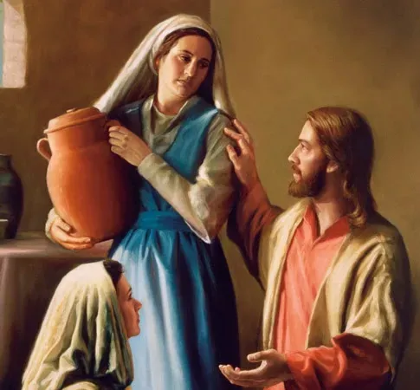
This Eckhartian goal of becoming the still-point in the midst of life can be encountered in his unusual reading of the episode (in Luke 10:38-42) of Jesus’s meeting with Mary of Bethany and her sister Martha. Eckhart’s interpretation suggests that he does not advocate retreat from life, represented by Mary, but rather a God-centered engagement with it, represented by Martha. What Eckhart advocates is integrated detachment, not renunciation. In Sermon 9, where he deals with this, unlike Jesus who had stated ‘But one thing is needful, and Mary has chosen that good part, which shall not be taken away from her’ (Luke 10:42), Eckhart commends Martha for leading a more integrated life than her sister Mary, saying that Martha is living ‘with things and not in things’ (‘You are among things, but they are not in you’) – a phrase that echoes the Sufi dictum quoted earlier of being in the world but not of it. He states, ‘Martha was so well grounded in her essence that her activity was no hindrance to her work: work and activity she turned to her eternal profit.’ Being ‘possessed of all things’ in God, she was free to act from her ground and essence; her egoic selfhood was extinguished in that ground, and thereby conformed to God’s Will so that her works were ‘guided by the eternal light.’ Empty of worldliness Martha’s work could be wholesomely focused on what was of ‘eternal profit.’ In Marguerite Porete’s celebrated phrase from The Mirror of Simple Souls, her actions could then be undertaken ‘without a why’ (‘ohne Warum’), from her true inner nature, free of worldly motives, because the soul in this pure state of essential holiness expresses only God’s Will.
While Eckhart’s reading of the Mary-Martha story is controversial, in a fundamental aspect it remains true to the spirit of Jesus’ teaching. This is the Jesus of William Blake, who acts ‘from impulse, not from rules’. Eckhart agrees that the ‘one thing needful’ is ‘the One that is God’. However, in his interpretation, Mary was ‘a well-discipled body, obedient to a wise soul’, while Martha ‘stood there in her essence’. Both sisters are surrendered to God, but (in Eckhart’s view) Martha has integrated the ‘one thing needful’ more radically than her sister and is therefore able to function in the world as the internally unmoving hinge to the outwardly moving door.
The model for this integrated internalization is Jesus himself, through his self-surrender to God in his acceptance of the ‘bitter cup’, as in Luke 22:42:
42 Father, if thou be willing, remove this cup from me: nevertheless not my will, but thine, be done.
Christ’s equanimity in the face of his suffering is the Eckhartian model of detachment. By being grounded in God, the detached soul is focused on His Will and what is of ‘eternal profit’, not on egoic self-interest or what is of worldly profit. This integrated grounding in God is also Eckhart’s approach to suffering, as we will see later.
It is interesting to note that in a different sermon, Eckhart reinterprets the phrase ‘one thing needful’ which Jesus has used about Mary (in Luke 10:42) and links it to his views on detachment. In Sermon 3 he states:
This above all else is needful: you must lay claim to nothing! Let go of yourself and let God act with you and in you as He will. … God must enter into your being and powers, because you have bereft yourself of all possessions, and become as a desert.
In Sermon 4, he adds:
The true word of eternity is spoken only in solitude, where a man is a desert and alien to himself and multiplicity.
To be ‘alien to oneself’ (not invested in one’s worldly persona or outer reputation as ‘Conrad or Henry’) and to be ‘alien to multiplicity’ (not caught up in ‘this or that’) begs the question: how does this work in practice? Eckhart appears to suggest, that the goal is to be centered in the Heart, and to be as still as the hinge of the moving door. To be truly detached, one must be able (like Martha) to live with equanimity, unaffected by the vicissitudes of the world. Eckhart describes the implacability of the soul at rest in her Citadel in his Sermon on Detachment in the following terms, likening her state a lead mountain, unmoved by worldly winds:
Now you may ask what this detachment is that is so noble in itself. You should know that true detachment is nothing else but mind that stands unmoved by all accidents of joy or sorrow, honor, shame, or disgrace, as a mountain of lead stands unmoved by a breath of wind. This immovable detachment brings a man into the greatest likeness to God. For the reason why God is God is because of His immovable detachment, and from this detachment He has His purity, His simplicity, and His immutability. Therefore, if a man is to be like God, as far as a creature can have likeness with God, this must come from detachment.
A crucial element of Eckhartian Gelassenheit is what the Sufis call ‘tawwakul’ – the complete reliance upon and trust in God. In short, the Outer Man must look to the Inner Man for support, and rest in the soul’s Ground. In the spiritual hierarchy of the cosmic procession, as each level derives from the higher level preceding it, so too it draw its perfection from its faith, directly or indirectly, in the sustaining Ground. Eckhart explains this in Sermon 70:
…the spirit can never be perfect unless body and soul are brought to perfection. Thus, just as the inner man, in spiritual wise, loses his own being by his ground becoming one ground, so too the outer man must be deprived of his own support and rely entirely on the support of the eternal personal being which is this very personal being.
The Bible teaches that God is a jealous God, which means that God will not enter the Citadel or Temple until it has been purged of its idols.
This requires the personal ego to yield to the Spirit. The Bible teaches (in Exodus 20:5 and 34:14) that God is a jealous God, which means that God will not enter the Citadel or Temple until it has been purged of its idols. This is the essence of faith: to preserve the Heart in her pristine and primordial state, ‘where neither moth nor rust doth corrupt’ (Matthew 16:20). One finds this same teaching in other faiths, for example in the Holy Qur’an, which states,
Let there be no change in one’s primordial nature (fitra) for this is the true purpose of religion, though most people know it not. (Sura Rum 30:30)
Similarly, the Tao Te Ching teaches one to empty oneself of everything to attain the stillness of one’s core nature (Tao 16). The Bhagavad Gita famously teaches that the soul should withdraw its senses from externals in order to rest in its inner nature, just as a tortoise withdraws its limbs under its shell (Bhagavad Gita 2:58). This sacred core is what the Hindu and Buddhist scriptures describe as the ‘Lotus of the Heart’ (Chandogya Upanishad 8:1:1) (one finds this also in the ‘wheel’ symbolism in Buddhism, and the ‘navel of the world’/Mount Meru/’Axis Mundi’ or Delphic Omphalos symbolism, and the Native American tradition of the Feathered Sun). The unanimous faith traditions teach that Man is a microcosm, possessing a transcendent spiritual Center connecting him to all creatures and to the universal Spirit that courses through the Cosmos.
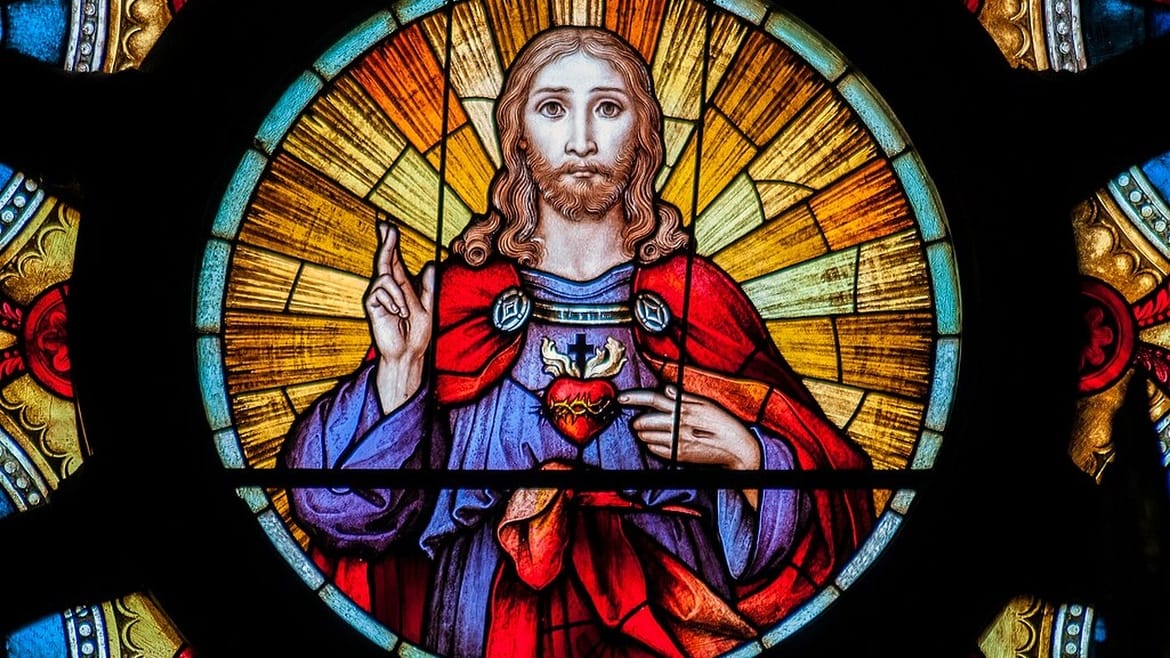
Eckhart repeatedly emphasizes that the soul contains the divine spark which is the sacred link to God. Man is noble precisely because the soul, through the gift of her primordial nature, shares God’s being. In Sermon 23, Eckhart explains:
The noblest thing that God works in all creatures is being. My father can give me my nature, but he does not give me my being: God alone does that. … To have more of God simply means being more like Him: the more likeness to God there is in us, the more spiritual we are.
The Inner Man ontologically participates in God’s Being, the Logos, which is the source of gnosis and love. This part of Man is the Heart. Eckhart repeatedly underlines the importance of preserving the soul’s Citadel in its pristine state to make it fit for divine grace. ‘God must enter into your being and powers,’ he says, but this can only occur when the soul becomes as pure as her ground – in Sermon 85, he refers to it as a state of ‘primal purity’ where, based on the principle ‘like attracts like,’ God’s light can enter. The soul must therefore become as pure as the groundless ground of Nothingness in order to attract God. Eckhart explains in Sermon 80:
God Himself cannot enter there [the Citadel in the soul] as long as He has any mode: neither as being wise nor as being good nor as being rich. God cannot enter there in any mode: He can only enter there in the nakedness of the divine nature. … all our perfection and all our bliss depend on our traversing and transcending all creatureliness, all being and getting into the ground that is groundless.
Only in that self-emptied state of Nothingness can the exchange of Wholeness occur. Eckhart explains the mechanism for this bargain of spiritual restoration in Sermon 4:
God must act and pour Himself into you the moment He finds you ready. … the very instant the spirit is ready, God enters without hesitation or delay. … God cannot leave anything void or unfilled, God and nature cannot endure that anything should be empty or void.
In Sermon 6, using the episode of Jesus and the moneychangers, Eckhart likens the soul to the temple which must be rid of the worldliness of the merchants. He states, ‘truth needs no merchandizing’. Goodness springs naturally from love. It is not transactional. Good deeds are undertaken ‘without a why’, purely for the sake of God and without any expectation of worldly gain. Eckhart explains:
If you would be free of any taint of trading, so that God may let you enter this temple, then you must do all that you can in all your works, solely to God's glory, and be as free of it as Naught is free, which is neither here nor there. You should ask nothing whatever in return. Whenever you act thus, your works are spiritual and godly, and the merchants are driven right out of the temple, and God is in there alone, for one is thinking only of God. See, that is how your temple is cleared of merchants!
To summarize, holiness, therefore, is the sanctifying of one’s inner temple to render it worthy to receive the Sacred Presence of the Lord. This is done by ridding it of the false idols of the worldly merchants. The soul must become wholesome, emptied of egoic and worldly attachments in order to be made whole – for it is in that state alone, when the soul becomes the ‘desert’ of Nothingness, that she is worthy of God, becoming the channel for His activity alone, to accommodate His outpouring flow of goodness and love.

The Alchemy of Healing
What we have been describing is Eckhart’s prescription for alchemical healing – alchemical because it involves a theurgic transmutation of the base elements of the soul into the gold of spiritual perfection. While Eckhart does not expressly employ the language of the medieval alchemist, he does indeed speak about spiritual transformation, which is also the aim of hermetic alchemy.
For example, in Sermon 25, Eckhart tells us:
…whatever comes to God is transformed: however base it may be, if we bring it to God, it sheds itself.
To find true healing (being ‘made whole’ in the Christic sense) the soul must be spiritually transformed by shedding all that is not God in order to rest in God, in the very ground of His love. In Sermon 4, Eckhart describes how this occurs through ‘the hook of love’. Like with any hook, it only draws us when the soul first draws it into herself; and then she is drawn up by a greater power than herself. To be ‘hooked’ is paradoxically to be free. Eckhart tells us,
God lies in wait for us with nothing so much as with love. For love resembles the fisherman's hook. The fisherman cannot get the fish till it is caught on the hook. … Therefore, just watch for this hook, so as to be blessedly caught: for the more you are caught, the more you are free.
While the image of the fisherman’s hook is not perfect because it suggests a limitation of freedom, it nonetheless conveys the meaning that love is a bond, albeit a paradoxically liberating bond. Man cannot be free except through the love that binds the soul by conforming it to her spiritual nature, and the soul can therefore only realize this freedom through an ontologically transformative process.
In Sermon 63, Eckhart describes panoptically the full arc of this process:
…when a man accommodates himself barely to God, with love, he is un-formed, then in-formed and transformed in the divine uniformity wherein he is one with God.
Only be being reduced to Nothingness, can the soul be ‘made whole’.
To be un-formed is to be naked before God, as Adam and Eve were in Paradise, innocent and pure. It is to be reduced to a state of primordiality, the soul’s Original state. The soul must be ‘reduced to Nothingness’, like ‘Poor Tom’ in Shakespeare’s tragedy, ‘King Lear’. Tom ‘o Bedlam, in Shakespeare’s play, has intentionally abandoned his outer persona as Edgar, the son and rightful heir of the Duke of Gloucester, stating in the process, ‘Edgar, I nothing am’ (KL, Act II: scene iii: line 21). Only in that nakedness of ‘I nothing am’ where the human identity and persona is merged into its transcendent Ground can the Inner Man realize the Reality of the Oneness of ‘I Am that I Am’ (Hebrew: Eyheh asher Eyheh) (Exodus, 3:14). (The Hebrew term ‘Eyheh’ is a cognate of the Aramaic, ‘Chaya’ (חַיָּא), meaning ‘life’, and is related to Yeshua’s role as ‘Saviour’, provided the bargain of exchanging one’s outer and temporal life for inner and eternal life is undertaken.) As Poor Tom, Edgar is, in the terminology of the first Beatitude, ‘poor in spirit’ and therefore he symbolizes what King Lear refers to as the ‘unaccommodated man’, stripped of his worldly ‘sophistications’ (KL, Act III: scene iv: lines 102-109). Only in this denuded state of utter dependence and receptivity – where ‘ripeness is all’ (KL, Act V; scene ii: line 12) – can ‘man accommodate himself barely to God, with love.’ Only be being reduced to Nothingness, can the soul be ‘made whole’ by being in-formed by the Logos, and reborn in the eternal reality of the indwelling Christ, who is love, and, thereby, be ‘transformed in the divine uniformity’ as ‘one with God.’
It is important to recognize that unlike the philosophers who posit a conceptual or idealistic realizing of God, Eckhart proposes an experiential breakthrough (Durchbruch) of the soul out of her createdness into her own ground of loving Oneness – where the soul and Spirit are One.
In Sermon 61 Eckhart tells us that there is an ‘inmost part’ of the soul (the Heart) ‘where love is so pure that it has no nature’ and that ‘out of the root, there a flower shall grow’. He elaborates, ‘this soul must emerge from her nature, and then God lies in wait for her to lead her home into Himself.’
This process requires both effort and grace so that the barter of Wholeness and Nothingness can occur: ‘just as much as you go out of all things, just so much, neither more nor less, does God enter in with all that is His’. The first step is in this process is metanoia, whereby the soul turns from the darkness of the outer world to the light of the inner Presence that is metaphysically translucent in the world. Through metanoia, detachment and spiritual receptivity, the soul creates the conditions to let God take control of her by the hook of love, and to ‘lead her home into Himself’. Eckhart is describing the dialectic of effort and grace, of faith and love: the soul prepares by her efforts of self-emptying to enter into the orbit and gravitational pull of the Spirit and then is led by God’s love into the Citadel. From another perspective, the soul returns, in faith and humility, to her own ground so that God can be born as the true and sempiternal flowering of love, goodness and beauty.
In any discussion of Eckhart and healing, one has to ask what exactly is being made whole? The Outer Man must be extinguished within the Inner Man. The soul/psyche must yield to the Spirit.
Eckhart seeks to heal the soul, fully understanding the reality of the human condition, which includes suffering. He does not deny the reality of suffering but seeks a remedy whereby the soul can transcend suffering in the experience of sublimating goodness. He acknowledges (in Sermon 9) that there is no creature, no saint, not even Jesus himself (the proverbial ‘man of sorrows’ from Isaiah 53:3), who is spared suffering. Like the Buddha, he accepts the fact of suffering and the inevitability of death as part of life. But he teaches that it is possible to ‘suffer without suffering’ in a way that makes acceptance through detachment a healing path to God. This is in line with the Sufi teaching to ‘die before you die’ so as to overcome the sting and victory of death itself. While the lot of the Outer Man is to suffer, the Inner Man can transcend it.
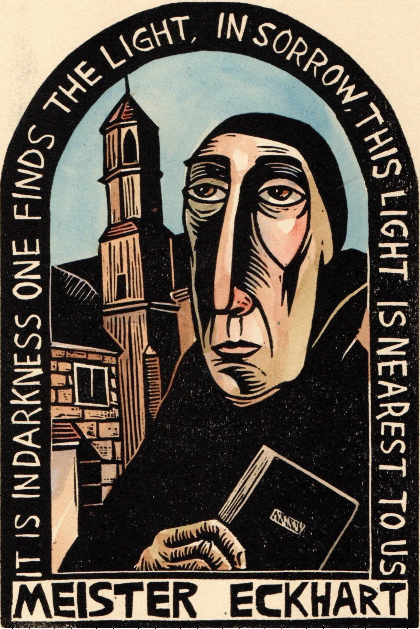
In his book, Meister Eckhart: Master of Mystics (Bloomsbury, 2011), Fr. Richard Woods (1941-2022) devotes an entire chapter to ‘Eckhart, Suffering and Healing’. He points out that Eckhart’s writings on suffering, particularly his ‘Book on Divine Comfort’ written in 1308 to counsel Queen Agnes of Hungary on grief (in view of the death of her husband and her father), are part of the classical tradition of such writings which include Boethius’s Consolation of Philosophy, a book written in prison in 523 to address how the soul might seek to come terms with the capriciousness of Fate.
Eckhart’s views on suffering were summarized by Woods in three propositions:
First, in God there is no suffering, only eternal and absolute joy.
Second, nevertheless God suffers by sharing in our suffering.
Third, therefore, to suffer rightly is to experience God, or in Eckhart’s pithy phrase, God is our suffering.
Woods explains that ‘by welcoming suffering as a form of God’s presence, we transcend all pain and bitterness.’ This is because, as Eckhart puts it, whatever befalls us comes, in a sense, ‘through’ God. After all, Man exists in a privative state, not in perfection, for only God is perfect. Therefore, outer privations must be endured but they can nonetheless be absorbed through detachment and their inward sublimation as God’s Will. The Inner Man, being detached from it, accepts what God wills and, by accepting it for His sake – just as Jesus accepted the bitter cup – its pain is made more bearable and transmuted by faith in God’s being present in the suffering.
(Healing is) opening a doorway to God, beyond the threshold of the suffering self. This is the allopathy of the unwounded soul, of the radical Nothingness that strengthens and heals, so that one’s faith makes one whole.
In The Book of Divine Comfort, Eckhart develops the idea that Woods refers to as the ‘doctrine of co-suffering’ by which any suffering, through its sublimation, is borne equally and ontologically with God. As Eckhart puts it, ‘my pain is in God and my pain is God.’ Woods comments that Eckhart ‘does not counsel us to seek suffering, but to accept it, not with resignation as inescapable, but as a gift of God’s presence and companionship.’ Such radical acceptance, as many spiritual teachers and medical practitioners have noted does in fact lighten the burden of suffering, making the patient more able to endure the ravages of pain through a deeper repose in God.
Pain can sometimes take us to a place beyond the bare experience of suffering, not by overcoming it through anodyne or analgesic insensitivity but by opening a doorway to God, beyond the threshold of the suffering self. This is the allopathy of the unwounded soul, of the radical Nothingness that strengthens and heals, so that one’s faith makes one whole.
One finds this idea of redemptive suffering in other writers too. For example, in his poem ‘Affliction (V)’, the Anglican poet George Herbert provides an image of a deeper level of rootedness and transcending fortitude that can come from trees surviving a storm: ‘Affliction then is ours;/ We are the trees, whom shaking fastens more.’
Simone Weil regarded ‘affliction’ (malheur) as a divine means for the soul’s self-emptying into God. Her term décréation describes what Eckhart refers to as the ‘un-forming’ or ‘shedding’ of the soul through detachment into the ground of her spiritual nakedness.
Here is a powerful passage from Weil’s book Waiting for God (trans. Emma Craufurd, New York: Harper & Row, 1951), from the chapter on ‘The Love of God and Affliction,’ in which the nail of the Crucifixion is portrayed as a symbol of décréation. She writes:
He whose soul remains ever turned toward God though the nail pierces it, finds himself nailed to the very center of the universe. It is the true center; it is not in the middle; it is beyond space and time; it is God. In a dimension that does not belong to space, that is not time, that is indeed quite a different dimension, this nail has pierced cleanly through all creation, through the thickness of the screen separating the soul from God.
Like Weil, the aim for Eckhart was to ‘suffer well’ when one must. We are to transcend for God’s sake what the human condition imposes on us, not out of a fatalistic quietism but out of the profound love that purifies the soul. Whatever suffering is inevitable should be borne by the soul’s sublimating acceptance of it, from a detached Center resting in God. By bearing her cross, the soul ‘suffers without suffering’, accepting what she must for God’s sake. Like Jesus accepting the bitter cup, the soul discovers a depth of her own inner dignity, transcending whatever indignities may be visited upon the outer self. By suffering with God, and in God, she is made whole by her faith. This is one of the meanings of the Qur’anic teaching, ‘Lo! with hardship goeth ease.’ (94, 5-6)
Eckhart’s teachings of the divine spark in the soul point to a vision of social equality and justice.
Eckhart’s teachings have profound implications for fragmented societies and communities and for the malaise of modernity. To be ‘made whole’ has political implications precisely because Eckhartian metaphysics is premised on the ground of interconnecting Wholeness. While, unlike Plato or Augustine, for example, Eckhart does not directly address issues of political governance, he has much to teach us about the integral bonds of community – a topic of especial relevance in today’s world where individualism and tribalism, in their many forms, are breaking up families and societies.
Eckhart’s teachings of the divine spark in the soul point to a vision of social equality and justice: equality because all souls contain the same Spirit by which they are One in God; and justice because the social order is built on the universally binding metaphysical foundations of dignity and love. Humanity is, at core, a sacred Whole, bound through spiritual kinship that requires to live in harmony. That harmonic vision is realized through love, as called for in the two supreme commandments of the Bible.
Jesus tells us that each of us is the other’s neighbour, and we are therefore our ‘brother’s keeper.’ In his parables (the Good Samaritan, the Prodigal Son, among others) and his example of catering to the wretched, he teaches what this ethic of love entails, stating in Matthew 25:40,
40 … Verily I say unto you, Inasmuch as ye have done it unto one of the least of these my brethren, ye have done it unto me.
We find this same teaching reflected in Eckhart. For example, in Sermon 18:
God should be a rule and a foundation of your love. The first object of your love should be God alone, and after that your neighbor as yourself, and no less than yourself. And if you love blessedness in yourself more than in another, that is wrong; for if you love blessedness in yourself more than in another, you love yourself; and if you love yourself, then God is not your sole love, and that is wrong.
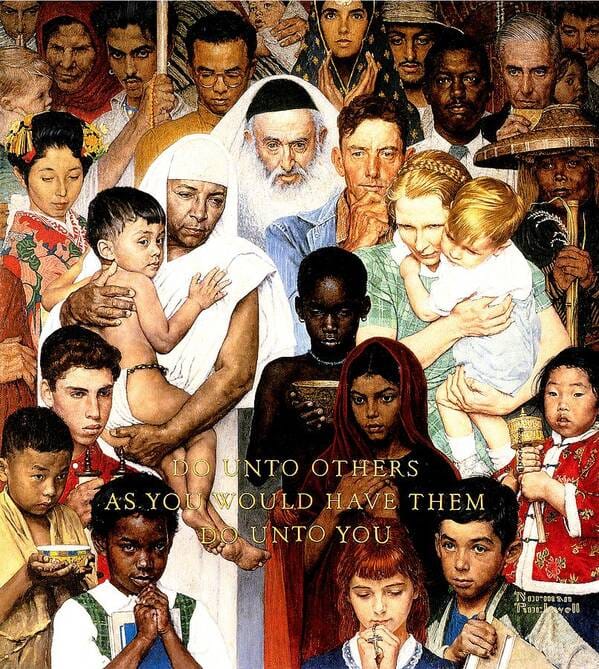
The Golden Rule is premised on humanity’s oneness in God – which provides the basis for integrity, dignity and human worth. This universal principle, which goes to the core of what it means to be human, is illustrated in the celebrated ‘Bani Adam’ verse by the Persian Sufi poet, Sa’di of Shiraz (1210-1291), whose lines adorn the portico of the United Nations building in Geneva. It reads:
The children of Adam are as limbs of each other,
Having been created from a single essence.
When the calamities of time affect one limb
The other limbs cannot remain unaffected.
If you have no sympathy for the troubles of others,
You are unworthy to be called ‘a Human’.
It is helpful to recall that the medical term ‘therapy’ originally meant to ‘care for’ and to ‘serve’. … Aristotle ended his Eudemian Ethics by stating his goal for the ethical man to be: ‘ton theon therapeuiein kai theorein’ or ‘to love and serve God’. This is also the heart of Eckhart’s message.
All men are equal because they share the same Spirit. And we are created to care for each other and for the world that the Creator has entrusted to us as His stewards. It is helpful to recall that the medical term ‘therapy’ originally meant to ‘care for’ and to ‘serve’. It is derived from the Greek term ‘therapeuiein’. Aristotle ended his Eudemian Ethics by stating his goal for the ethical man to be: ‘ton theon therapeuiein kai theorein’ or ‘to love and serve God’. This is also the heart of Eckhart’s message. Broken societies can either choose to pull apart through individualism and tribalism or they can choose to pull together to heal, as God’s instruments of love, looking beyond outer differences to work together to serve the common good.
Concluding Remarks: Eckhart and Hope
Given the title of this year’s conference: ‘Meister Eckhart for Today: Break(ing) through Despair to Hope’, we would like to emphasize how Eckhart’s teachings provide a basis for hope in a broken world.
Hope is one of the three theological virtues (from the triad of faith, hope and love, mentioned in 1 Corinthians 13:13), and is the ‘anchor of the soul’ (Hebrews 6:19). Just as the soul is the bridge between the human and the divine, hope is the bridge between faith and love. Eckhart teaches us that the soul begins in faith and moves to love.
The basis of hope is that within the soul’s core is a divine spark of light – a healing and salvific light. From our discussion, it will be clear that despair is the result of turning away from that light, while hope is the promise of finding repose in it, in that Citadel – Eckhart’s Castle – where the soul breaks through when emptied of her egoic and worldly idols in a sincere readiness for God.
Like Qoheleth (the Preacher in Ecclesiastes), Eckhart emphasizes that there is no peace or healing to be found in the world, but only in the ground of Being. He tells us (in The Talks of Instruction):
If people seek peace in outward things … this is all in vain and brings them no peace.
Eckhart points us to a place that American poet Christian Wiman calls our ‘bright abyss’.
He counsels us, in Jesus’s words from the Beatitudes, to be ‘poor in spirit’, to be detached from vanities that glitter with false allure, drawing the soul away from the true, loving and healing spirit of light. He points us to a place that American poet Christian Wiman (b.1966) calls our ‘bright abyss’, the pleromic Nothingness from which love springs. Just as Wiman writes of God’s presence as a ‘storm of peace’ in ‘every riven thing’, and Simone Weil invites us to cling to love in the midst of our affliction and thereby discover the shining mercy of God in the depths of our inconsolable grief, so too Eckhart teaches us to find in brokenness an opening to God. Eckhart’s model of detachment is Jesus himself, who ‘made himself of no reputation, and took upon him the form of a servant’ and ‘humbled himself, and became obedient unto death, even the death of the cross’ and was thereby exalted above everything (Philippians 2:7-9).
The breakthrough from despair to hope is thus the breakthrough of the soul to the Spirit. For it is only there, within the inviolable sanctuary of the Heart’s Citadel, that we can touch the very ground of hope and healing – and so find there ‘the peace of God, which passeth all understanding’ (Philippians 4:7).


