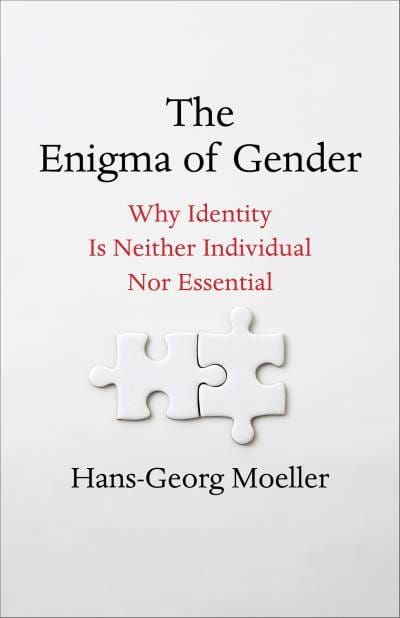
This is a profoundly confused work, but its confusion is instructive as an illustration of the consequences of adopting the profane point of view. As René Guénon wrote, there is no such thing as a profane realm, only a profane perspective. The corollary of this truth is that adopting the profane point of view is to take on a necessarily blinkered one, distorting the object of perception – namely (sacred) reality. As part of this general bewilderment, academic philosophizing of the type Moeller’s volume represents is now more disoriented, now less so. This particular book is to be placed on the relatively more perplexed end of that spectrum.
This perplexity begins on the book’s cover. The blurb on the back of the volume informs prospective readers that it places “Daoism in conversation with present-day thinkers”. All three of the endorsements that follow emphasize Moeller’s “Daoist approach”. Parenthetically, one must note that one of these endorsements is from Robin Wang. This is, as the reader will come to appreciate, rather disappointing given the astute grasp of Chinese Tradition that Wang has displayed in her own writing.
the book has relatively little interest in the Daoist Tradition, with the author not infrequently displaying a dismissive contempt for Daoism
Despite what the back cover leads one to believe, the book has relatively little interest in the Daoist Tradition, with the author not infrequently displaying a dismissive contempt for Daoism. Indeed, from pages 80 to 173 Daoism is referred to only once, and in passing at that. Daoism disappearing for 93 pages from the discourse of a slender volume of a mere 177 pages is quite remarkable for a monograph ostensibly adopting a “Daoist approach”. Why, then, bother reviewing this work for Sacred Web, whose readership would assuredly be more interested in authentic expositions of Daoism? Two reasons. Firstly, as an example of the abuses that those Traditions finding their origins east of the Indus River are uniquely subjected to by contemporary modern academia. Secondly, as a case in point of the incoherence that adopting the profane point of view can and (in recent times in particular) often does result in.
If not Daoism, what then is Moeller’s primary concern? The title of the book is a better indication of his object. Essentially, Moeller posits that identity has passed through three stages, which he terms “sincerity”, “authenticity” and “profilicity” (the last being a neologism of Moeller’s coinage). Identities of sincerity are those where the individual ‘sincerely’ identifies with their social prescribed roles. Authenticity refers to the valuing of individuals’ discovering and fulfilling their pre-existing inner ‘true selves’ without regard for or in spite of societal prescription. Profilicity refers to notions of identity wherein it is realized that no such true self exists, the self being an individualistic if useful fiction, and identity is instead the result of the affirmation by others of a profile one constructs for one’s ‘self’. Moeller’s focus with these “identity technologies” is (as the book’s title indicates) on gender, although he is inconsistent in this regard. Indeed, aside from the thematization of these three identity regimes, there is very little that is consistent about this book.
if Moeller is so dismissive of metaphysics why does he engage at all with a pre-eminently metaphysical Tradition like Daoism?
Another thing that Moeller is consistent about is his rejection of metaphysics. Metaphysics simply does not exist. This is something he repeatedly asserts without supplying an argument or explanation for why he takes this position. We shall return to this assertion presently, but first let us consider a question that has already occurred to the reader – if Moeller is so dismissive of metaphysics why does he engage at all with a pre-eminently metaphysical Tradition like Daoism?
The answer is to be found in Moeller’s interpretation of Daoism, which the following extended quotation makes clear:
Unlike in monotheist or Platonic metaphysics, Daoism does not presume any ultimate idea, teleological purpose, or intelligent design at work behind what is. Behind everything that is is that which is not. (p. 18)
Even a passing familiarity with Daoism reveals the error contained in this passage. Daoism most certainly does contain an “ultimate idea” (or better said, an ultimate reality) behind “everything that is” – the Dao after which the Tradition is named. Of course, it could be said – consonant with the opening passage of the Dàodéjīng道德经 – that this ultimate reality “is not” in the sense that, being Absolute, it is beyond even the category of being. For this reason, Guénon referred to ultimate reality in its fullness as “non-being” and Schuon to the same as “beyond being”. However, it is clear that this is not what Moeller means. He renders the aforementioned opening passage as “A dao that can be spoken is not a constant dao” (p. 17)[[1]]. He continues: “To state that neither the dao nor the sage… has a constant (cháng常) name is to say that they have neither a definite identity nor a specific role”. Clearly, Moeller is asserting that Daoism posits an ontological nihilism with which he is in agreement. This nihilism, he then goes on to argue, demonstrates the ultimate falseness of sincere or authentic understandings of gender, as both are premised on gender and the self having an essence, where profilic identity has no such ‘weakness’. Daoism (which Moeller sometimes qualifies as “early Daoism” since what he denotes by that term is almost entirely restricted to the Dàodéjīng and Zhuāngzǐ庄子) teaches us to be “at ease” with the insubstantiality of the gendered roles we inhabit.
Moeller treats Daoism as mere philosophy – a human creation he can freely take from and syncretize with his own ideas, an exotic relish with which to enliven what are ultimately pedestrian postmodern ideas about gender.
The problem with this is that, much as it would surprise Moeller to hear, he has adopted a fundamentalist hermeneutic in his approach to Daoism. What he presents as Daoism is his reading of these foundational texts without regard for the fact that Daoism is not a dead letter but a living Tradition still practiced by millions of people globally with valid chains of initiation stretching back millennia. This living body of Tradition Moeller only makes a single contemptuous reference to (“so-called Daoist religion” (p. 25)). He makes a solitary reference to the commentarial Tradition (p. 26), and other than this he makes it clear that what he presents as ‘Daoism’ are merely his own ideas, inspired by selective and idiosyncratic readings of passages from Daoist scripture. Indeed, in this way his “Daoist approach” is more offensive than that of fundamentalist. Wahabis, for all their manifold faults, treat the Holy Qur’an as what it is – a record of the words of God. Just so, the Dàodéjīng records the words of Laozi, not merely a man but an incarnation of Dàodé Tiānzūn道德天尊(The Heavenly Lord of Dao and Virtue) – one of Daoism’s three supreme deities. Instead, Moeller treats Daoism as mere philosophy – a human creation he can freely take from and syncretize with his own ideas, an exotic relish with which to enliven what are ultimately pedestrian postmodern ideas about gender. Had he instead consulted the commentaries of the Tradition, he would have found that his interpretation of Daoism as upholding ontological nihilism is without basis. He could consequently make no claim that his ideas about gender are in any way ‘Daoist’. The opening passage of the Dàodéjīng is an apophatic henological statement, something Moeller shows no understanding of. Quite apart from his inconsistency with the Daoist Tradition as a whole, his foundational premises about ultimate reality defy logic. If the true Dao not being the Dao which can be named does not refer to the limitless potential that is anterior to manifestation but instead to mere nothingness, then this seems to imply that Moeller believes something can come out of nothing, obviously an impossibility.

Moeller’s engagement with Daoism ends with a discussion of the well-known principles of yin and yang. These he correctly identifies as metaphysical, and therefore dismisses them as “social constructs” that “did not evolve biologically” (p. 77) and hence, we are left to infer, cannot refer to anything real. It is most remarkable that a book that presents itself as drawing Daoism into contemporary debates on gender so flippantly tosses aside the principal contribution the Tradition has to make on the topic.
From here, the book goes on to establish what, rather than Daoism, is actually central to this book’s thesis. That is, the rejection of the self as a static or essential entity. Rather the ‘self’ is a convenient fiction denoting a contingent epiphenomenon of aggregates that are constantly in flux. By “self” Moeller here means the essence of the individual personality and not what Hinduism denotes the Ātman. Most readers of Sacred Web will immediately recognize what Moeller has here formulated as a simple restatement of the Buddha’s doctrine of anattā. And yet we find not a single reference to Buddhism in relation to this theory of the self, such that I must conclude that Moeller is guilty of plagiarism (he certainly cannot plead ignorance as there are references to Buddhism elsewhere in the text). Moeller goes on to part ways with his (unacknowledged) appropriation of the teaching of anattā by making a sharp turn into scientism arguing that, on the basis of the most recent science, there is no evidence of free will (p 63).
modernity recognizes nothing higher than materiality ontologically, reason mentally, and the empirical scientific method epistemologically. …In the postmodern perspective, reality is totally subject to the human will as no material limit to this will is any longer accepted.
And so, we come to the second reason this book is worth reviewing. It serves as an example of the kind of projects that our current historical juncture is wont to produce. We currently live in an age of transition from modernity to postmodernity. If in Tradition the gnostic faculty of the intellect with which we comprehend metaphysical verities is recognized as the highest way of knowing, modernity recognizes nothing higher than materiality ontologically, reason mentally, and the empirical scientific method epistemologically. By contrast, postmodernity signifies a fall to a lower stage still, where reason and material reality are discredited, and no faculty higher than sentiment is recognized. With this comes the full realization of the demiurgic drive to usurp God’s role as creator. In the postmodern perspective, reality is totally subject to the human will as no material limit to this will is any longer accepted.
As already stated, we are in a state of transition between these two stages of decline, and as such confused works that have a foot in either, such as the one presently under consideration, should be expected.
It is revealing of modern epistemological prejudices that this contradiction is allowed to pass in a work published by an academic press as prestigious as Columbia!
Is Moeller a materialist – that is to say a modern – or is he a postmodern? At least based on this text, one cannot tell – and frankly I doubt that Moeller himself knows. On the one hand, he strongly affirms that only those phenomena attested to by the empirical method are real. The “gendered soul” is, for example, dismissed as “unscientific” (p 146). However, The Enigma of Gender itself is principally composed of descriptive statements that do not even meet the standards of ‘social science’, which are far laxer than those of the natural sciences. At best, Moeller could be said to be making casual observations but it would be more accurate to say that he builds his argument primarily on anecdote. Why are metaphysical statements (and implicitly, the gnostic epistemology by which they are determined) so casually and categorically waved away, while the author employs (from a modern perspective) an equally “unscientific” method? It is revealing of modern epistemological prejudices that this contradiction is allowed to pass in a work published by an academic press as prestigious as Columbia!
This inconsistent relationship with scientism is also to be found in Moeller‘s ambiguous position on if – and to what extent – socially constructed gender is determined by biological sex? If Moeller rejects a metaphysical essence to gender, does he accept that gender is in some way linked to sex, and that the material facts of sex in some way limit how gender can be constructed? Certain passages suggest that he does. He appears to affirm de Beauvoir’s position that sex has some degree of determination on gender: “de Beauvoir… was fully aware that social gender hierarchies had taken root so deeply precisely because they were propped up by biology…” (p 157). He also cites Natalie Wynn on p 131 to the same effect, despite referencing Judith Butler later on the same page – without addressing Butler’s famous claim that sex too is a social construct.
If sex is not the Sache selbst (the Kantian thing-in-itself) then why is the male gender ‘assigned’ to male bodies?
How then, are we to reconcile this with his assertion on p 77-8: “There is no meaning in sex as the Sache selbst–all the meaning biology takes on is ascribed to it from the outside.”? If sex is not the Sache selbst (the Kantian thing-in-itself) then why is the male gender ‘assigned’ to male bodies? Why does he later claim that patriarchy is “propped up by biology”? On p 169 Moeller states that gender is “always already, and has always been, socially conditioned in conjunction with a person’s biology… which are also not self-determined”. If by not self-determined he presumably means ‘also socially constructed’, the Beauvoirian distinction between sex and gender appears to break down. Indeed, this is an intractable problem for all (post)moderns who want to deny the essentiality of gender – why then has the male sex ‘dominated’ the female? This is what it is asserted, but it is difficult to see how it is a meaningful statement if sex is a socially contingent phenomenon.
This leads one to consider the curiosity of the phrase “patriarchal society” – used by Moeller and other ‘gender theorists’. It seems a rather redundant pairing of terms. Where are matriarchal societies to be found, outside of Bachofen’s imagination? Nowhere. Even avowedly egalitarian societies continue to be male dominated, as Moeller concedes (p 120). To appropriate a phrasing of Robert Michels’, who says society, says patriarchy.
Yang is the active, leading element. So, it naturally follows that men would predominate in social positions expressive of yang.
How to account for this? A materialist interpretation, such as Moeller suggests in connection with de Beauvoir, may have it that patriarchy is a product of men’s superior physical strength. This may have some measure of truth, but it is far from satisfactory. If this were the explanation, would we not expect to see a universal hierarchy of strength amongst men? And yet this is not the case. Furthermore, how does one account for the continued predominance of men in leadership positions in modern societies where technology has largely neutralized the social effects of muscular strength? What is more, the division of labor in traditional societies often has little to do with differences in bodily might.
Is not the metaphysical explanation that Moeller discounts more compelling? Sex and gender are products at lower levels of manifestation of the predominance of yang or yin in an individual’s constitution. Yang is the active, leading element. So, without undermining the principle of complementarity, it naturally follows that men would predominate in social positions expressive of yang, while women would predominate in social positions expressive of yin.
To return to the subject of this review, Moeller seems torn between the modern and postmodern perspectives. His central thesis of the profilicity of gender seems more consonant with a postmodern perspective, where social reality is seen as totally unmoored from material reality. Despite this, he is unwilling to part ways with scientism – perhaps because this would force him to engage with the possibility of the reality of metaphysics, or else maybe because on some level he fears losing all purchase on objectivity. This latter is a well-founded fear for those looking over the precipice of postmodernism.
The confusions described above are compounded by other aspects of Moeller’s writing that one cannot give a more charitable appellation than sloppiness. It is often highly ambiguous if Moeller’s quoting other scholars indicates approval of the sentiments contained in those quotations as he usually fails to clarify this. Aside from his central trinity of identity technologies, he rarely defines his terms, or even acronyms. The reader is never enlightened as to what “TGD”, used repeatedly on p 143, stands for. Indeed, among these undefined terms is included metaphysics which Moeller claims in a footnote (p 181) to have “no exact equivalent in the Chinese language”. This is a most baffling contention as Chinese pointedly does have an exact translation of metaphysics – xíng'érshàngxué 形而上学. This is, literally – the study (xué学) of that which is above/superior to/transcends (shàng上) material form (xíng形), ér而 being a grammatical particle. In the body of the text, it is often difficult to ascertain whether Moeller means metaphysics in the sense of supramaterial reality, or in the way that term is often misused by academic philosophy to mean any ‘fundamental ontology’.
A climax in the confusion of this book is reached in the conclusion, when Moeller states flatly that the theories of identity offered in this book are “not normative” (p 172). He continues, quoting another scholar’s appraisal of his thought (of which he approves): “I am not “trying to claim that any of these identity technologies are good or bad in themselves, or that any of them are somehow more effective at creating ‘real’ identity”” (p 172). The reader is left in astonishment! What of the claim, on the very first page of the book, that the objective of the book is to help movement towards “better narratives” about gender? What does “better” mean, if not something normative?
The book moves freely between normative and descriptive statements without making any effort to keep the two separate.
Perhaps the author would reply that he means “better” in a purely descriptive sense. But no such strict distinction is maintained in the book, which moves freely between normative and descriptive statements without making any effort to keep the two separate. Indeed, from a Traditional perspective, one understands that such a separation is, in the last analysis, a modern error. In Platonic terms, goods are such by virtue of their participation in the Good, which is identified with the True. But even without accepting this metaphysical perspective, what sense does it make to say that an identity technology like that of sincerity, which is premised on the belief in an essential (gendered) self, is no better or worse that a profilic identity, after having spent long stretches of this book attacking the notion of an essential self or an essence to gender? Furthermore, Moeller proves incapable of being consistent about whether the shift from sincere to profilic identity is a description of what is occurring or an imperative. His claim to not be making normative statements and the first of his “ten theses on gender” (p 167) would suggest the former. However, just a page earlier he describes the persistence of sincere conceptions of gender as being “enthralled by a deep nostalgia for authenticity”. The voice that is speaking here seems to be one not detachedly observing a shift to profilicity, but urging it.
Before concluding, I would like to offer a miscellany of observations about this work that did not fit into the overall theme of this review. Moeller is at pains to frame the pre-Qin Chinese philosophical concern with properly fulfilling roles as “identity politics” (p 38). It is not at all obvious that such an assimilation can be made. I may fulfil a role, and believe it is important to do so properly, without that role forming a part of my identity. For example, a soldier given guard duty. It is entirely conceivable, probable even, that such a soldier does his best to carry out this role as he deems it important, without regarding being a guard as an important (or even at all a) part of his identity.
On p 88 Moeller makes the claim that the decline of marriage and childbirth in East Asia has driven the shift from sincere to profilic identities. This because “[i]t is impossible for a permanently childless single person to be a “sincere” woman or man in the specific sense of forming one’s gendered self in orientation to family roles”. This is a bizarre claim in view of East Asia’s long running institutions of Buddhist and Daoist monasticism, which entailed large numbers of people committing to being “permanently childless single person[s]” and even renouncing their family names, all without any impact on societal gender identity.
Moeller repeatedly ‘slips up’ in his prose and expresses himself in terms inconsistent with his central thesis. On p 115 he writes of cosmetic surgery which functions to “make people look more like the gender they identify with.” Surely, he means sex, not gender, the latter being a social construct and the former a material fact? But if he does mean sex, where does this leave the very concept of transgender? In his definitive statement on profilic gender identity, he quotes Natalie Wynn to say that the aim of a gender profile is to get “others to see us for what we are” (p 167). What we are? Shouldn’t he mean, what we want to be? What we are suggests an essential self.
If it is best to be at ease with whatever conditions one finds oneself in, then why go through the difficulties of transitioning from one gender to another?
On this note, there is a tension between Moeller’s advocacy of profilicity, and his simultaneous promotion of his Daoism-derived notion of being at ease with gendered roles, whatever they may be, without forming attachments to them. If it is best to be at ease with whatever conditions one finds oneself in, then why go through the difficulties of transitioning from one gender to another?
Lastly, some words must be dedicated to perhaps the most shocking argument of this book. It entails some vulgarity, and for that I apologize to the readers. Towards the end of the work, Moeller offers examples of profilic identity. One of these, is a television program about an all-female rap group. Moeller analyses a music video by the group used to promote the program, which he describes as featuring “promiscuity and highlighting sexualized body parts” (p161-2) and he asserts that “[n]othing in the video portrays them in accordance with traditional female gender roles, such as wife, mother, or daughter” (p 162). He also discusses the lyrics of the song, ascertaining that these women have “fully emancipated themselves from male repression” and “cast away the restrictions tied to traditional feminine gender roles”(p 162). It is important to avoid reducing criticism of modernism down to a simple moralism as moral decline is a second order effect of modernity, but moral decline is also a dimension of decline. That sexual promiscuity of the must profligate kind as portrayed in this video should be portrayed as aspirational and emancipatory is truly bewildering and perverse in every sense of the word. Additionally, does Moeller really mean to suggest that ‘slut’ is not a female gender role of quite some vintage? Lastly, no explanation is given as to why a fictional rap group is used as an example when any number of female rappers like Nicki Minaj, Cardi B and Megan Thee Stallion exist, who are in any case better known? One suspects this is yet another example of the postmodern impulse. In the descent to a perspective below that of materialism, products of imagination and sentiment are valued over material reality. Thus, fiction comes to be treated as superior to and having a determining effect on, material reality. In this, we find a curious inversion of the Hermetic formula, “as above, so below”.
Finally, so as not to leave the reader with this sour note, let us single out some things for which Moeller deserves praise. He rightly acknowledges that it is an error to equate individualism with the West and collectivism with the East. Collectivism was a feature of both the Traditional West, and modern Western ideologies like Marxism and fascism. Secondly, the book contains an extended discussion of so-called “third genders” in a plethora of Traditional societies. This discussion serves as a helpful corrective to the linked claims, common in contemporary academia, that the sexual binary is a Western colonial construct and that transgenderism is an accepted part of other civilizations. Moeller soberly assesses that the reasoning behind “third genders” in these different civilizations reinforces the normativity of the gender binary, rather than undermining it.
[[1]]: Note here the use of the article “a” in contrast to “the” used in most translations of this passage. Chinese does not truly have articles, but one gets the impression that his choice of “a” rather than “the” here is to suggest that Dào in Daoism does not denote the Absolute